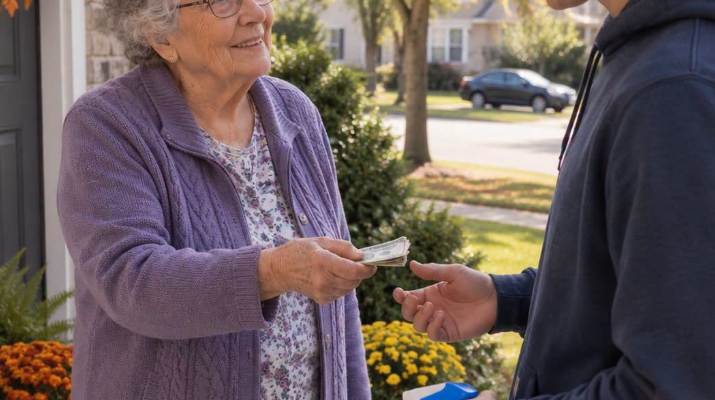
I Won $233 Million In The Lottery And Told No One — Only My Grandson Helped Me. After years of feeling invisible, I called my family and said I needed a little help paying for my medication. My son went silent before blocking me; my daughter replied with a short message: “Mom, please handle it yourself. I’m strapped right now — I’m sure you’ll be okay.” Only my 20-year-old grandson immediately drove 200 miles with his last $300, bringing groceries and an envelope “so you won’t worry.”
Sometimes the cruelest sound in the world isn’t shouting—it’s silence.
Three weeks after quietly winning $233 million in the Mega Millions lottery, Sandra Williams, a 67-year-old widow from Ohio, decided to conduct what she later called a family test. She told no one. Not her son Derek—the polished bank manager who spoke to her the way he spoke to customers with bad credit. Not her daughter Ashley, who once raised her wine glass at Christmas and joked about “finally getting some decent inheritance when the old lady kicks the bucket.”
Sandra had raised them alone after her husband died—working double shifts at Miller’s Diner, pouring coffee until her wrists throbbed, saving every spare dollar to send them through college. She bought their first cars, helped them through early debts, quietly paid loans they swore they’d already handled.
But lately, affection had turned into lectures—and warmth had cooled into a distance no amount of money could repair.
So she picked up the phone.
“Derek,” she said softly, “I’m a little short this month. My heart medication costs more than I expected.”
His voice shifted instantly into professional formality.
“Mom, I can’t keep enabling this behavior. You need to learn how to live within your means.”
Then—click.
Dial tone.
Her daughter’s response came through text.
“Mom, please handle it yourself. I’m strapped right now. I’m sure you’ll be okay.”
No offer of help. No “Are you alright?”
Just two polite dismissals from the children she had carried through every hardship of their lives.
Sandra placed the phone down and smiled—a small, tired smile born from somewhere deeper than anger.
She had more money in one account than her children would earn in their entire lives, yet neither of them could spare a moment of compassion.
Then the phone rang again.
“Grandma?”
It was Jake, her 20-year-old grandson.
“Are you okay? How much do you need? I’ve got maybe $300 saved. I’ll drive down tonight.”
Two hundred miles.
His final $300.
No hesitation. No calculation.
Just love.
That was the moment Sandra understood who still belonged in her heart—and who had quietly removed themselves from it.
The following morning, she called a dealership.
By Saturday, a silver Honda Civic sat shining in her driveway.
Jake was outside washing soap from the hood, smiling like sunlight, when his mother’s Mercedes rolled up to the curb.
Ashley stopped mid-step.
Derek arrived minutes later, his tie loosened, suspicion already in his eyes.
“Mom,” Ashley demanded, “where did you get the money for that car? Last week you said you couldn’t afford your prescriptions.”
Sandra leaned back in her porch chair, a faint smile crossing her face.
“Oh, that?” she said. “I decided to skip my medication this month. Apparently generosity is great for the heart.”
The expressions on their faces—shock, confusion, and sudden worry—were priceless.
What they didn’t realize was the strategy behind her calm expression, crafted by a woman who had spent her life surviving through quiet strength and careful planning.
The lawyers had already been contacted.
The trusts were prepared.
Every conversation, every cold response, had been documented and filed.
And when her children finally discovered the truth—that their mother had never been poor, but the anonymous winner of one of the largest jackpots in the state’s history—it would already be too late to change what their greed had cost them.
Because Sandra’s next step wasn’t about money.
It was about legacy.
About teaching the most powerful lesson a mother can give:
That love without compassion is nothing more than entitlement pretending to be family.