.My Family Mocked My Uniform — Then The Admiral Revealed Why My Father Was Afraid”
## **PART 1**
My name is **Nathan Walker**.
I was thirty-nine years old when I returned to Boston for my grandmother’s memorial service.
It was the first time I had stepped inside the Walker family home in eleven years.
Not because I didn’t love them.
Because they had made it clear I was no longer welcome.
My grandmother, Eleanor Walker, had been the person who raised me to believe that character mattered more than reputation.
She never cared about expensive cars, powerful friends, or family names.
She cared about one question:
“Did you help someone today?”
My father, however, saw the world differently.
Charles Walker believed our family name was a doorway.
He was a successful investment executive who spent his life building connections with wealthy clients and influential people.
He had already planned my future before I was old enough to understand what a future meant.
I was supposed to join his company.
Wear a suit.
Sit in expensive offices.
Build the Walker legacy.
But when I turned twenty-six, I made a decision that destroyed everything.
I joined the Navy.
My father thought it was a phase.
“You went to college for business,” he told me.
“No, Dad. I went because I wanted to do something meaningful.”
He stared at me.
“You want to throw away your future?”
“I want to choose my own.”
That was the last serious conversation we had.
After that, every phone call became shorter.
Every holiday invitation disappeared.
My younger sister, Emily, stopped answering my messages.
My father told relatives I had “lost direction.”
Nobody asked me why.
Nobody wanted the answer.
For eleven years, I served.
I spent months away from home.
I missed birthdays.
I missed weddings.
I missed the moments normal families shared.
But I kept going.
Because every time I helped someone come home safely, I remembered why I chose the uniform.
Then my grandmother died.
And suddenly, I had a reason to return.
The memorial was held at a private estate outside Boston.
The same house where I used to spend summers as a child.
The same place where my grandmother taught me how to repair old clocks in her workshop.
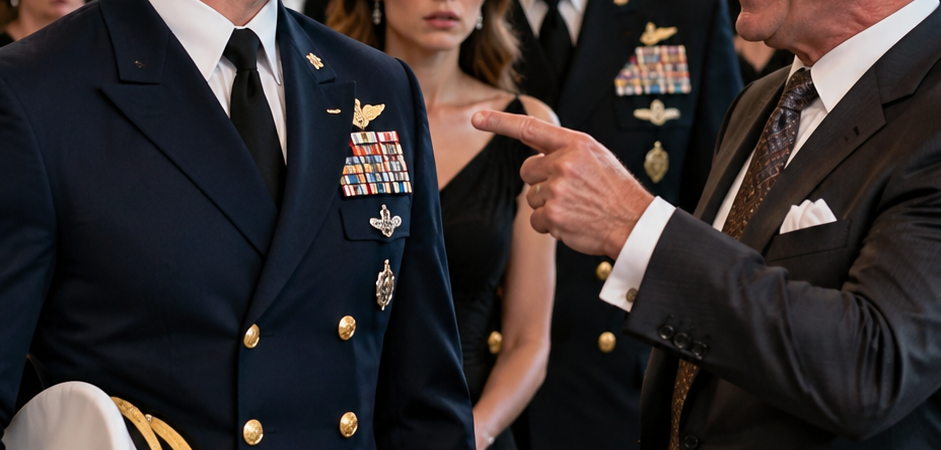
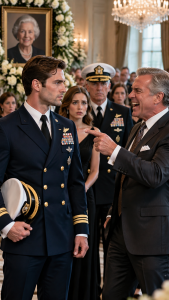
When I arrived, I wore my formal Navy uniform.
The room immediately became quiet.
Not because people respected me.
Because they recognized me.
Old family friends.
Business partners.
People who hadn’t seen me in years.
Then my father walked toward me.
He looked me up and down.
The medals.
The uniform.
The years I had spent away.
Then he smiled.
Not proudly.
Almost sadly.
“Well,” he said loudly enough for others to hear.
“Look who finally decided to come home.”
A few people turned.
I knew that tone.
It wasn’t a greeting.
It was a performance.
“I came for Grandma.”
My father nodded.
“Of course.”
He looked at my uniform.
“Still playing soldier?”
The room became uncomfortable.
I said nothing.
He continued.
“You know, Nathan, some people grow up.”
My sister stood beside him.
She looked away.
My father laughed softly.
“I always wondered when you would realize the Navy wasn’t a real career.”
A few people smiled awkwardly.
I felt the old wound reopen.
The one I thought had healed.
Then he said the sentence that made everyone look at me.
“Imagine having all those opportunities and choosing to disappear.”
I looked at him.
“I didn’t disappear.”
He raised an eyebrow.
“No?”
“No. I was serving.”
Before he could answer, the front doors opened.
Everyone turned.
A man in a dark suit entered.
The room immediately changed.
People stopped talking.
Several retired officers stood straighter.
My father’s expression changed.
Because he knew exactly who had walked in.
The man crossed the room.
Straight toward me.
My father whispered:
“That can’t be…”
The stranger stopped in front of me.
Then he smiled.
“Nathan Walker.”
“Yes, Admiral.”
He extended his hand.
“It’s been too long.”
The entire room went silent.
My father stared.
The man turned slightly toward everyone.
“This is Commander Walker’s family?”
My father quickly stepped forward.
“Yes. I’m his father.”
The Admiral looked at him.
Then back at me.
“I’m sorry.”
My father frowned.
“Sorry for what?”
The Admiral answered calmly.
“For the fact that your son spent the last decade protecting people while his own family believed he was wasting his life.”
Nobody moved.
Then he reached inside his jacket.
He pulled out a small black folder.
My name was written on it.
**Nathan Walker — Personal.**
My heart stopped.
“What is that?” my father asked.
The Admiral looked at him.
“Something Eleanor Walker asked me to deliver.”
My father’s face changed.
“What did she ask you?”
The Admiral held the folder tighter.
“She told me one thing.”
He looked at me.
“Do not give this to Nathan until after her funeral.”
I opened my mouth.
“Why?”
The Admiral looked directly at my father.
“Because your grandmother was afraid someone in this room would try to stop you from knowing the truth.”
My father went completely still.
And for the first time in eleven years…
I saw fear on his face.
—
# **PART 2**
The folder felt heavier than it should have.
I stared at my grandmother’s handwriting.
My name.
My memories.
My past.
Everything I thought I knew suddenly felt uncertain.
My father stepped closer.
“Nathan, whatever that is, we should discuss it privately.”
The Admiral didn’t move.
“No.”
One word.
Everyone heard it.
My father forced a laugh.
“I’m his father.”
The Admiral nodded.
“And Eleanor Walker was his grandmother.”
The room went silent.
Then he looked at me.
“She wanted you to know something before anyone else could change the story.”
I opened the folder.
Inside was a letter.
The handwriting was shaky.
But I knew it instantly.
My grandmother wrote:
“Nathan,
If you are reading this, it means I am gone.
I need you to know something.
You were never abandoned by me.
I was told you wanted nothing to do with this family.”
I stopped reading.
Slowly, I looked up.
My father looked away.
The Admiral watched him carefully.
The letter continued.
“I called you many times.
I wrote letters.
But they never reached you.”
My hands started shaking.
Because I remembered.
The unanswered calls.
The silence.
The years when I believed my grandmother had stopped caring.
Then I saw another document.
A list of dates.
Phone calls.
Returned mail.
Messages.
My grandmother had tried.
Over and over.
Someone had blocked every connection.
I looked at my father.
“Why?”
He didn’t answer.
The Admiral did.
“Your father told your grandmother that you wanted distance.”
My chest tightened.
“That wasn’t true.”
“No.”
The Admiral looked at me.
“It wasn’t.”
My sister covered her mouth.
“Dad…”
My father finally spoke.
“I was protecting the family.”
I almost laughed.
“Protecting?”
He looked angry now.
“You embarrassed us.”
The room went quiet.
“You walked away from everything I built.”
I looked down at my uniform.
“No.”
I said softly.
“I built something too.”
The Admiral nodded.
“That is exactly what Eleanor understood.”
Then he handed me another paper.
“This was her final request.”
I read the first line.
**Transfer of Family Foundation Leadership.**
I looked confused.
“What is this?”
The Admiral answered.
“Your grandmother created a foundation years ago.”
My father interrupted.
“That foundation belongs to the family.”
The Admiral looked at him.
“No.”
The room froze.
“It belongs to Nathan.”
My father’s face turned white.
—
# **PART 3**
I couldn’t speak.
For years, I believed my family rejected me because I chose service over money.
But standing there, holding my grandmother’s final letter, I realized something worse.
They had rewritten the story.
My father stepped forward.
“You don’t understand what you’re doing.”
I looked at him.
“I understand more than I ever have.”
He lowered his voice.
“You think wearing that uniform makes you better than us?”
I shook my head.
“No.”
I looked around the room.
“But I know now that losing this family was never because I left.”
Nobody spoke.
The Admiral placed another envelope on the table.
“Your grandmother asked me to deliver this too.”
I opened it.
Inside was a photograph.
Me.
At age ten.
Sitting beside my grandmother’s old desk.
On the back she had written:
“Never let anyone convince you that kindness is weakness.”
I started crying.
Because that was the woman I remembered.
Not the person my father described.
Not the person everyone thought had forgotten me.
The Admiral spoke quietly.
“General Walker spent her final months making sure the truth was preserved.”
I looked at him.
“Why didn’t she tell me herself?”
He paused.
Then answered:
“Because she believed you would come home when you were ready.”
I looked across the room.
At my father.
At my sister.
At the family I had spent eleven years trying to understand.
My father looked smaller than I remembered.
Not powerful.
Not untouchable.
Just a man who had spent years controlling a story that was finally ending.
My sister walked toward me.
“Nathan…”
I waited.
“I’m sorry.”
Two words.
Two words I had wanted for eleven years.
But forgiveness was not something I could give instantly.
So I simply nodded.
The next morning, I visited my grandmother’s grave alone.
I placed my uniform cap beside the flowers.
And I whispered:
“You were right.”
Because she had taught me something my father never understood.
A legacy wasn’t built by the people who carried your last name.
It was built by the people who carried your values.
Years later, people would ask me why I stayed away so long.
I always gave the same answer.
“I wasn’t running away from my family.”
“I was finding myself without them.”
And that was the truth my grandmother wanted me to know all along.