PART 1 — THE HOUSE THEY THOUGHT THEY OWNED
My name is Captain Ava Bennett.
I had been away for eleven months.
Eleven months of deployments, long nights, bad coffee, missed birthdays, and calls home made whenever the time difference allowed.
All I wanted when I returned was my own bed.
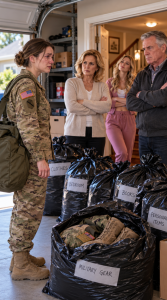
Instead, I found garbage bags.
Dozens of them.
Lined up across the garage.
Black plastic bags stuffed with my clothes, books, family photographs, kitchen supplies, and military gear.
I recognized one immediately.
My old rucksack.
Another contained my service uniforms.
Another had my winter coats.
I stood there with my travel bag still over my shoulder, staring at everything I owned.
Then my mother appeared in the doorway.
“You’re home.”
I looked at her.
“Clearly.”
She sighed.
“You weren’t supposed to arrive until Friday.”
“My orders changed.”
My father stepped behind her.
He folded his arms.
“We had to make arrangements.”
I looked inside the house.
My furniture was still there.
But everything had been rearranged.
The guest room had disappeared beneath someone else’s belongings.
My office had become a children’s playroom.
And the framed photograph of my grandfather, who had raised me after my grandmother died, was gone from the fireplace.
“Where’s Chloe?”
My younger sister appeared on the stairs.
She was wearing one of my old sweaters.
“Hey, Ava.”
I stared at it.
“That’s mine.”
She looked down.
“Oh.”
Then she shrugged.
“I’ve been cold.”
My stomach tightened.
“Why are your things in my house?”
My father answered.
“You’ve been away nearly a year.”
“So?”
“Chloe needed somewhere to live.”
“And you decided to move her in?”
My mother stepped forward.
“Don’t make this difficult.”
I looked toward the master bedroom.
“What about my room?”
Chloe smiled awkwardly.
“Mom said it made sense for me to take it.”
“You moved into my bedroom?”
“You’re rarely here.”
I stared at all three of them.
Then my father said the sentence that explained everything.
“You can sleep downstairs until you figure out what you’re doing.”
I almost laughed.
“This is my house.”
My mother shook her head.
“It was your grandfather’s house.”
“No.”
I looked at her.
“He transferred it to me.”
“Your grandfather was old.”
My father added,
“Things were complicated.”
I didn’t argue.
I simply picked up one of the trash bags.
“Where did you put my documents?”
My mother hesitated.
“Which documents?”
“The property records.”
Silence.
That was enough.
I walked straight downstairs.
Behind an old workbench was a storage cabinet I had built with my grandfather when I was nineteen.
I moved two boxes.
Then lifted a section of plywood.
The safe was still there.
I entered the combination.
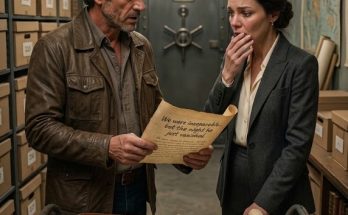
Inside was the original trust agreement.
My grandfather had transferred the property to me years earlier.
Not my father.
Not my mother.
Me.
I took photographs of every page.
Then I checked my bank accounts.
My deployment savings account was short.
$52,000.
I checked another account.
Empty.
Then I found a document uploaded nine months earlier.
Limited Power of Attorney.
My mother’s name was listed as my authorized agent.
My signature appeared at the bottom.
Except I had never signed it.
I stared at the screen.
Then another transaction appeared.
A transfer made three weeks after my deployment began.
$52,000.
My heart began pounding.
Someone had used a forged document to take my money while I was overseas.
And whoever did it knew exactly when I would be gone.
That night, my father came downstairs.
“Tomorrow morning, we’ll finish the transfer.”
“What transfer?”
“The house.”
I looked at him.
“You mean the house that’s already legally mine?”
He smiled.
“You’re going to sign it over to Chloe.”
“Why?”
“She has children.”
“She has one child.”
“And you have the military.”
I stared at him.
“What does that mean?”
He lowered his voice.
“You should think carefully before creating unnecessary trouble.”
Then he walked away.
I watched him disappear up the stairs.
I didn’t sleep.
At 5:40 a.m., I drove to the military legal assistance office.
A JAG attorney named Major Elena Ruiz reviewed my documents.
She looked at the trust.
Then the forged power of attorney.
Then the bank statements.
She looked up.
“Captain Bennett, this isn’t a family disagreement.”
“I know.”
“This appears to involve fraud.”
I nodded.
She handed the documents to a civilian property attorney who worked with military personnel.
His name was Daniel Price.
He read everything silently.
Then he turned to the final page.
His expression changed.
“Where did you get this?”
“It was in my grandfather’s safe.”
He placed the document flat on the table.
“Captain…”
He pointed to the signature.
“That isn’t the only trust agreement.”
I stared at him.
“What do you mean?”
He turned the page.
“There was a second transfer.”
And suddenly, the house wasn’t the only thing my family had been trying to take from me.
PART 2 — THE SECOND INHERITANCE
Daniel explained that my grandfather had created two separate legal instruments.
The first transferred the house to me.
The second involved a much larger investment account.
It had been established for my future.
The beneficiary?
Me.
My parents had known about neither document in full.
Or so they claimed.
I checked the records.
The second trust had been opened fifteen years earlier.
It contained stocks, bonds, and several commercial properties.
The estimated value was more than $1.8 million.
I stared at the number.
“I never knew.”
Daniel nodded.
“Your grandfather specifically instructed the trustee not to disclose it until after your twenty-fifth birthday.”
“I was twenty-six when he died.”
“And someone signed paperwork claiming you had declined the inheritance.”
I looked at him.
“Who?”
He slid the document toward me.
My father’s signature was on it.
So was my mother’s.
And beneath theirs was a signature that made my blood run cold.
My sister Chloe.
I sat back.
“They knew.”
Major Ruiz folded her hands.
“We need to establish who had access to your documents while you were deployed.”
I already knew.
My mother had helped manage some of my mail.
My father had access to the house.
Chloe had access to my office.
I went home that afternoon.
Everyone was waiting.
My father had already placed transfer documents on the dining table.
“Sign these.”
I sat down.
“Before I do, I have a question.”
He looked impatient.
“What?”
“Where did the $52,000 go?”
The room went silent.
My mother stood.
“What are you talking about?”
“My deployment savings.”
Chloe looked at Dad.
He answered too quickly.
“You must have spent it.”
“I was overseas.”
“So?”
“I couldn’t have spent fifty-two thousand dollars from an account you couldn’t access.”
He stared at me.
Then my mother said:
“Maybe your bank made a mistake.”
I placed the forged power of attorney on the table.
“Then why does this exist?”
Nobody spoke.
I watched Chloe’s face.
She looked terrified.
My father became angry.
“You’re making a huge mistake.”
“No.”
I looked at him.
“You made it.”
Then I stood.
“I am not signing anything.”
My father slammed his hand against the table.
“Do you know what your behavior is doing to this family?”
I stared at him.
“You moved into my house.”
He looked away.
“You took my room.”
Silence.
“You packed my belongings into garbage bags.”
Silence.
“You stole fifty-two thousand dollars.”
My mother started crying.
“We didn’t steal anything.”
“Then explain the transfer.”
She couldn’t.
That evening, Chloe came to my room.
She looked exhausted.
“I need to tell you something.”
I waited.
“I didn’t know about the money.”
“Did you know about the house?”
She looked at the floor.
“Yes.”
“How?”
“Dad told me you were going to sign it over.”
“Why did you believe him?”
“Because he said Grandpa wanted me to have it.”
I almost laughed.
“My grandfather hated being manipulated.”
She began crying.
Then she said something that changed everything.
“Dad said if I didn’t cooperate, he’d cut me off.”
“What was he going to do with the house?”
“I don’t know.”
“Think.”
She wiped her eyes.
“He was planning to sell it.”
I froze.
“Sell it?”
She nodded.
“He already had a buyer.”
That explained the urgency.
They didn’t want Chloe to own the house.
They wanted to use her name to make the transfer look legitimate.
Then Chloe handed me her phone.
There was a message from my father.
Once Ava signs, everything is ours.
I stared at the screen.
Everything.
Not just the house.
The second trust.
My savings.
Everything.
That night, I left the house.
I met Daniel and Major Ruiz at a secure office.
We preserved the messages.
We filed the appropriate reports.
And the next morning, investigators examined the financial records.
They found more transfers.
Money moved from my account.
Payments to a private lender.
A deposit for another property.
My father had been preparing to buy a second house using my money.
But then the investigator found one more document.
A loan agreement.
The borrower was my father.
The collateral was listed as:
Ava Bennett’s inherited property.
I stared at it.
“He pledged my house as collateral without owning it.”
Daniel nodded.
“Yes.”
Then he added:
“That may be the most important document we’ve found.”
“Why?”
“Because whoever forged these documents wasn’t just trying to steal your property.”
He paused.
“They were trying to conceal a much larger financial problem.”
I looked at the paperwork again.
My father’s debts were enormous.
And suddenly, I understood.
My house wasn’t their goal.
It was their last chance to keep their entire financial life from collapsing.
PART 3 — THE HOUSE THEY COULDN’T TAKE
The investigation moved quickly.
The bank records established the $52,000 transfer.
The forged power of attorney was examined.
The property documents were reviewed.
The second trust was confirmed.
And the loan secured against my property was uncovered.
My father had been borrowing money against assets he didn’t own.
My mother had helped him obtain access to my financial information.
Chloe had been pressured into supporting the story.
But Chloe eventually cooperated.
She showed investigators the messages.
Emails.
Draft agreements.
And photographs of my belongings being packed before I even returned home.
The family’s story collapsed.
Weeks later, I stood in court while the property dispute was resolved.
The judge reviewed the original trust documents.
The house was legally mine.
There was no ambiguity.
The unauthorized transfer was invalid.
The forged power of attorney was investigated separately.
And my parents were ordered to stop using my property and return the remaining belongings.
When I returned home, the garbage bags were gone.
My photographs were back on the walls.
My grandfather’s portrait was above the fireplace again.
My office was mine.
My bedroom was mine.
The house was finally quiet.
Chloe came to see me one afternoon.
“I’m sorry.”
I nodded.
“I know.”
She looked around.
“I didn’t realize what Dad was doing.”
“You do now.”
She nodded.
“I want to make it right.”
I looked at her.
“Then tell the truth.”
She did.
Her testimony helped investigators reconstruct how the forged documents had been created.
And gradually, the family began facing the consequences of choices they had made while I was gone.
My father’s debt problems became public.
His business collapsed.
My mother’s financial involvement was investigated.
The $52,000 was recovered.
The second trust was transferred into my control.
But I didn’t celebrate.
I spent months thinking about what my grandfather had wanted when he created those trusts.
He hadn’t given me money because he thought I needed rescuing.
He had given me choices.
He wanted me to have a foundation strong enough that no one could tell me where I belonged.
One evening, I sat on the back porch overlooking the garden.
My grandfather had planted the first tree there.
I remembered him telling me when I was young:
“Never let anyone convince you that something belongs to them just because you love them.”
At the time, I didn’t understand.
Now I did.
Family isn’t permission to cross boundaries.
Love isn’t a license to take.
And sacrifice doesn’t create a debt that other people get to collect.
A few months later, I used part of the trust to restore the house.
I kept the original floor plan.
Kept my grandfather’s workshop.
Kept the old kitchen table.
But I changed the locks.
Every one of them.
When my mother called one final time, she cried.
“We’re still family.”
I looked around the house.
“Yes.”
She waited.
“But family doesn’t mean ownership.”
She didn’t answer.
I continued:
“You packed my life into garbage bags because you thought I would come home and accept whatever you decided.”
My voice stayed calm.
“You were wrong.”
Then I ended the call.
I never moved away.
I never sold the house.
Not because I wanted to prove something to them.
Because it was mine.
I had earned the right to come home.
Eleven months earlier, I had left that house wearing a uniform and carrying orders.
When I returned, my family had tried to convince me I no longer belonged there.
They thought the empty bedrooms meant I was temporary.
They thought my absence meant permission.
They thought my silence meant weakness.
But they forgot one important thing.
I had spent my entire career learning how to remain calm when everything around me was uncertain.
So I didn’t scream.
I didn’t threaten them.
I didn’t throw them out that first night.
I documented everything.
And I let the evidence speak.
The last time I walked through the garage, I saw one black trash bag still sitting in the corner.
I opened it.
Inside was an old sweatshirt my grandfather had given me.
I held it for a moment.
Then I smiled.
Because they had tried to pack away my life.
They couldn’t.
The house still stood.
The trust still stood.
The truth still stood.
And so did I.
My grandfather had left me a house.
He had left me an investment.
But more importantly, he had left me one final lesson:
Never confuse being generous with surrendering your rights.
My family thought my deployment had given them eleven months to take my life apart.
Instead, those eleven months gave me something they couldn’t have predicted.
Perspective.
When I finally came home, I realized I wasn’t returning to the family I remembered.
I was returning to the life they had tried to take.
And this time…
I had the documents to prove it was mine.