PART 1 — THE BABY THEY REFUSED
My name is Alison Grant.
My older sister, Rebecca, had been my best friend since childhood.
We shared clothes.
Secrets.
Family vacations.
Even the same bedroom for several years when we were growing up.
So when doctors told her she couldn’t safely carry a pregnancy, I knew what that diagnosis did to her.
She cried for weeks.
Then one night she came to my apartment.
“Ali, please.”
I already knew what she was going to ask.
“I can’t do this for you.”
She burst into tears.
“You’re the only person I trust.”
Her husband, Martin, sat beside her.
“We’ll be forever grateful.”
I was thirty-six.
My children were teenagers.
I wasn’t planning to have another baby.
But Rebecca showed me the fertility clinic reports.
She showed me their embryo.
She told me it was the only chance they had left.
So I agreed to become their surrogate.
The pregnancy was difficult.
I dealt with constant fatigue, months of nausea, and enough appointments to make the inside of a hospital feel like my second home.
Rebecca attended almost every one.
She would place her hand on my stomach whenever the baby moved.
“My little miracle,” she’d whisper.
Martin would smile.
“We’re going to spoil her.”
They knew the baby was female.
At least, that’s what I believed.
They had chosen the name Emma Rose.
They bought pink blankets.
A white crib.
Tiny dresses.
Rebecca even painted the nursery herself.
She said the baby would be loved more than anything in the world.
I believed her.
Then, thirty-eight weeks into the pregnancy, labor began.
The delivery was exhausting.
Hours later, I heard the cry.
A nurse placed the baby against my chest.
She was tiny.
Warm.
Perfect.
I started crying.
“Emma.”
I kissed her forehead.
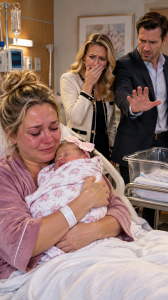
Then the door opened.
Rebecca entered with Martin.
I expected them to cry.
Instead, Rebecca stopped.
Her face changed.
Martin looked at the baby.
Then at the nurse.
Then at me.
“No.”
I frowned.
“What?”
Rebecca stepped backward.
“This isn’t right.”
“What’s wrong?”
Martin whispered:
“That’s not the baby we were promised.”
The nurse looked confused.
I stared at them.
“What are you talking about?”
Rebecca shook her head.
“We were promised a healthy embryo.”
“She is healthy,” the nurse said.
Martin looked angry.
“That’s not what I mean.”
He pointed at the baby’s wrist.
There was a small reddish birthmark.
Rebecca’s eyes filled with tears.
“We specifically told the clinic we didn’t want that.”
My heart dropped.
“Didn’t want what?”
Rebecca couldn’t answer.
Martin did.
“We selected the embryo because of the family history.”
I looked at him.
“She’s your biological child.”
“I know.”
“Then what exactly are you rejecting?”
Neither answered.
I pulled the baby closer.
Rebecca whispered,
“We can’t take her.”
I stared at my sister.
The woman who had begged me to carry this child was now standing in front of me as though the baby were a defective product.
Martin turned toward the door.
“Come on.”
Rebecca followed him.
At the doorway, she looked back.
“She isn’t what we agreed to.”
Then they left.
I sat there holding the little girl.
My little niece.
My sister’s daughter.
And I felt something inside me change.
Not anger.
Not revenge.
Something deeper.
Because I had just realized that the couple who had spent nine months calling this child their miracle had never truly understood what a miracle was.
A nurse noticed the tears in my eyes.
She sat beside me.
“Do you want me to call your family?”
I looked down at the baby.
“No.”
“Why?”
I gently touched the birthmark on her wrist.
“Because before anyone makes another decision about her, I want to see the original records.”
The nurse frowned.
“What records?”
“The embryo records.”
And when the clinic sent them upstairs less than an hour later, I saw one line that made my entire body go cold.
The embryo they had rejected…
was not the mistake.
The mistake was theirs.
PART 2 — THE SECRET IN THE FILE
The clinic coordinator entered the room carrying a sealed folder.
“I don’t understand,” she said. “Your sister and her husband were very clear about their preferences.”
“What preferences?”
She opened the file.
They had selected an embryo from a donor profile chosen specifically for certain hereditary traits.
I stared at the forms.
Then I saw something strange.
A handwritten note had been added to the original consent paperwork.
Do not disclose the donor’s identity to the recipients.
I looked at the coordinator.
“Why?”
“We don’t usually—”
“Please check.”
She made a phone call.
A few minutes later, another physician entered.
Dr. Lena Morris, the clinic’s medical director.
She sat beside me.
“Alison, there’s something you need to know.”
My stomach tightened.
“The embryo transferred into your uterus was the embryo selected by Rebecca and Martin.”
“Then why are they refusing the baby?”
Lena looked at the file.
“Because they were told something that wasn’t true.”
“What?”
“They were told the donor was anonymous.”
I stared at her.
“He wasn’t?”
“No.”
She explained that the genetic material came from a donor connected to a major medical research program.
The clinic had been legally restricted from disclosing the donor’s identity because of a complicated inheritance arrangement.
Rebecca and Martin had learned about the donor through a private broker.
They had chosen the embryo believing the donor’s identity came with certain financial connections.
But the broker had lied.
There was no inheritance.
No hidden trust.
No wealthy biological family waiting to recognize the child.
The couple had spent enormous amounts of money because they believed the baby would connect them to wealth.
And the moment they realized there was no fortune attached, they rejected her.
I stared at the baby.
“They wanted her because of who they thought her biological father was.”
Lena nodded.
“And when they discovered the information had been fabricated…”
“They decided she wasn’t worth keeping.”
The words made me sick.
Then Lena showed me another document.
The broker’s name.
The payments.
And messages between Martin and the broker.
One sentence stood out.
If the donor turns out to be the person you promised, we’ll proceed with the transfer. Otherwise, we want out.
I read it twice.
My sister and her husband hadn’t simply changed their minds.
They had treated the baby like a financial transaction.
I called Rebecca.
She answered immediately.
“You need to sign the release paperwork.”
“No.”
“What?”
“You heard me.”
“Alison, this is complicated.”
“No.”
Martin came onto the phone.
“She’s our daughter.”
“Then why did you leave her?”
Silence.
I continued.
“You didn’t reject her because of a medical problem.”
Neither answered.
“You rejected her because she didn’t come with the financial connection you expected.”
Rebecca began crying.
“That isn’t fair.”
“Fair?”
I looked down at the newborn sleeping against my chest.
“You asked me to carry her because you said you’d love her regardless of genetics.”
“We do love her.”
“Then why did you walk away?”
She had no answer.
I ended the call.
That evening, investigators from the clinic contacted the broker.
The paperwork was frozen.
The financial arrangement was suspended.
And Rebecca and Martin were informed that the matter would be investigated.
But I still had one problem.
The baby was my sister’s child.
And yet her parents had abandoned her.
I couldn’t simply walk away.
So I called my attorney.
Her name was Sophie Grant.
She reviewed the surrogacy contract.
Then she looked at me.
“You have an option.”
“What option?”
“You can refuse to sign the post-birth transfer until the abandonment issue is resolved.”
I looked at the baby.
“What would happen to her?”
“Child-protection authorities would ensure she is safe while the court determines the next step.”
I swallowed.
“She needs a family.”
Sophie nodded.
“I know.”
I looked down.
“She has one.”
Sophie was silent.
I realized what I was thinking.
“I want to keep her.”
She studied me carefully.
“You understand this could become a long legal process.”
“Yes.”
“You understand your sister may fight you.”
“Yes.”
I looked at the tiny face sleeping against my chest.
“But I’m not handing her to two people who already decided she wasn’t valuable enough.”
Three days later, Rebecca and Martin came back to the hospital.
They brought lawyers.
They brought documents.
They demanded the baby.
I refused.
Then Martin said something that changed everything.
“She has no legal claim to the child.”
I looked at him.
“Neither did your money.”
He went silent.
A social worker stepped between us.
“The court will decide.”
Rebecca started crying.
“She’s my daughter.”
I answered quietly.
“Then you should have treated her like one.”
That night, I went home without the baby.
She remained temporarily under medical supervision while the legal process began.
I sat alone in my living room.
The nursery I had prepared for her was empty.
I started crying.
Then my phone rang.
It was the clinic director.
“Alison?”
“Yes?”
“We received another message from the donor.”
I froze.
“What donor?”
She lowered her voice.
“The biological father.”
My heart started pounding.
“He saw the records.”
“What does he want?”
A long pause.
“He wants to know why a little girl carrying his genetic material has been abandoned.”
And suddenly, the story was about to become much bigger than my sister’s broken promise.
PART 3 — THE CHILD THEY THOUGHT WAS WORTHLESS
The biological father wasn’t a billionaire.
He wasn’t a celebrity.
He wasn’t the mysterious wealthy man Rebecca and Martin had imagined.
He was Dr. Daniel Avery, a geneticist who had donated through a research program after losing his own daughter years earlier.
He had never known the embryo would result in a child.
When he learned what had happened, he contacted the clinic.
Not to claim the baby.
To make sure she was safe.
He offered to fund her medical care.
He offered legal assistance.
And he asked one question:
“Does she have someone who truly wants her?”
The clinic gave them my name.
Daniel asked to meet me.
We sat across from each other in a small conference room.
“I don’t want to interfere with her life,” he said.
“I understand.”
“But I’ve read what happened.”
I nodded.
“She deserves better.”
He looked at me.
“So do you.”
I almost laughed.
“This stopped being about me a long time ago.”
He smiled sadly.
“I can see that.”
The court proceedings lasted months.
Rebecca and Martin initially fought.
Then the financial investigation uncovered the messages between them and the broker.
Their case weakened quickly.
Eventually, they admitted that their decision had been motivated partly by the information they had been given about the donor.
They had believed the child would connect them to wealth.
When that turned out to be false, they wanted out.
The truth was devastating.
But it also made one thing clear.
The baby hadn’t been unwanted because something was wrong with her.
She had been rejected because something was wrong with the adults around her.
The court ultimately granted me guardianship.
Later, after further proceedings, I became her legal parent.
I named her Emma Grace.
I kept the small birthmark on her wrist uncovered.
Because it wasn’t something to hide.
It was simply part of her.
Rebecca asked to see her once.
I agreed, under supervision.
She sat across the room staring at the little girl.
Emma was six months old by then.
She was laughing.
Rebecca started crying.
“I made a terrible mistake.”
I looked at her.
“Yes.”
“She looks happy.”
“She is.”
Rebecca wiped her tears.
“Does she know I’m her mother?”
I answered honestly.
“She knows who loves her.”
Rebecca lowered her head.
For years, I wondered what I would say if my sister ever apologized.
When the moment came, I didn’t scream.
I didn’t humiliate her.
I simply said:
“You wanted a child who would make your life better.”
Rebecca nodded.
“You got one who needed you to make hers better.”
She cried.
But I had already made my peace.
Emma grew up surrounded by people who wanted her.
My older children adored her.
My parents eventually accepted her.
Even Daniel, the biological donor, stayed at a respectful distance while supporting her future.
He never tried to replace the people raising her.
He simply made sure she knew, when she was old enough to understand, that her existence had never been a mistake.
Years later, Emma asked me about the mark on her wrist.
“Why do I have this?”
I smiled.
“Because everyone carries something that makes them different.”
She touched it.
“Is it bad?”
“No.”
I kissed her forehead.
“It means you’re you.”
She smiled.
And that little girl who had once been rejected before she had even left the hospital eventually became the brightest part of my life.
Looking back, I realize my sister thought she was rejecting a child.
She wasn’t.
She was revealing herself.
She showed me exactly what happened when people treated love like a contract.
When they attached conditions to parenthood.
When they decided someone’s worth depended on what that person could give them.
I never gave Emma the life Rebecca and Martin had promised.
I gave her something better.
A home where nobody would ever ask what she could provide before deciding whether she was loved.
And that’s the lesson I learned the day my sister walked away from her newborn daughter:
A baby is never a failed investment.
A child is not a product that has to match someone’s expectations.
And love is not something a person has to earn by being exactly what someone else ordered.
My sister wanted the perfect baby.
What she got was a real one.
And I will be grateful for the rest of my life that, when they turned away from her, I was standing there.
Because sometimes the family you’re born into isn’t the family that saves you.
Sometimes family is simply the person who looks at you when everyone else walks away…
and says,
“You’re staying with me.”