PART 1 — THE LAST FAVOR
My name is Marianne Cole.
Seven days earlier, I had buried my husband, Robert.
We had been married for thirty-eight years.
Our life wasn’t glamorous.
We didn’t own yachts.
We didn’t travel first class.
But we had something I valued more.
A home full of memories.
The kitchen where Robert taught our son, Caleb, how to make pancakes.
The porch where we drank tea every evening.
The little garden where we planted tomatoes together.
After Robert died, the house felt impossibly large.
Every room reminded me of him.
For six days, I barely ate.
I slept on the couch because our bedroom felt too empty.
Then, on the seventh morning, I did something nobody expected.
I bought a ticket.
Not to a hotel.
Not to a temporary apartment.
I bought a twelve-month rail-and-hotel travel package that would take me across the country.
I had spent my entire marriage putting everyone else first.
Robert had always joked,
“You’ll never learn to say no.”
He was right.
I had paid Caleb’s college tuition when his scholarships fell through.
I had covered his first business loan.
I had babysat his daughter when he and his wife needed weekends away.
Whenever something went wrong, my phone rang.
And every time, I answered.
After Robert’s funeral, Caleb hugged me once.
Then his first question was:
“Mom, what are you going to do with the house?”
Not, How are you?
Not, Do you need anything?
The house.
I couldn’t stop thinking about that.
So I called an old real-estate friend.
Three days later, I had signed a private listing agreement.
The house wasn’t officially on the market yet.
But I had made my decision.
I was leaving.
Not because I hated my family.
Because I finally wanted to find out who I was when nobody needed anything from me.
That evening, Caleb arrived.
He didn’t come alone.
His wife, Melissa, followed him.
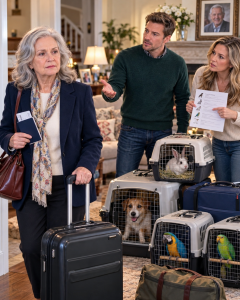
Behind them were four pet carriers.
A terrier.
A rabbit.
Two parrots.
They carried bags of food and a handwritten schedule.
I stared at them.
“What’s all this?”
Caleb dropped a suitcase near the sofa.
“We’re going away.”
“Where?”
“Mexico.”
“For how long?”
“Three weeks.”
Melissa smiled.
“We need someone responsible to watch the animals.”
I looked at the carriers.
“I’m grieving.”
Caleb sighed.
“I know, Mom.”
But his tone made it sound like grief was an inconvenience.
“You’ll be fine.”
Melissa handed me a sheet of paper.
“Morning feeding at seven. Rabbit medication at nine. The dog gets nervous around thunderstorms. And the parrots need fresh water twice a day.”
I stared at the instructions.
“You planned all this?”
“Of course,” Melissa said. “We knew you’d help.”
I looked toward Robert’s photograph above the fireplace.
Then back at my son.
“You’re leaving tomorrow?”
“Yes.”
He smiled.
“Thanks, Mom. We can always count on you.”
That sentence hurt more than anything he had said at the funeral.
Because I suddenly understood.
They didn’t see me as their mother.
They saw me as the person who always said yes.
So I smiled.
“Of course.”
Caleb kissed my cheek.
Melissa hugged me for exactly two seconds.
Then they left.
The door closed.
Silence filled the house.
I stood among the pet carriers.
Then I walked upstairs.
I opened my bedroom closet.
My suitcase was already packed.
Passport.
Clothes.
Travel documents.
Robert’s old watch.
And one envelope.
I opened it.
Inside was the completed sale agreement for the house.
I had signed it that morning.
The buyer would take possession in thirty days.
Caleb didn’t know.
Melissa didn’t know.
Nobody knew.
I sat on the edge of the bed.
For years, I had believed being needed was the same as being loved.
That night, I finally understood the difference.
The next morning, I was going to stop being available.
And when Caleb came home, he was going to discover that the woman he thought would always be waiting…
was gone.
PART 2 — THE LIFE THEY NEVER NOTICED
I spent the next two weeks preparing quietly.
The animals were safe.
I followed their schedules.
I hired a neighbor to help with the dog.
I arranged a professional pet sitter for the days I would be traveling.
Then I packed the final boxes.
Photographs.
Robert’s books.
His old fishing jacket.
The ceramic mug he used every morning.
I didn’t take everything.
I left the furniture.
I left the dining table.
I left the things that belonged with the house.
But I took the memories that belonged to me.
Then the phone calls began.
Caleb:
“Mom, can you send me money for the hotel?”
Melissa:
“Mom, the airline charged our card twice.”
Caleb:
“Can you call the bank?”
I handled none of it.
For the first time, I said:
“I can’t.”
Each time, they sounded surprised.
“What do you mean?”
“I can’t.”
That was it.
No explanation.
No apology.
No emergency rescue.
One evening, Caleb called again.
“Mom, you sound different.”
“I’ve been thinking.”
“About what?”
“My life.”
He laughed.
“You’re being dramatic.”
I smiled.
“No. I’m being honest.”
Two days later, my attorney called.
“The closing is scheduled for next Friday.”
“Good.”
“Are you sure?”
“Yes.”
“You understand you’ll need somewhere to live immediately afterward.”
I looked at the train ticket on my desk.
“I already do.”
The day before closing, I received a message from Caleb.
We’ll be home Sunday. Don’t forget the parrots.
I stared at it.
Then I typed:
Everything is taken care of.
He replied:
Knew I could count on you.
I didn’t answer.
The next morning, I handed the house keys to the new owner.
I stood in the empty living room for a final minute.
I touched the wall where Robert’s photograph had hung.
Then I whispered:
“I’m going.”
I left.
My train departed at noon.
For the first time in decades, I had no schedule controlled by someone else.
No school pickup.
No grocery list from my son.
No medical appointments for someone else’s child.
No last-minute favor.
Just a ticket and a destination.
Three days later, Caleb returned home.
The house was empty.
The furniture was gone.
Their luggage had nowhere to go.
The pets were at the neighbor’s home, safe and cared for.
He called me.
I answered.
“Mom! Where are you?”
“On a train.”
“What?”
“I sold the house.”
Silence.
“You sold Dad’s house?”
“Our house.”
“You can’t do that!”
“I did.”
“You didn’t tell me!”
“You never asked.”
He started shouting.
“Where are we supposed to stay?”
“I don’t know.”
“You knew we were coming back!”
“Yes.”
“Then why would you do this?”
I looked out the train window.
“Because you never once asked where I was going.”
He went quiet.
Then Melissa took the phone.
“This is unbelievable.”
I said calmly:
“You left four animals in my living room six days after their funeral.”
“We trusted you.”
I closed my eyes.
“No.”
“You depended on me.”
And that was the end of the conversation.
But I didn’t realize the consequences were about to reach much further than the house.
Because the mortgage on the property had been paid off years earlier.
And Caleb had been living in the house without paying rent for nearly four years.
When the sale completed, the new owner discovered unpaid utility bills, neglected repairs, and several contracts Caleb had placed in his own name using the house as his mailing address.
He was suddenly forced to solve problems he had always handed to me.
And then another surprise arrived.
My attorney called.
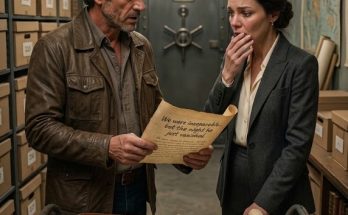
“The buyer found something in the attic.”
“What?”
“Old financial records.”
I froze.
“Whose?”
“Your husband’s.”
Robert had apparently kept a private ledger documenting every time he had loaned money to Caleb.
The total was staggering.
Nearly $180,000.
I had never known.
Robert hadn’t kept the records to punish our son.
He kept them because he had always believed that one day Caleb needed to learn to stand on his own.
The final page contained a handwritten note.
Marianne, when you’re ready, stop rescuing him.
I cried when I read it.
Because Robert had understood something I had been too afraid to admit.
Helping someone forever can become a way of preventing them from growing.
And maybe he had been waiting for me to learn it.
PART 3 — THE WOMAN WHO FINALLY LEFT
My year of traveling changed me.
I saw mountains I’d only seen in photographs.
I sat beside oceans I had never visited.
I ate dinner alone and discovered I didn’t hate it.
I joined a book club in Portland.
Took a painting class in Santa Fe.
Spent Christmas in a tiny mountain town.
And every morning, I made coffee exactly the way Robert had taught me.
I missed him.
But I was no longer drowning in grief.
I was learning how to live beside it.
Caleb’s life changed too.
He rented an apartment.
Found steadier work.
Paid his bills.
Started budgeting.
He had no choice.
For the first time, nobody was arriving with a rescue package.
Months later, he called me.
“Mom?”
“Yes?”
“I found the ledger.”
“I know.”
“Dad wrote something to you.”
“Yes.”
There was a long silence.
Then he said:
“He knew.”
“He knew what?”
“That you were always going to keep saving me.”
I looked out over the ocean.
“He wasn’t angry.”
“I know.”
Caleb’s voice broke.
“I didn’t realize how much I depended on you.”
I said nothing.
Then he asked:
“Are you coming home?”
I smiled.
“I am home.”
He laughed softly.
“You’re still traveling.”
“Yes.”
“Where are you now?”
“Seattle.”
“What are you doing there?”
“Learning to kayak.”
He laughed.
“You hate water.”
“I used to.”
That conversation changed something between us.
Not because I forgave him immediately.
Because he finally stopped asking what I could do for him.
He started asking how I was.
A year after Robert’s funeral, Caleb and Melissa visited me.
They brought no luggage.
No pets.
No paperwork.
No requests.
Just flowers.
Caleb sat beside me on the porch of the little cottage I had rented near the coast.
“I’m sorry.”
I nodded.
“I know.”
“I treated you like you would always be there.”
“You did.”
He looked down.
“Do you hate me?”
I smiled.
“No.”
“Then what do you feel?”
I thought for a moment.
“Peace.”
He nodded.
I handed him a cup of coffee.
Just like I had done for Robert for thirty-eight years.
But this time, there was no debt attached to it.
No expectation.
No obligation.
Just love.
Months later, I bought a small cottage outright.
Nothing huge.
Just two bedrooms, a garden, and a porch overlooking the water.
I planted tomatoes there.
The same kind Robert and I once grew.
I framed his handwritten note.
And I placed it beside the kitchen window.
Stop rescuing him.
Not as a warning.
As a reminder.
I still loved my son.
I still loved my family.
But I finally understood that love and access are not the same thing.
Being someone’s mother doesn’t mean becoming their permanent emergency service.
Being a grandmother doesn’t mean becoming a free babysitter.
And being family doesn’t mean you stop having a life of your own.
The day I left that old house, I thought I was abandoning my family.
I wasn’t.
I was finally refusing to abandon myself.
Caleb had spent years saying:
“Mom, we can always count on you.”
He was right.
He could count on me to tell him the truth.
To love him.
To support him when he genuinely needed help.
But he could no longer count on me to clean up every consequence of his choices.
And strangely enough, that was what finally helped him become independent.
The woman who had been everyone’s backup plan finally stopped being available on demand.
The house was sold.
The pets were safe.
My son learned to stand on his own.
And I learned that grief doesn’t mean your life has to stop.
Sometimes grief is the moment that forces you to ask the question you have avoided for years:
What would my life look like if I stopped living it for everyone else?
I finally found out.
And I loved the answer.
Because when my husband died, I thought I had lost the person who knew me best.
Instead, his final note helped me find the person I had forgotten.
Me.
And that became the greatest gift he ever left me.
Not a house.
Not money.
Permission to finally live my own life.
And for the first time in forty years, I wasn’t waiting for anyone to call.
I was simply waiting for the next train.