PART 1 — THE CALL I WAS NEVER SUPPOSED TO HEAR
My mother called me crying at 9:17 on a Tuesday morning.
“Camille, please. Your brother needs you.”
Those words had been the emergency alarm in our family for as long as I could remember.
Whenever Darius made a mistake, someone called me.
Whenever he needed money, someone called me.
Whenever my parents wanted something fixed without admitting it was their responsibility, somehow my name appeared in the conversation.
This time, my mother said Darius owed $46,000.
“He could lose everything,” she sobbed.
I closed my eyes.
“How much time does he have?”
“Until tomorrow.”
I should have asked why.
I should have asked what happened.
Instead, I heard myself say:
“I’ll take care of it.”
My mother immediately sounded relieved.
“Oh, sweetheart. I knew you wouldn’t abandon your brother.”
I promised to authorize the transfer before noon the following day.
“You’re such a blessing,” she whispered.
Then the call seemed to end.
I carried my coffee toward the kitchen sink.
That’s when I heard my mother’s voice again.
“So?”
I stopped.
My father answered.
“I told you she’d cave.”
Then Darius laughed.
Not nervously.
Not awkwardly.
He sounded amused.
“Camille always does this,” he said. “She needs to feel like the hero.”
I froze.
My mother laughed softly.
“She pretends she’s so independent.”
My father’s voice followed.
“She’d be miserable if nobody needed her.”
My fingers tightened around the coffee mug.
Then Darius said:
“Besides, what else is she going to do with all that money?”
I stared at the dark reflection of myself in the kitchen window.
My mother laughed.
“She has that ridiculous house.”
“The mansion?” Darius said.
“That’s the one.”
Then my mother said the sentence that made something inside me go completely still.
“That million-and-a-half-dollar house is basically her consolation prize.”
Silence.
Then Darius laughed again.
“She built a huge house because she couldn’t build a real family.”
The coffee mug slipped from my hand.
It struck the sink.
The handle cracked.
But I barely noticed.
I looked around my kitchen.
The enormous island my mother had chosen.
The dining room where I hosted every holiday.
The guest bedrooms where my parents stayed whenever they visited.
The theater room where Darius had stored boxes for three years.
Suddenly, none of it felt like my home.
It felt like a service station.
A place where everyone came when they wanted something.
Then my mother said:
“Don’t worry. I’ll call her tomorrow and tell her how emotional Darius got.”
Darius laughed.
“She’ll send it immediately.”
Something inside me finally broke.
Not loudly.
Not dramatically.
Just quietly.
I picked up the phone.
And said:
“You don’t need to call tomorrow.”
Every voice on the other end disappeared.
My mother whispered:
“Camille?”
I looked at the broken coffee mug in the sink.
“I’ve been listening.”
Nobody spoke.
Then Darius finally said:
“How long?”
“Long enough.”
My mother immediately started crying.
“Sweetheart, you misunderstood—”
“No.”
I took a breath.
“I understood perfectly.”
Darius interrupted.
“Don’t make this into some huge family drama.”
I almost laughed.
“Darius, you’re not getting the $46,000.”
“What?”
“The transfer is canceled.”
My mother gasped.
“But you promised!”
“I promised before I heard what you actually thought of me.”
My father finally spoke.
“Everyone says things they don’t mean.”
I stared through the window at the life I had spent years building for people who apparently didn’t respect me.
“Maybe.”
I paused.
“But people also reveal the truth when they think nobody is listening.”
Then I ended the call.
I stood alone in my enormous kitchen.
For the first time, I wasn’t angry.
I was clear.
And the next morning, I made a phone call that would change everything.
PART 2 — “THEN BUILD AN EXIT”
The person I called was my closest friend, Tasha.
She listened while I told her everything.
When I finished, she didn’t immediately tell me to forgive my family.
She didn’t tell me to calm down.
She simply asked:
“What do you want?”
I didn’t know how to answer.
Nobody had ever asked me that.
My entire adult life had been organized around what everyone else needed.
My parents needed help.
Darius needed money.
Someone needed a place to stay.
Someone needed a loan.
Someone needed a holiday dinner.
Someone needed a favor.
And I always said yes.
Tasha was silent for a moment.
Then she said four words:
“Then build an exit.”
I looked around my house.
“An exit from what?”
“From being everyone’s emergency plan.”
That sentence stayed with me.
That afternoon, I called my financial adviser.
Not to transfer $46,000.
To review everything.
My accounts.
My property.
My investments.
The expenses I had quietly covered for other people.
And then I did something I’d never done before.
I made a list.
Every loan.
Every unpaid expense.
Every “temporary” arrangement.
Every time someone had promised to pay me back.
The total shocked me.
Over the years, I had given my family far more than I had ever admitted to myself.
And most of it had never been returned.
That evening, my mother called again.
I didn’t answer.
Then my father.
I ignored him too.
Then Darius sent a message.
You really won’t help me?
I typed:
Not anymore.
He responded immediately.
You have more than enough.
I stared at those words.
Not Are you okay?
Not I’m sorry.
Not We shouldn’t have talked about you that way.
Just:
You have more than enough.
I deleted the message.
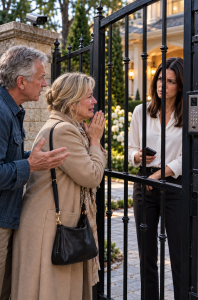
Three days later, my parents arrived at my house.
I watched them through the security camera as they stood outside the gate.
My mother was crying.
My father looked angry.
I opened the gate but didn’t invite them inside.
My mother stared at me.
“You’re really doing this?”
“Doing what?”
“Turning your back on your family.”
I shook my head.
“No. I’m finally turning toward myself.”
My father sighed.
“Your brother made a mistake.”
“I know.”
“He needs help.”
“I know.”
“You can afford it.”
“I know.”
He looked frustrated.
“Then why won’t you pay?”
I looked directly at him.
“Because being able to afford something doesn’t mean I’m obligated to buy it.”
My mother started crying again.
“You’re punishing us because of one conversation.”
“No.”
I paused.
“I’m changing my life because of years of conversations.”
Neither of them spoke.
Then my mother whispered:
“But we’re your parents.”
“And I’m your daughter.”
I looked at both of them.
“When was the last time either of you asked how I was doing without needing something?”
They had no answer.
That silence hurt more than anything they’d said on the phone.
I closed the gate.
Then I went inside.
For the first time in years, I felt strangely peaceful.
But I wasn’t finished.
Because Tasha’s advice had made me realize something.
I didn’t just need boundaries.
I needed to decide what my life was actually going to look like without my family constantly occupying it.
And that meant making one decision nobody expected.
I was going to sell the house.
PART 3 — THE HOUSE WAS NEVER THE CONSUMATION PRIZE
The house had six bedrooms.
A theater room.
A huge kitchen.
A beautiful garden.
A guest suite my parents practically considered theirs.
And a garage filled with Darius’s belongings.
For years, everyone called it proof that I had made it.
But after that phone call, I realized something.
I had spent years maintaining a house large enough for people who didn’t actually value me.
So I called a realtor.
Two weeks later, the house was listed.
My parents found out before I told them.
My mother called immediately.
“You’re selling the house?”
“Yes.”
“Why?”
“Because I don’t need it.”
“But where will we stay when we visit?”
I almost smiled.
“I don’t know.”
She became silent.
Then she said:
“You’re really serious.”
“Yes.”
Darius called that evening.
“You can’t just sell the house because you’re angry.”
“I’m not angry.”
“Then why are you doing this?”
“Because I want a different life.”
He scoffed.
“You always need to make everything dramatic.”
“No, Darius.”
I looked around the room.
“This is the first decision I’ve made that has nothing to do with you.”
He hung up.
Three months later, the house sold.
I moved into a smaller home with a garden, two bedrooms, and a quiet little office overlooking the trees.
It wasn’t nearly as impressive.
But for the first time in years, every room belonged to me.
There was no guest room permanently reserved for my parents.
No boxes from Darius in the garage.
No giant dining table waiting for a family that only gathered when I paid for everything.
Just my books.
My plants.
My photographs.
My life.
Darius eventually solved his debt without my money.
He sold a car.
Closed his business.
Negotiated payment arrangements.
It wasn’t easy.
But he survived.
Months later, he called me.
“I owe you an apology.”
I didn’t say anything.
He continued.
“I thought you’d always rescue me.”
“I know.”
“I thought you liked being the one who fixed everything.”
“I know.”
He took a breath.
“And Mom and Dad…”
He stopped.
“What?”
“They were wrong about you.”
I smiled sadly.
“No.”
“They were wrong about what your house meant.”
I looked around my smaller home.
“What did they think it meant?”
“That you were lonely.”
I looked through the window at my garden.
“I wasn’t lonely.”
I paused.
“I was surrounded by people who never learned how to see me.”
There was silence.
Then Darius said:
“Are we still family?”
I thought about that question for a long time.
“Yes.”
“But things are different now.”
“Very different.”
“Can I visit?”
“Call first.”
He laughed.
“Fair enough.”
We eventually rebuilt a relationship.
Not the old one.
A healthier one.
My parents took longer.
They wanted the old Camille back.
The woman who answered every call.
The woman who paid every bill.
The woman who opened her home whenever they needed somewhere to go.
But she was gone.
Not because she hated them.
Because she finally understood something:
Being generous doesn’t mean allowing people to use you.
Being successful doesn’t mean becoming your family’s emergency fund.
And having a beautiful life doesn’t make that life a consolation prize.
Years later, I sometimes think about that phone call.
The $46,000.
The laughter.
My mother’s words.
My father’s assumption that I’d cave.
Darius joking that I needed to feel necessary.
They thought they had accidentally exposed me.
But what they really did was give me something I had been missing for years.
Clarity.
That night, I thought I had lost my family.
Instead, I finally found myself.
And the biggest lesson wasn’t that I stopped helping them.
It was this:
The moment you stop confusing being needed with being loved, you become free.
I didn’t need a million-dollar house to prove I mattered.
I didn’t need to rescue my brother to prove I was a good sister.
And I didn’t need my parents’ approval to know that the life I built was real.
The house wasn’t my consolation prize.
It was simply a house.
The real prize was waking up one morning and realizing:
My life no longer belonged to everyone who knew how to ask me for something.
It belonged to me.