My Brother’s Wife Pushed Me Down the Mansion Steps to Steal My Inheritance—But When the Family Lawyer Opened My Grandfather’s Final Letter, Everyone Learned What She Had Really Been After
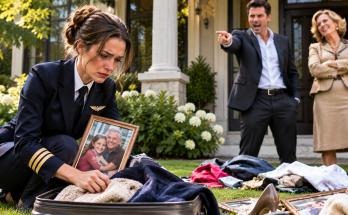
“You have ten minutes to pack your things and leave this house!” my sister-in-law screamed, shoving a suitcase toward me. When I refused to surrender the mansion my grandfather had legally left me, she grabbed my arm and pushed me backward down the marble steps. My brother stood frozen as I struck the floor. She thought she had finally removed the only person standing between her and a fortune worth millions. But three days later, our family lawyer arrived with a sealed letter my grandfather had ordered him to open only if someone tried to take the estate from me. And the first sentence made my sister-in-law turn completely white.
Part 1: The Mansion She Wanted to Call Her Own
My name is Olivia Bennett, and I never imagined that the home where I grew up would become the center of a family war.
Bennett Manor stood on twenty acres of wooded land outside Boston. My grandfather, Henry Bennett, had purchased it decades earlier and spent his life restoring the property. The mansion had tall windows, sweeping staircases, a library filled with antique books, and gardens my grandmother had planted herself.
My grandfather was a successful businessman, but he never believed money made someone better than anyone else.
He taught me how to balance a business ledger, repair a broken garden gate, and keep my promises even when doing so was inconvenient.
My older brother, Andrew, had always been more interested in appearances. He liked expensive watches, exclusive restaurants, and telling people about the Bennett family’s wealth.
When he married Vanessa Cole, I hoped she would help him become more grounded.
Instead, Vanessa seemed fascinated by everything my family owned.
She photographed the mansion’s grand staircase, posted pictures of the gardens online, and frequently referred to the estate as “our family palace.”
At first, I thought she was simply excited about joining the family.
Then my grandfather died.
His will was read two weeks after the funeral.
Andrew received a substantial investment portfolio, several properties, and a valuable collection of antique automobiles. I inherited Bennett Manor and the company responsible for managing the estate.
My grandfather’s decision was deliberate.
I had helped him care for the property for years, and he trusted me to preserve it.
The will was properly signed, witnessed, and filed. The estate belonged to me.
Andrew congratulated me at the time.
Vanessa did not.
She leaned toward me after the meeting and whispered, “You know Andrew deserves half of that mansion.”
I stared at her.
“Grandfather made his own decision.”
“He was old. Perhaps he didn’t understand what he was doing.”
“His attorney supervised the entire process.”
Vanessa smiled without warmth.
“Enjoy it while you can.”
For the next six months, she made my life miserable.
She demanded access to the estate’s business accounts, insisted that Andrew should approve all major decisions, and criticized every renovation I authorized.
When I refused to let her organize a luxury wedding at the mansion without paying the venue fees, she accused me of being greedy.
When I declined to let her move her relatives into the guesthouse, she told Andrew I was trying to destroy his marriage.
Andrew repeatedly asked me to compromise.
“She’s my wife, Olivia,” he said. “Can’t you just make things easier?”
“Easier for whom?”
He never answered.
Then Vanessa discovered that a property developer had offered to purchase part of the estate’s surrounding land for a substantial sum.
The offer included a proposal to build luxury homes near the wooded boundary.
I rejected it because the development would destroy the gardens and damage the historic grounds.
Vanessa was furious.
“You’re sitting on a fortune and refusing to let anyone benefit from it!”
“It’s my responsibility to protect what Grandfather left me.”
“You think you’re better than us.”
“No. I think I have an obligation to honor his wishes.”
That evening, Vanessa confronted me in the mansion’s entrance hall.
She carried a folder containing a proposed agreement that would give Andrew and her shared control over the estate.
“I want you to sign this,” she demanded.
I read the first page and handed it back.
“No.”
Her face twisted with anger.
“You have no idea what you’ve done to this family.”
“I have done nothing except follow the will.”
Andrew appeared at the top of the staircase.
“What’s happening?”
“Your sister is refusing to share the inheritance,” Vanessa snapped.
Andrew looked at me.
“Olivia, can we please settle this without lawyers?”
“We already settled it. Grandfather’s will is clear.”
Vanessa threw the folder onto a table.
“Then get out of my way.”
I stepped toward the staircase to leave the argument behind.
She caught my arm.
“Give me the keys to the estate office.”
“No.”
She shoved me.
I lost my balance and tumbled down several marble steps. Pain shot through my back as I struck the landing.
For a few seconds, I couldn’t breathe.
Andrew rushed toward me, but Vanessa stood frozen at the top of the stairs.
“Olivia!” he shouted.
I tried to sit up and immediately regretted it.
My brother called an ambulance.
At the hospital, doctors discovered that I had suffered a painful back injury and a fractured wrist. I would need weeks of recovery, but I was fortunate to have avoided more serious damage.
While I was being examined, Vanessa called my phone repeatedly.
When I finally answered, her voice sounded strangely calm.
“You need to think carefully about what happens next,” she said. “Your brother and I are willing to let you keep some of the property if you cooperate.”
I ended the call.
Then I contacted my grandfather’s attorney, Mr. Harrison.
He listened without interrupting.
When I finished, he said something that made me sit up despite the pain.
“Olivia, your grandfather anticipated that someone might try to pressure you into surrendering the estate.”
“What do you mean?”
“There is a sealed letter in my office. He gave me specific instructions about when it could be opened.”
“When?”
“Only if someone attempted to take Bennett Manor from you against your will.”
My heart began to pound.
“Has that happened?”
“Based on what you’ve just told me, I believe it has.”
Mr. Harrison paused.
“Olivia, I think it’s time we read your grandfather’s final letter.”
Part 2: The Letter Behind the Locked Cabinet
Three days later, I returned to Bennett Manor with my wrist in a brace and my back supported by a medical belt.
Andrew had insisted that Vanessa stay away until the situation was resolved. I wasn’t sure whether he was protecting me or trying to keep the family from falling apart, but I was grateful for the quiet.
Mr. Harrison arrived shortly after noon carrying a leather document case.
We met in my grandfather’s library.
The room smelled of old paper and cedar. His favorite armchair remained beside the window, and the clock above the fireplace continued ticking as though nothing had changed.
Mr. Harrison placed a sealed envelope on the desk.
My grandfather’s handwriting appeared across the front.
For Olivia, if anyone tries to take what I have entrusted to her.
My eyes filled with tears.
I had seen that handwriting thousands of times.
Mr. Harrison broke the seal and unfolded the letter.
The first paragraph read:
My dearest Olivia, if you are reading this, someone has likely mistaken your kindness for weakness. I want you to understand that I did not leave Bennett Manor to you because you were my favorite grandchild. I left it to you because you were the only person who understood that an inheritance is a responsibility, not a prize.
I pressed my fingers against my lips.
Mr. Harrison continued reading.
My grandfather explained that years earlier, he had discovered irregularities in a proposed sale involving the estate’s surrounding land.
A development company had approached him with an offer to purchase the property. The negotiations had eventually collapsed after questions arose about the company’s financial disclosures and the identity of its actual investors.
My grandfather had refused to proceed.
He had also instructed his attorneys to preserve the records in case anyone later attempted to revive the proposal without proper authorization.
The letter continued:
If anyone pressures Olivia to sell the land, surrender the estate, or sign documents she does not understand, the original records must be reviewed before any transaction proceeds.
Mr. Harrison opened his case and removed a second folder.
Inside were historic property documents, correspondence, and copies of the earlier development proposal.
I recognized the company name immediately.
It was the same developer whose offer I had rejected months earlier.
Mr. Harrison explained that the company had recently approached the estate’s management office again, claiming that Andrew and Vanessa had agreed to help secure the property.
I stared at him.
“Andrew never had authority to do that.”
“Correct,” he replied. “The records show that you are the sole owner of the estate. Any proposed sale would require your authorization.”
Then he showed me an email chain provided by the estate’s business manager.
Vanessa had been discussing the land with a representative of the development company.
She had described herself as a family decision-maker and claimed that Andrew could persuade me to transfer control.
One message included a proposed payment to a consulting business associated with her sister.
The payment was described as a success fee for helping secure the property.
It had not been paid, and the documents did not establish that a crime had occurred. But the arrangement raised serious questions that required independent legal review.
I felt sick.
Vanessa hadn’t simply wanted a beautiful mansion.
She wanted to control the land because a developer was prepared to pay a fortune for it.
The wedding arguments, the pressure to sign documents, and the demand for the estate keys suddenly made sense.
I looked at Mr. Harrison.
“Did Grandfather know this might happen?”
“He knew that money can make people behave in ways their families never expect. That’s why he instructed us to preserve these records.”
I asked whether Andrew had been involved in the developer discussions.
Mr. Harrison shook his head.
“We have not established the full extent of his knowledge. He will need to answer questions honestly.”
That afternoon, Andrew came to the library.
He looked exhausted.
“Vanessa told me the developer only wanted to discuss a possible sale,” he said. “She said you were being unreasonable and that we could all benefit.”
“Did you know she was asking for money?”
He hesitated.
“She said there might be a consulting fee.”
“Did you know she had been contacting the developer using my name?”
“No,” he said quickly. “I swear I didn’t.”
I studied his face.
I wanted to believe him, but I could not ignore the fact that he had repeatedly pressured me to surrender the estate without ever asking why Vanessa was so determined to get it.
“Andrew, I need you to tell the truth to the lawyers, even if it hurts your marriage.”
He sat down heavily.
“I never wanted you to get hurt.”
“But you kept asking me to give her what she wanted.”
He covered his face with his hands.
For the first time, I saw how deeply he had allowed his desire for an easy life to blind him.
Before he left, Mr. Harrison handed me another document.
It was a formal notice requiring the developer to preserve all relevant communications and confirming that no sale or transfer had been authorized.
The estate was safe for the moment.
But Vanessa was about to discover that the letter she had never known existed was only the beginning of the truth.
Part 3: The Fortune She Could Never Steal
The legal review began immediately.
My attorney contacted the development company, secured the relevant records, and clarified that I alone had authority over Bennett Manor.
The company paused its discussions while its representatives reviewed the disputed communications.
Vanessa was asked to explain why she had described herself as authorized to negotiate on behalf of a property she did not own.
Her attorney responded on her behalf.
I did not attempt to investigate her myself or confront her privately. I wanted the matter handled properly, especially after the assault at the staircase.
The police investigation continued separately.
Witness statements, medical records, and the accounts of everyone present were gathered. Vanessa’s actions would be assessed through the legal process, not by my anger.
Meanwhile, I focused on recovering.
My grandfather’s letter had reminded me that I didn’t have to sacrifice my health or dignity to keep my family comfortable.
For years, I had believed that saying no made me a difficult sister.
Now I understood that a boundary was not an attack.
It was a decision about what I would and would not allow.
Several weeks later, Andrew came to visit me.
Vanessa had moved out of their apartment temporarily while the family tried to understand what had happened.
Andrew looked ashamed.
“I should have protected you,” he said.
I waited.
“I knew she was putting pressure on you. I knew you were uncomfortable. I kept telling myself that if you agreed, everything would become peaceful.”
He swallowed hard.
“I was more worried about upsetting my wife than losing my sister.”
Those words hurt, but they were honest.
“I love you, Andrew,” I said. “But you cannot repair this by asking me to pretend it never happened.”
“I understand.”
He agreed to cooperate with the lawyers and provide his records of the discussions with the developer.
As the review progressed, the developer withdrew the proposed transaction while the questions surrounding its negotiations were examined. The company confirmed that no completed sale of the estate had taken place.
The estate remained mine.
The investigation into the disputed communications and the assault continued through the appropriate authorities. I made no public accusations beyond the facts documented in the records.
I had no interest in turning my family’s pain into entertainment.
I wanted the truth established and the estate protected.
Then came the day I had been waiting for.
Mr. Harrison invited me to his office to review the final set of documents my grandfather had prepared.
The last page of the sealed letter contained a personal message:
Olivia, if you have reached this point, remember that the value of this estate is not measured by what someone would pay to own it. Its value lies in the lives it touches, the memories it protects, and the promises it allows you to keep. Never let another person’s greed convince you that you are wrong for protecting what is yours.
I read the words slowly.
Then I cried.
Not because I had won a legal dispute.
Because my grandfather had understood exactly what I was struggling to learn.
I didn’t need to prove that I deserved the estate.
I needed to honor the responsibility he had placed in my hands.
Over the next year, I restored the gardens, renovated the guest cottages, and expanded the estate’s wedding business. I created a scholarship in my grandparents’ names for students pursuing careers in hospitality and historic preservation.
The property became more successful than ever.
Rachel and Thomas, the couple whose wedding date had started the conflict, visited the estate on their first anniversary.
They brought a framed photograph of themselves beneath the garden arch.
“We wanted you to have this,” Rachel said. “You kept your promise when it would have been easier to break it.”
I placed the photograph in the reception office.
It reminded me that protecting the estate had never been only about protecting a building.
It was about protecting the commitments made within it.
Andrew and I slowly began rebuilding our relationship. We did not return to the easy closeness we had once shared, but we learned to speak honestly without expecting the other person to surrender.
As for Vanessa, the consequences of her actions were handled through the appropriate legal and family processes. I did not use the estate or my financial position to punish her.
I simply refused to give her control over my life.
One spring afternoon, I stood at the top of the marble staircase where she had pushed me.
Sunlight streamed through the tall windows, illuminating the old stone floor.
I remembered the pain, the hospital, and the fear that I might lose everything my grandparents had entrusted to me.
Then I looked toward the library.
The letter was safe in the attorney’s archives, and the estate’s ownership records were secure.
For the first time in months, I felt completely at peace.
My grandfather had left me a mansion, a business, and a responsibility.
But the most important inheritance was the lesson he had taught me long before he died:
Family is not a permission slip to take what belongs to someone else. Love does not require surrendering your boundaries, and loyalty does not mean protecting people from the consequences of their own choices.
Vanessa had believed she could push me out of the way and claim everything I had inherited.
She had underestimated the strength of the truth.
And my brother had learned, far too late, that keeping the peace is not always the same as doing what is right.
I remained at Bennett Manor, not because I had defeated my family, but because I had finally stopped allowing their expectations to decide my future.
My grandparents’ home was still standing.
Their garden was still blooming.
And the woman they had trusted with their legacy was still there, keeping her promise.