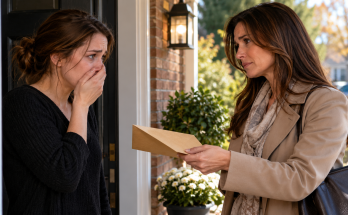
Part 1: My Ex-Husband Left Me $2,000—Five Years Later, the Bank Manager Saw My Name and Locked the Office Door
I was sixty-six years old when I discovered that the man who had abandoned me after thirty-nine years of marriage had been hiding something from me.
Five years earlier, on the day our divorce became official, my former husband, Richard, placed a bank envelope on the courthouse bench beside me.
“There’s two thousand dollars in the account,” he said. “At least you won’t have to ask me for anything again.”
He said it with such indifference that I felt as though I had been a stranger in his life rather than the woman who had cooked his meals, raised his children, and stood beside him through every difficult year.
I wanted to throw the envelope back at him.
Instead, I put it inside my handbag and walked away without saying goodbye.
For the next five years, I lived alone in a small apartment on the outskirts of Milwaukee.
I learned how to stretch a bag of groceries across an entire week. I stopped buying coffee outside and began repairing my old clothes instead of replacing them.
When my heating bill became too expensive one winter, I wore two sweaters indoors and slept beneath three blankets.
My daughter, Emily, occasionally offered to help.
“Mom, why don’t you move in with us?” she asked one afternoon.
“You already have enough on your plate,” I replied. “I’m perfectly fine.”
I wasn’t.
But I had spent nearly four decades making other people’s lives easier. I didn’t know how to admit that I was struggling with my own.
Throughout those five years, I never touched Richard’s money.
The account card remained inside the envelope, hidden beneath a stack of old utility bills in my kitchen drawer.
To me, those two thousand dollars represented the final insult of our marriage.
Richard had once promised that we would grow old together. We had planned to travel after retirement, plant roses in our backyard, and spend our evenings watching our grandchildren play.
Instead, at sixty-one, I found myself signing divorce papers while the woman he had been seeing waited outside in her car.
I thought the worst part was losing him.
I was wrong.
The worst part was discovering how quickly the world forgot that I had ever mattered to him.
Then, last Tuesday, something happened that forced me to open that drawer.
I collapsed while carrying a basket of laundry up the stairs.
At the hospital, the doctor told me that I needed further testing and treatment. He explained the costs carefully, but I barely heard him after he mentioned the initial deposit.
I had less than four hundred dollars in my checking account.
That evening, I sat at my kitchen table and took out Richard’s old envelope.
For five years, I had treated it like something poisonous.
Now, it was the only money I had left to turn to.
The following morning, I put on my cleanest cardigan, slipped the card into my handbag, and took the bus downtown.
The bank had been renovated since my last visit. The walls were brighter, the counters were polished marble, and the waiting area was filled with people staring at their phones.
I waited twenty minutes before a young teller called me forward.
“I’d like to withdraw the entire balance from this account,” I said, handing her the card.
She typed my information into the computer.
Then she frowned.
She checked the screen again and leaned closer to the monitor.
“I’m sorry, ma’am. Could you wait a moment?”
My stomach tightened.
“Is there a problem?”
She didn’t answer immediately. Instead, she called someone over and whispered something I couldn’t hear.
A few minutes later, a woman in a navy suit emerged from a glass office.
She introduced herself as the branch manager, then asked me to confirm my full name and date of birth.
When I finished, she looked at her computer.
Then she looked at me.
“Mrs. Wilson,” she said quietly, “this account doesn’t contain two thousand dollars.”
My fingers tightened around the edge of the counter.
“I knew it,” I whispered. “He lied to me.”
The manager shook her head.
“No, ma’am. I don’t believe that’s what happened.”
She turned toward the teller and asked her to print a particular document.
When the paper emerged, the manager read it silently.
Her expression changed.
Then she picked up the telephone and requested access to a secure file connected to my account.
I stood there, embarrassed and frightened, wondering whether I had somehow walked into the wrong bank.
Finally, the manager returned and asked me to follow her into a private office.
She closed the door.
On her desk sat a thick envelope with my name written across it in Richard’s familiar handwriting.
I hadn’t seen that handwriting in five years.
“Before I show you what’s inside,” she said, “there’s something you need to understand about your former husband.”
She paused, watching my face.
“Five years ago, he gave you access to an account. But the account you were told about wasn’t the only one he opened.”
My heart began to pound.
“What are you saying?”
The manager slid a document across the desk.
And when I saw the date printed at the top, my entire body went still.
Richard had opened the second account three days before our divorce became final.
And according to the document, I was the only person authorized to access it.
Part 2: The Secret He Had Kept in the Bank
I stared at the document until the words began to blur.
“Why would he do that?” I asked.
The manager folded her hands on the desk.
“I can’t tell you what was in his mind when he opened the account. But I can explain what our records show.”
She turned the document toward me.
The account had been opened in my name, with Richard listed as the person who funded it. A note attached to the file instructed the bank to deliver the enclosed letter to me if I ever appeared in person to close the account.
I looked at the envelope again.
“Did he leave this here five years ago?”
“Yes.”
“Why didn’t anyone send it to my home?”
“The instructions specifically stated that it should be given to you in person.”
My hands were shaking when I opened it.
Inside was a letter and a statement showing that the account contained considerably more than the two thousand dollars Richard had mentioned at the courthouse.
There was enough to pay my immediate medical expenses and still leave a substantial amount.
I read the first lines.
Margaret, if you are reading this, then you have finally decided to use the money I left for you.
I stopped.
For a moment, I couldn’t breathe properly.
I hadn’t heard Richard call me Margaret in years. Near the end of our marriage, he had started calling me by my last name whenever he was angry, as though even my first name were something I no longer deserved.
I forced myself to continue.
I know you will probably hate me for what I did. You have every right to.
I could tell you that I was unhappy, that I wanted a different life, or that our marriage had become something I no longer understood. Those things might explain why I left, but they do not excuse how I treated you.
Tears slipped down my cheeks.
I wiped them away and kept reading.
Richard explained that the two thousand dollars had been a small, visible account he expected me to find immediately.
The second account was different.
It contained money he had saved over several years, along with proceeds from an investment he had sold shortly before the divorce.
He had placed it in my name because he knew I would refuse money if he offered it as an apology.
He also knew I might never forgive him.
Then I reached the paragraph that made my hands go cold.
There is one more thing you deserve to know.
The house we lived in for twenty-eight years was sold before our divorce. I told you it had to be sold to cover my debts. That was not the whole truth.
I stopped reading.
The house.
The place where our children had taken their first steps. The backyard where Richard had built a crooked wooden swing. The kitchen where I had spent countless nights waiting for him to come home.
He had told me that his business was failing and that we would lose everything if we didn’t sell.
I had believed him.
The letter continued.
Some of the money from that sale went toward the debts. The rest was placed into a separate investment account. I have included the records because you deserve to know exactly what happened.
I looked at the manager.
“Does this mean he stole money from me?”
She chose her words carefully.
“I can’t determine that from this letter alone. The account records may help clarify the situation, and a lawyer can review whether you have any additional legal rights.”
I returned to the letter.
The final page contained a name I recognized immediately.
Daniel.
My younger brother.
Daniel had died eight years earlier, leaving behind a daughter named Sophie. She was only seventeen at the time, and Richard and I had promised to help her finish school.
But after our divorce, I lost contact with her.
Richard had told me that she had moved away and wanted a fresh start. I never questioned him because I was too busy trying to rebuild my own life.
Now his letter revealed that the money from the house had been connected to something involving Sophie.
I made a promise to your brother before he died, Richard wrote. I failed to keep it properly, and I have carried that failure for years.
The money in this account was never meant to buy your forgiveness. It was meant to give you a choice I should never have taken away from you.
There is another envelope with the documents. Please read it before deciding what to do with the money.
I searched the envelope.
At the bottom was a smaller sealed packet.
My name appeared on the front, but beneath it were three additional words.
For Margaret and Sophie.
I looked up at the manager.
“Can you tell me where Sophie is?”
She shook her head.
“We only have the records your former husband provided.”
I carefully opened the second packet.
Inside was a recent address, a telephone number, and a short handwritten note.
Margaret, Sophie believes I abandoned her when she needed help most. She doesn’t know what happened to the money I promised her father I would protect.
If you can, please find her. She deserves the truth from someone who loved her father.
I read that sentence twice.
Then I picked up my phone.
I hadn’t spoken to Sophie in nearly five years.
I didn’t know whether she would answer.
But when I dialed the number, a young woman’s voice came through after the third ring.
“Hello?”
My throat tightened.
“Sophie? It’s Aunt Margaret.”
There was a long silence.
Then she said something that made me sit down.
“Aunt Margaret, I’ve been trying to find you for three years.”
And before I could ask why, she added:
“Richard told me you never wanted to see me again.”
Part 3: The Truth That Finally Set Us Free
For several seconds, neither of us spoke.
I was sitting in the bank manager’s office, holding a letter from the man who had broken my heart, while my niece told me she had spent three years believing I had rejected her.
“Sophie, I never said that,” I finally whispered.
“I know that now,” she replied. “But I didn’t know it then.”
She explained that after my divorce, she had contacted Richard because she needed help paying for college.
Her father had left behind a small inheritance, and Richard had promised to manage it until she turned eighteen.
But when she asked about the money, he told her that unexpected expenses had consumed most of it.
He offered to help her find work instead.
She refused.
Not because she was ungrateful, but because she had begun to suspect that something wasn’t right.
When she asked to speak to me, Richard told her I was struggling emotionally and had asked not to be contacted.
“I believed him,” Sophie said. “I thought you were ashamed of me because I couldn’t afford college.”
I closed my eyes.
I remembered the birthday cards I had sent to her old address. Every one had been returned.
I remembered calling Richard once to ask whether he had heard from her.
He told me she was doing well and wanted distance from the family.
I had believed that, too.
“Where are you now?” I asked.
“About forty minutes from Milwaukee. I work at a dental office. I rent a small apartment.”
“Can I see you?”
Her voice trembled.
“Yes. Please.”
We agreed to meet the following afternoon at a little café near the river.
That night, I barely slept.
I kept thinking about Richard’s letter and the second account. I didn’t know whether he had intended to protect me, protect Sophie, or simply ease his own conscience.
Perhaps all three were true.
But I knew one thing: whatever he had done, I needed to understand the full story before deciding what came next.
The following morning, I contacted a lawyer recommended by the hospital’s social worker. I brought the bank statements, the letters, and the documents connected to the sale of our old house.
The lawyer explained that the records would need careful review. The money might be legally mine, but the question of Sophie’s inheritance was separate and could require additional investigation.
For the first time in years, I felt something I had almost forgotten.
I felt capable of asking questions without apologizing for asking them.
When I arrived at the café the next afternoon, Sophie was already sitting by the window.
She looked so much like her father that my heart ached.
She stood up as soon as she saw me.
For one awkward moment, we simply stared at each other.
Then she crossed the room and wrapped her arms around me.
I held her tightly.
“I never stopped loving you,” I whispered.
She began to cry.
“Neither did I.”
We sat together for nearly two hours, talking about everything we had missed.
Her first job. Her tiny apartment. The college classes she had taken at night. The people who had helped her when she thought she had no family left.
Then I showed her the letter.
When she read the paragraph about her father’s money, her expression changed.
“I knew something was wrong,” she said. “My dad had saved for years. He wouldn’t have wanted me to have nothing.”
We agreed that neither of us would spend the money until the lawyer had examined the records.
Over the following weeks, the documents revealed that Richard had transferred a portion of the proceeds from the sale of our house into a separate account. Some of that money was connected to the inheritance he had promised to protect for Sophie.
The records also showed that he had later deposited additional funds into my account.
The full legal picture was complicated, but the lawyer helped us establish a clear path for investigating what belonged to each of us.
I used part of my available funds for my medical treatment.
For the first time in months, I stopped lying awake wondering whether I could afford the care I needed.
Sophie received independent legal advice about her father’s inheritance, and we began working together to recover the records she had been denied.
Richard never asked me to forgive him.
Three months later, I learned from our former neighbor that he had died peacefully in a care facility after a long illness. He had apparently been living alone for some time.
I sat at my kitchen table with the letter beside me.
I felt sadness, but not the kind I had expected.
I mourned the man I had once loved. I mourned the life we had planned and the years we had lost to pride, silence, and mistrust.
But I no longer felt that I owed him my forgiveness simply because he had finally told part of the truth.
I could be grateful for the money that helped me survive without pretending that his choices had not hurt me.
A month later, Sophie came to my apartment carrying two cups of coffee and a paper bag of pastries.
She had found a small place closer to me and was considering taking additional courses so she could advance at work.
“I thought you might want company,” she said.
I smiled and moved a chair toward the table.
For years, I had believed that surviving meant never asking anyone for help.
I thought dignity meant enduring hardship quietly and proving that the person who left you had not destroyed you.
But that afternoon, watching Sophie laugh as she told me about her week, I finally understood something.
My life had not ended when Richard walked away.
It had not ended when I struggled to pay my bills, when I became ill, or when I discovered that someone I trusted had hidden the truth.
I was sixty-six years old.
I still had choices to make, people to love, and a future that belonged to me.
The money Richard left behind mattered.
The truth mattered.
But the most valuable thing I recovered was the family connection I had believed was lost forever.
And when Sophie reached across the table and took my hand, I realized that the final chapter of my life would not be written by the man who had left me.
It would be written by the people who chose to stay.