Part 1: The Will That Broke My Heart
My husband left me nothing after 67 years of marriage. Not a house. Not a bank account. Not even the wedding ring he had promised would stay with me forever.
Then his lawyer handed me a sealed envelope and whispered, “Your husband made me promise to give you this only after everyone believed he had betrayed you.”
My name is Margaret, and I was 86 years old when I buried the man I had loved since I was nineteen.
My husband, Arthur, and I met at a small college dance in 1959. He was a shy young man with neatly combed brown hair, a crooked smile, and only enough money in his pocket to buy us one soda.
I still remembered how he apologized for not being able to afford dinner.
I laughed and told him, “As long as you can make me laugh, I’ll never go hungry for love.”
He kept that promise for nearly seven decades.
We married the following spring. We bought a little house with peeling white paint, raised three children, welcomed six grandchildren, and survived things that would have broken many couples.
There were years when money was scarce. There were nights when we argued over bills. There were mornings when one of us woke up sick and the other stayed beside the bed until sunrise.
But Arthur always held my hand before falling asleep.
Every anniversary, he would kiss my forehead and say, “One lifetime isn’t enough for me, Maggie.”
So when he passed away peacefully in his sleep, just three weeks after our 67th anniversary, I felt as though half my soul had disappeared with him.
I thought the funeral would be the hardest day of my life.
I was wrong.
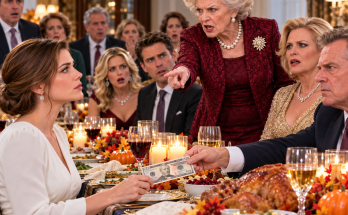
Two weeks later, our family gathered at the office of Arthur’s attorney, Mr. Bennett, for the reading of the will.
Our eldest son, Daniel, sat beside his wife. Our daughter, Susan, held a tissue in her trembling fingers. Our youngest, Michael, kept staring at the floor.
Arthur’s younger sister, Beatrice, sat across from me in an expensive black dress. She had always been distant toward me, but I never imagined she would matter much after her brother’s death.
Mr. Bennett adjusted his glasses and began reading.
Arthur had left a generous donation to a children’s hospital. His antique watch went to Daniel. His beloved fishing boat went to Michael. His savings were divided among the grandchildren.
Then Mr. Bennett paused.
He looked directly at me.
“Under the terms of this will, Arthur leaves his wife, Margaret, no personal assets or financial inheritance.”
For a moment, I thought I had misunderstood him.
“I’m sorry,” I whispered. “Could you repeat that?”
He read the sentence again.
My hands began to shake.
The house where I had raised our children was apparently not mine. The savings we had discussed for years were nowhere in my name. Even the small investment account Arthur had shown me last Christmas had been assigned elsewhere.
After 67 years of marriage, I was being told I had inherited nothing.
Beatrice leaned back in her chair and sighed.
“Well, Margaret,” she said coldly, “perhaps you should have paid more attention to the finances.”
I stared at her, unable to answer.
Daniel immediately protested. Susan started crying. Michael demanded to know whether his father had lost his mind.
But Beatrice simply collected her handbag.
“Arthur always knew what he was doing,” she said. “We should respect his wishes.”
When the meeting ended, my children escorted me outside. I told them I wanted to be alone, then returned to the attorney’s office because I had forgotten my purse.
That was when Mr. Bennett stopped me.
“Mrs. Margaret, please wait.”
He locked the office door and opened a drawer.
“There is something your husband instructed me to give you privately. He said I must wait until the will had been read and everyone had left.”
He placed a yellowed envelope in my hands.
My name was written across the front in Arthur’s familiar handwriting.
Beneath it were seven words:
“For my Maggie, when the truth can no longer wait.”
I opened the letter with trembling fingers.
The first sentence made my knees weaken.
“My darling, if you are reading this, then everyone now believes I left you nothing. I needed them to believe that.”
I looked up at the lawyer.
“What does this mean?”
Mr. Bennett’s expression turned grave.
“Your husband spent the last eleven months preparing for something, Mrs. Margaret. And he made me promise that I would not interfere until you had read every word.”
I looked back at the letter.
Arthur had written one final sentence at the bottom of the first page.
“Whatever you do, Maggie, do not let my sister take you to the old house on Willow Lane.”
My heart stopped.
Because Beatrice had called me that very morning and insisted she was coming to collect me.
She had said she wanted to take me somewhere Arthur had once called home.
And I had already promised to go.
Part 2: The Secret Behind the Locked Door
I called Beatrice from the lawyer’s office.
She answered on the second ring.
“Margaret, are you ready? I’ll be there in twenty minutes.”
I swallowed hard. “Why do you want to take me to Willow Lane?”
Silence.
Then she laughed softly.
“Arthur’s old property. You remember it, don’t you? He always said there was something important there.”
“What’s important about it?”
“Stop asking questions, Margaret. Just bring the envelope he left you.”
My blood ran cold.
I hadn’t told her about the letter.
“How do you know about an envelope?”
She hung up.
I turned to Mr. Bennett, who had gone pale.
“Does Arthur own a property on Willow Lane?”
The attorney slowly nodded.
“Not anymore. He transferred it into a private trust almost thirty years ago. The records are sealed, and I was never authorized to disclose the beneficiaries.”
“Who are the beneficiaries?”
He shook his head.
“Your husband instructed me to let you discover that yourself.”
I returned home and locked every door.
For hours, I sat in Arthur’s favorite armchair, reading his letter over and over.
He wrote about a terrible mistake he had made in his youth. Before we married, Arthur had been involved in a business partnership with a man named Samuel Whitmore.
Samuel had trusted Arthur with his life’s savings. But when their business collapsed, the money disappeared, and Samuel was publicly blamed.
Arthur claimed he had discovered years later that someone close to him had deliberately manipulated the accounts.
He had tried to correct the injustice, but the evidence had vanished.
Then came the part that made my hands shake.
“Maggie, Samuel had a daughter. Her name was Clara. I found her twenty-eight years ago. She was living in poverty, raising a little boy alone. I discovered that she had inherited nothing but her father’s debts because someone had stolen what belonged to him.”
Arthur had quietly helped Clara for years.
He paid for her son’s education. He helped her buy a modest home. He funded a small business in her name.
But he had never told me.
Why?
His letter explained that the person responsible for the original fraud had been his own sister, Beatrice.
She had worked in Samuel’s business office as a young woman. According to Arthur, she had secretly diverted money into an account and then destroyed the records.
Arthur had discovered evidence only recently, after finding old correspondence hidden inside their father’s desk.
He had confronted Beatrice.
She denied everything.
Then she threatened to expose Arthur’s own involvement in the failed business if he ever spoke publicly.
I struggled to understand why my husband had waited so long.
The next page answered that question.
“I was afraid, Maggie. I was ashamed. I told myself I was protecting our family, but I was really protecting my reputation. I cannot undo those years. I can only make sure the truth survives me.”
A photograph slipped from the envelope.
It showed Arthur standing beside a woman in her fifties and a young man wearing a graduation gown.
On the back, Arthur had written:
“Clara and her son, David. The family I was afraid to acknowledge.”
I sank into my chair.
Did Arthur have another family?
Had he betrayed me for decades?
I felt as though I had lost him a second time.
At the bottom of the envelope was a key and a handwritten address.
Willow Lane.
I almost called Beatrice to confront her. Instead, I called Mr. Bennett.
“Can you come with me tomorrow?”
“Of course,” he replied. “But Margaret, there’s something else you should know. Your husband changed his will after receiving a letter from someone claiming to have proof of the original fraud.”
“Who sent it?”
“We don’t know. It arrived anonymously.”
That night, I barely slept.
At eight the next morning, Mr. Bennett arrived at my house. We drove to Willow Lane, where an old brick building stood behind a rusted iron gate.
The key opened a narrow side door.
Inside was a small office covered in dust. Filing cabinets lined the walls. On the desk sat a wooden box bearing Arthur’s initials.
I opened it.
Inside were bank statements, photographs, signed contracts, and a bundle of letters.
And beneath them was a document that made me gasp.
It was a deed to our family home.
The house I believed I had lost had already been transferred into a trust with my name on it.
Arthur had not left me homeless.
He had protected the house from the inheritance dispute.
But the deed wasn’t the biggest surprise.
At the bottom of the box was a letter addressed to Beatrice.
It was dated just five days before Arthur died.
And the first line read:
“I know what you did to Samuel Whitmore, and I know what you are planning to do to Margaret.”
Mr. Bennett took the letter from my trembling hands.
“We need to call the police,” he said.
Before he could reach for his phone, headlights swept across the dusty windows.
A car had stopped outside.
The front door slammed.
Then I heard Beatrice’s voice.
“Margaret? I know you’re in there.”
She wasn’t alone.
A younger man walked in behind her, carrying a briefcase.
And when I saw his face, I recognized him from the photograph.
David Whitmore.
Arthur’s secret beneficiary.
He looked straight at me and said, “Mrs. Margaret, please don’t sign anything she gives you.”
Beatrice’s face turned white.
Because David had brought something that could destroy her.
Part 3: The Truth My Husband Took to His Grave
“Get out of this building!” Beatrice shouted.
David didn’t move.
Instead, he placed his briefcase on the desk and opened it.
“My mother spent twenty-eight years believing her father was a criminal,” he said. “Arthur spent the last eleven months helping me prove that he wasn’t.”
He removed several documents and laid them beside the wooden box.
They included original bank ledgers, old business contracts, and copies of letters bearing Beatrice’s signature.
Mr. Bennett examined them carefully.
“These could establish where the missing money went,” he said.
Beatrice shook her head.
“Those documents are fabricated. Arthur was old and confused. He was being manipulated!”
David calmly opened another folder.
“Then perhaps you can explain these bank transfers. The account was opened under a false business name, but the money eventually moved into an account connected to you.”
For the first time in my life, I saw Beatrice look genuinely frightened.
She turned toward me.
“Margaret, you must understand. Your husband was going to ruin everything. I was trying to protect this family.”
“By stealing from another family?” I asked.
“You know nothing about what happened!”
“No,” I replied, holding Arthur’s letter against my chest. “But I intend to learn everything.”
Beatrice suddenly reached for the documents.
David pulled them away.
Mr. Bennett stepped between them and ordered her to stop.
A few minutes later, he called the authorities and explained what we had discovered. Beatrice left before they arrived, but she could no longer control the evidence.
Over the following weeks, investigators examined the records. They interviewed former employees and traced the old financial transactions.
The investigation confirmed that money had been diverted from Samuel Whitmore’s business. Several records connected the transfers to accounts controlled by Beatrice.
The case was complicated by the passage of time, and not every allegation could be established in court. But the evidence was sufficient to trigger a formal investigation into the fraud and the more recent attempts to interfere with Arthur’s estate.
Meanwhile, David told me the rest of the story.
Arthur had met his mother, Clara, years after Samuel died. He discovered that she had spent decades trying to clear her father’s name.
Arthur helped her privately because he felt responsible for not investigating the fraud when he first had the chance.
He had not fathered another child.
David was not Arthur’s son.
He was the grandson of the man Arthur had failed to defend.
I cried when I heard that.
Not because Arthur had betrayed me, but because I finally understood the weight he had carried.
Still, I was angry.
I had been his wife for sixty-seven years. I deserved the truth while he was alive.
A week later, Mr. Bennett invited me back to his office.
He placed a second envelope on the desk.
“Arthur asked me to give you this once the documents at Willow Lane had been discovered.”
I opened it.
My dearest Maggie,
If you have reached this letter, you know why I could not simply leave you everything in an ordinary will.
Beatrice had begun pressuring me to sell the family house and transfer the proceeds through a company she controlled. When I refused, she threatened to challenge my judgment and claim that you were incapable of managing your own affairs.
I was afraid she would use the inheritance proceedings to take away your home.
So I separated your protection from my will. The house is held in trust for you. Your living expenses are secured by an account managed independently of my estate. The attorney has the documents.
I left the will looking as though I had forgotten you because I needed Beatrice to believe she had won. I needed her to stop watching the arrangements I had made for you.
I know this was cruel. I know you will ask why I did not trust you with the truth.
The answer is that I was ashamed. I spent too many years keeping a secret because I was afraid of what it would cost me. In the end, I repeated the same mistake by hiding my plan from you.
You deserved better than silence, Maggie. You always did.
Please forgive me for the things I should have told you while I still had the chance.
And please remember this: you were never the thing I left behind. You were the person I was trying to protect.
Forever yours,
Arthur.
I pressed the letter to my heart and wept.
For days, I couldn’t stop thinking about those words.
Arthur had protected me financially, but he had also hurt me emotionally. Both things were true.
I couldn’t pretend his choices were perfect simply because I loved him.
Yet I finally understood that the will had never told the whole story.
The house remained mine under the trust. The independent account provided for my needs. Our children eventually understood why their father had arranged things differently from what they expected.
And David’s family finally had a chance to restore Samuel’s name.
Months later, David invited me to the dedication of a small scholarship fund established in his grandfather’s honor. It would help students whose families couldn’t afford college.
I attended wearing the pearl necklace Arthur had given me on our fortieth anniversary.
After the ceremony, I stood beside the garden and looked at the photograph I had brought from home.
It showed Arthur and me on our wedding day, young and smiling, believing we had decades to tell each other everything.
I touched his face in the photograph.
“You should have trusted me, Arthur,” I whispered. “I would have stood beside you.”
The wind moved gently through the trees.
For the first time since his death, I felt something other than grief.
I felt peace.
Not because every secret had been forgiven, or because the past could be repaired, but because the truth had finally come into the light.
I returned to our little house, opened the windows, and made two cups of tea out of habit.
Then I laughed softly at myself and poured one cup away.
I was still learning how to live without him.
But I was no longer afraid of losing everything.
Because the greatest inheritance Arthur left me wasn’t the house, the money, or even the explanation hidden inside those envelopes.
It was the truth.
And at eighty-six, I had finally learned that love can survive terrible mistakes—but only when we are brave enough to stop hiding behind them.
The End.