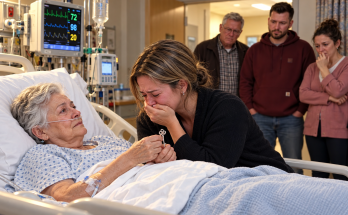
PART 1: The Call Nobody Expected
It was a chilly October morning in Briarwood, Ohio, when emergency dispatcher Sarah Mitchell answered a call that would haunt her for years.
“911. Tell me what’s happening.”
For several seconds, she heard nothing but quiet breathing.
Then a tiny voice whispered, “Please help me. My legs hurt, and I can’t move.”
Sarah immediately sat upright.
“Sweetheart, what’s your name?”
“Lily.”
“How old are you, Lily?”
“Six.”
Sarah softened her voice. She had spent seventeen years answering emergency calls, but something about the little girl’s frightened breathing made her especially concerned.
“Okay, Lily. I’m here with you. Is there a grown-up nearby who can help?”
“No.”
“Where is your mommy?”
“She went to work. She said I should stay in my room.”
Sarah began tracing the call while asking Lily simple questions that would help emergency crews find her.
Lily described a small blue house with a white fence and a mailbox that had fallen sideways. Within minutes, Sarah had enough information to dispatch an ambulance and police officers.
“Lily, help is coming. Can you tell me what happened to your legs?”
The little girl began crying.
“I tried to stand up, but it hurt. I can’t make them go together.”
Sarah kept her voice steady.
“Don’t force yourself to move, sweetheart. Just stay where you are. Can you tell me if you’re alone in the house?”
“Yes.”
A pause followed.
Then Lily whispered something that made Sarah’s fingers freeze above the keyboard.
“Please don’t tell Daniel I called.”
Sarah carefully asked who Daniel was.
“My mommy’s boyfriend.”
“Is Daniel there right now?”
“No. But he’s coming back later.”
“Why are you afraid of Daniel, Lily?”
The child didn’t answer.
Sarah could hear a television playing faintly in the background. Somewhere nearby, a dog barked twice. Then Lily spoke again, so quietly that Sarah almost missed the words.
“He says I fall too much.”
Sarah signaled the responding officers to approach carefully and requested immediate medical assistance.
Seven minutes later, a police cruiser pulled into the driveway of the blue house. Paramedics followed close behind.
The front door was locked, and nobody answered their knocks.
One officer called through the door.
“Lily? We’re here to help you. Can you hear us?”
A faint voice came from inside.
“The key is under the flowerpot.”
The officers entered and followed the sound of a cartoon playing in a small bedroom.
They found Lily sitting on the carpet beside her bed. She wore an oversized gray sweatshirt and dark leggings. Her cheeks were wet with tears, and she was holding a stuffed rabbit tightly against her chest.
One paramedic, Rachel Brooks, immediately knelt beside her.
“Hi, Lily. I’m Rachel. We’re going to help you, okay?”
Lily nodded, but when Rachel asked whether she could straighten her legs, the little girl began sobbing.
“It hurts! Please don’t make me!”
Rachel stopped immediately.
“It’s okay. Nobody is going to force you to move.”
Her partner checked Lily’s vital signs while Rachel assessed her as gently as possible. There was no obvious external injury that explained the severity of the pain.
But Lily flinched whenever anyone mentioned her mother’s boyfriend.
When the paramedics prepared to transfer her onto a stretcher, Lily grabbed Rachel’s hand.
“Can you promise me something?”
“Of course. What is it?”
“Don’t let him take me home.”
Rachel exchanged a concerned glance with her partner.
“We’re taking you to the hospital first, sweetheart. Right now, we’re going to make sure you’re safe.”
As the ambulance doors closed, Lily finally released a breath she seemed to have been holding for a very long time.
Neither paramedic knew that the little girl’s words would soon lead doctors to discover something far more disturbing than an unexplained injury.
And when Lily’s mother arrived at the hospital, one simple question would change everything.
PART 2: The X-Rays That Changed Everything
At Briarwood Children’s Hospital, Dr. Emily Carter examined Lily while nurses carefully monitored her pain.
The little girl was frightened, exhausted, and reluctant to answer questions about what had happened at home.
Dr. Carter didn’t rush her.
“Lily, you haven’t done anything wrong. My job is to help you feel better. Can you tell me when your legs first started hurting?”
Lily stared at the stuffed rabbit in her lap.
“Yesterday.”
“Did something happen yesterday?”
She nodded faintly.
“What happened, sweetheart?”
“Daniel got mad.”
Dr. Carter waited quietly, giving Lily time to continue.
“He said I was being bad because I spilled my juice. He grabbed me, and I fell.”
The doctor asked no leading questions. Instead, she documented Lily’s words and arranged for a specialist examination and imaging to determine the cause of her pain.
The first X-rays revealed fractures near her upper legs and hips.
But those weren’t the only findings.
Additional imaging suggested that some injuries were older than others. Several showed signs of healing, indicating that they had occurred well before the previous day.
Dr. Carter stepped into the hallway to speak privately with the hospital’s child-protection team.
“These injuries need a thorough investigation,” she explained. “We cannot determine exactly how they happened from the images alone, but the different stages of healing are concerning.”
A nurse contacted the appropriate authorities while the medical team continued caring for Lily.
Less than an hour later, her mother, Amanda, rushed into the emergency department.
She was still wearing her grocery-store uniform, and her hands were shaking.
“Where’s my daughter? Someone called and said she was hurt!”
A nurse led her to Lily’s room.
Amanda hurried to the bed and reached for her daughter’s hand.
“Oh, baby. What happened to you?”
Lily immediately turned toward the wall.
Her mother looked stunned.
“Lily, sweetheart, it’s Mommy.”
The little girl pulled the blanket closer to herself.
Dr. Carter gently asked Amanda to speak with her in a private consultation room.
There, the doctor explained the results of the examination.
Amanda stared at the images on the screen.
“Broken bones? No. That can’t be right. She hasn’t had an accident.”
“Has Lily complained about pain before?”
Amanda hesitated.
“Sometimes. She said her legs hurt a few weeks ago, but Daniel told me she was exaggerating. He said children complain when they want attention.”
Dr. Carter remained calm.
“Who was caring for Lily when you were working?”
“Daniel. He’s been living with us for eight months.”
“Have you noticed any other changes in her behavior?”
Amanda’s face slowly changed.
She remembered Lily refusing to be alone with Daniel. She remembered the nightmares, the sudden silence at dinner, and the way her daughter had started asking whether she could sleep in her mother’s room.
Each time, Daniel had offered the same explanation.
Lily was difficult.
Lily was clumsy.
Lily was trying to cause trouble.
Amanda had believed him because she desperately wanted their new household to work.
Now, sitting beneath the harsh hospital lights, she began to realize how many warnings she had dismissed.
Then Dr. Carter asked one more question.
“Has Daniel ever been alone with Lily when she’s been injured?”
Amanda opened her mouth, but no words came out.
Before she could answer, a police detective entered the room.
He introduced himself as Detective Michael Reeves and explained that officers had responded to the house after Lily’s emergency call.
“We need to speak with you about the circumstances surrounding your daughter’s injuries,” he said.
Amanda nodded, trembling.
Then the detective added something that made her blood run cold.
“Ma’am, your daughter specifically asked the dispatcher not to tell Daniel she had called.”
Amanda covered her mouth.
At that moment, her phone began vibrating.
Daniel’s name appeared on the screen.
She stared at it until the call stopped.
Seconds later, a message appeared.
Why are there police cars outside our house? Call me immediately.
Another message followed.
Where is Lily? Don’t let anyone put ideas in her head.
Amanda felt the room tilt around her.
For the first time, she wasn’t wondering whether Daniel had misunderstood Lily.
She was wondering what he was so desperate to hide.
And then the detective received a call from one of the officers who had searched the house.
They had found something in a locked storage cabinet.
Something that might explain why Lily had been so afraid to speak.
PART 3: The Secret Behind the Locked Cabinet
Detective Reeves stepped into the hallway to take the officer’s call.
When he returned, his expression was serious.
“Mrs. Mitchell, officers have located several items in your home that require further investigation. We need to establish who had access to them and whether they relate to your daughter’s injuries.”
Amanda gripped the edge of her chair.
“What did they find?”
“A collection of handwritten notes and photographs documenting Lily’s supposed accidents. Some dates appear inconsistent with the medical findings. Investigators are preserving everything for review.”
Amanda shook her head.
“I never saw any of that.”
The detective didn’t accuse her. He simply explained that the investigation would need to establish who created the records and why.
Across the hall, a child-protection specialist was speaking with Lily in a quiet room. The conversation was conducted carefully, without pressuring her to repeat details or suggest answers.
After some time, Lily shared that Daniel had repeatedly blamed her for accidents and warned her not to tell her mother about what happened at home.
She also described occasions when he had hurt her and then insisted that she had fallen.
The specialist documented Lily’s statements and made sure she understood that she was not responsible for what had happened.
Meanwhile, doctors continued treating her injuries.
Her fractures required careful management, pain relief, and a rehabilitation plan. Although the medical team could not promise an immediate recovery, they reassured Amanda that Lily would receive the care she needed.
Amanda sat beside her daughter, crying silently.
“I should have listened,” she whispered. “I’m so sorry, baby.”
Lily looked at her for a long moment.
“Will he come back?”
Amanda reached for her hand, stopping when she saw her daughter tense.
“You don’t have to hug me or talk if you don’t want to,” she said gently. “The police are investigating, and we’re going to make sure you have a safe place to stay.”
Lily’s shoulders slowly relaxed.
For the first time that morning, she looked directly at her mother.
“Can I sleep with my door open?”
Amanda nodded through her tears.
“Yes. However you feel safe.”
Later that afternoon, investigators located Daniel and brought him in for questioning. The evidence gathered from the house, the medical findings, and the accounts provided during the investigation were examined together.
Daniel denied deliberately injuring Lily.
But the investigation continued, and authorities worked to determine what had happened, when the injuries occurred, and whether anyone else had known about them.
For Amanda, the most painful realization was not simply that someone she trusted might have harmed her child.
It was that Lily had been trying to tell her something was wrong long before the emergency call.
She had complained of pain.
She had become frightened.
She had asked not to be left alone.
And every time, an adult had found a reason to dismiss her fears.
Over the following weeks, Lily began working with medical professionals and a trauma-informed counselor. Recovery was slow. Some days she laughed at cartoons and asked for her favorite pancakes. Other days, a sudden noise made her hide beneath a blanket.
Her mother learned to stop asking her to explain everything at once.
Instead, Amanda listened.
One evening, as the autumn rain tapped against the hospital window, Lily reached for her mother’s hand.
“Mommy?”
“I’m here.”
“Did I do something bad when I called 911?”
Amanda felt tears fill her eyes.
“No, sweetheart. You did something brave. You asked for help when you were scared, and that was the right thing to do.”
Lily considered this quietly.
Then she asked, “Will the lady on the phone know I’m okay?”
Amanda contacted the hospital social worker, who helped pass along an appropriate message of thanks to the emergency communications team.
When dispatcher Sarah Ward learned that Lily was receiving care and had been connected with people responsible for protecting her, she sat quietly at her desk for a moment.
She had answered thousands of calls during her career.
But she would always remember the six-year-old who had whispered that she couldn’t move her legs—and then found the courage to ask for help.
Lily’s story did not end with one phone call or one hospital examination. It continued through treatment, investigation, and the difficult work of rebuilding trust.
And the lesson her mother carried forward was painfully simple:
Sometimes, children cannot explain what is happening to them in the words adults expect.
Sometimes, they speak through fear, silence, sudden changes in behavior, or a quiet request not to be left alone.
The most important thing an adult can do is listen, take their concerns seriously, and make sure they are safe.
Because that morning, a six-year-old girl didn’t need someone to tell her to be brave.
She needed someone to believe that she was hurting.
And finally, someone did.