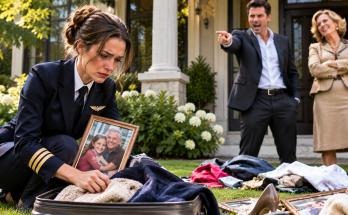
My Parents Forced My Adopted Daughter to Sit in the Servants’ Room on Christmas—Then a Lawyer Revealed the Secret My Grandmother Had Left Behind
On Christmas Eve, my mother told my eight-year-old adopted daughter that she wasn’t allowed to sit at the family dining table because “this celebration is for real grandchildren.” While my nieces wore matching velvet dresses and opened their presents, my little girl sat alone in the back kitchen, clutching the photograph of the mother she had lost. When I confronted my parents, my father threatened to remove me from his will. I was about to take my daughter and leave when a stranger in a gray suit appeared at the front door. He introduced himself as my late grandmother’s attorney and asked one question that made my mother drop her wineglass: “Has anyone told Daniel what his grandmother decided about the family estate—and the little girl she specifically named in her final letter?” My father turned white. My mother whispered, “That letter was never supposed to be found.” And suddenly, I realized that my daughter had been at the center of a secret long before I had ever adopted her.
Part 1 — The Christmas Dinner My Daughter Wasn’t Allowed to Attend
My name is Daniel Whitmore. I was forty years old, the owner of a successful architectural firm in Seattle, and the proud father of an eight-year-old girl named Lily.
I adopted Lily when she was four.
Her biological mother, Emily, had been my closest friend in college. Years later, when Emily died after a long illness, I learned that she had left behind a little girl who needed a permanent home.
I had never planned to become a father that way.
But when I met Lily, with her enormous brown eyes and her habit of holding a stuffed rabbit whenever she felt frightened, I knew I couldn’t walk away.
The adoption took time. There were interviews, background checks, court hearings, and difficult conversations about Lily’s future.
Eventually, the judge approved the adoption.
I brought Lily home on a rainy Thursday afternoon.
She stood in the middle of my living room, looking around as though she was afraid to touch anything.
“Is this really my house?” she asked.
I knelt beside her.
“It’s our house.”
She looked at me carefully.
“And can I call you Dad?”
I had to look away for a moment before answering.
“Every single day, if you want.”
From that afternoon onward, I never thought of her as anything other than my daughter.
She loved painting, chocolate pancakes, and stories about brave explorers. She was fascinated by the moon and insisted that the stars looked brighter whenever someone she loved was watching from the ground.
But Lily also carried a sadness that no amount of affection could completely erase.
Sometimes, she asked questions about Emily.
Sometimes, she woke from nightmares and searched the house to make sure I was still there.
And sometimes, when she saw families holding hands in public, she grew unusually quiet.
I promised myself that she would always know she belonged somewhere.
Unfortunately, my parents did not share that belief.
My mother, Victoria Whitmore, was obsessed with family traditions. Every holiday had a strict schedule, every guest had an assigned seat, and every family photograph had to look perfect.
My father, Richard, believed that the Whitmore name was a legacy that had to be preserved.
He had inherited a substantial estate from my grandfather and spent decades expanding the family’s real-estate holdings.
My younger sister, Caroline, had two biological children, Olivia and Henry.
My parents adored them.
They bought them expensive toys, enrolled them in elite schools, and spoke about their achievements as if the children had personally rescued the family business.
Lily received a different kind of attention.
My mother called her “Daniel’s little adoption project” when she thought I couldn’t hear.
My father repeatedly referred to her as “the child from outside the family.”
Whenever I challenged them, they offered the same excuses.
“We’re simply adjusting,” my mother would say.
“Don’t expect everyone to feel the way you do,” my father added.
I tried to be patient.
I wanted Lily to have grandparents. I wanted her to experience the warmth of a large family. And I foolishly believed that time would soften my parents’ attitudes.
Then came the Christmas that changed everything.
My grandmother, Eleanor Whitmore, had died eight months earlier.
She had been the one person in my family who had never treated Lily differently.
When I introduced them, Eleanor had taken Lily’s small hand in hers and said, “Well, hello, sweetheart. I’ve been waiting to meet you.”
Lily had smiled shyly.
“Are you my grandma too?”
Eleanor had kissed her forehead.
“If your father says you’re family, then you’re family to me.”
Those words meant more to me than she could have known.
Before her death, Eleanor had lived in a beautiful old estate outside Seattle. It had a long gravel driveway, a library filled with leather-bound books, and a dining room where generations of Whitmores had celebrated Christmas.
My parents decided to host the first Christmas gathering there after her passing.
They insisted that the entire family attend.
I hesitated.
But Lily was excited.
She had made a handmade card for my mother and spent an entire afternoon painting a picture of a Christmas tree surrounded by people holding hands.
“Maybe Grandma Victoria will like this one,” she told me.
I smiled.
“I hope so, sweetheart.”
On Christmas Eve, Lily wore a beautiful green dress with a velvet ribbon in her hair. She carried her painting in a gift bag and held my hand as we walked into the estate.
The house was magnificent.
A huge Christmas tree stood beside the staircase. White lights shimmered across the windows, and the dining room was filled with candles, silverware, and crystal glasses.
My mother greeted Caroline and her children with enthusiastic hugs.
Then she looked at Lily.
“Oh. You brought her.”
I felt my jaw tighten.
“Of course I brought my daughter.”
My mother gave a thin smile.
“Well, we’ll have to work out the seating.”
I should have turned around right then.
Instead, I helped Lily remove her coat and followed everyone into the living room.
For a while, the evening appeared normal.
Caroline’s children played with their new toys. My father discussed business with his guests. My mother walked around checking the table arrangements.
Lily sat beside me, carefully holding the gift she had made.
When dinner was announced, my mother called everyone into the dining room.
Olivia and Henry were placed beside my parents.
Caroline sat opposite them.
My father occupied the head of the table.
I noticed that no place had been set for Lily.
“Where is her chair?” I asked.
My mother didn’t look up from the silverware.
“We thought she might be more comfortable in the back kitchen.”
I stared at her.
“What?”
She finally turned.
“This dinner is a family tradition. The main table is for the Whitmore grandchildren.”
“Lily is my daughter.”
“Daniel, please don’t start.”
My father joined the conversation.
“Your mother is trying to avoid confusion. The other children have grown up in this family.”
“And Lily hasn’t because you keep treating her like an outsider.”
My father lowered his voice.
“This is my mother’s estate. We will celebrate Christmas according to our traditions.”
I looked at Lily.
She was watching us, trying to understand why everyone was speaking so carefully.
I knelt beside her.
“Sweetheart, do you want to sit with me?”
She nodded immediately.
I pulled out the chair beside mine.
My mother stepped between us.
“Daniel, I already told you. There isn’t a place for her here.”
For a moment, the entire room went silent.
Then my father said the words I would never forget.
“She isn’t a real Whitmore grandchild. You cannot expect us to pretend that she is.”
Lily heard him.
I saw it in her face.
Her shoulders dropped, and she looked down at the painting in her hands.
“I’m sorry,” she whispered.
I turned toward her.
“What are you sorry for, sweetheart?”
She swallowed.
“I thought Grandma Victoria might like my picture. I didn’t know I wasn’t supposed to sit here.”
My heart shattered.
I lifted her into my arms.
“You did nothing wrong.”
My mother sighed impatiently.
“Must we make everything emotional?”
That was when I lost my patience.
“You’re telling an eight-year-old child that she isn’t welcome at Christmas, and you’re asking me not to be emotional?”
My father stood.
“Lower your voice.”
“No.”
The word surprised even me.
I had spent years avoiding arguments with my parents. I had tolerated their comments, excused their behavior, and hoped they would eventually accept Lily.
But my daughter was standing beside me, holding a painting she had made with love, while the people who called themselves her family treated her like an inconvenience.
I wasn’t going to let it happen again.
I took Lily’s coat from the hallway.
“We’re leaving.”
My mother followed us.
“If you walk out of this house, don’t expect your father to support your business interests.”
I turned around.
“What does my business have to do with Lily?”
My father folded his arms.
“You need to remember who helped you get started.”
I stared at him.
“I built my company with my own work. And even if I owed you everything, it would not give you the right to humiliate my daughter.”
I reached for the front door.
Then the doorbell rang.
My father frowned.
“Who could that be?”
A man in a gray suit stood on the porch. He carried a leather briefcase and held a large envelope with a law firm’s name printed across the front.
“Mr. Richard Whitmore?” he asked.
My father nodded cautiously.
“My name is Thomas Bennett. I was Eleanor Whitmore’s attorney.”
My mother went completely still.
Thomas looked toward me.
“Daniel, I apologize for arriving without notice. I’ve been attempting to contact you regarding your grandmother’s final instructions.”
My father stepped forward.
“Whatever this is, it can wait until after Christmas.”
“I’m afraid it cannot.”
Thomas opened his briefcase.
“Your grandmother left a letter that was to be delivered to you personally if certain circumstances arose concerning her estate.”
My mother suddenly grabbed the edge of the console table.
“What letter?”
Thomas looked at her.
“The letter concerning Daniel’s daughter.”
The color drained from my mother’s face.
My father turned sharply toward him.
“That’s impossible.”
Thomas removed a sealed envelope.
“Eleanor was very specific. She instructed me not to disclose the contents until Daniel had received the document directly.”
I stared at the envelope.
My grandmother had never mentioned a secret letter.
I had assumed her will contained the usual arrangements for property, investments, and family possessions.
Thomas handed it to me.
My mother’s voice trembled.
“Daniel, please. Don’t open that here.”
I looked at her.
“Why?”
She couldn’t answer.
I opened the envelope.
Inside was a handwritten letter from Eleanor and a second document bearing the signature of the estate’s independent trustee.
The first line of Eleanor’s letter read:
My dear Daniel, if you are reading this, I fear that my family has failed to understand the most important lesson I ever tried to teach them.
I looked up.
My father had gone pale.
And my mother was whispering something I could barely hear.
“She promised she wouldn’t tell him.”
Part 2 — The Letter My Grandmother Hid for a Reason
I read Eleanor’s letter standing in the hallway.
My hands trembled as I unfolded the pages.
My dear Daniel,
If Thomas has delivered this letter, then something has happened that I hoped I would never have to address.
I have watched the way certain members of our family speak about Lily. I have heard the comments about blood, names, and inheritance. I have watched you try to keep the peace because you want your daughter to have a relationship with her grandparents.
I understand why you have tried. But peace purchased at the expense of a child’s dignity is not peace at all.
I stopped reading.
My eyes burned.
My grandmother had known.
She had seen the way my parents treated Lily, and she had been preparing for the possibility that it would get worse.
I continued.
There is something you do not know about the house where we are standing.
Many years ago, I established a separate charitable fund to support children who had lost their parents or had been placed in permanent care. I wanted to ensure that my wealth could help children who had no control over the circumstances into which they were born.
The fund is administered independently. Neither your father nor your mother has authority to redirect its assets.
When you told me about Lily, I asked Thomas to review whether the fund could support her education and future needs without interfering with the legal arrangements of her adoption.
I looked at Thomas.
“She created a fund for Lily?”
Thomas nodded.
“She created a fund to help eligible children in circumstances similar to Lily’s. Your grandmother also made specific arrangements concerning Lily’s educational support.”
I looked down at the letter again.
I did not create this fund because I thought Lily needed to earn a place in our family. I created it because every child deserves a chance to build a future.
I have also instructed the trustee to review any attempt to influence the fund for reasons unrelated to its purpose.
My father stepped forward.
“That fund was supposed to support the family’s charitable work.”
Thomas replied calmly.
“It does support charitable work, Mr. Whitmore. It was established under Eleanor’s instructions and is managed independently.”
My mother began to cry.
I continued reading.
Daniel, if anyone tells you that Lily’s adoption makes her less deserving of love or protection, remember this: a family name is something we inherit. Character is something we choose.
I cannot choose character for your parents. But I can make sure that my wishes are clear.
The estate trustee has been instructed to preserve the fund’s independence and to investigate any unauthorized effort to redirect its resources.
I have also left you a separate personal letter explaining why I made these arrangements. Thomas will provide it after the estate documents have been reviewed.
Love your daughter without apology. Protect her without hesitation. And never allow anyone to convince you that a child’s worth depends on the circumstances of her birth.
With all my love,
Grandma Eleanor.
I lowered the letter.
For a long moment, nobody spoke.
Then my father laughed nervously.
“Your grandmother was old. She had become sentimental.”
Thomas closed his briefcase.
“Eleanor was fully capable of making her decisions. The documents were prepared with independent legal advice.”
My father turned toward him.
“Are you suggesting that I interfered with her estate?”
“I’m saying that the trustee has requested clarification about several communications concerning the fund.”
Thomas placed a second document on the console table.
It contained a summary of the fund’s purpose and the instructions Eleanor had provided.
The fund had been designed to support children’s education, health needs, and development.
It was not a personal inheritance for the Whitmore grandchildren.
It was not money my father could distribute according to his preferences.
And it certainly wasn’t something my mother could use to decide which child deserved a place at Christmas dinner.
I looked at my parents.
“Did you know about this fund?”
My mother wiped her cheeks.
“We knew your grandmother had charitable arrangements.”
“Did you know she wanted Lily’s educational needs considered?”
She hesitated.
My father answered for her.
“We knew she had become attached to the child.”
“That isn’t what I asked.”
My mother looked down.
“Yes.”
The answer hurt more than I expected.
They had known that Eleanor cared about Lily.
They had known that she wanted to protect her future.
And they had still treated her like an outsider.
Thomas explained that the trustee had recently received a request to reconsider certain allocations from the fund. The request had cited family concerns and suggested that support for Lily should be limited because she was not biologically related to the Whitmore family.
The trustee had not approved the request.
Instead, the trustee had asked Thomas to deliver Eleanor’s letter and clarify her instructions.
“Who submitted that request?” I asked.
Thomas paused.
“The records include communications from more than one family member. The trustee is reviewing them before reaching any conclusion about responsibility.”
I looked at my parents.
My father refused to meet my eyes.
My mother gripped the edge of the table.
I understood then that the letter was not simply a touching message from my grandmother.
It was a warning.
She had anticipated that someone might try to use the family name to interfere with a charitable fund meant to help vulnerable children.
And now the trustee was investigating.
I folded the letter carefully.
“Does this change Lily’s adoption?”
“No,” Thomas answered immediately. “The charitable fund and the adoption are separate matters. Nothing in these documents changes Lily’s legal relationship with you.”
I felt relief.
“Can my parents prevent her from receiving support?”
“Not by personal preference. The trustee must follow the fund’s governing documents and eligibility requirements.”
My father slammed his hand against the console table.
“This is absurd! You’re allowing a child who isn’t related to us to influence the family estate!”
Thomas looked at him steadily.
“Mr. Whitmore, the fund belongs to the charitable arrangement your mother created. It is not yours to control.”
My father turned toward me.
“Daniel, you are going to let an outsider destroy this family?”
I looked at Lily.
She was standing beside me, still holding her painting.
“No,” I said. “I’m going to stop this family from hurting my daughter.”
My mother began sobbing.
“We never meant for it to go this far.”
“Then why did you send her away from the table?”
She had no answer.
Thomas suggested that we move the discussion to his office after the holiday. He advised everyone to preserve relevant documents and communicate with the trustee through the proper channels.
I agreed.
Then I took Lily’s hand.
We walked out of the mansion together.
In the car, she sat quietly in the passenger seat, holding her stuffed rabbit.
After several minutes, she asked, “Dad, did Grandma Eleanor really like me?”
I looked at her.
“She loved you.”
“Even though I’m adopted?”
“Because you’re you, sweetheart. Not because of where you were born.”
She thought about that for a moment.
Then she looked out the window.
“Can we still have Christmas at home?”
I smiled sadly.
“Yes. And you can sit wherever you want.”
We drove home through the falling snow.
That night, we made hot chocolate, put on our pajamas, and watched a movie beneath a blanket on the sofa.
Lily placed her painting on the coffee table.
I asked whether she wanted to give it to Grandma Victoria another time.
She shook her head.
“No. I want to keep it.”
I nodded.
“Then we’ll keep it.”
After she went to bed, I called Thomas.
I wanted to know what my grandmother had done and why my parents seemed so frightened.
Thomas told me that the trustee would meet with the family after Christmas to review the disputed communications.
He also explained that Eleanor had left one final personal letter for me.
It had not yet been delivered because the trustee wanted the other estate documents confirmed first.
“Daniel,” he said, “your grandmother was very deliberate. She did not want the fund used as a weapon in a family argument. She wanted it protected for its intended purpose.”
I stared at the Christmas tree.
“Did she know my parents would treat Lily this way?”
“I cannot know exactly what she expected. But she was concerned about how some family members understood inheritance and belonging.”
I thanked him and ended the call.
Then I sat quietly in the living room.
My parents had spent years telling me that family meant loyalty.
My grandmother had taught me that loyalty without compassion was simply obedience.
And I finally understood why she had left those instructions.
She wanted Lily’s future protected from people who believed they had the right to decide which children mattered.
But the most important part of the story was still waiting to be revealed.
Part 3 — The Christmas My Daughter Finally Took Her Place
The meeting with the estate trustee took place in January.
I arrived with Thomas and an independent attorney who could advise me about Lily’s interests.
My parents were present, along with representatives responsible for administering Eleanor’s charitable fund.
The trustee began by explaining the fund’s purpose.
It had been created to support children who had experienced the loss of a parent, a change in guardianship, or other difficult circumstances.
The fund could provide assistance with education, healthcare, and approved developmental needs.
Its assets were administered independently.
No member of the Whitmore family could simply redirect the money to themselves or exclude a child because of personal prejudice.
That was the first thing my parents needed to understand.
The second was that the trustee had not approved the request to limit Lily’s eligibility.
The fund’s administrator had determined that Lily’s circumstances could be considered under the established criteria.
The final decision about support would be made according to those criteria, not according to my father’s opinion of who counted as a Whitmore.
I felt relieved.
But I was not there to secure money for Lily.
I was there because my parents had allowed an eight-year-old child to believe she was unwanted.
No amount of charitable support could erase that.
Thomas then presented Eleanor’s final personal letter.
It had been kept separately from the other documents.
He handed it to me.
I opened it slowly.
My dear Daniel,
There is one more thing I want you to understand.
I did not arrange these protections because I believed Lily would become wealthy. I arranged them because I know what happens when people confuse inheritance with importance.
Your grandfather and I built this family through hard work. We also made mistakes. We sometimes cared too much about appearances and not enough about the people standing in front of us.
When you brought Lily to meet me, I saw a little girl who needed a safe place to belong. I did not see a problem to solve or a name to preserve.
I saw a child.
If my family ever makes her feel that she must earn a place among us, remember that you have my full permission to walk away from the table.
No property is worth more than your daughter’s peace.
I hope my family learns to do better. But if they do not, please do not sacrifice Lily’s childhood while waiting for them to change.
Love her loudly.
Protect her quietly.
And never confuse forgiveness with allowing someone to hurt her again.
All my love,
Eleanor.
I had to stop reading.
Tears blurred the page.
My grandmother had understood exactly what I had struggled to admit.
I had been so determined to keep my family together that I had repeatedly exposed Lily to people who treated her as less important.
I had called it patience.
Sometimes, it had simply been fear of disappointing my parents.
I folded the letter and placed it in my pocket.
My father cleared his throat.
“Daniel, we need to discuss what happens next.”
I looked at him.
“What happens next is that Lily’s interests will be handled according to the fund’s rules, and our relationship will depend on how you treat her.”
My mother began crying again.
“We have apologized.”
“No, you haven’t.”
She stared at me.
“You said you never meant to hurt her. You haven’t acknowledged what you actually did.”
My father leaned forward.
“Your mother made a mistake with the seating arrangement. Must we turn one Christmas dinner into a lifelong punishment?”
I looked directly at him.
“It wasn’t a seating arrangement. You told my daughter she wasn’t a real grandchild. You watched her apologize for wanting to sit with her family. You threatened me because I refused to accept it.”
He looked away.
“I was trying to maintain our traditions.”
“Then your traditions need to change.”
The trustee interrupted gently to return the conversation to the estate matter.
The disputed request would continue through the formal review process. The fund would remain independent, and any support for Lily would be determined by its established rules.
I accepted that decision.
I did not demand that my parents lose their inheritance.
I did not ask the trustee to punish them.
I wanted the arrangements respected and Lily’s future protected.
After the meeting, my mother approached me in the hallway.
“Can I see Lily?”
I considered the question.
For years, I had wanted my parents to love my daughter.
I still wanted that.
But I no longer believed that wanting something made it safe.
“Not yet,” I said. “She needs time, and so do I.”
My mother nodded through her tears.
“I understand.”
I hoped she did.
But I would judge her by what she did next, not by what she said that afternoon.
Over the following months, I focused on Lily.
We spent weekends hiking, painting, and baking cookies that always came out slightly crooked.
I signed her up for art classes because she loved drawing.
She made friends at school and began talking more confidently about the future.
Sometimes, she still asked questions about her grandparents.
I answered honestly but gently.
I never told her that she needed to forgive them.
I never told her that she had to accept an apology.
I wanted her to understand that she could be kind without allowing someone to mistreat her.
My parents eventually sent a letter addressed to Lily.
It contained a simple apology.
They acknowledged that she had been treated unfairly at Christmas and that she should never have been told she was less important because she was adopted.
They did not ask her to keep a secret.
They did not mention the charitable fund.
They did not demand a visit.
I read the letter first, then discussed it with Lily’s counselor.
When we decided to share it with her, I sat beside her on the sofa and read it aloud.
She listened quietly.
Then she asked, “Do I have to go back to their house?”
“No, sweetheart.”
“Even if they say sorry?”
“Even then. You can decide when you’re ready, and you can take your time.”
She thought about it.
“Maybe someday. But not yet.”
I kissed her forehead.
“That’s completely okay.”
Months later, Lily agreed to meet my mother at a public garden.
I stayed beside her throughout the visit.
My mother arrived without gifts. She sat on a bench and spoke softly.
“I’m sorry I made you feel like you didn’t belong,” she told Lily. “You should never have been treated that way.”
Lily looked down at her shoes.
“Why did you send me to the kitchen?”
My mother closed her eyes.
“Because I was wrong. I cared too much about an old idea of family, and I forgot what being a grandmother was supposed to mean.”
Lily remained quiet for a long moment.
Then she asked, “If I come to Christmas next time, can I sit at the table?”
My mother began to cry.
“Yes. You can always sit at the table.”
Lily did not hug her.
She simply nodded.
That was enough for that day.
Trust would have to be rebuilt slowly.
My father was slower to change.
He continued to defend his concern about the family name and the estate. I told him that I would not bring Lily into situations where she was treated as inferior.
Eventually, he agreed to meet with me privately.
He admitted that he had confused protecting the family’s assets with protecting the family itself.
It was not a perfect apology, but it was the first time he had taken responsibility without blaming someone else.
I told him that a relationship with Lily would require consistent respect.
He agreed.
I did not promise that everything would return to normal.
Some things could not.
The next Christmas, I hosted the celebration at my own home.
There was no formal seating chart.
No one was ranked by birth.
No child was asked to earn a place at the table.
Lily helped me decorate the tree. She placed her favorite ornament near the bottom so she could reach it, then stood back and admired her work.
When dinner was ready, she carried a small stack of napkins to the table.
I watched her for a moment.
She was smiling.
Not because she was trying to please anyone.
Not because she was afraid of making a mistake.
She was simply happy to help.
I walked over and hugged her.
“Everything okay, sweetheart?”
She nodded.
“Can I sit beside you?”
I pulled out the chair next to mine.
“That seat has been yours from the beginning.”
She climbed into the chair and smiled.
Later, she brought me a new drawing.
It showed a house with a large Christmas tree in front. Four people stood in the garden, holding hands. Above them, she had painted a bright yellow sun.
At the bottom, she wrote:
LOVE MAKES A FAMILY.
I held the drawing against my chest.
For a moment, I could almost hear my grandmother’s voice.
No property is worth more than your daughter’s peace.
She had been right.
The legal review of the charitable fund was completed through the proper channels, and its assets remained under independent administration. Any assistance for Lily was determined according to the fund’s rules rather than my parents’ preferences.
The most important result, however, was not financial.
It was that Lily finally understood that her place in my life could never be taken away by someone else’s opinion.
My parents and I did not return to the relationship we had before that Christmas.
We built something different, with clearer boundaries and more honesty.
I allowed room for change, but I did not sacrifice Lily’s emotional safety to make the adults comfortable.
And I stopped believing that being a good son required me to tolerate everything my parents did.
Sometimes, being a good father meant disappointing them.
Sometimes, loving your family meant walking away from a table where your child was not welcome.
And sometimes, the person who teaches you the greatest lesson about family is the person who never shared your blood at all.
One evening, while tucking Lily into bed, she reached for my hand.
“Dad?”
“Yes, sweetheart?”
“Grandma Eleanor really wanted me to be happy, didn’t she?”
I smiled.
“She did.”
Lily closed her eyes.
“I’m glad she knew me.”
I squeezed her hand.
“So am I.”
I stayed beside her until she fell asleep.
Then I returned to the living room and placed Eleanor’s letter in a frame beside Lily’s drawing.
Two pieces of paper.
One written by a grandmother who understood love.
The other drawn by a little girl who had once believed she needed permission to belong.
I looked at them for a long time.
My parents had thought the Whitmore name was the family’s greatest inheritance.
My grandmother had understood something they had forgotten.
A name can be passed down through generations.
Money can be placed in a trust.
A house can be inherited.
But kindness must be practiced, and love must be shown.
My daughter did not need my parents to declare her a real grandchild. She needed me to stand beside her when they tried to make her feel otherwise.
And that Christmas, I finally understood that protecting my daughter was not an act of rebellion against my family.
It was the clearest expression of what family was supposed to mean.
Because no child should ever have to sit alone in a kitchen wondering whether she deserves a place at the table.
And no father should ever have to choose between his parents’ approval and his child’s dignity.
But if that choice ever comes again, I already know what I will do.
I will take my daughter’s hand.
I will pull out her chair.
And I will remind her, for as long as I live, that she never has to earn her place in my heart.