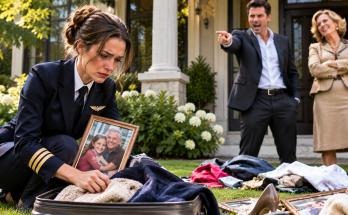
My Grandmother Left Me a Rusty Key and One Final Rule: “Open the Abandoned Farmhouse Before Anyone Reads My Will”—Then My Father Saw What Was Inside and Begged Me to Burn It
“Whatever you do, Emily, take the entire family to the old farmhouse before the lawyer reads my will,” my grandmother whispered three days before she died. “And don’t let your father open the door first.”
I thought the medication was making her confused.
Grandma Margaret was eighty-four, frail but sharp-minded, and she had spent her final weeks in a hospital room overlooking a parking lot. Yet when she pressed a cold brass key into my palm, her eyes were perfectly clear.
“Promise me,” she said.
I promised.
What I didn’t understand was why her instruction made my father look as if someone had threatened to expose him.
At the funeral, he barely cried. He spent more time asking the attorney when the will would be read than remembering the woman who had raised him.
My uncles wanted to know about her savings. My aunt demanded information about the farmhouse. Cousins who hadn’t visited Grandma in years suddenly remembered how much they loved her.
Then the attorney arrived with a sealed envelope.
“Before I read Mrs. Margaret Hayes’s will,” he announced, “her final instructions require the entire family to visit the farmhouse on Willow Creek Road.”
My father shot to his feet.
“No. Absolutely not.”
Everyone turned toward him.
The attorney calmly opened his briefcase.
“Your mother was very specific. The will cannot be read until the family has fulfilled this request.”
My father looked at the key in my hand.
For the first time in my life, I saw genuine fear in his eyes.
When we arrived at the farmhouse the following Saturday, I unlocked the door.
The moment it swung open, my father grabbed my arm.
“Emily, close it!” he shouted. “You don’t know what you’re looking at!”
But I had already seen the photographs on the wall, the locked filing cabinet beneath the window, and the small wooden box bearing my name.
And when the attorney stepped inside and said, “I believe we should all sit down before we discuss what Mrs. Hayes discovered twenty-seven years ago,” my father backed toward the door.
That was when I realized Grandma hadn’t sent us there to divide an inheritance.
She had sent us there to uncover a lie.
Part 1: The Key Grandma Hid Until Her Final Days
My name is Emily Hayes, and I was twenty-nine when my grandmother died.
To most people, Margaret Hayes was a quiet woman who lived on a modest farm outside Asheville, North Carolina. She wore simple dresses, baked apple pies, and kept a vegetable garden behind her house.
To me, she was the person who had made my childhood feel safe.
My parents, Richard and Linda, were busy people. My father ran a regional construction company, and my mother managed the social side of his business, attending charity events and maintaining friendships with people who could help his career.
They provided everything I needed financially.
What they rarely provided was time.
Grandma filled that space.
When I was little, she picked me up from school, taught me how to make biscuits, and let me sit beside her on the porch while thunderstorms rolled across the fields.
She knew when I was lying about being happy. She could tell from my voice when I had a difficult day. And whenever my parents argued, she never forced me to take sides.
“People can love each other and still make terrible choices,” she used to tell me. “What matters is whether they have the courage to admit those choices.”
I didn’t fully understand those words until much later.
My father had always been uncomfortable with how close Grandma and I were.
Whenever I wanted to spend a weekend at the farmhouse, he complained that I was wasting time in the countryside.
“There’s nothing out there for you,” he would say. “You need to focus on your future.”
Grandma never argued with him.
She simply waited for me on the porch with a glass of lemonade and a plate of warm cookies.
When I graduated from college, she gave me a small silver pendant that had belonged to her mother.
“Keep something that reminds you who you are,” she said.
I wore it almost every day.
Then, shortly after my twenty-ninth birthday, Grandma became seriously ill.
I visited her whenever I could. During one of those visits, I noticed that she had placed a photograph of our family on her bedside table.
It showed my father as a young man, standing beside Grandma in front of the farmhouse.
Behind them was a second man I didn’t recognize.
He was tall, dark-haired, and smiling at the camera. His arm rested on my father’s shoulder.
“Who’s that?” I asked.
Grandma stared at the photograph for several seconds.
“Someone who should never have been forgotten,” she replied.
Before I could ask another question, my father entered the room.
He picked up the photograph and placed it facedown.
“Mom needs to rest,” he said.
Grandma looked at me.
“Come back tomorrow, sweetheart.”
The next afternoon, she was too tired to talk. Two days later, she died peacefully with me holding her hand.
At the funeral, my father delivered a polished speech about her kindness, generosity, and devotion to family.
He spoke about the farmhouse, the garden, and the wonderful childhood memories he had made there.
But he never mentioned the unfamiliar man in the photograph.
After the service, relatives gathered at my parents’ house.
My uncle Robert asked whether Grandma had left instructions about the farmhouse. My aunt Patricia wanted to know whether the land had been appraised. One cousin wondered aloud whether the old property might be worth more than the family realized.
I sat in the corner, listening to people discuss the value of Grandma’s life as though she were a collection of assets waiting to be divided.
My father seemed impatient.
“When is the will being read?” he asked.
“Mr. Collins will contact us,” my mother replied.
“Why wait? We know what Mom intended.”
My uncle Robert frowned.
“Do we?”
Dad ignored him.
Three days later, the attorney, Daniel Collins, called and asked the family to attend a meeting at his office.
When we arrived, he explained that Grandma had left specific instructions.
“Before the will is read,” he said, “Emily must take everyone to the farmhouse and open the front door with the key Margaret left for her.”
My father immediately objected.
“This is ridiculous. The farmhouse has been closed for years. We can deal with the property after the will.”
“Your mother anticipated that objection,” Mr. Collins replied. “She instructed me not to proceed until this condition was fulfilled.”
My mother looked at me.
“Emily, you don’t have to do this. It’s probably some sentimental idea your grandmother had near the end.”
I remembered Grandma’s clear eyes and the urgency in her voice.
I took the brass key from my purse.
“I promised her.”
My father stood so abruptly that his chair scraped across the floor.
“Give me that key.”
I pulled my hand away.
“No.”
His face changed.
“You have no idea what you’re getting involved in.”
The room went silent.
Mr. Collins closed his folder.
“Richard, I suggest you choose your next words carefully.”
My father stared at the attorney, then at me.
For a moment, I thought he might try to take the key by force.
Instead, he turned toward the window and muttered, “Fine. Let’s get this over with.”
We agreed to meet at the farmhouse that Saturday.
As I left the office, Mr. Collins stopped me.
“Emily, your grandmother trusted you for a reason. When you open that door, don’t let anyone rush you. Look at everything carefully, and please allow me to inspect any documents before they are moved.”
“Why?” I asked.
He studied my face.
“Because your grandmother believed that someone in your family had been hiding something important for a very long time.”
I barely slept that night.
I kept thinking about the photograph, the stranger beside my father, and the fear I had seen in his eyes.
By Saturday morning, I had dozens of questions.
I just didn’t know which answer would hurt the most.
Part 2: What Was Waiting Inside the Farmhouse
The drive to the farmhouse took nearly two hours.
My father drove separately from the rest of us. My mother sat beside him, staring straight ahead. My uncle Robert and aunt Patricia followed in another car.
Mr. Collins rode with me.
He carried a briefcase containing copies of Grandma’s instructions and a small notebook where he had recorded the details of the meeting.
“Did my grandmother tell you what was inside?” I asked.
“Not everything.”
“What did she tell you?”
He looked out the window at the passing trees.
“She said the farmhouse contained records that would help explain several decisions she made years ago. She also said she wanted the family to see them together, rather than hearing competing versions of the story afterward.”
“Did it have something to do with the will?”
“Partly. But she seemed more concerned about the truth than the money.”
When we arrived, the farmhouse looked exactly as I remembered it.
The white paint had faded. The porch railing needed repairs. Tall grass surrounded the old stone path, and the garden had grown wild.
I stepped out of the car and felt a sudden ache in my chest.
This was where Grandma had taught me to ride a bicycle. Where she had helped me study for exams. Where she had comforted me after my first heartbreak.
Now it looked abandoned.
My father approached the porch with his hands in his pockets.
“Open the door, Emily.”
I took out the key.
Before I could insert it, he grabbed my wrist.
“Wait.”
I looked at him.
“What?”
He glanced at the attorney.
“Maybe we should inspect the building first.”
Mr. Collins shook his head.
“Margaret’s instructions were clear. Emily is to open the door, and the family is to enter together.”
My father released my wrist.
I inserted the key and turned it.
The lock clicked.
The door creaked open.
I stepped inside.
The first thing I noticed was the smell of old wood and dust. The second was the wall covered with photographs.
There were dozens of them.
Grandma as a young woman. My father as a boy. My mother on her wedding day. My uncle Robert standing beside a tractor.
And in nearly every photograph from a particular period, the same unfamiliar man appeared.
He was sometimes standing beside Grandma. Sometimes sitting at the kitchen table. In one picture, he was holding a baby.
I moved closer.
The baby wore a white blanket and had a tiny silver pendant pinned to the fabric.
My pendant.
I touched the one around my neck.
“That can’t be right,” I whispered.
My mother made a strangled sound.
“Emily, stop looking at those.”
I turned toward her.
“Who is he?”
She shook her head.
“It’s nothing.”
My father moved toward the wall.
“Those are old photographs. They don’t mean anything.”
But his voice was unsteady.
Mr. Collins stepped between him and the photographs.
“Please don’t remove anything. We need to document the contents as they are.”
I continued through the room.
On a wooden desk stood a small box with my name engraved on the lid.
Beside it was a locked filing cabinet.
My father moved toward the box.
“Give it to me.”
I stepped in front of him.
“Grandma left it for me.”
“Emily, you don’t understand what this could do to the family.”
“Then explain it.”
He said nothing.
Mr. Collins examined the box and confirmed that the key in my hand fit its small lock.
Inside lay three things: a photograph, a handwritten letter, and a folded document bearing Grandma’s signature.
The photograph showed the unfamiliar man holding a newborn baby. Grandma stood beside him, smiling.
On the back, someone had written:
Daniel and Margaret with little Emily. April 1997.
My hands began to shake.
Daniel was the name of the attorney.
The baby’s name was mine.
But the man in the photograph was not my father.
I turned the picture over again, hoping I had misunderstood.
Then I opened the letter.
Emily,
If you are reading this, I have finally kept my promise to tell you the truth.
The man in these photographs was your biological father, Daniel Hayes. He was my youngest son, and he died when you were still a baby.
Your mother, Linda, was married to Daniel when you were born. After his death, Richard helped raise you, and I believed that the family could move forward without allowing grief to destroy your childhood.
But some truths were hidden for too long, and the silence created wounds that should never have been allowed to grow.
I stopped reading.
My biological father.
My grandmother’s youngest son.
I looked at my mother.
She was crying.
“Why didn’t you tell me?” I whispered.
She covered her mouth.
My father stepped forward.
“Emily, put the letter down.”
I backed away.
“No. I want to know.”
Mr. Collins opened the folded document from the box.
It was a copy of a legal record relating to my adoption by my father, Richard, after Daniel’s death. The document confirmed that Richard had legally adopted me when I was a young child.
I stared at him.
“You adopted me?”
He looked away.
“Yes.”
“And nobody told me?”
“We thought it was best.”
“For whom?”
He had no answer.
My mother began to speak through her tears.
“Daniel was your biological father. He was a kind man, Emily. He loved you very much. But he died in an accident when you were very young. Richard and I were already together, and he wanted to raise you as his own.”
“Then why hide it?”
My mother shook her head.
“We were afraid you’d feel different. We wanted you to have a normal childhood.”
I looked at the photographs.
“Grandma knew.”
“Yes,” she whispered.
“And she kept these here?”
My mother nodded.
“She said that one day you deserved to know.”
I turned toward my father.
“Why did you try to stop me from opening the door?”
He looked at the floor.
“Because I was afraid.”
“Of what?”
He took a long breath.
“Of losing you.”
I almost laughed, but the sound caught in my throat.
“You didn’t lose me by telling me the truth. You lost my trust by hiding it.”
For the first time, he looked genuinely ashamed.
But the documents in the box weren’t finished.
Mr. Collins opened the remaining pages and began reading a separate statement Grandma had prepared.
It explained that Daniel had left behind a small inheritance, including a share in the farmhouse and a modest investment account. Those assets had been managed according to the estate documents while I was growing up.
The records showed that Grandma had kept the assets separate and had established a plan for their eventual transfer to me.
She had also documented a dispute concerning the handling of certain family records after Daniel’s death.
Mr. Collins explained that the documents needed further review before any conclusions could be drawn about the past financial arrangements.
My father looked pale.
“What does this have to do with the will?”
Mr. Collins closed the file.
“Your mother instructed me to explain the family history before discussing the estate. She believed Emily should know who her biological father was and why these records mattered to her future.”
I looked again at the locked filing cabinet.
“What else is in there?”
My father moved toward the door.
“Nothing. We’ve seen enough.”
Mr. Collins stepped in front of him.
“Richard, we have not finished.”
My father turned angrily.
“You can’t force us to stay here.”
“No one is forcing you to stay,” the attorney replied. “But the contents of this property must be handled according to Margaret’s instructions and the relevant legal requirements.”
I looked at my father.
For most of my life, I had thought his silence meant he had nothing to hide.
Now I understood that silence could also be a decision.
And every year he had kept the truth from me, that decision had become harder to explain.
But I still didn’t know why Grandma had insisted that the entire family be present.
Then Mr. Collins took a small envelope from his briefcase.
It bore my grandmother’s handwriting.
To be opened only after Emily has seen the photographs and read the first letter.
He handed it to me.
Inside was one final note.
My dear Emily,
The truth about your father is only the beginning. Before the family discusses my estate, I want you to understand why I made the decisions I did.
Your father left you more than a name. He left you a future, and I have spent years protecting it.
Please ask Richard about the account he was instructed to preserve.
I looked up.
“What account?”
My father’s face drained of color.
And for the first time, I realized that the secret about my biological father might not be the only thing my family had kept from me.
Part 3: The Inheritance That Was Never Meant to Be a Secret
Nobody spoke for several seconds.
My mother sat down on an old wooden chair, her hands trembling.
My uncle Robert looked at my father.
“Richard, what account is she talking about?”
My father rubbed his forehead.
“It’s an old matter. It was handled years ago.”
“Then explain it,” I said.
He looked at me, and I saw something I had never seen in him before.
Uncertainty.
Mr. Collins opened his briefcase and removed a separate folder.
“Margaret asked me to bring copies of the records relating to Daniel’s estate. These documents show that an investment account was established for Emily after her biological father’s death. The account was intended to support her education and future needs.”
I stared at the papers.
“How much money was in it?”
“The original balance was modest by today’s standards,” he explained. “It grew through investment over time. However, we need a complete accounting to determine the exact balance and whether every transaction was properly documented.”
My father interrupted.
“I handled those matters as her legal guardian. There was nothing improper about it.”
Mr. Collins nodded.
“Your role as guardian was recognized. The question is whether the account was administered according to the instructions and legal requirements in effect at the time. That is what the records need to establish.”
I looked at my father.
“Did you use the money?”
He didn’t answer immediately.
My mother began crying again.
“Richard, tell her.”
He turned toward her.
“You don’t understand.”
“Then help us understand,” I said.
My father sat down heavily.
When I was young, he explained, the family had faced financial difficulties. His business had nearly collapsed during a recession, and he had borrowed money to keep it operating.
He claimed he believed that certain funds could be used temporarily and restored later.
But he admitted that he had not told me about the account or explained how it had been managed.
“I intended to put everything back,” he said. “I thought I could repair the situation before you ever needed the money.”
“Did you?”
He looked away.
“I don’t know whether every amount was restored.”
The answer was devastating.
I had spent my life believing that my father had adopted me out of love and that my grandmother’s affection was simply the affection of a devoted grandmother.
Now I had discovered that my biological father’s legacy had been hidden from me, and that the financial arrangements made for my future might not have been handled as intended.
I felt angry, confused, and strangely sad for the little girl I had been.
She had never needed a fortune.
She had needed the truth.
Mr. Collins explained that the records would have to be reviewed independently. He would arrange for the relevant financial statements to be obtained and advised that no one should make accusations until the facts were established.
I agreed.
I didn’t want revenge. I wanted answers.
My father, however, seemed more concerned about the family’s reputation.
“Emily, please don’t turn this into a public scandal.”
I looked at him.
“I didn’t bring us here. Grandma did.”
He lowered his head.
“She knew I was afraid you’d find out.”
“Then why didn’t you tell me yourself?”
He was silent.
My mother finally spoke.
“We convinced ourselves that keeping the truth from you was protecting you. But after a while, we were protecting ourselves from having to explain it.”
I turned toward her.
“Did you know about the account?”
She nodded slowly.
“I knew it existed. I didn’t know all the details. Richard told me it had been handled properly.”
“Did you know Grandma had kept the documents?”
“No.”
I looked around the farmhouse.
The photographs, the old desk, the filing cabinet, and the small box all seemed to hold pieces of a life I had never been allowed to understand.
Then I noticed a final envelope tucked beneath the lining of the wooden box.
It had my name on it and a date written several years earlier.
I opened it carefully.
Emily,
If you have reached this letter, then you have seen the photographs and learned about your father.
I want you to know that Daniel loved you. He held you in his arms and spoke about the person you might become. He never had the chance to watch you grow, but he wanted you to have every opportunity life could offer.
I cannot undo the years of silence. I can only make sure that the truth is no longer hidden.
The farmhouse and the documents connected to it are part of your history. They are not a weapon to use against your family. They are a reminder that you deserve to know where you came from and that your future should never depend on someone else’s willingness to tell you the truth.
Please remember this: you can love people without excusing everything they do.
Love, Grandma.
I pressed the letter to my chest.
For the first time that morning, I cried.
Not because of the money.
Not because my father had hidden something from me.
I cried because my grandmother had spent years protecting a truth she feared I might never discover, and because she had somehow understood that knowing it would matter to me even if it changed every relationship in my life.
Mr. Collins arranged for the farmhouse documents to be secured and inventoried. He also explained that the will would be read once the conditions Grandma had set were fulfilled.
We returned to his office the following week.
My relatives gathered in the conference room, quieter than they had been at the previous meeting.
Nobody asked about the value of the farmhouse.
Nobody joked about dividing the estate.
They had all seen the photographs. They had heard the letter. They knew that the will was no longer simply a question of who would receive which asset.
Mr. Collins opened the document.
Grandma had left specific gifts to several relatives, but she had also made arrangements to ensure that the farmhouse and its associated records would be handled according to her wishes.
She left me the interest she held in the farmhouse, subject to the terms of the estate documents, along with the right to access and preserve the family records connected to my biological father.
She also directed that the financial account established for me be independently reviewed and that any unresolved obligations be addressed through the appropriate legal process.
There was no magical fortune hidden behind a wall. No secret vault filled with gold. No sudden declaration that I owned every property in the family.
Instead, Grandma had left me something more meaningful.
She had left me the right to know my history, the means to investigate the unanswered questions, and the freedom to decide what role the farmhouse would play in my future.
The review of the account took months.
The records were incomplete, and some transactions were difficult to reconstruct. My attorney worked with the relevant financial professionals to establish what could be verified and determine whether any obligations remained.
The process was complicated, but it was conducted carefully.
My father and I barely spoke during that time.
Eventually, he wrote me a letter.
He admitted that he had allowed fear and pride to guide his decisions. He had wanted to be the father I knew, and he believed that revealing the truth about my adoption would undermine that relationship.
He also acknowledged that his handling of the financial account had not been transparent and that he should have explained the arrangement to me years earlier.
He didn’t ask me to forgive him immediately.
He wrote that he understood if I needed distance.
I read the letter several times.
I was still angry. I still felt betrayed. But I could see that he had finally begun to accept responsibility instead of insisting that his intentions excused everything.
We met for coffee a few weeks later.
He looked older than I remembered.
“I don’t expect you to forget what happened,” he said. “I just want a chance to be honest with you from now on.”
I looked at him for a long time.
“I don’t know what our relationship will look like yet.”
“I understand.”
“But I don’t want to spend the rest of my life hating you.”
He nodded, his eyes wet.
It wasn’t forgiveness, not completely.
It was a beginning.
Months later, I returned to the farmhouse alone.
I repaired the porch railing, cleared the overgrown garden, and cleaned the windows. I left the photographs on the wall, including the one of my biological father holding me as a baby.
I placed Grandma’s letters in a protected box and kept copies of the important documents with my attorney.
I didn’t sell the farmhouse.
I couldn’t.
It had become more than a property. It was the place where I had learned to bake, ride a bicycle, and believe that someone would always listen when I needed to talk.
Now it was also the place where I had learned that love and secrecy were not the same thing.
One afternoon, while sitting on the porch, I looked at the photograph of my biological father.
For years, I had wondered why Grandma sometimes looked at me with a sadness I couldn’t explain.
Now I understood.
She had loved a son she lost too soon, and she had spent the rest of her life trying to make sure his daughter would never lose the truth about him.
I couldn’t recover the years I had spent unaware of my own history.
But I could decide what to do with the years ahead.
I began preserving the farmhouse as a family archive. I organized the photographs, labeled the letters, and created a record of the stories Grandma had told me. I invited relatives to contribute memories, but I made it clear that the documents would not be altered or removed without proper permission.
Some relatives apologized for focusing on the inheritance before remembering the woman who had left it.
Others stayed distant.
I accepted that not every relationship would be repaired.
As for my father, we began speaking again, slowly. Trust returned in small moments rather than grand declarations. He answered questions he had once avoided, and I learned to ask them without feeling guilty.
One day, he stood beside me on the farmhouse porch and looked at the garden.
“Your grandmother would have been proud of what you’ve done here,” he said.
I touched the silver pendant at my neck.
“I think she wanted me to stop being afraid of the truth.”
He nodded.
“She always was braver than the rest of us.”
I looked toward the old front door—the same door he had begged me not to open.
For a moment, I could almost hear Grandma’s voice telling me to come inside before the tea got cold.
I finally understood why she had insisted that the family visit the farmhouse before the will was read.
She didn’t want us to fight over her possessions without first confronting the truth about the people who had built our family.
She wanted us to understand that an inheritance could be divided on paper, but a person’s history could not be erased simply because it was uncomfortable.
And she wanted me to know that I had never been a mistake, a burden, or a secret that needed to be hidden.
I was her granddaughter.
I was my father’s daughter.
And I was entitled to know the truth.
Sometimes, the most valuable thing a loved one leaves behind isn’t money or property. It’s the truth they finally give you the courage to face—and the freedom to decide who you want to become after you know it.