Part 1: The Adoption Papers Beside My Hospital Bed
Three hours after giving birth to twins, I watched my mother-in-law walk into my hospital room carrying adoption papers, a leather handbag, and the kind of smile people wear when they believe they have already won.
“Be reasonable, Elena,” Margaret Sterling announced, placing the folder beside my water cup. “My daughter has spent eight years trying to have a baby. You have two. It’s only fair that you give her one.”
I stared at her, convinced the pain medication had somehow made me misunderstand her words.
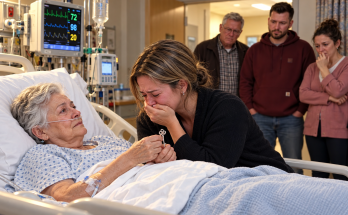
My newborn twins, Noah and Sophie, lay beside me in their tiny hospital blankets. My C-section incision throbbed whenever I moved, and the slightest cough sent pain shooting through my abdomen. An IV ran into my wrist, and the heart monitor beside my bed continued its steady rhythm.
Yet Margaret seemed completely uninterested in any of that.
She was interested in my children.
“I’m not giving either of my babies away,” I replied quietly.
Her smile disappeared.
“Don’t be dramatic. My daughter, Vanessa, deserves to be a mother. You’re unemployed, you live in a modest house, and my son practically supports you. What exactly makes you qualified to raise two children?”
I looked at my mother-in-law for several seconds.
Three years earlier, I had married her son, Daniel, believing I was joining a family that valued loyalty and kindness.
Instead, Margaret had spent every holiday reminding me that I wasn’t wealthy enough for her family. She criticized my inexpensive clothes, mocked my old car, and repeatedly suggested that Daniel could have married someone with a real career.
What she didn’t know was that I had never been unemployed.
I had simply refused to discuss my work at family gatherings.
I was Elena Brooks, a senior judge on the state’s superior court. My decisions had affected multimillion-dollar corporations, criminal prosecutions, and custody disputes involving some of the most powerful people in the region.
My husband knew my profession. My closest colleagues knew my family situation.
But Margaret had never bothered to ask me a single serious question about my life.
She had decided I was insignificant, and no amount of evidence seemed capable of changing her mind.
She opened the folder and pushed it toward me.
“Sign here. Vanessa will take Noah home. You can keep the little girl if you insist on being difficult.”
My stomach tightened.
The papers weren’t merely an informal agreement. They contained a proposed transfer of parental rights, with Vanessa’s name already typed into several sections.
I noticed something else.
The date on the first page was from the previous week.
My babies hadn’t even been born when Margaret began preparing to take one of them.
“How long have you been planning this?” I asked.
She ignored the question.
“You should be grateful I’m offering to help. Two babies will ruin your life. You’ll lose your figure, your freedom, and whatever little attention my son still gives you.”
I pulled both children closer.
“Get out of my room.”
Margaret’s face turned crimson.
“Excuse me?”
“You heard me. These are my children. You have no authority to take them anywhere.”
She leaned over the bed.
“You think having a private room makes you important? Daniel told me you were staying here because you demanded special treatment. You don’t deserve a VIP room, Elena. You should be thanking this family for everything.”
I reached for the nurse-call button.
Margaret slapped my hand away.
Then she grabbed Noah from beside me.
My newborn son immediately began crying.
“Give him back!” I shouted, struggling to lift myself despite the agony in my abdomen.
“Stop behaving like a lunatic!” she snapped. “You’re clearly incapable of handling this situation.”
I reached for the emergency call button mounted beside my bed and pressed it as hard as I could.
A sharp alarm sounded.
Margaret froze for half a second before turning toward the door.
“Good,” she muttered. “Let everyone see how unstable you are.”
She clutched Noah against her chest and began shouting for help before anyone had even entered.
Within moments, two hospital security officers rushed inside, followed by a nurse and a uniformed police officer who had been stationed nearby.
Margaret immediately began crying.
“This woman is dangerous!” she screamed. “She tried to attack me while I was helping her! I’m trying to protect my grandson!”
The officer looked at me, then at Margaret.
“Ma’am, please put the baby down.”
“Absolutely not! She’s mentally unstable!”
The nurse moved toward my bed, alarmed by the blood beginning to seep through the dressing near my incision.
But Margaret continued talking.
“She has no job, no money, and no ability to raise two children. My daughter is prepared to give this boy a wonderful home. I’ve brought the legal documents.”
The officer glanced at the folder.
“Who authorized this adoption?”
“I’m his grandmother. I don’t need permission to do what’s best for him!”
“That isn’t how adoption works,” the nurse interrupted.
Margaret turned on her.
“Stay out of family matters!”
Then she pointed at me.
“Look at her! She’s hysterical! Restrain her before she hurts somebody!”
The officer took a step toward the bed.
I raised my chin, fighting through the pain.
“Officer, before you touch me or separate me from my children, I want you to examine the documents she’s carrying and review the hospital’s security footage.”
Margaret laughed.
“Listen to her! She thinks she can give orders to the police!”
At that exact moment, the door opened again.
A tall police chief entered with two detectives behind him.
His eyes swept across the room, taking in the crying newborn, the security officers, the papers on the tray, and my mother-in-law holding my son.
Then he looked directly at me.
His expression changed instantly.
“Judge Brooks?”
The entire room fell silent.
Margaret’s mouth fell open.
The chief stepped forward, removed his hat, and addressed me with unmistakable respect.
“Your Honor, are you injured? What happened here?”
Margaret looked from him to me.
Then back to him.
“Judge?” she whispered.
I held my daughter close and looked straight at the woman who had spent three years calling me a useless gold digger.
“Yes, Chief,” I said. “I believe we have a serious problem. And I suspect the adoption papers are only the beginning.”
Because as one of the detectives picked up the folder, he discovered a second document hidden beneath the first.
It wasn’t an adoption form.
It was a financial authorization bearing my husband’s signature.
And beside his signature was a date that made my blood run cold.
Daniel had signed it two weeks before my twins were born.
Part 2: The Secret My Husband Had Been Hiding
Chief Michael Harris immediately ordered the room cleared of unnecessary personnel.
The nurse checked my incision while another staff member carefully returned Noah to my arms. For the first time since Margaret had entered, I could breathe without wondering whether someone was about to carry one of my children away.
Margaret, however, had stopped crying.
She stood beside the window, clutching her handbag.
“That document means nothing,” she insisted. “Daniel was simply helping his sister. Families make arrangements like this all the time.”
Chief Harris looked at the detective holding the papers.
“Secure everything. Photograph the documents, preserve the originals, and contact hospital administration. Nobody removes a child from this room without the mother’s consent or lawful authorization.”
Margaret’s face hardened.
“You cannot treat me like a criminal! My son is married to her. We have rights!”
“Being a relative doesn’t give you automatic parental rights,” I replied.
She stared at me as if I had spoken a foreign language.
The detective examined the second document more carefully.
It appeared to authorize the transfer of funds from an account connected to my husband’s business into an account associated with Vanessa.
But the amount was what caught my attention.
Four hundred and eighty thousand dollars.
“Chief,” the detective said, “we should probably speak with the husband.”
I already knew why.
Daniel had told me he was working late on the evening before my scheduled delivery. He had kissed my forehead that morning and promised he would be at the hospital when the twins arrived.
Instead, he had sent a text saying an urgent business problem was keeping him away.
Now I understood that something far more deliberate might have been happening.
Chief Harris asked me whether I wanted Daniel contacted.
“Yes,” I answered. “But I want the call documented, and I don’t want anyone telling him what we’ve found.”
The chief nodded.
One of the detectives stepped into the corridor to make the call.
Margaret suddenly moved toward the door.
“I’m leaving.”
“Please remain here while we establish what happened,” the officer said.
She spun around.
“You have no right to detain me!”
“Then cooperate voluntarily,” the chief replied. “That will make this much easier.”
She looked at me with pure hatred.
“You’ve always wanted to destroy this family. You married my son for his money, and now you’re using your position to humiliate me.”
I almost laughed.
For three years, I had endured her insults because I believed keeping peace within my marriage was worth the effort. I had allowed her to mistake my restraint for weakness.
But this time, she had crossed a line no apology could erase.
“You came into a hospital room while I was recovering from major surgery,” I said. “You tried to take my newborn son, and you brought documents designed to make it look legitimate. Whatever happens next will be determined by the evidence, not by my feelings about you.”
For the first time, Margaret had nothing to say.
Twenty minutes later, Daniel arrived.
He rushed through the doorway wearing an expensive navy suit, his expression carefully arranged into concern.
“Elena! Mom told me you were having some kind of episode. Are the babies okay?”
He stopped when he saw Chief Harris.
Then he noticed the detectives.
His eyes landed on the documents.
For one brief second, his face lost all color.
It was enough.
“Daniel,” I said, “why did you sign a financial authorization involving your sister two weeks before our children were born?”
He swallowed.
“It’s not what you think.”
“Then explain it.”
He glanced at his mother.
Margaret shook her head almost imperceptibly.
That tiny exchange told me more than either of them intended.
The chief asked Daniel to sit down.
Daniel refused.
“I don’t have to answer questions about my private business.”
“That’s your choice,” the detective replied. “But the documents may be relevant to the attempted transfer of a newborn child. We’ll need to establish their origin and purpose.”
Daniel finally sat.
After several minutes of evasive answers, he admitted that Vanessa had been desperate to become a mother and that Margaret had suggested a family arrangement.
“She thought Elena might agree after the birth,” he explained. “We were going to discuss it privately.”
“You signed documents before asking me?” I asked.
“I thought you would understand eventually.”
“And the money?”
He looked away.
“Vanessa needed financial support.”
“Nearly half a million dollars?”
Silence.
Then his phone vibrated.
A detective asked him to place it on the table.
Daniel hesitated before unlocking the screen. When he did, a message appeared from Vanessa.
Did Mom get Noah? Tell me the papers worked. I need the money transferred before Monday, or the lawyer will expose everything.
Nobody spoke.
Daniel reached for the phone, but the detective moved it away.
Margaret suddenly began shouting.
“Vanessa didn’t mean anything bad! She just wanted a family!”
I felt my daughter stir against my chest.
I lowered my eyes to her tiny face, then looked at my son.
They were not bargaining chips. They were not solutions to another woman’s heartbreak. They were two human beings whose lives had barely begun.
“What lawyer?” I asked.
Margaret’s eyes widened.
Daniel stared at the floor.
Finally, the detective read the message again and asked Daniel to explain.
He broke.
Vanessa had been involved in a financial dispute with a former business partner. According to Daniel, she feared losing her home and had asked him for money. Margaret had convinced him that arranging for Vanessa to raise one of the twins would somehow protect the family from scandal.
But there was another problem.
The financial documents suggested that money had already been moved from an account Daniel controlled on behalf of a family business.
And Vanessa’s message implied that someone had threatened to expose what she knew.
The detective took Daniel’s statement and requested the relevant financial records. Nothing had yet established the full extent of any wrongdoing, but the documents raised questions that could no longer be dismissed as a family misunderstanding.
Then the chief’s phone rang.
He listened for a moment before turning toward me.
“Your Honor, we’ve confirmed something important. The attorney named on these documents says he never witnessed your signature, never advised you about adoption, and never authorized anyone to use his office’s letterhead.”
My heart pounded.
Someone had made the papers look official.
Someone had prepared a plan involving my children without my knowledge.
And someone had expected me to be too weak, too exhausted, or too frightened to challenge it.
Chief Harris lowered his voice.
“There’s one more thing. The hospital has reviewed the visitor logs. Your mother-in-law didn’t arrive alone this afternoon.”
I stared at him.
“Who came with her?”
He looked toward Daniel.
“Your husband’s sister, Vanessa.”
Daniel closed his eyes.
And then the chief delivered the words that changed everything.
“She was waiting downstairs with a carrier, a prepared discharge request, and a driver who believed he was taking home a baby whose mother had already signed away her rights.”
Part 3: The Woman They Thought They Could Silence
By early evening, the maternity floor had become the center of an investigation.
Hospital administrators preserved the visitor records and security footage. The detectives collected copies of the documents and began verifying the signatures, financial transactions, and messages connected to the proposed adoption.
Vanessa was interviewed separately.
She initially insisted that she had believed everything was legitimate. But when investigators showed her the message asking whether Margaret had obtained Noah, her story began to change.
She admitted that she had known I had never agreed to the arrangement.
She also admitted that her mother had told her I would eventually surrender one of the twins because I supposedly lacked the resources to care for both.
Neither claim was true.
I had already arranged childcare, medical coverage, and financial plans for my children. My salary was more than sufficient, and my work schedule allowed for parental leave.
But the most damaging evidence came from a series of messages exchanged between Daniel and Margaret.
They had discussed my expected delivery date, the hospital’s visitor rules, and the possibility that I would be too exhausted after surgery to resist their demands.
One message from Margaret read:
She never stands up for herself. Once the papers are in front of her, she’ll sign. She doesn’t have the courage to challenge us.
Daniel’s reply was shorter.
Just make sure Vanessa gets Noah. I’ll deal with Elena afterward.
I read the messages in silence.
For three years, I had mistaken Daniel’s avoidance for peacekeeping. Whenever his mother insulted me, he told me not to take it personally. Whenever she questioned my career, he asked me to be patient.
Now I understood that his silence had not always been neutrality.
Sometimes it had been permission.
Chief Harris sat beside my bed while the detective explained the next steps.
“Your Honor, we’ll continue investigating the attempted removal of the child and the financial records. Any criminal charges will depend on what the evidence establishes.”
“Understood,” I replied.
I was a judge, but I was not about to interfere with the investigation or demand special treatment. I wanted the facts established properly, with every witness interviewed and every document authenticated.
My title could not undo what had happened to my children.
Only accountability could begin to address it.
Daniel approached my bed after the officers finished speaking.
“Elena, please. I made a mistake.”
I looked at him.
“You helped plan this.”
“I never wanted you to get hurt.”
“You knew I had just undergone surgery. You knew your mother was coming here with papers I had never seen. You knew Vanessa was waiting downstairs.”
He lowered his voice.
“I thought if we gave her Noah, everyone would be happy. You would still have Sophie. We could visit him whenever we wanted.”
I stared at him, struggling to comprehend the casual cruelty of his explanation.
“You thought you could divide my children like property and negotiate access afterward?”
He rubbed his face.
“Vanessa has suffered so much.”
“And what about our children? What about their right to remain with their mother?”
He had no answer.
I took a slow breath, ignoring the ache in my abdomen.
“Daniel, I spent years hoping you would become the husband you promised to be. But you didn’t just fail to protect me. You participated in a plan to take our son away from me.”
“I love you.”
“No,” I said quietly. “You love the version of me that never asks you to take responsibility.”
His face crumpled.
I asked the nurse to help me settle the babies, then requested that Daniel leave the room. Any further communication about our children would take place through appropriate legal channels.
Margaret tried one final time to approach the bed.
“Elena, please. Think about the family. We can settle this without ruining anyone’s life.”
I looked at her.
“You had the opportunity to think about family when you entered this room. You chose a different path.”
She began crying.
For years, her tears had made everyone around her retreat. They had been her most reliable weapon: she could humiliate someone in public, then become the victim the moment they objected.
This time, nobody rushed to comfort her.
The chief asked her to step into the corridor while the investigation continued.
As she passed the doorway, she turned back toward me.
“You’ll regret this. You think being a judge makes you untouchable?”
I held my daughter closer.
“No. I think being their mother means I have to protect them.”
She left without another word.
Over the following weeks, the investigation uncovered additional inconsistencies in the financial records and evidence that the proposed adoption documents had been prepared without my authorization. The attorney whose name appeared on the papers cooperated with investigators and provided records showing that he had never approved the supposed agreement.
The authorities continued examining the conduct of everyone involved. Daniel faced serious consequences for his role in the scheme, while Margaret and Vanessa were required to answer questions about the attempted transfer and the documents they had presented.
My marriage ended.
The legal process took time, and there were painful conversations about custody, trust, and the future. I did not pretend that a dramatic moment in a hospital could erase every problem overnight.
But one thing was certain: Noah and Sophie remained with me while the proper authorities and family court addressed the situation.
Months later, I returned to my chambers.
A framed photograph of my twins sat on my desk. Noah was sleeping with one tiny fist raised beside his face, while Sophie appeared to be glaring at the photographer.
Whenever the work became difficult, I looked at that picture and remembered the afternoon I had nearly lost everything I loved.
One morning, a letter arrived from Margaret.
She wrote that she had been ashamed of Vanessa’s struggles and had convinced herself that taking one of my children would solve them. She admitted that she had judged me without understanding who I was, and that discovering my position as a judge had frightened her because she finally understood the power she had underestimated.
I read the letter twice.
Then I placed it in a drawer.
An apology might eventually matter. It could never make what she had done acceptable.
My children would grow up knowing that family was not defined by blood, wealth, social standing, or a shared surname.
Family was defined by love, respect, and the willingness to protect someone even when doing so was inconvenient.
And I would teach them one lesson above all others:
Never mistake a quiet person for a powerless one. Sometimes the person you underestimate is the very person who will refuse to let you get away with what you’ve done.