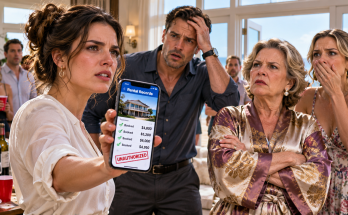
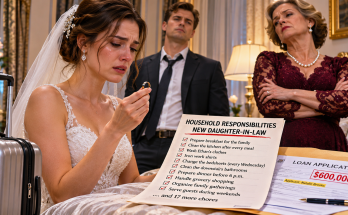
PART 1 — MY HUSBAND LEFT ME STRANDED IN JAPAN WITH $12.14. HE THOUGHT I WOULD BEG HIM TO SAVE ME.
My husband disappeared from our hotel in Kyoto while I was sleeping. He took my passport, my cellphone, and nearly every dollar in our joint bank account.
On my pillow, he left a handwritten note.
“You’re on your own now. Figure out how to get home.”
Beneath it, his mother had written a message of her own.
“Let’s see who actually cares enough to come rescue you.”
I read those words three times.
For seven years, I had been married to Ethan Bennett. I had believed we were building a life together. I had defended him when his mother, Margaret, criticized me. I had tolerated his sister’s constant demands and pretended not to notice how often my husband put his family’s comfort ahead of mine.
But I never imagined they would abandon me in a foreign country.
I jumped out of bed and checked the wardrobe.
Empty.
Ethan’s suitcase was gone. So were Margaret’s belongings and the bags his sister had packed for the trip.
I rushed to the bathroom.
My passport wasn’t there.
Neither was my phone.
Then I opened the hotel safe.
Nothing.
My heart began pounding.
Without my passport, I couldn’t simply board a plane home. Without my phone, I couldn’t access my travel documents or contact most of the people I knew. And without money, even finding a solution would be difficult.
I hurried downstairs to the reception desk.
A young employee named Miss Sato greeted me.
“Good morning, Mrs. Bennett. How can I help you?”
“Could you tell me whether my husband checked out?”
She typed something into her computer.
“Mr. Bennett checked out at 6:10 this morning. The other two members of your party left with him.”
I stared at her.
“Did he leave any message for me?”
“No, ma’am.”
I swallowed hard.
“Can you help me find my return flight?”
She contacted the airline.
After several minutes, she turned toward me with an apologetic expression.
“I’m afraid your ticket was canceled this morning.”
“Canceled? By whom?”
“The booking’s primary account holder submitted the cancellation.”
Ethan had arranged our flights.
I gripped the edge of the counter.
“Were the other passengers’ tickets canceled, too?”
Miss Sato checked again.
“No. The other three passengers still have confirmed reservations.”
He hadn’t canceled the trip. He had canceled only my ticket.
I walked to an ATM, hoping the bank account would at least give me enough money to find help.
I inserted my card and entered my PIN.
The screen displayed my available balance.
$12.14.
The night before, our joint account had contained more than four thousand dollars.
Now almost everything was gone.
I stood motionless beside the machine.
Then I remembered the words on Margaret’s note.
Let’s see who actually cares enough to come rescue you.
They hadn’t simply left me behind.
They had planned to make me helpless.
I wanted to cry. I wanted to call Ethan and demand an explanation. I wanted to believe that some terrible misunderstanding had taken place.
But I knew better.
My name is Claire Bennett, and for nineteen years, I had worked as an international travel insurance claims adjuster. My job involved investigating suspicious claims, reviewing financial records, and helping resolve complicated cases involving travelers in emergencies.
Ethan had always dismissed my career.
“You spend all day arguing about lost suitcases,” he once joked.
Margaret often laughed along with him.
Neither of them understood how much I had learned about fraud, documentation, and financial investigations.
And neither of them knew how carefully I had prepared for emergencies throughout my career.
I returned to the reception desk.
“Miss Sato, could I use a private telephone?”
“Of course. Is everything all right?”
“No,” I answered honestly. “But I know what to do next.”
She led me to a quiet area of the lobby.
I sat down, took a pen, and wrote a verification code I had memorized years earlier.
Then I dialed an international number.
A woman answered.
“Financial Fraud Investigations. Please describe the nature of your emergency.”
I provided my verification details and explained what had happened.
My missing passport.
My canceled flight.
The money withdrawn from our joint account.
The deliberate actions that had left me stranded thousands of miles from home.
The woman listened carefully.
“Mrs. Bennett, which financial matter would you like us to review first?”
I looked down at the note in my hand.
For months, I had suspected something was wrong with a mortgage Ethan had arranged under his own name. I had intended to ask him about it when we returned home.
Now, I wondered whether that mortgage was connected to everything that had happened.
I took a deep breath.
“Start with the mortgage registered to Ethan Bennett,” I said. “I believe there may be suspicious information in the application.”
There was a pause.
Then the woman replied, “Understood. We’ll document your concerns and explain the appropriate next steps.”
I hung up and stared out the hotel window.
Kyoto was beautiful that morning. People walked along the street carrying shopping bags and cups of coffee, completely unaware of the nightmare unfolding in my life.
Ethan thought I would spend the day begging him to return.
Margaret thought I would break down and prove that I couldn’t survive without their family.
They had made one enormous mistake.
They had confused being alone with being powerless.
And while they were enjoying their journey home, I was about to discover why my husband had been so desperate to leave me behind.
Because the suspicious mortgage was only the beginning—and the first document I found would reveal a secret that had been hidden from me for years.
PART 2 — THE MORTGAGE MY HUSBAND NEVER TOLD ME ABOUT
I spent the next several hours working through the emergency procedures available to me.
Miss Sato helped me contact the appropriate authorities about my missing passport. I began arranging the necessary documentation to return home, and I made sure the hotel recorded the circumstances of my husband’s departure.
I also contacted my bank through its official emergency service.
The representative confirmed that several transactions had occurred overnight.
I requested that the transactions be documented and that the bank review whether any of them required further investigation.
I couldn’t assume every withdrawal was illegal simply because Ethan had made it. But the timing, combined with the missing passport and canceled flight, raised serious questions.
Then I remembered the mortgage.
Three weeks before our trip, Ethan had received a letter from a financial institution. He had placed it in a drawer and told me it was routine paperwork.
Later, I noticed the name of a property I didn’t recognize.
When I asked about it, he said he was helping a friend with an investment.
I hadn’t pushed the issue.
Now, I regretted that decision.
I contacted the attorney whose details appeared on the paperwork I had previously seen. After confirming my identity, I explained why I was concerned.
The attorney didn’t immediately disclose private financial information. Instead, she told me what documentation I would need to obtain through the proper channels.
That was enough to give me a direction.
I requested copies of the documents I was entitled to access and asked that any suspected irregularities be preserved for review.
Then I sat quietly in the hotel room.
For the first time since waking up, I allowed myself to think about my marriage.
Had Ethan planned this for weeks?
Had Margaret helped him?
Was the missing money connected to the mortgage?
And why had they taken my passport?
I had no answers yet.
But I remembered something else.
Two months earlier, Ethan had asked me to sign several documents. He claimed they were routine forms related to our household finances.
I had been busy with work and had asked him to explain them later.
He said there was nothing to worry about.
I hadn’t signed anything that day.
But I couldn’t remember whether I had signed another document months before.
The possibility frightened me.
If someone had used my information without permission, I needed to know.
That evening, I received an unexpected message through the hotel’s computer system.
It was from Ethan.
“I hope you’ve learned not to interfere in things you don’t understand. Stay where you are. Someone will contact you.”
I read it twice.
He hadn’t asked whether I was safe.
He hadn’t offered to send money.
He hadn’t explained why he had taken my passport.
He was warning me to stay out of his business.
I saved the message and reported it to the appropriate people handling my situation.
Then I replied with a single sentence.
“Please arrange for my passport to be returned and explain why my ticket was canceled.”
He didn’t answer.
The following morning, I received a call from the attorney.
She had reviewed the initial information I provided and found a discrepancy that needed further examination.
A mortgage application had been submitted for a property in another state.
The application listed Ethan as the primary applicant.
But there was a problem with the supporting financial information.
A document appeared to contain a signature attributed to me.
The attorney could not yet determine whether it was authentic, and she made it clear that further verification would be necessary.
I sat down slowly.
“Are you saying someone may have signed my name?”
“I’m saying the document requires review,” she replied. “We need to establish how it was prepared, who submitted it, and whether the signature is genuine.”
I looked at the window.
For seven years, I had trusted Ethan with my life.
Now I was being told that a financial document connected to him might contain a signature bearing my name that I did not recognize.
I asked the attorney to explain how I could formally challenge the document if it proved to be unauthorized.
She outlined the process.
I took notes.
I didn’t shout or make threats.
I simply followed each step.
That afternoon, the bank confirmed that it had begun reviewing the suspicious transactions I had reported. The airline also provided documentation showing when and how my ticket had been canceled.
Piece by piece, the situation was becoming clearer.
But then my phone number appeared on the hotel’s computer screen.
Someone had managed to contact the reception desk asking whether I was still there.
Miss Sato came to find me.
“Mrs. Bennett, a man called asking for you. He said he was your husband’s business partner.”
My stomach tightened.
“Did he leave his name?”
She handed me a note.
It read:
“Tell Claire to stop asking questions. She doesn’t know what she’s getting herself into.”
I stared at the handwriting.
It wasn’t Ethan’s.
I turned the note over.
There was a second line.
Ask your husband why he needed your signature.
For several seconds, I couldn’t breathe.
Because whoever had written that message knew about the mortgage.
And they knew I had started investigating it.
I called the attorney again.
She advised me to preserve the note, avoid confronting anyone alone, and continue through the appropriate official channels.
I agreed.
Then I opened my notebook and wrote down the question that had been haunting me since the beginning.
Why would my husband go to such extraordinary lengths to strand his own wife?
I had thought the answer was cruelty.
Now I suspected it was fear.
And if Ethan was afraid of what I might discover, the truth could be much more serious than an emptied bank account.
PART 3 — THE TRUTH HE TRIED TO BURY BEFORE I COULD GET HOME
It took several days to arrange the necessary travel documentation and resolve the immediate problems created by my missing passport and canceled ticket.
During that time, I stayed in contact with the authorities and the professionals reviewing the financial records.
I kept copies of every message.
I saved every receipt.
I wrote down the names of everyone I spoke with and the details of each conversation.
I had spent nearly two decades telling other people how important documentation could be during an investigation.
Now, it was the only thing preventing my situation from becoming a collection of conflicting stories.
Ethan contacted me again shortly before I was scheduled to leave Japan.
This time, he sounded angry.
“You’ve gone too far, Claire.”
I kept my voice steady.
“You left me without a passport, canceled my flight, and emptied our joint account. What exactly did you expect me to do?”
“You should have called me.”
“I tried.”
“You should have waited until we could discuss this privately.”
“Privately? You left a note on my pillow telling me to figure out how to get home.”
He was silent.
Then he said, “You don’t understand the financial situation.”
“Then explain it.”
“I can’t do that over the phone.”
“Fine. Explain it through your attorney.”
He hung up.
I sat quietly for a moment.
Then I returned to the paperwork.
The next update came from the attorney reviewing the mortgage documents.
The signature attributed to me had not yet been conclusively established as fraudulent. However, several inconsistencies had prompted additional questions about how the application had been prepared.
The property was not an ordinary investment.
It was connected to a business venture Ethan had been involved in for more than a year.
And the financial records suggested that money from several sources had been used in ways that required further explanation.
I asked the attorney whether any of the records established that I had knowingly agreed to the arrangement.
She explained that the answer would depend on the complete documentation and any additional evidence that could be obtained.
I understood.
I wasn’t interested in inventing a crime or accusing someone without proof.
I wanted the truth.
Then, on the morning I was finally preparing to return home, a new document arrived.
It was an email Ethan had sent to a financial adviser several weeks before our trip.
The attorney had obtained it through the appropriate process.
I read the first paragraph.
Then the second.
And by the time I reached the final lines, my hands were shaking.
Ethan had discussed the possibility that I might discover the mortgage arrangement.
He had asked what would happen if I challenged the supporting documents.
The adviser’s response had warned him that any disputed signature would need to be examined and that he should not submit information he could not verify.
Ethan’s reply was short.
“I’ll deal with Claire before she has a chance to interfere.”
I read the sentence again.
Then I remembered the note on my pillow.
Figure it out yourself.
The missing passport.
The canceled ticket.
The money that had vanished overnight.
For the first time, I had documentary evidence suggesting that Ethan had been thinking about how to prevent me from questioning the arrangement before he left me stranded.
It didn’t answer every question.
It didn’t establish that every transaction was unlawful.
But it changed how I understood his actions.
I returned home through the proper travel process and went directly to the attorney’s office.
Ethan was not there.
Margaret was.
She sat in the waiting room with her arms crossed, wearing the same expression she had worn at our wedding when she told me that I would never be good enough for her son.
“You’ve made a terrible mistake,” she said.
I sat across from her.
“Which mistake?”
“Dragging private family matters into an investigation.”
“Did you know he was going to leave me in Japan?”
She looked away.
That was answer enough to make me suspicious, but not enough to prove what she had known.
“Did you help him cancel my ticket?”
“I was trying to protect my son.”
“From what?”
She pressed her lips together.
I placed a copy of the message she had left on my pillow in front of her.
“From a woman who might ask questions?”
Her eyes filled with anger.
“You have no idea what Ethan has been dealing with.”
“Then tell me.”
She said nothing.
I stood up.
“I’ve spent years trying to earn your respect. I’ve defended Ethan when you treated me like an outsider. I’ve accepted explanations that never made sense because I wanted to believe my marriage was worth saving.”
My voice trembled, but I continued.
“You and Ethan left me alone in another country without the documents I needed to get home. You made me afraid for my safety, and you expected me to beg for help.”
Margaret lowered her eyes.
“I thought you would call him.”
“I did.”
“And?”
“He told me to stop asking questions.”
For the first time, she looked uncertain.
I gathered my documents.
“The professionals reviewing this matter will determine what happened. I won’t make threats, and I won’t hide evidence to protect anyone. But I will not pretend this never happened.”
As I turned toward the door, Margaret spoke.
“Claire, wait.”
I stopped.
She hesitated before asking, “What did you find?”
I looked at her.
“The beginning of the truth.”
Then I left.
The following weeks were difficult.
The financial review continued. The bank investigated the disputed transactions. The attorney worked through the mortgage documentation, and the relevant parties were asked to provide explanations and records.
Some questions were answered.
Others remained unresolved.
I didn’t know how the process would end, and I refused to promise myself a particular outcome.
But I knew something had changed permanently.
I no longer needed Ethan to admit that I deserved respect.
I no longer needed Margaret to approve of my life.
And I no longer confused keeping a marriage together with keeping myself silent.
Eventually, Ethan asked to meet me.
I agreed to speak with him in a public place, with the boundaries I needed to feel safe.
He arrived looking exhausted.
For a long time, neither of us spoke.
Then he said, “I never thought you would go this far.”
I looked at him.
“You left me stranded in Japan with twelve dollars and fourteen cents. What did you think I would do?”
He lowered his eyes.
“I thought you would call me and ask me to come back.”
“And would you have?”
He didn’t answer.
That silence told me more than any apology could have.
I had spent seven years believing that love meant trusting someone even when their behavior made no sense.
Now I understood that trust was not a debt I owed someone simply because I had married him.
It had to be earned.
And once someone deliberately endangered your safety to keep you quiet, words alone could not rebuild it.
I stood up.
“The truth will be handled through the proper process, Ethan. As for our marriage, I need time to decide what comes next.”
He reached for my hand.
I stepped back.
Not because I wanted revenge.
Not because I wanted to destroy him.
But because, for the first time in seven years, I was choosing my own safety over his comfort.
When I walked outside, the air felt different.
I thought about that hotel room in Kyoto.
The empty safe.
The missing passport.
The note on my pillow.
I remembered how frightened I had been when I first saw my bank balance.
And I remembered the moment I picked up the telephone and decided to ask questions instead of begging for help.
Ethan and Margaret had believed they could leave me helpless in a foreign country and control what happened next.
They had forgotten that I was capable of making decisions without their permission.
They left me in Japan believing I would spend my life asking them to rescue me. Instead, I came home determined to uncover the truth—and to build a life in which nobody could use my love as a weapon against me again.
If your spouse deliberately stranded you in another country to stop you from asking questions, would you ever consider rebuilding that marriage, or would the betrayal be too much to forgive?