PART 1 — My Mother Said My Daughter Wasn’t Really Family
“Those dishes won’t wash themselves, Renata. Stop staring at the presents and get back to work.”
My mother’s voice sliced through the Christmas music.
I stood at the entrance to the kitchen, holding a small gift wrapped in silver paper.
For a moment, I couldn’t understand what I was seeing.
My six-year-old daughter was standing on a wooden stool.
Her little blue Christmas dress was splashed with soapy water.
Her tiny hands trembled as she scrubbed plates almost as large as her chest.
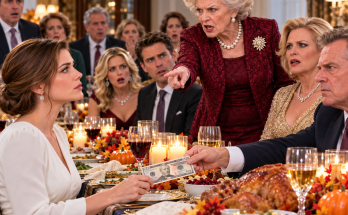
Beyond the kitchen doorway, my nieces Sofia and Emma were opening presents beneath a magnificent Christmas tree.
They were laughing.
They were wearing matching velvet dresses.
And they hadn’t lifted a finger all morning.
Meanwhile, my daughter was washing the dishes left behind by twenty-three guests.
“Renata?”
She turned toward me.
The moment she recognized my face, her eyes filled with tears.
“Daddy!”
She reached for me, but my mother grabbed another plate and placed it in front of her.
“Finish this first.”
I felt something inside me go frighteningly still.
My name is Mauricio DeLuca.
I was forty-one years old, and I had spent most of my adult life building a business empire that my family proudly claimed as its own achievement.
People negotiated carefully around me.
Business rivals thought twice before challenging me.
But nothing in my life had prepared me for the sight of my own mother treating my little girl like a servant.
I crossed the kitchen in three strides.
“Get down, sweetheart.”
Renata climbed off the stool.
She immediately wrapped her arms around my waist.
I felt her wet fingers clutch the back of my shirt.
“I’m sorry, Daddy,” she whispered.
Those three words hurt more than anything my mother could have said.
“Sorry for what?”
“I broke one of Grandma’s cups.”
I looked at the sink.
A chipped porcelain cup sat beside the faucet.
It wasn’t even broken in half.
My mother folded her arms.
“She was careless. I told her to be more careful, but she doesn’t listen.”
“She is six years old.”
“And six-year-olds can learn respect.”
I stared at my mother.
“Respect?”
“Yes, Mauricio. Respect. You can’t keep treating her like a princess simply because you adopted her.”
The words landed between us like a slap.
From the living room, my sister Paola called out.
“Mom, where’s Emma’s gold bracelet?”
My mother immediately turned toward the doorway.
“On the table, darling! I’ll bring it.”
Then she looked back at Renata.
“Don’t touch anything else while I’m gone.”
I stepped between them.
“You won’t speak to her like that again.”
My mother blinked.
She had never expected me to challenge her in her own house.
For years, I had tolerated her sharp remarks.
I had ignored the comments about Renata’s birth parents.
I had convinced myself that Grandma Carmen simply needed time to accept the child I had adopted when she was two.
I was wrong.
My father appeared in the kitchen, holding a glass of expensive wine.
“What is all this shouting about?”
I pointed toward the sink.
“Ask your wife why my daughter is washing dishes while the other grandchildren open presents.”
My father barely glanced at Renata.
“Because the other girls understand how things work in this family.”
I stared at him.
“What does that mean?”
He sighed as though I were embarrassing him.
“Paola’s daughters are our blood. Renata is not.”
The kitchen seemed to grow smaller.
Renata pressed her face against my stomach.
My father continued.
“You can’t expect us to treat everyone exactly the same. Family has obligations, and blood means something.”
I felt my jaw tighten.
“Then let me explain something to you.”
My voice was quiet.
“Renata is my daughter. She has my name, my protection, and my love. There is no distinction in my house.”
My father laughed bitterly.
“Your house, perhaps. But this is still your mother’s home.”
I took off my expensive coat and wrapped it around Renata’s shoulders.
“Then perhaps we should leave.”
My mother returned from the living room.
She heard the last sentence.
“Don’t be ridiculous. It’s Christmas.”
“You made my child wash dishes while her cousins opened presents.”
“She needed something to do.”
“She needed a grandmother.”
For the first time, my mother’s expression changed.
Something cold passed through her eyes.
“Be careful, Mauricio. You have no idea what you’ve brought into this family.”
I stared at her.
“What exactly is that supposed to mean?”
She looked away.
My father suddenly became interested in his wine.
Neither answered.
I lifted Renata into my arms.
Her cheek rested against my shoulder.
“Daddy, can we go home now?”
“Yes, sweetheart.”
“But what about my present?”
I looked toward the living room.
Her small wrapped gift sat underneath a chair, forgotten among the expensive boxes.
I picked it up.
“We’ll open it at home.”
As I carried her toward the front door, my sister Paola appeared in the hallway.
She wore a sparkling gold dress and held a champagne glass.
“Seriously, Mauricio? You’re leaving because Mom asked your daughter to help?”
I stopped.
“Help?”
Paola rolled her eyes.
“Don’t make everything about discrimination. Sofia and Emma are her cousins. They have different responsibilities.”
“What responsibility does a six-year-old have to wash twenty-three people’s dishes?”
Paola shrugged.
“Maybe learning gratitude.”
I looked at her daughters.
They were sitting beneath the tree, surrounded by toys that cost more than most families spent on an entire Christmas.
Then I looked at Renata.
She was shivering beneath my coat.
“Enjoy your Christmas, Paola.”
I walked out.
The cold December air struck my face.
My driver hurried toward us, but I waved him away.
I needed a moment to breathe.
Renata lifted her head.
“Daddy?”
“Yes?”
“Does Grandma not like me because I don’t have the same mommy in heaven?”
My heart broke.
Renata’s biological mother had died shortly after giving birth.
Her father had never been identified in the original records.
I had met Renata through a children’s charity I supported.
She had been a frightened little girl with enormous brown eyes who barely spoke.
I had visited her every week.
Eventually, I stopped pretending that I was simply helping her.
I wanted to bring her home.
I adopted her legally.
I changed my entire life around her.
And I had believed love would be enough to make my family understand.
I brushed a damp strand of hair away from her face.
“Listen to me, sweetheart. Families aren’t made by having the same blood. They’re made by loving each other.”
She studied my face.
“Then you’re my real daddy?”
I swallowed hard.
“I’m your daddy forever.”
She finally smiled.
It was small, uncertain, and heartbreakingly beautiful.
Then she whispered something that made me stop breathing.
“Grandma said I should be grateful you took me because nobody else wanted me.”
For several seconds, I couldn’t speak.
I held her tighter.
“No one gets to tell you that again.”
I carried her to the car.
We drove home through streets glowing with Christmas lights.
Renata fell asleep against my shoulder before we reached our neighborhood.
I watched her sleeping face and made a promise.
No one in my family would ever make her feel unwanted again.
I didn’t know that the real danger had already begun.
Because when we arrived home, my housekeeper, Elena, was waiting near the entrance.
She held a cream-colored envelope.
“Mr. DeLuca, this arrived earlier today.”
I recognized the law firm’s name immediately.
Bennett, Shaw and Whitmore.
They had handled several complicated matters for my late grandfather, Vittorio DeLuca.
I opened the envelope.
Inside was a formal letter requesting an urgent private meeting concerning my daughter’s adoption records and a sealed family trust.
My grandfather had died seven months earlier.
His estate had been divided among several family members.
At least, that was what I had been told.
I read the letter twice.
One sentence had been underlined.
Certain documents concerning Renata DeLuca may materially affect the distribution of the Vittorio DeLuca Family Trust.
I looked toward the staircase.
Renata was asleep in her bedroom.
Why would my daughter’s adoption records affect my grandfather’s estate?
I called the law firm.
A receptionist answered.
When I gave my name, she immediately transferred me to a senior attorney.
“Mr. DeLuca,” the man said, “I’m glad you’ve called. We’ve been trying to reach you privately.”
“What is this letter about?”
There was a pause.
“Before I explain anything, I need to ask whether you’ve opened the sealed envelope included with our correspondence.”
I looked down.
There was a second envelope beneath the letter.
It was thicker.
It bore my grandfather’s signature across the seal.
“No,” I replied. “I just received it.”
The attorney exhaled.
“Then please do not allow anyone else to open it. Your grandfather left specific instructions.”
I frowned.
“Instructions about what?”
“About a document he believed your mother might try to destroy.”
The room seemed to freeze.
“My mother?”
“I cannot discuss the full contents over the telephone. Please come to our office tomorrow morning.”
I ended the call and stared at the envelope.
Then I heard footsteps behind me.
My wife, Isabella, had entered the room.
She looked at the letter.
“What happened?”
I handed it to her.
She read the first paragraph, then looked up at me.
“Why would Renata’s adoption records have anything to do with your grandfather’s trust?”
“That’s exactly what I’m trying to find out.”
I turned toward my study.
The envelope was still in my hand.
I intended to lock it away until morning.
But as I reached for the study door, my phone rang.
It was my mother.
I answered without greeting her.
“Why did you send me that letter?” she demanded.
I stiffened.
“I didn’t send you anything.”
“The law firm’s letter. What have you been telling them?”
I looked at Isabella.
She had heard every word.
“How do you know about it?”
Silence.
Then my mother spoke in a trembling voice.
“Mauricio, listen to me carefully. Whatever that lawyer tells you, you must not believe him.”
“Why?”
“Because your grandfather was confused before he died.”
“Confused about Renata?”
My mother began breathing rapidly.
“Don’t open the envelope.”
I looked down at the sealed document.
“Why not?”
Her voice broke.
“Because if you read what’s inside, you’ll destroy this family.”
I heard a sharp sound in the background.
Then my father spoke.
“Carmen, give me the phone.”
The call ended.
I stood motionless.
My mother had never been afraid of me.
Not when I confronted her.
Not when I threatened to leave.
Not even when I cut off the financial support my parents depended on.
But now, she sounded terrified.
And she knew exactly what was inside that envelope.
I returned to the kitchen to get a glass of water.
Something white lay on the counter.
A folded piece of paper.
I recognized Renata’s handwriting.
She had drawn it earlier that week.
It showed our family standing beneath a Christmas tree.
I was holding her hand.
Isabella stood beside me.
But Grandma Carmen and Grandpa were drawn on the opposite side of the page.
Between us stood a little black box.
Above it, Renata had written a sentence in crooked letters.
Grandma says Daddy must never find the secret box.
I stared at the drawing.
Then I remembered something my grandfather had told me during his final weeks.
He had asked me to promise that I would always protect the child who needed me most.
At the time, I had assumed he meant Renata.
Now I wondered whether he had known something I didn’t.
I called the law firm again.
This time, the attorney answered immediately.
“Mr. DeLuca?”
“I need to know one thing.”
“Go ahead.”
“Did my grandfather leave something specifically for Renata?”
A long silence followed.
Then the attorney said six words.
“Yes. And it changes everything.”
Before I could ask another question, he added:
“Mr. DeLuca, you need to come tomorrow. Bring the original adoption certificate. And please, for your daughter’s safety, do not tell your mother about our meeting.”
I ended the call.
For the first time in my life, I was afraid of what my own family might be hiding.
And I had a terrible feeling that Renata was the only person who knew where the truth began.
PART 2 — My Grandfather Left a Secret That Could Destroy My Family
I barely slept that night.
Every time I closed my eyes, I saw Renata standing on that stool.
Her wet hands.
Her frightened face.
My mother’s expression when she realized I had received the letter.
And those words on the drawing.
Daddy must never find the secret box.
At six the next morning, I went to Renata’s bedroom.
She was awake, sitting beneath her blanket and holding a stuffed rabbit.
“Good morning, princess.”
She looked at me cautiously.
“Are we going to Grandma’s house again?”
“No, sweetheart.”
“Not even for breakfast?”
“Not even for breakfast.”
She considered that.
Then she smiled.
“Can we make pancakes?”
I laughed despite myself.
“Yes. As many as you want.”
She climbed into my arms.
I carried her downstairs and made pancakes while Isabella prepared coffee.
For a little while, the world felt normal.
Then Renata asked a question that changed the morning.
“Daddy, do you remember Grandpa Vittorio?”
“Of course.”
“He came to my school once.”
I stopped pouring the pancake batter.
“When?”
“Before Christmas last year. He brought me a little wooden horse.”
I remembered the toy.
My grandfather had given it to her during a charity event.
“What about him, sweetheart?”
Renata looked toward Isabella.
“Grandpa said I had the same eyes as someone in his old pictures.”
I crouched beside her chair.
“Did he say whose eyes?”
She nodded.
“He said, ‘You look just like your mother.’”
I felt a chill.
My grandfather had met Renata only a handful of times.
And her biological mother had died before Renata was old enough to remember her.
“What else did he say?”
Renata frowned, trying to remember.
“He asked me if Grandma ever talked about a little girl named Lucia.”
Isabella slowly lowered her coffee cup.
I stared at my daughter.
“Lucia?”
Renata nodded.
“Grandpa said Lucia was important. Then he told me that if Grandma ever became angry with me, I should remember that I was loved before I was even born.”
I felt the blood drain from my face.
“Did you tell Grandma about that conversation?”
“No.”
“Why not?”
Renata looked down.
“Because Grandma told me Grandpa sometimes forgot things.”
She paused.
“Then she said I shouldn’t ask about people who weren’t in our family.”
I stood up.
I needed to speak with the attorney immediately.
At eight-thirty, I left Isabella with Renata and drove to Bennett, Shaw and Whitmore.
The office occupied the top three floors of a historic building downtown.
A senior attorney named Daniel Shaw greeted me at the entrance to his conference room.
He was in his late sixties, with silver hair and a careful, measured voice.
He closed the door behind me.
“Thank you for coming, Mr. DeLuca.”
I placed the envelope on the table.
“Tell me what my grandfather left for my daughter.”
Daniel sat opposite me.
“Before we begin, I need to establish several facts.”
He opened a leather folder.
“Your grandfather established the DeLuca Family Trust more than twenty years ago. The original beneficiaries were your father, your aunt, and your sister.”
“I know that.”
“Seven months ago, after your grandfather died, a supplementary document was discovered in a private storage vault.”
“What document?”
“A sealed amendment.”
Daniel removed a copy from the folder.
“It was signed and witnessed six weeks before your grandfather’s death.”
I scanned the page.
My grandfather’s signature was unmistakable.
“What does it say?”
Daniel folded his hands.
“It directs a portion of the family trust into a protected fund for a child identified as Renata DeLuca.”
I looked up.
“How much?”
He gave me the figure.
I stared at him.
The amount was substantial enough to make Renata financially secure for the rest of her life.
But the money wasn’t what frightened me.
It was the next paragraph.
The fund could not be distributed until Renata’s biological identity had been independently verified.
“Why would my grandfather establish a trust for a child whose biological family he barely knew?”
Daniel’s expression became serious.
“Because, according to his private letter, he believed she was connected to a woman named Lucia Moretti.”
I leaned forward.
“Who was Lucia?”
Daniel removed another document.
“Your grandfather’s younger sister.”
I felt as if the floor had shifted beneath me.
“My grandfather had a sister?”
“Yes. She died more than thirty years ago.”
I searched my memory.
I had never heard the name.
Not once.
Daniel continued.
“Lucia was estranged from the family. She left home when she was twenty-two and spent several years living abroad.”
“What happened to her?”
“Officially, she died in a traffic accident.”
“And unofficially?”
Daniel looked directly at me.
“Your grandfather believed the circumstances surrounding her death had been deliberately misrepresented.”
I stared at the papers.
“What does that have to do with Renata?”
Daniel slid a photograph across the table.
It showed a young woman standing beside a stone fountain.
She had dark hair, expressive brown eyes, and a delicate smile.
I looked at the photograph for several seconds.
Then my stomach tightened.
The resemblance to Renata was extraordinary.
The same eyes.
The same shape of the face.
Even the small dimple near the left cheek.
“Who gave you this?”
“Your grandfather’s private archive.”
Daniel opened the folder again.
“His instructions were explicit. If a child matching this description was legally adopted by a member of the DeLuca family, the firm was to investigate whether the child was descended from Lucia Moretti.”
I struggled to understand.
“Are you saying Renata might be related to my grandfather?”
“Potentially. But we need evidence.”
I stood up and paced beside the window.
My family had never mentioned Lucia.
My father had never spoken of her.
My mother had never said the name.
Yet my grandfather had secretly arranged a trust for Renata.
“Why did he keep this hidden?”
Daniel handed me a handwritten letter.
“Perhaps this will explain it.”
The letter was dated three weeks before my grandfather died.
I recognized his handwriting immediately.
Daniel,
If you are reading this, I am no longer able to protect the truth myself.
Lucia did not abandon this family because she was selfish, as Carmen has always claimed.
She left because she discovered something about our family’s inheritance that frightened her.
She entrusted evidence to someone she believed would protect her child.
I failed her once.
I will not fail her daughter.
I read the letter twice.
Then I looked up.
“Carmen?”
Daniel nodded.
“Your mother married into the DeLuca family decades ago. She was present during several of the events described in the archive.”
“My mother was involved?”
“I cannot establish that from this letter alone.”
I continued reading.
The final paragraph was written in darker ink.
If Mauricio has adopted the child, tell him everything. He is the only person in this family I believe will put the child’s welfare above money.
I sat down slowly.
My grandfather had trusted me.
And he had expected my own mother to interfere.
“What’s in the sealed envelope?”
Daniel reached for it.
“This contains the first part of the evidence.”
He broke the seal carefully.
Inside were three documents and a small photograph.
The first document was a copy of a birth registration.
The second was a letter written by Lucia.
The third was a medical record that had been preserved among my grandfather’s papers.
Daniel placed the photograph in front of me.
It showed Lucia holding a newborn baby.
On the back, someone had written a name.
Renata.
My hands began to tremble.
“Is that my daughter?”
“We cannot confirm that yet.”
Daniel pointed to the birth registration.
“The original records indicate that Lucia gave birth to a daughter shortly before she died. The child was initially registered under a different surname.”
“Why was the name changed?”
“We’re investigating.”
“Who raised the child?”
“The records are incomplete. There are references to a private children’s home and an emergency guardianship arrangement.”
I stared at the photograph.
A newborn baby.
A woman who died under suspicious circumstances.
A family secret that had remained buried for decades.
And my six-year-old daughter standing at the center of it.
Daniel slid the second document toward me.
“There’s something else.”
It was a letter from Lucia.
The handwriting was hurried.
To whoever finds this,
If my daughter is ever returned to the Moretti family records, please remember that she belongs to no one who claims ownership of her.
She belongs to herself.
Protect her from anyone who uses inheritance as a weapon.
I swallowed hard.
Those words sounded like a warning written specifically for Renata.
I looked at Daniel.
“Why did my mother tell me not to open this envelope?”
He didn’t answer immediately.
Instead, he placed a final document on the table.
It was an inventory of the items discovered in my grandfather’s private vault.
One entry had been circled in red.
Original guardianship ledger — location unknown.
“What is that?” I asked.
“A record of the people who handled Lucia’s child after her death.”
“And where is it now?”
Daniel shook his head.
“Your grandfather believed your mother had taken it.”
I felt a wave of anger.
“Why would she do that?”
“Because the ledger may establish who authorized the child’s transfer and whether that transfer was lawful.”
I looked at the photograph again.
“If Renata is Lucia’s daughter, why was she placed for adoption?”
“That is one of the questions we need to answer.”
I thought of Renata’s biological mother.
The official records said she had died shortly after giving birth.
But what if the records were incomplete?
What if the woman I had been told about wasn’t the whole story?
I took a breath.
“What do you need from me?”
“Your daughter’s original adoption certificate, permission for a properly conducted DNA test if legally appropriate, and any documents you possess concerning her biological history.”
I nodded.
“Whatever you need.”
Daniel paused.
“One more thing, Mr. DeLuca.”
“What?”
“Your father contacted our office yesterday.”
My stomach tightened.
“What did he want?”
“He demanded that we withdraw the amendment and destroy the correspondence.”
I gripped the edge of the table.
“Did you?”
“Absolutely not.”
Daniel’s voice hardened.
“Your grandfather’s instructions were legally documented. No member of the family can simply erase them because they dislike the consequences.”
I thanked him and left with copies of the documents.
On the drive home, I called my father.
He answered on the fourth ring.
“What do you want?”
“I want to know why you’re trying to interfere with Renata’s trust.”
Silence.
Then he sighed.
“Your grandfather made mistakes.”
“Was Lucia one of them?”
The silence that followed was different.
It was the silence of a man hearing a name he had spent years trying to forget.
“Where did you hear that name?”
“From the documents Grandpa left.”
My father lowered his voice.
“You need to stop this investigation.”
“Why?”
“Because you’re digging into things you don’t understand.”
“Then explain them to me.”
He said nothing.
“Did my mother take the guardianship ledger?”
“I don’t know what you’re talking about.”
“Did you know Lucia had a daughter?”
My father abruptly ended the call.
I drove home faster than I should have.
When I arrived, Isabella was standing in the living room.
She held Renata’s small backpack.
“Something happened,” she said.
I looked toward the stairs.
“Where’s Renata?”
“Asleep upstairs. She had a nightmare.”
I set the documents on the table.
“What happened?”
Isabella opened the backpack.
Inside was a folded sheet of paper, a small wooden horse, and an old photograph.
I recognized the photograph immediately.
It was the same picture of Lucia holding the baby.
I stared at Isabella.
“Where did you get this?”
“Renata said Grandma gave it to her.”
My blood ran cold.
“When?”
“Today, before you came home. Carmen arrived unexpectedly and asked to speak with her.”
I felt a surge of fury.
“You let my mother see Renata?”
“I didn’t know what was happening. She said she wanted to apologize.”
I picked up the photograph.
“Where is she now?”
“Gone.”
I looked at the paper.
It contained a handwritten message.
Your father is not telling you everything. Ask him what happened on the night Lucia died.
Beneath the message was my mother’s signature.
I read it twice.
My mother had written the note herself.
But why would she tell me to question my father?
Was she trying to protect Renata?
Or was she trying to make me distrust him before he could reveal the truth?
I heard a small sound on the staircase.
Renata stood there holding her stuffed rabbit.
“Daddy?”
I immediately put the papers down.
“Come here, sweetheart.”
She walked toward me.
“Grandma said you might be angry.”
I knelt in front of her.
“Did she say anything else?”
Renata nodded.
“She said I have something that belongs to me.”
She reached into her pocket.
And pulled out a tiny brass key.
I stared at it.
It was old and worn, with a small number stamped into the metal.
317.
“Where did you get that?”
“Grandma gave it to me.”
“What did she say it opens?”
Renata looked toward the window.
“She said Grandpa kept my real name inside a little box.”
My hands went cold.
I called Daniel immediately.
When I told him about the key, he went silent.
Then he asked me to read the number again.
“Three-one-seven,” I said.
I heard him shuffle papers.
“Mr. DeLuca, I believe that key belongs to a private storage facility listed in your grandfather’s archive.”
“What is stored there?”
“I don’t know. But there’s a note in his instructions concerning locker 317.”
“What note?”
Daniel hesitated.
Then he said:
“Your grandfather wrote that the person who opened that locker would discover why Lucia’s daughter disappeared from the official records.”
I looked at Renata.
She was standing beside me, holding the key in her tiny hand.
“Daddy,” she whispered, “am I in trouble?”
I pulled her into my arms.
“No, sweetheart. You’re not in trouble.”
But I knew someone else was.
Someone who had spent decades hiding the truth.
And tomorrow, I intended to find out who.
PART 3 — The Secret Box Revealed Who Renata Really Was
The storage facility stood on the outskirts of the city, behind a row of warehouses and a tall iron fence.
Daniel met me there the next morning.
He had brought the documents from his office and a representative authorized to verify the contents of the locker.
I had wanted to bring Renata.
Isabella convinced me otherwise.
“She deserves to be a child today,” she said. “Let the adults handle the truth.”
She was right.
So I left Renata at home with her favorite cartoons, a plate of pancakes, and a promise that I would return before lunch.
Locker 317 was located at the end of a narrow corridor.
The brass key turned smoothly.
Inside stood a small metal cabinet.
Daniel opened it.
There were three boxes.
One was marked with my grandfather’s initials.
Another carried Lucia’s name.
The third had no label at all.
I opened the first box.
It contained old family photographs, letters, and a leather-bound ledger.
Daniel examined the ledger carefully.
“This may be the document we’ve been looking for.”
He opened it to the first page.
The entries recorded a series of guardianship transfers dating back more than thirty years.
Names had been crossed out.
Dates had been amended.
Several signatures appeared beside handwritten corrections.
One signature belonged to my father.
Another belonged to my mother.
I felt my stomach tighten.
Daniel compared the entries with the copies from his office.
“This is significant,” he said.
“Tell me what you’re seeing.”
He pointed to a line dated shortly after Lucia’s death.
A baby girl had been placed under temporary guardianship.
The child’s original name was listed as Renata Moretti.
Three weeks later, the guardianship was transferred to a private intermediary.
The final entry contained a surname that had been scratched out.
“Why would they change her name?” I asked.
Daniel continued turning pages.
“There’s a second transfer here. The child was moved to another care facility. After that, the trail becomes incomplete.”
I looked at the ledger.
“Can we establish that this child is my daughter?”
“Not from the ledger alone. But we can investigate the records and arrange appropriate testing.”
I opened Lucia’s box.
Inside was a bundle of letters tied with faded ribbon.
The first was addressed to my grandfather.
The second was addressed to a woman named Elena Moretti.
The third was addressed to a child.
I opened the letter addressed to Elena.
Please forgive me for leaving so suddenly.
I know you believe I have abandoned the family, but I cannot remain in a house where every decision is made according to money and reputation.
If anything happens to me, please protect my daughter.
Her name is Renata.
She deserves a life that belongs to her, not one controlled by the people who believe our name gives them ownership.
I stared at the page.
Lucia had written those words years before Renata was born.
But the letter suggested she had already feared what would happen to her future child.
Daniel opened the final box.
Inside was a sealed packet of medical records, a birth certificate, and a small cassette recorder.
He examined the documents.
“The birth certificate lists Lucia Moretti as the mother. The father’s name is blank.”
I felt an unexpected wave of sadness.
Renata had spent her entire life without knowing the people who came before her.
And now we were discovering that someone had deliberately obscured her history.
Daniel inserted the cassette into a portable player.
A man’s voice filled the room.
It was my grandfather.
Older.
Weaker.
But unmistakably his.
“If this recording is being played, then I have failed to correct the mistake while I was alive.”
He paused to cough.
“Lucia’s daughter was taken from the family records after Lucia’s death. I was told the child had been placed with distant relatives. I believed that explanation for years.”
I gripped the edge of the table.
“Then, in the final months of my life, I discovered that the records had been altered.”
My grandfather continued.
“I confronted Carmen. She denied knowing anything about the transfers. My son, however, admitted that he had signed documents he did not understand.”
Daniel looked at me.
The recording continued.
“I cannot prove who ordered the original changes. I can only say that my family allowed fear and money to become more important than a child’s future.”
My grandfather’s voice trembled.
“If Renata is Lucia’s daughter, the trust must protect her. Not because she carries our name. Not because she may inherit our fortune. But because she deserves the truth.”
The recording ended.
For a long moment, neither Daniel nor I spoke.
Then I asked the question I had been avoiding.
“Why did my mother treat Renata so cruelly?”
Daniel closed the box.
“We don’t know yet.”
I looked at the ledger again.
There were too many unanswered questions.
Who had altered the records?
Why had Renata’s identity been obscured?
Why had my mother kept the ledger?
And why had she suddenly given Renata the key?
I gathered the documents.
“We’re going to find out.”
That afternoon, Daniel arranged a meeting with my father.
I insisted that my mother attend too.
They arrived at my house shortly before four.
Carmen wore a dark coat and carried a handbag tightly against her side.
My father looked exhausted.
Neither greeted Isabella.
Neither asked where Renata was.
I placed copies of the ledger, the letters, and the recording transcript on the table.
My father stared at the papers.
My mother turned pale.
“Where did you get those?”
“Locker 317.”
Her hand tightened around her handbag.
I watched her carefully.
“You knew what was there.”
She looked at my father.
He shook his head almost imperceptibly.
I noticed.
So did Daniel.
“Mr. DeLuca,” the attorney said, “we need a complete account of the guardianship transfers. If the records were unlawfully altered, the appropriate authorities may need to investigate.”
My mother suddenly stood.
“This is absurd.”
“No,” I replied. “What’s absurd is that my six-year-old daughter has been treated like an outsider while you kept secrets about her identity.”
Carmen’s face hardened.
“You have no idea what you’re accusing me of.”
“Then explain the ledger.”
She said nothing.
I turned to my father.
“Did you sign those documents?”
He stared at the table.
“Yes.”
The word was barely audible.
“Why?”
He rubbed his forehead.
“Your grandfather told me it was necessary to protect the family.”
“Protect the family from what?”
My father looked at my mother.
She shook her head.
But he continued.
“Lucia had discovered that certain estate documents had been changed without her consent. She intended to challenge them. Your grandfather was furious, and everyone feared a public scandal.”
Daniel leaned forward.
“Which documents?”
My father swallowed.
“Documents concerning the original family trust.”
I stared at him.
“Was Renata’s identity changed because of that dispute?”
“I don’t know.”
“Then why did you sign the transfer?”
“Because I was told the child would be placed somewhere safe.”
My mother finally spoke.
“You were never supposed to know any of this.”
I turned toward her.
“Why?”
She looked at me for several seconds.
Then she sat down slowly.
“Because Lucia was not the only person who stood to lose everything.”
The room went silent.
Carmen opened her handbag.
She removed an old envelope and placed it on the table.
Inside was a copy of a trust agreement.
Daniel examined it.
His expression changed.
“What is this?”
My mother looked at him.
“The original trust was never supposed to be divided the way your grandfather later arranged it.”
Daniel studied the document.
“This appears to be an earlier draft.”
“It wasn’t a draft,” Carmen replied. “It was signed.”
My father stared at her.
“You told me that document had been destroyed.”
“I lied.”
I felt a chill.
My mother continued.
“Lucia was entitled to a share of the estate. When she died, that share should have passed to her child. But the records were altered, and the child disappeared from the family documents.”
Daniel carefully placed the agreement beside the ledger.
“If this is authentic, it could have serious legal consequences.”
My mother nodded.
“I know.”
I stared at her.
“Then why did you let me believe Renata was simply an orphan with no connection to our family?”
Carmen’s eyes filled with tears.
“Because I was afraid.”
“Afraid of what?”
She looked toward the staircase.
“Afraid that once you knew who she was, you would take her away from me.”
I couldn’t believe what I was hearing.
“You treated her like she didn’t belong.”
“I know.”
“You made her wash dishes while her cousins opened presents.”
My mother began crying.
“I know.”
“You told her nobody else wanted her.”
She covered her face.
“I know.”
Her tears did not erase anything.
They did not undo the humiliation Renata had suffered.
And they certainly did not explain why my mother had allowed it to continue.
I waited until she looked at me.
“Tell me the truth.”
Carmen took a trembling breath.
“Lucia was your grandfather’s sister. She had a daughter. After Lucia died, your grandfather tried to find the child, but the records had already been changed.”
“By whom?”
“I don’t know who made the first changes. Your father signed the transfer papers because he believed the child was going into a protected guardianship arrangement.”
My father lowered his head.
Carmen continued.
“Years later, when I learned that the child might still be alive, I found a record connected to the children’s home where Renata had lived.”
I felt my hands clench.
“You recognized her?”
“I suspected.”
“And instead of telling me, you tried to keep her away from the family.”
Carmen nodded.
“Your grandfather had changed the trust. If Renata’s identity was confirmed, she would receive the protected inheritance he had established for her.”
I stared at my mother.
“So this was about money.”
“At first, yes.”
The admission was quiet.
Brutally honest.
“But later, when you adopted her, I became frightened. I thought you would uncover everything.”
I felt sick.
“You were afraid of losing an inheritance, so you punished a child.”
Carmen began to cry harder.
“I thought if she never became part of the family, the investigation would stop.”
Daniel’s voice was firm.
“That decision may have exposed everyone involved to further scrutiny.”
My mother nodded.
“I understand.”
I stood.
“No, you don’t.”
I walked toward the staircase.
Renata was sitting in the living room with Isabella, drawing pictures.
She looked up when I entered.
“Daddy! Look!”
She held up a drawing of a house.
There were four people standing in front of it.
Me.
Isabella.
Renata.
And a small figure holding a wooden horse.
“That’s Grandpa,” she explained. “He’s watching over us.”
I crouched beside her.
“It’s beautiful, sweetheart.”
She studied my face.
“Are you sad?”
I took her little hands in mine.
“A little.”
“Because of Grandma?”
I hesitated.
Then I decided she deserved the truth, expressed in a way a child could understand.
“Grandma made some very bad choices. The grown-ups are going to work on fixing them.”
Renata thought about that.
“Does that mean I have to go away?”
“No.”
“Even if I’m not really related to everyone?”
I held her close.
“You don’t have to earn your place in this family. You already have one.”
She rested her head against my shoulder.
“Can I still call you Daddy?”
I felt tears burn my eyes.
“Every single day.”
That evening, Daniel confirmed that the documents justified a formal investigation into the altered records and the original trust.
We agreed that Renata’s identity would be verified through appropriate legal procedures and that any inheritance would remain protected until the matter was resolved.
Months later, the results arrived.
The evidence established that Renata was Lucia Moretti’s biological daughter and a descendant of the DeLuca family.
The guardianship records had been altered.
The original trust documents had been improperly concealed.
The investigation identified the people responsible for specific transfers and document changes, and the matter proceeded through the appropriate legal channels.
My mother cooperated with the investigation.
My father acknowledged his role in signing the transfer papers.
Neither apology erased their actions.
But the truth was no longer buried.
Renata’s protected trust was recognized under the valid estate documents, and independent trustees were appointed to safeguard her interests until she became an adult.
I made one condition clear.
No one would use that money to control my daughter.
No one would demand affection in exchange for inheritance.
And no one would ever make her feel that she had to prove she belonged.
The following Christmas, I invited my parents to our home.
Not because everything was forgiven.
Not because I had forgotten the sink, the dishes, or the tears.
I invited them because I wanted Renata to grow up knowing that boundaries and forgiveness could exist together.
My mother arrived carrying a small wrapped present.
She stood awkwardly in the doorway.
Renata watched her from beside the Christmas tree.
Carmen knelt.
“Renata, I owe you an apology.”
My daughter said nothing.
“I treated you unfairly. I made you feel unwanted, and you never deserved that.”
My mother held out the present.
“You don’t have to forgive me today. I only wanted you to know that what I did was wrong.”
Renata looked at me.
I didn’t tell her what to do.
The choice belonged to her.
After a moment, she accepted the gift.
“Thank you, Grandma.”
Carmen began to cry.
Renata did not rush into her arms.
She simply placed the present beneath the tree and returned to her coloring book.
It was a small moment.
But it was an honest one.
Later that evening, as snow began falling outside, Renata climbed onto my lap.
“Daddy?”
“Yes, sweetheart?”
“Grandpa knew I was important, didn’t he?”
I looked at the wooden horse sitting beside the fireplace.
“Yes. He did.”
“Even before he knew me?”
I kissed the top of her head.
“Especially before he knew you.”
She smiled and leaned against me.
Across the room, my parents sat quietly.
For the first time, nobody asked Renata to wash dishes.
Nobody compared her to her cousins.
Nobody told her that blood mattered more than love.
And when the presents were opened, she received the same thing every child deserves.
A place at the table.
A family that respected her.
And the freedom to be a little girl.
I used to believe that protecting my daughter meant giving her everything I could buy.
Now I understood that protection sometimes meant confronting the people you loved most.
Sometimes it meant opening the envelope everyone begged you to leave sealed.
And sometimes it meant accepting that the truth could break a family apart before it gave anyone a chance to rebuild it.
Renata never needed an inheritance to make her my daughter.
She never needed a famous surname.
She never needed a DNA test.
She was mine the moment I promised to protect her.
The documents only revealed what should never have been questioned.
She had always belonged.
And no family secret, no fortune, and no lie would ever change that.