My Fiancé Abandoned Me at the Church After 120 Guests Arrived—Then His Mother Demanded Her Diamond Necklace Back, and My Grandfather Revealed the Secret That Silenced Everyone
Part 1: The Wedding That Never Happened
At 2:47 p.m., seventeen minutes before I was supposed to walk down the aisle, my fiancé sent me a message that shattered everything I believed about love.
“I’m sorry, Claire. I can’t go through with this. Please don’t look for me.”
That was it.
No phone call.
No explanation.
No goodbye.
Just one message from the man who had promised to love me for the rest of his life.
I stood in the bridal room of St. Andrew’s Church, wearing a white satin wedding gown, holding a bouquet of ivory roses, while 120 guests waited outside for a ceremony that would never happen.
Then his mother walked through the door.
She wasn’t crying.
She wasn’t worried about her son.
She was holding a cream-colored envelope.
“Claire,” Margaret said, avoiding my eyes, “I need the diamond necklace back before you leave. It belonged to my mother, and it has been in our family for generations.”
I stared at her.
“You mean the necklace you gave me as an engagement present?”
“It was a family heirloom. The wedding isn’t happening, so naturally, it needs to come home.”
I couldn’t believe what I was hearing.
My fiancé had abandoned me less than twenty minutes before our wedding, and his mother was already worried about a necklace.
Then she placed the envelope on the dressing table.
Inside was an itemized bill for $7,800.
The rehearsal dinner.
The flowers she had ordered for the groom’s family.
And a weekend hotel reservation she had made for relatives traveling from out of state.
At the bottom, she had written one sentence.
Please arrange payment within thirty days.
I looked up at her.
“Are you asking me to pay for your son’s decision not to marry me?”
Margaret’s expression hardened.
“I’m simply trying to recover the family’s expenses. I’m sure you understand that everyone has suffered an inconvenience.”
An inconvenience.
That was what she called watching me stand in a wedding dress while the man I loved disappeared.
My name is Claire Bennett.
I was thirty-three years old, a veterinary technician living in a small town outside Nashville, Tennessee.
I had spent five years building a life with my fiancé, Michael Turner.
We had met when he brought his injured golden retriever to the veterinary clinic where I worked.
He was funny, attentive, and seemed genuinely proud of the work I did.
He brought me coffee during long shifts.
He remembered the names of my patients.
He even volunteered at the animal shelter because he knew how much the animals meant to me.
When he proposed, I believed I had found the person I would grow old with.
His family was different from mine.
The Turners owned several successful car dealerships, lived in an enormous house outside town, and seemed to measure everything by its price.
Margaret frequently commented on my inexpensive clothes and my small apartment.
She once asked Michael whether he worried that marrying someone with my salary would limit his future.
He laughed it off.
“Mom, Claire is the most genuine person I know.”
Back then, I believed he meant it.
My family wasn’t wealthy, but we had always been close.
My grandfather, Walter Bennett, had raised me alongside my grandmother after my parents died in a car accident when I was twelve.
He was a retired carpenter with rough hands, a quiet voice, and a habit of fixing things long after other people had given up on them.
He taught me how to change a tire, balance a checkbook, and recognize the difference between someone who needed help and someone who simply wanted to take advantage of kindness.
When Michael proposed, Grandpa hugged me and whispered, “I hope he understands what a lucky man he is.”
I smiled.
“I think he does.”
Grandpa studied Michael for a moment before answering.
“I hope so, sweetheart.”
I should have paid more attention to the hesitation in his voice.
During our engagement, I paid for my own dress, my shoes, and most of the small details that made the wedding feel personal.
My grandfather insisted on paying for the reception dinner.
He wanted to give me something meaningful, and I accepted because I knew how much it mattered to him.
He had spent months helping the local community center prepare the meal, and he had personally chosen the menu.
Michael’s family agreed to cover the rehearsal dinner and the honeymoon hotel.
Everything seemed settled.
Then, three weeks before the wedding, Michael started acting strangely.
He canceled dinner plans.
He stopped discussing our honeymoon.
He spent long evenings talking privately with his mother.
Whenever I asked whether something was wrong, he kissed my forehead and said he was simply stressed about work.
I wanted to believe him.
On the morning of the wedding, I woke up excited and nervous.
My bridesmaids helped me get dressed.
My best friend, Lauren, pinned my veil into my hair.
Grandpa arrived carrying a small velvet box containing a simple silver bracelet that had belonged to my grandmother.
“Your grandmother wore this on our wedding day,” he said. “I want you to have it.”
I hugged him tightly.
“Thank you, Grandpa.”
He held me at arm’s length.
“Whatever happens today, remember something. You are not worth less because someone fails to recognize your value.”
I laughed nervously.
“Why would anything happen?”
He smiled sadly.
“Sometimes people show us who they are when they think they have something to lose.”
At the time, I didn’t understand.
Now, standing in the bridal room with Michael’s message glowing on my phone, I finally did.
I called him.
Straight to voicemail.
I called again.
Nothing.
His best man, his brother Nathan, eventually arrived with a face so pale I thought he might be ill.
“Claire, I’m sorry,” he whispered.
“Where is Michael?”
Nathan looked at the floor.
“He left town.”
“Where did he go?”
“I don’t know exactly.”
I grabbed his arm.
“Did something happen?”
Nathan swallowed.
“He said he couldn’t marry you.”
I felt the room tilt.
“Why?”
He shook his head.
“He wouldn’t tell me.”
I sat down before my legs gave out.
For five years, I had believed Michael was my partner.
Now I couldn’t even get him to explain why he had abandoned me.
And before I could absorb that betrayal, Margaret began demanding money and jewelry.
When she finally left the bridal room, I remained seated in front of the mirror.
My makeup was perfect.
My bouquet was fresh.
My wedding gown looked exactly as I had imagined it.
Everything was ready except the groom.
Then Grandpa Walter entered.
He took one look at my face and sat beside me.
“Has he called?”
I shook my head.
“His mother wants the necklace back. And she says I owe them $7,800.”
Grandpa’s jaw tightened.
“Did she really?”
I handed him the envelope.
He read the bill slowly.
Then he folded it and placed it inside his jacket.
“Don’t worry about that right now.”
“Grandpa, what am I supposed to do?”
He looked toward the church doors.
“There are 120 people waiting for you. There’s a reception hall full of food, and there’s a band that has been practicing for this evening.”
I started crying.
“I can’t go out there like this.”
He took my hands.
“Why not?”
“Because everyone will know.”
“Know what?”
“That Michael left me.”
Grandpa shook his head.
“No, sweetheart. They’ll know that Michael left. Those are two very different things.”
I looked at him through my tears.
He continued.
“You didn’t break your promise. You didn’t disappear. You didn’t leave someone standing at an altar.”
He paused.
“So why should you be the one hiding?”
For the first time that afternoon, I lifted my head.
Grandpa stood and offered me his arm.
“Come on. Let’s tell your guests the truth.”
I wiped my cheeks, adjusted my veil, and took his arm.
We walked into the church together.
One hundred and twenty guests turned toward us.
I heard whispers.
I saw shocked expressions.
I noticed Michael’s relatives sitting near the front, staring at their hands.
Grandpa stepped toward the altar.
“There won’t be a wedding today,” he announced calmly. “Michael has chosen not to come.”
A wave of murmurs spread through the room.
Grandpa waited until everyone was quiet.
“But Claire’s reception has already been paid for. The food is ready, the musicians are waiting, and every person in this room came because they care about her.”
He turned toward me.
“Sweetheart, what would you like to do?”
I looked at the people who had come to celebrate with me.
Then I remembered the animals I had cared for over the years, the ones who had arrived frightened and injured, yet still found the courage to trust again.
I took a deep breath.
“I would like everyone to come to the reception.”
Someone began clapping.
Then another person joined in.
Within seconds, the church filled with applause.
I was still heartbroken.
But I wasn’t going to let Michael’s decision erase the entire day.
I changed into comfortable white shoes, kept my wedding dress on, and followed Grandpa to the reception hall.
I had no idea that Margaret would arrive less than an hour later, demanding her necklace in front of everyone.
And I certainly didn’t know that Grandpa Walter had been carrying a secret about Michael’s family for nearly twenty years.
A secret that was about to change everything.
Part 2: The Necklace and the Secret in Grandpa’s Pocket
By six o’clock, the reception hall was full.
White roses decorated the tables.
The musicians played gentle music while guests shared dinner and tried to make the best of an impossible situation.
My best friend Lauren stayed beside me.
Every so often, she squeezed my hand and reminded me that I didn’t have to pretend to be happy.
“I know this isn’t the day you wanted,” she whispered. “But you’re not alone.”
I looked around the room.
My cousins had traveled from Georgia.
My coworkers had taken time off to attend.
Neighbors who had known me since childhood were sitting beside friends I had met only recently.
They had all shown up for me.
That meant more than I could explain.
Grandpa sat at the head table, speaking with an elderly couple from his church.
Every few minutes, he glanced toward the entrance.
I finally asked him why.
“Are you expecting someone?”
He considered the question.
“Perhaps.”
“Who?”
He gave me a small smile.
“Someone who needs to decide whether the truth matters more than appearances.”
Before I could ask what he meant, the doors opened.
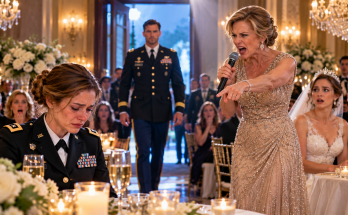
Margaret walked inside.
She wore a dark blue dress and carried a structured leather handbag.
Her expression suggested she expected everyone to stop what they were doing.
She headed straight toward me.
“Claire, we need to settle this.”
The musicians gradually lowered their volume.
Conversations faded.
Margaret stopped in front of the head table.
“I came for the necklace.”
I looked at her calmly.
“I told you that I would return it.”
“Then please do so now.”
I removed the necklace from my handbag.
It was a delicate diamond pendant with a small gold chain.
I had kept it in its original velvet box.
I handed it to her.
“Here you are.”
She inspected it immediately.
Then she slipped it into her handbag.
“Thank you. Now, about the expenses.”
I stared at her.
“Your son abandoned me at the altar, and you came here to demand money?”
“Michael has been under considerable pressure,” she replied. “You should understand that the wedding created financial commitments.”
I almost laughed.
“Financial commitments?”
“Yes. The rehearsal dinner, the hotel arrangements, and several other expenses.”
“Then send the documentation to my attorney.”
Her eyebrows rose.
“Your attorney?”
“I have no intention of arguing with you in front of our guests. If you believe I owe you money, you can make your claim through the proper channels.”
Margaret looked around the room.
“I expected more maturity from you.”
Grandpa rose slowly from his chair.
“And I expected more compassion from you.”
Margaret turned.
“Walter, this is a private family matter.”
“You made it public when you sent my granddaughter a bill while she was still wearing her wedding dress.”
Her cheeks reddened.
“I am trying to protect my family’s property.”
Grandpa nodded.
“Then perhaps we should talk about property.”
Something changed in Margaret’s expression.
She stared at him.
“What does that mean?”
Grandpa reached into his jacket and removed a small brown envelope.
He placed it on the table.
“I had hoped never to need this.”
Margaret looked at the envelope as though she recognized it.
“What is that?”
“Something your husband signed twenty years ago.”
The room grew quiet.
Margaret glanced around nervously.
“This is not the place.”
“Actually,” Grandpa replied, “you made it the place when you decided to embarrass Claire in front of everyone.”
He opened the envelope.
Inside were several old documents, a bank receipt, and a letter bearing the name of a company I had never heard of.
I stared at him.
“Grandpa, what is this?”
He took a breath.
“Twenty years ago, your future father-in-law, Charles Turner, was trying to keep his first dealership from going bankrupt.”
I knew Charles as Michael’s father, a wealthy businessman who rarely attended family gatherings unless important people were present.
Grandpa continued.
“At the time, I was working as a contractor. I had just sold a piece of land I inherited from my parents. Charles approached me through a mutual friend and asked whether I would consider investing in his struggling business.”
Margaret folded her arms.
“My husband built his business himself.”
“I never said he didn’t,” Grandpa replied. “But he didn’t build it alone.”
He explained that Charles had borrowed a substantial amount from him to prevent the business from collapsing.
The loan had been documented.
There were signed repayment terms.
And when the business recovered, Charles had agreed to repay the principal plus a share of the profits.
For years, Grandpa had received payments.
Then, after Charles expanded into several new dealerships, the payments stopped.
Grandpa had tried contacting him repeatedly.
Eventually, Charles’s attorney argued that the remaining amount had already been settled through a transaction Grandpa did not recognize.
The dispute never reached court because Grandpa chose not to pursue it.
He had been dealing with my grandmother’s illness and did not want to spend his remaining time fighting a wealthy businessman.
“I decided that my peace was worth more than the money,” Grandpa explained. “But I kept every document.”
Margaret shook her head.
“This is ridiculous. Whatever arrangement existed between my husband and you has nothing to do with Michael and Claire.”
“Perhaps,” Grandpa replied. “But your husband has been telling people for years that he built his business without anyone’s help. And today, you came here acting as though my granddaughter should be ashamed of her circumstances.”
He paused.
“I wanted to let the past remain in the past. But I won’t let you confuse financial success with moral superiority.”
I looked at the documents.
I had never known Grandpa had once invested in a business.
He had spent his entire life repairing houses, fixing broken fences, and helping neighbors with projects they couldn’t afford.
I had assumed he had little money beyond his modest pension and savings.
“Grandpa,” I whispered, “why didn’t you tell me?”
He smiled sadly.
“Because I didn’t want you to measure your worth by what I had or what anyone else owned.”
Margaret reached for the envelope.
Grandpa gently moved it out of her reach.
“These are copies. The originals are with my attorney.”
She stared at him.
“You cannot threaten my family.”
“I’m not threatening anyone. If Charles believes the matter was settled, he can provide the records showing that. My attorney has already requested the relevant documentation.”
Margaret looked toward the exit.
Then her phone began ringing.
She checked the screen.
It was her husband.
She answered quickly.
“Charles, what is happening? Walter Bennett is here, and he’s making accusations about an old loan.”
She listened.
Her face grew pale.
“What do you mean you remember?”
Another pause.
“No, of course I didn’t know.”
She looked at Grandpa again.
Then, in a much quieter voice, she said, “All right. I’ll tell her.”
She ended the call.
Nobody spoke.
I felt as though I were watching a scene from someone else’s life.
Margaret slowly sat down.
“My husband says he remembers the agreement.”
Grandpa nodded.
“I thought he might.”
“He says there was a dispute over the final payment.”
“Then the attorneys can review it.”
Margaret looked at me.
For the first time since I had met her, she seemed uncertain.
“Claire, I didn’t know about this.”
I believed she might be telling the truth.
But her ignorance did not erase what she had done.
“You didn’t need to know about an old loan to treat me with kindness,” I replied.
She lowered her eyes.
Across the room, Nathan approached us.
Michael’s younger brother looked exhausted.
“Claire, there’s something else you need to know.”
Margaret turned sharply.
“Nathan, not now.”
He shook his head.
“No, Mom. It’s time.”
He looked at me.
“Michael didn’t leave because he suddenly realized he wasn’t ready to get married.”
My heart began pounding.
“What are you saying?”
Nathan swallowed.
“For months, Dad and Mom have been pressuring him to end the engagement. They thought marrying you would make him less acceptable to certain business partners.”
Margaret stood abruptly.
“That is not what happened.”
Nathan continued anyway.
“They wanted him to marry someone from another wealthy family. Someone who could help the business expand.”
I felt sick.
“Did Michael agree?”
Nathan’s silence answered me.
Finally, he whispered, “He said he loved you. But he also said he couldn’t risk losing his family’s financial support.”
I stared at him.
The man I had loved had not simply become frightened at the last moment.
He had spent months weighing me against money.
And when the moment came, he had chosen money.
Margaret covered her face.
Nathan looked at me with tears in his eyes.
“He was supposed to tell you himself. I kept hoping he would find the courage.”
I turned away, unable to speak.
Grandpa placed a steady hand on my shoulder.
“You don’t have to decide anything tonight,” he said.
But I knew one thing already.
Even if Michael returned tomorrow with flowers and apologies, the man I had planned to marry was no longer the man I believed he was.
Then Grandpa looked toward the entrance.
A black sedan had just pulled into the parking lot.
Charles Turner was arriving.
And he was carrying a folder of his own.
Part 3: The Truth No One Could Buy
Charles entered the reception hall without his usual entourage.
He looked older than I remembered.
His expensive suit was wrinkled, and he carried a thick folder beneath one arm.
He walked directly toward Grandpa.
“Walter,” he said quietly.
Grandpa stood.
“Charles.”
For several seconds, the two men simply looked at each other.
Then Charles extended his hand.
Grandpa accepted it.
“I owe you an apology,” Charles said.
Margaret stared at her husband.
“Charles, what are you doing?”
He turned toward her.
“Something I should have done years ago.”
He placed the folder on the table and opened it.
Inside were copies of the original loan agreement, bank records, and correspondence between their attorneys.
He admitted that Grandpa had helped save the first dealership when the business was struggling.
The loan had allowed Charles to pay suppliers and keep employees working while he reorganized the company.
The business eventually recovered.
Charles expanded.
The dealerships became profitable.
But a dispute over the final accounting had led to an unresolved balance, and he had allowed the disagreement to remain buried.
“I told myself the paperwork was complicated,” Charles said. “I told myself we had already paid enough. And eventually, I stopped answering Walter’s calls.”
He looked at Grandpa.
“That was wrong.”
Grandpa studied the documents.
“I don’t need an apology to make the past disappear, Charles. I need the records to be reviewed honestly.”
Charles nodded.
“My attorney will cooperate with yours. If the review confirms an outstanding obligation, I’ll settle it according to the agreement.”
There was no dramatic announcement of a hidden fortune.
No sudden revelation that Grandpa secretly owned the entire dealership chain.
Just an old business dispute, documented evidence, and a wealthy man finally agreeing to face a responsibility he had avoided.
Somehow, that felt more powerful.
Margaret sat silently beside the table.
The guests had begun whispering again, but no one seemed interested in the wedding anymore.
They were watching a family confront a truth it had tried to ignore.
Charles turned toward me.
“Claire, I owe you an apology as well.”
I looked at him cautiously.
“For what?”
“For allowing my family to make you feel as though you weren’t good enough for my son because you didn’t come from money.”
He paused.
“I knew my wife wanted Michael to marry someone from a wealthy family. I should have stopped that pressure instead of pretending it wasn’t happening.”
I swallowed.
“Did Michael know?”
“Yes,” Charles admitted. “He knew exactly what we expected of him.”
I looked away.
I had spent five years believing love meant standing together when life became difficult.
Michael had treated love as something he could abandon when it became inconvenient.
Charles seemed to understand what I was thinking.
“I can’t ask you to forgive him,” he said. “And I won’t ask you to reconsider the wedding.”
“Good,” I replied quietly. “Because I’m not reconsidering it.”
He nodded.
“I understand.”
For the first time that evening, I felt no need to explain myself.
I did not have to prove I was worthy of Michael.
I did not have to compete with his family’s money.
And I did not have to convince anyone that abandoning a bride at the altar was wrong.
The facts spoke for themselves.
Margaret approached me a few minutes later.
She held the diamond necklace in its velvet box.
“I owe you an apology,” she said.
I waited.
“I shouldn’t have sent you that bill. I was angry and embarrassed, and I wanted to protect my family from the consequences of Michael’s decision.”
She looked down at the necklace.
“I also shouldn’t have treated you as though your financial circumstances made you less deserving of respect.”
I believed she was ashamed.
But I had learned that an apology was only a beginning.
“Thank you for saying that,” I replied. “You can send any legitimate financial claim to my attorney. I won’t discuss it here.”
She nodded.
Then she asked, “Will you ever forgive Michael?”
I looked across the hall at the empty chair where he should have been sitting.
“I don’t know.”
That was the truth.
I might eventually forgive him for my own peace.
But forgiveness would not mean marrying him.
It would not mean pretending that his decision had been harmless.
And it would not mean reopening a door he had chosen to close.
Later that night, I removed my veil and placed it carefully inside its box.
Lauren helped me change out of my wedding gown.
Grandpa waited outside the dressing room, holding my coat.
When I emerged, he looked at me with the same gentle expression he had worn when I was a little girl.
“Ready to go home?”
I nodded.
Then I stopped.
“Grandpa?”
“Yes, sweetheart?”
“Thank you for standing beside me.”
He took my hand.
“You don’t have to thank me for loving you.”
I hugged him tightly.
For years, I had imagined my wedding day as the beginning of a new family.
I had pictured a husband beside me, children in our home, and holidays filled with laughter.
That future was gone.
But as I walked toward the exit, I realized that my entire future had not disappeared with it.
I still had people who loved me.
I still had work that mattered to me.
I still had the animals I cared for, the friends who showed up, and a grandfather who had taught me that dignity was worth more than appearances.
The following week, Grandpa’s attorney began reviewing the old loan records with Charles’s legal team.
They eventually reached a settlement based on the documented balance and the terms they could establish from the records.
Grandpa did not celebrate.
He simply thanked his attorney and returned to the ordinary routines he loved.
He used part of the settlement to make repairs to his home and donated some of his own savings to the local animal shelter.
When I asked why, he shrugged.
“Money is useful, Claire. But it doesn’t make a person good.”
I never forgot that sentence.
Michael contacted me twice.
The first message was an apology.
The second asked whether we could meet.
I replied once.
“I hope you find the courage to build a life you choose for yourself. But I will not be the person waiting at the end of that journey.”
Then I blocked his number.
Months later, I learned that he had moved into an apartment away from his parents while he reconsidered his future.
I wished him well.
But I did not return to him.
On the anniversary of the wedding that never happened, Grandpa and I visited the animal shelter together.
We brought supplies, helped clean the kennels, and spent the afternoon with a nervous golden retriever who had recently been abandoned by its owner.
The dog trembled whenever someone approached.
I sat on the floor beside it and waited patiently.
Eventually, it moved closer and rested its head against my knee.
I stroked its fur.
“You’re safe now,” I whispered.
Grandpa watched from the doorway.
“You know,” he said, “sometimes the most important thing isn’t finding someone who promises never to leave.”
I looked up.
“What’s more important?”
“Finding the courage to stop chasing someone who already has.”
I smiled through my tears.
That evening, we went home and cooked dinner together.
There was no wedding cake.
No orchestra.
No expensive decorations.
Just a simple meal, a warm kitchen, and the quiet comfort of being with someone who had never made me earn his love.
I eventually married again, years later, to a kind man who worked as a park ranger and never once asked me to prove that I belonged beside him.
But that is another story.
The wedding that never happened taught me something I have carried ever since.
The worst thing that happened to me that afternoon wasn’t that a man abandoned me at the altar. It was that I almost believed his decision meant I wasn’t worth staying for.
It took my grandfather, my friends, and one painfully honest day to help me understand the truth.
A person who walks away from you because you cannot increase their wealth has not discovered your lack of value.
They have revealed their own priorities.
And sometimes, the most beautiful beginning doesn’t happen when someone says, “I do.”
Sometimes it happens when you finally say, “I deserve better,” and mean every word.