PART 1
My name is Daniel. I’m 36 years old, and for almost seven years, I believed I had the kind of family everyone wished for.
I married my wife, Emma, when we were both in our late twenties. She had a big family, and from the beginning, I tried my best to become part of it.
Her parents welcomed me.
Her younger brother, Jason, became someone I considered a close friend.
At least, that’s what I thought.
I’ve always been the kind of person who fixes things.
Cars.
Home repairs.
Electrical problems.
Anything mechanical.
It was something my father taught me when I was young.
“People remember the person who shows up when things break,” he used to say.
So when Jason opened his small auto repair shop, I wanted to help him succeed.
The first few months, I spent almost every weekend there.
I repaired equipment.
Fixed broken lifts.
Organized his tools.
Helped him diagnose difficult car problems.
I even trained some of his employees because I had more experience than they did.
I never asked for money.
Never asked for ownership.
Never asked for anything.
Whenever someone thanked me, I would just smile.
“Family helps family.”
That became my answer.
But slowly, something changed.
The phone calls stopped sounding like requests.
They became orders.
“Dan, the shop compressor is making a weird noise. Come check it.”
“Dan, my truck needs new brakes before Monday.”
“Dan, can you come over tonight? The garage door won’t open.”
And I always went.
Even when I was tired.
Even when I had my own things to do.
Because I wanted to be someone they could count on.
But appreciation slowly disappeared.
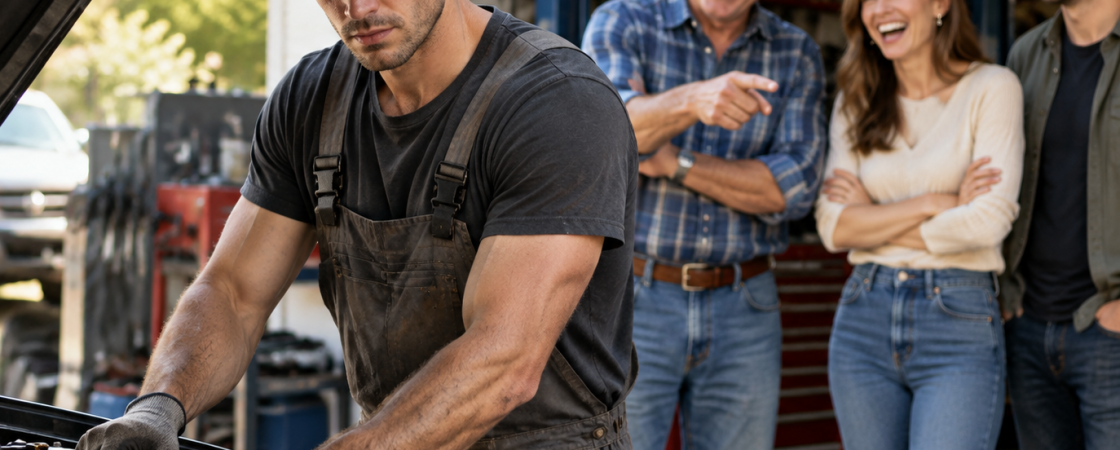
One Saturday morning, I arrived at Jason’s shop expecting to help him replace a broken machine.
Instead, I found a clipboard sitting on my workbench.
A list.
Not a message.
Not a thank you.
Just a list of tasks.
Replace compressor filter.
Fix employee’s car.
Check electrical system.
Repair office door.
I stared at it for a moment.
Then I looked around.
Everyone was drinking coffee and talking while I was already expected to work.
That night, I told Emma how I felt.
She looked surprised.
“Daniel, they’re just comfortable with you.”
“Comfortable?” I asked.
“Yes. They know you’ll always help.”
That sentence stayed in my mind.
Because I realized she was right.
They knew I would always help.
So they stopped appreciating it.
A few weeks later, something happened that changed everything.
I had just finished repairing Jason’s most expensive machine.
I spent six hours fixing it.
When I finally closed my toolbox, Jason walked over.
He looked at the machine.
Then looked at me.
“You know, Dan, if you stopped coming here, I could just hire someone else.”
I thought he was joking.
Then he smiled.
“Honestly, maybe someone younger would be faster.”
Emma was standing nearby.
She laughed.
Not loudly.
Just enough to show she didn’t think it mattered.
I looked at my dirty hands.
The same hands that had helped build his business.
The same hands that had saved him thousands of dollars.
And I realized something.
They didn’t see me as family.
They saw me as free labor.
So I did something I had never done before.
I packed my tools.
And I went home.
The next Saturday…
I didn’t show up.
PART 2
At first, nobody said anything.
I thought maybe they finally understood.
Maybe they realized how much I had been doing.
But instead…
The messages started.
“Are you coming today?”
I didn’t answer.
Then another message came.
“Jason’s machine is still broken.”
I looked at my phone.
Then put it down.
For years, I had rushed whenever they needed me.
This time, I decided to choose myself.
Monday morning, Emma came into the kitchen angry.
“So you’re really not helping my family anymore?”
I looked at her.
“I helped your family for seven years.”
“They’re upset.”
“I’m sure they are.”
She crossed her arms.
“You’re acting like they used you.”
I stayed quiet.
Because I didn’t want to argue.
I wanted her to understand.
But she didn’t.
That same week, something unexpected happened.
My old friend Michael called me.
He owned a company that managed maintenance for several factories.
We had talked before about my mechanical skills.
He said something I never expected.
“Daniel, I’ve been watching what you do for years. You’re not just a guy who fixes things. You understand systems. You understand problems before they happen.”
I laughed.
“I just repair machines.”
“No,” he said. “You solve problems.”
He offered me a position.
A real position.
Better pay.
Benefits.
A chance to build something.
For years, I had spent my energy making someone else’s business successful.
Now someone finally saw my value.
I accepted.
Two weeks later, I attended my first business meeting with Michael.
We were discussing a new maintenance program that could save companies thousands of dollars.
During the meeting, someone took a photo.
Michael posted it online.
Just a simple picture.
Me sitting at a conference table.
Talking.
Planning.
Moving forward.
I didn’t think anything of it.
Until my phone rang.
It was Emma.
“Why are you meeting with Michael?”
I was confused.
“What do you mean?”
“I saw the picture.”
“So?”
“You never told me you were doing this.”
I paused.
“You never asked.”
Silence.
Then she said:
“You’re making decisions without me.”
I smiled sadly.
“No, Emma. I’m finally making decisions for myself.”
That night, she was quiet.
But the next day, she showed me something.
A message from Jason.
He had written:
“Funny how Daniel thinks he’s too important now.”
I read it twice.
Then I handed the phone back.
And for the first time…
I didn’t feel angry.
I just felt free.
Because I finally understood.
People who only value you when they need you…
never really valued you at all.
PART 3
Three months later, my life looked completely different.
I was no longer spending every weekend fixing problems that weren’t mine.
I was traveling between businesses, helping companies improve their maintenance systems.
The strange thing was…
The more I stopped giving myself away for free…
The more people respected me.
One afternoon, Emma came home early.
She sat across from me.
“I need to apologize.”
I looked at her.
“For what?”
She took a deep breath.
“For not seeing what was happening.”
I didn’t say anything.
She continued.
“I thought because you loved my family, helping them was something you wanted to do.”
“I did want to help.”
“Then what changed?”
I looked at her.
“They stopped seeing it as kindness.”
She lowered her eyes.
A few days later, Jason called me.
I almost didn’t answer.
But I did.
His voice sounded different.
“Dan…”
“Yeah?”
“I need your help.”
The old me would have immediately asked what was wrong.
The old me would already be grabbing my tools.
But I waited.
“With what?”
“My shop equipment. Things keep breaking.”
I was quiet.
Then he said something I never expected.
“I didn’t realize how much you actually did.”
I leaned back.
After seven years…
He finally noticed.
“I appreciate you now.”
Those words should have made me happy.
But they came too late.
I wasn’t angry anymore.
I just understood my worth.
“I’m glad you see it now,” I said.
“But things have changed.”
“Can you at least teach my employees?”
I smiled.
“I can help. But this time, it’s a professional arrangement.”
There was silence.
“How much would you charge?”
I looked out the window.
Years ago, I would have said:
“Nothing. We’re family.”
But I had learned something important.
Respect doesn’t mean taking advantage.
Kindness doesn’t mean having no boundaries.
And family doesn’t mean one person sacrifices everything while everyone else benefits.
So I gave him my price.
He agreed.
Months later, Jason’s business improved.
Not because I saved him.
Because he finally learned to respect the person helping him.
And me?
I stopped being the guy everyone called when something broke.
I became the person people called because they valued what I brought to the table.
Sometimes the hardest thing to fix…
isn’t a machine.
It’s the way people see your worth.