PART 1 — The Boy My Mother Chose to Save
I was eight years old when I first saw the homeless boy sleeping behind our house. His name was Gabriel, and he looked like someone the entire world had forgotten. His clothes were torn, his shoes were falling apart, and his face was so thin that his cheekbones stood out beneath his dirty skin. He slept beneath an abandoned wooden shelter near the rubbish dump, using a piece of cardboard as a mattress and an old blanket to protect himself from the cold.
My father had died only a few months earlier, leaving my mother and me struggling to survive. We lived in a small house with peeling white paint, a leaking roof, and a kitchen where my mother carefully counted every coin before buying groceries. Sometimes, she skipped dinner and told me she had already eaten. I believed her because I was too young to understand that hunger could make a mother lie to protect her child.
Then Gabriel appeared, and somehow, my mother found enough food for him every single day.
At first, she gave him leftover rice and vegetables. Later, she began preparing an extra portion of whatever she cooked for us. On rainy mornings, she carried him dry clothes. When winter arrived, she gave him an old coat that had belonged to my father. Whenever she saw him sitting alone behind our house, she stopped to talk to him as though he were a member of our family.
I couldn’t understand it.
One Sunday afternoon, I walked into the kitchen and discovered my mother placing a freshly baked chocolate cake into a cardboard box. It was my birthday week, and she had promised to make that cake for me. I had been thinking about it for days.
“Where are you taking that?” I asked.
She looked up and smiled gently. “Gabriel hasn’t eaten anything warm today. I’ll take him a slice.”
“But you said it was for my birthday!”
“I’ll make another one for you, sweetheart.”
“With what money?” I shouted. “We barely have enough food for ourselves! Why do you care more about that stranger than you care about me?”
The moment those words left my mouth, her expression changed. She put down the box and stared at me with a seriousness I had never seen before.
“Listen to me carefully,” she said. “Gabriel is not the person you think he is. And one day, you may understand why I couldn’t turn my back on him.”
I demanded that she explain, but she refused.
Instead, she took the cake outside.
That evening, I sat in my bedroom and cried. I convinced myself that Gabriel had stolen my mother’s affection, and from that day forward, I hated him. Whenever he tried to speak to me, I ignored him. When he waved at me from behind the fence, I walked away. If he left a small gift near our back door, I threw it into the rubbish without even looking inside.
Gabriel never became angry with me. He never complained about the way I treated him. He simply lowered his eyes, smiled sadly, and continued accepting whatever my mother offered him.
Years passed, and my resentment grew.
By the time I was eighteen, I had found a job in another city and decided to leave our small town behind. I wanted a better life, a bigger house, and a future that had nothing to do with poverty or the mysterious boy my mother seemed determined to save.
On the morning I left, she stood in our doorway holding a small envelope.
“Please keep this safe,” she said.
I barely glanced at it before placing it inside my suitcase.
“Mom, I have a bus to catch. I’ll call you when I arrive.”
She reached for my hand.
“And if anything happens to me, promise me you’ll look after Gabriel.”
I pulled my hand away, frustrated.
“Why are you still talking about him? He’s not your son!”
For a moment, she looked as though I had broken something inside her.
Then she whispered, “That’s exactly why you need to understand.”
I left without asking what she meant.
For the next fifteen years, my life moved forward. I found a better job, married a kind man, and eventually had two children of my own. I called my mother occasionally, usually during holidays, but our conversations became shorter as the years passed. Whenever I asked about her health, she said she was fine. Whenever she asked me to visit, I promised I would come soon.
But soon became another month, and another year.
I never returned to the old house.
Then, one rainy Tuesday morning, my phone rang.
A doctor told me that my mother had suffered a severe stroke. She was in the hospital, and her condition was deteriorating rapidly.
I drove through the night to reach her.
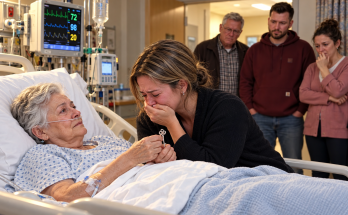
When I entered her hospital room, she looked so small beneath the white sheets. Her hands trembled, and her voice was barely audible. I rushed to her bedside, took her hand, and apologized for every year I had stayed away.
She squeezed my fingers weakly.
I asked her whether she needed anything, whether she wanted me to call a relative, or whether there was someone she wished to see.
Her lips moved.
“Gabriel.”
I froze.
“Mom, why are you asking for him? I’m here. I’m your daughter.”
Tears rolled down her cheeks.
“Promise me,” she whispered. “Don’t abandon him when I’m gone.”
I wanted to argue. I wanted to tell her that after everything I had sacrificed to build my own life, I couldn’t spend the rest of it taking responsibility for a stranger.
But then I saw the fear in her eyes.
So I nodded.
“I promise.”
My mother closed her eyes, and for the first time in years, she looked peaceful.
She died that afternoon.
I held her hand until the nurses gently asked me to step away. As I left the hospital, I realized that I had spent so many years being angry with my mother that I had forgotten how to simply be her daughter.
At her funeral, I searched the crowd for Gabriel.
He wasn’t there.
I told myself that I shouldn’t have expected him to come. Perhaps he had moved away. Perhaps something had happened to him. Perhaps, after all those years, he had finally disappeared from our lives.
But three days after the funeral, I returned to our childhood home to collect her belongings.
And that was when everything changed.
PART 2 — The Stranger Who Knew My Mother’s Final Secret
The house looked smaller than I remembered.
The white paint had begun to peel away from the walls, and the garden my mother once cared for was overgrown with weeds. I unlocked the front door and stepped inside, immediately recognizing the faint scent of cinnamon that had always filled her kitchen.
For several minutes, I stood there without moving.
Then I began sorting through her belongings. I packed her clothes into boxes, separated old photographs, and placed her favorite dishes into a cabinet I planned to take home. Every object reminded me of something I had forgotten, and every memory made me regret the years I had wasted staying away.
By sunset, I was exhausted.
I prepared a simple dinner using the food I had brought with me. Then I remembered my promise to my mother.
I needed to find Gabriel.
I drove through the neighborhood, asking a few older residents whether they had seen him. Most shook their heads. One elderly woman told me that she hadn’t seen him near the dump for years. Another said that a black vehicle had occasionally appeared near the old property, but she assumed it belonged to someone visiting the neighboring house.
I returned home feeling defeated.
As I turned onto our street, I noticed a polished black SUV parked beside the curb.
A man stood next to it, wearing a tailored charcoal coat, dark trousers, and expensive leather shoes. He looked to be in his late thirties, perhaps a little older. His hair was neatly styled, his face clean-shaven, and his posture confident.
He looked nothing like the homeless boy I remembered.
When he noticed my car, he stepped forward.
“I was beginning to think you wouldn’t come back,” he said.
I lowered my window.
“Can I help you?”
He stared at me for several seconds. His eyes glistened, and his mouth trembled as though he were trying to control his emotions.
Then he spoke a name I hadn’t heard in years.
“It’s Gabriel.”
I stepped out of the car, unable to hide my shock.
“No. That can’t be possible.”
He gave me a faint smile.
“I know I look different.”
I studied his face, searching for something familiar. Then I noticed a small scar above his left eyebrow. I remembered seeing that scar when I was a child, after he had fallen against a broken piece of wood behind our house.
It really was him.
“What happened to you?” I asked. “Where have you been all these years? Why didn’t you come to the funeral?”
His expression changed.
“I wanted to come. I was on my way when I received a call from your mother’s lawyer. There was something I needed to take care of before I could face you.”
I felt a wave of anger rise inside me.
“Something more important than saying goodbye to the woman who fed you for twenty years?”
He lowered his head.
“No. Nothing was more important than her. That’s why I’ve come back.”
He opened the passenger door of his SUV and took out a small wooden box. The corners were worn, and a thin brass lock held it shut.
“I promised your mother I would keep her secret until the right moment,” he said. “She made me swear that I would tell you only after she was gone, and only when you were ready to hear the truth.”
I folded my arms.
“What truth?”
He looked toward the house where my mother had spent most of her life.
“Your mother didn’t save me because she felt sorry for a homeless boy.”
“Then why did she?”
“Because twenty years ago, she made a promise to someone she loved. A promise that changed both our lives.”
My heart began to pound.
“Who?”
Gabriel opened the wooden box and removed an old photograph. It showed my father standing beside a younger man outside a brick building. My father was smiling, with one hand resting on the other man’s shoulder.
I had never seen the photograph before.
But the man beside my father looked strangely familiar.
Gabriel turned the photograph over.
On the back, my father’s handwriting read: To my brother, Daniel. No matter what happens, we’ll always protect our children.
I stared at the words.
“My father didn’t have a brother named Daniel.”
Gabriel’s eyes filled with tears.
“Your father did have a brother. They had a terrible argument years before you were born, and they never reconciled. Your mother was the only person who knew where Daniel had gone.”
He paused before continuing.
“Daniel was my father.”
The world seemed to stop.
I stepped backward, shaking my head.
“You’re telling me you’re my cousin?”
“Yes.”
“But why were you living behind our house? Why didn’t Mom tell me? Why did she let me believe you were a stranger?”
Gabriel took a deep breath.
“Because when my father died, I was seventeen. I had nowhere to go, and I was too ashamed to ask anyone for help. Your mother found me sleeping behind the dump. She recognized me immediately, but she didn’t tell you who I was because she had promised my father that she would protect me without revealing his past until I was ready.”
I could barely speak.
He continued.
“Your father and mine had fallen out over a business disagreement. Your father believed his brother had betrayed him. But before my father died, he sent your mother a letter explaining what had really happened. She tried to bring the brothers together, but your father died before she could.”
I thought about the meals, the clothes, the coat that had belonged to my father, and all the years I had spent hating Gabriel.
“Why didn’t she tell me when I was older?”
“She wanted to. But then you left, and she was afraid that if she told you, you would think she had lied to you all those years. She kept waiting for the right moment.”
He handed me the wooden box.
“There’s more. And this part concerns you.”
Inside lay a sealed envelope bearing my name.
The handwriting was unmistakable.
It belonged to my mother.
Gabriel’s voice broke as he spoke.
“She made me promise that I would give you this letter after her funeral. She said it contained the one truth you deserved to know before deciding what to do with the house.”
I stared at the envelope, my hands trembling.
Then I broke the seal.
The first line made my knees weak.
My dearest daughter, if Gabriel has finally told you who he is, then the time has come for you to learn what your father left behind.
I looked up at Gabriel.
“What did my father leave behind?”
He took a long breath and pointed toward the old house.
“Something that could change your entire future.”
PART 3 — The Inheritance Hidden Behind the Wall
I sat at the kitchen table where my mother had once prepared meals for Gabriel, my hands shaking as I unfolded the letter.
The first few paragraphs were filled with memories. My mother wrote about the day she met my father, the little house they had bought together, and the dreams they had shared before his sudden death. She described the difficult years that followed and admitted that she had made mistakes trying to protect me from painful truths.
Then the letter changed.
Your father and his brother once owned a small commercial property together. They purchased it when they were young, believing that one day it would provide security for their families. When their relationship collapsed, your father took responsibility for the debts while Daniel disappeared. Your father never stopped loving his brother, but pride prevented him from reaching out.
I stopped reading.
I remembered my father as a hardworking man who repaired broken furniture and worked late into the evening. I had never known he had owned a business property.
I continued.
Before your father died, he placed the original ownership documents, financial records, and a letter from his brother inside a sealed metal compartment behind the wooden panel in our bedroom closet. He asked me to keep them safe until you were old enough to understand what they meant.
My breath caught.
The property was small when your father bought it. Over the years, the surrounding neighborhood changed, businesses expanded, and the land became valuable. I learned that the building had been sold to a development company, but the ownership records showed that your father had retained his legal share.
I looked at Gabriel.
“Are you saying my father owned part of a building that’s now worth a fortune?”
He nodded slowly.
“Your mother spent years trying to establish the ownership history. She hired a lawyer, gathered records, and discovered that the property had increased dramatically in value. The company that owns the building recently agreed to settle the remaining ownership dispute.”
“How much?”
Gabriel hesitated.
“The settlement and the value of the remaining assets are estimated at several million dollars. But the exact amount depends on the final legal accounting.”
I covered my mouth.
For years, my mother had struggled to pay bills. She had mended her own clothes, repaired broken appliances, and sometimes gone without food. Yet she had been carrying a secret that might have changed everything.
“Why didn’t she use the money?” I whispered.
“Because she wasn’t certain the claim would succeed. She didn’t want to risk the little money she had on a legal fight, and she didn’t want you to build your life around an inheritance that might never come. She also wanted to make sure your father’s brother wasn’t forgotten.”
Gabriel reached into the wooden box and produced another document.
It was a legal agreement bearing the signatures of my mother, a lawyer, and Gabriel.
“My father left me something too,” he said. “Your mother helped establish a trust that would protect me while I rebuilt my life. She used what little she could spare to help me study, find work, and get back on my feet. I eventually became a financial consultant. After years of saving and investing, I built my own company.”
I stared at him.
“You went from sleeping behind our house to owning that SUV?”
He laughed softly, though tears remained in his eyes.
“Not overnight. It took years. Your mother never gave me money to become rich. She gave me food, clothes, and a reason to believe that my life wasn’t over.”
He looked down at the photograph of my father.
“She told me that if I ever became successful, I should help someone else the way she helped me. She never asked me to repay her.”
I felt tears running down my cheeks.
For twenty years, I had believed Gabriel was the reason my mother had less to give me. I had resented every meal she carried outside, every birthday dessert he received, and every moment she spent worrying about him.
Now I understood that she had been teaching me something I had been too angry to learn.
Kindness was not always a choice between helping one person and loving another. Sometimes, it was simply the decision not to let someone suffer when you had the power to help.
But Gabriel wasn’t finished.
“There is one more thing your mother asked me to tell you,” he said.
He removed a second envelope from the box. This one was addressed to both of us.
I opened it carefully.
Inside was a short handwritten message.
My beloved daughter and Gabriel, I could not repair the relationship between your fathers, but perhaps you can begin again where they left off. The house is yours to decide what to do with. The inheritance belongs to my daughter according to the legal documents, but I hope she will remember that wealth means very little if it cannot bring something good into the world.
Below the message was a final sentence.
Gabriel, thank you for keeping the promise I made you keep. You were never a burden to me. You were family, even when I could not explain why.
I broke down.
Gabriel moved closer and gently placed a hand on my shoulder.
For the first time in my life, I didn’t pull away from him.
“I’m sorry,” I whispered. “I was cruel to you when we were children. I thought you were taking something from me. I never understood what my mother was doing.”
Gabriel shook his head.
“You were a child who had lost her father. You were frightened, and you wanted your mother to yourself. I never blamed you.”
That kindness hurt more than any accusation could have.
We spent the rest of the evening going through the documents together. The next morning, we contacted the lawyer named in my mother’s letter. He confirmed that the ownership claim was legitimate and explained the legal process for transferring the estate.
The inheritance would take time to settle, but for the first time, I could see the future my mother had quietly hoped to protect.
A few weeks later, Gabriel and I returned to the old house. We stood in the backyard where he had once slept beneath a broken shelter, looking at the patch of ground where my mother used to leave his meals.
“I want to do something here,” I told him.
“What do you have in mind?”
I looked at the small house, then at the place where Gabriel had spent so many lonely nights.
“I want to turn this property into a community center. A place where young people without families can get meals, learn practical skills, and find help before the world convinces them they’re worthless.”
Gabriel smiled.
“I think your mother would have loved that.”
We began planning the project together. Gabriel offered to contribute money and professional support, while I used part of the inheritance to fund the renovation. We decided to name the center after my mother, so that every person who entered would know the story of the woman who had never stopped believing that a struggling young man deserved another chance.
Months later, on the day the center opened, I stood beside Gabriel as families arrived through the front doors. Children laughed in the courtyard. Volunteers carried boxes of food into the kitchen. A young man who had recently lost his home sat at a table while someone helped him complete a job application.
I watched him for a long time.
Then I understood something my mother had known all along.
Sometimes, the people we resent are the very people who reveal the parts of ourselves we need to change.
Gabriel had once been a hungry boy behind our house. I had once been a little girl who thought love was something that could run out if it was shared with someone else.
We had both grown older, but only one of us had understood the lesson my mother was trying to teach.
That evening, I placed her photograph above the center’s fireplace. Beneath it, I hung a small wooden plaque with the words she had written in her final letter:
“You never know how much a simple act of kindness can change someone’s life. Sometimes, the person you save today becomes the person who helps you understand your own heart tomorrow.”
I stood there, holding Gabriel’s hand, and finally felt close to my mother again.
For twenty years, she had fed a homeless boy behind our house.
But the greatest thing she gave him was not food, money, or shelter.
She gave him a future.
And in the end, he helped me discover the one thing I had been missing all along: the true meaning of family.