My Sister Moved Her Family Into the Lake House I Inherited From Grandma—Then a Locked Drawer Revealed Why She Had Been Hiding My Mail for Years
Part 1
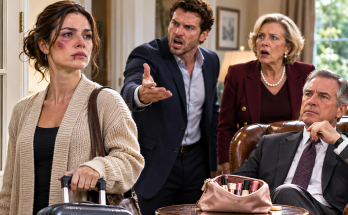
When I arrived at the lake house my grandmother had left me, I found my older sister standing on the porch, holding a glass of champagne while her husband carried my furniture inside.
“Finally, someone in this family knows how to use this place,” she said with a smug smile.
I stared at her, unable to believe what I was seeing.
The house had been left to me, not her.
I had spent the last six months traveling between my apartment in Cleveland and the small town where Grandma Eleanor had lived, helping arrange her funeral, sorting through her belongings, and handling the legal paperwork for her estate.
Now, barely two weeks after the inheritance had been finalized, my sister Vanessa was acting as if she owned everything.
“What are you doing here?” I asked.
She took another sip of champagne.
“Moving in, obviously.”
“Vanessa, this is my house.”
Her smile disappeared for a moment before returning.
“Don’t be ridiculous, Claire. We’re family. Grandma would have wanted us to share.”
Behind her, my brother-in-law, Mark, carried a cardboard box through the front door.
Their two children ran across the wooden deck, shouting excitedly about which bedrooms they wanted.
I looked past them toward the lake, where the afternoon sunlight glittered across the water.
This house was more than a property to me.
It was where Grandma taught me to bake apple pies, where she sat beside me after my first heartbreak, and where she told me stories about our family that nobody else seemed willing to discuss.
She had promised me that one day, the house would be mine.
And now my sister had moved in without even asking.
“Please take your things and leave,” I said quietly.
Vanessa laughed.
“You really want to throw your own sister out onto the street?”
“I’m asking you to respect my property.”
Her expression hardened.
“You always were selfish, Claire. Grandma spoiled you, and now you’re using her death to get what you want.”
Those words hurt more than I expected.
For years, Vanessa had been the favorite daughter, the one our parents defended no matter what she did.
When she dropped out of college, Mom blamed the professors.
When she borrowed money and failed to repay it, Dad called it a misunderstanding.
When I worked double shifts to pay my bills, they praised me for being independent.
But when Vanessa needed something, everyone expected me to help.
I had learned to stay quiet because arguing never changed anything.
This time, however, I wasn’t going to surrender.
I opened my handbag and pulled out a folder containing the estate documents.
“The attorney confirmed that the house belongs to me,” I said. “Your name isn’t on the deed.”
Vanessa glanced at the papers without taking them.
“Paperwork can be changed.”
“What does that mean?”
She smiled again, but there was something nervous behind her eyes.
“It means you should stop making threats and start thinking about your family.”
I turned toward Mark.
“Did you know she planned to move in?”
He suddenly became fascinated by the cardboard box in his hands.
That was when I understood they had discussed this long before I arrived.
I called our grandmother’s attorney, Mr. Bennett, and explained what was happening.
He asked me to send him photographs of the property documents and said he would review the situation immediately.
When I hung up, Vanessa folded her arms.
“Go ahead and call every lawyer in the state,” she said. “You still won’t get this house back.”
I froze.
“Get it back?”
She looked away.
For the first time, I noticed a stack of envelopes on the hallway table.
They were addressed to me.
Some were from the estate attorney.
Others carried official-looking return addresses.
Every envelope had been opened.
My stomach tightened.
“Why is my mail here?”
Vanessa stepped in front of the table.
“You’ve been busy. I was just helping you organize things.”
I reached for the envelopes.
She grabbed my wrist.
“Don’t start something you can’t finish, Claire.”
I pulled away and collected every letter.
Then I noticed one envelope at the bottom of the stack.
It had been sealed with red tape, and Grandma’s handwriting appeared across the front.
For Claire, only after Vanessa has received the documents she was promised.
I stared at the words.
My grandmother had written that letter before she died.
And somehow, my sister had gotten hold of it.
Part 2
I drove straight to a small hotel in town and locked myself in my room before opening the envelopes.
The first few contained ordinary estate correspondence.
The next contained a notice from the county recorder’s office.
According to the document, someone had submitted a request to place a temporary restriction on the lake house’s title.
The request had been rejected because the applicant lacked the required legal authority.
The applicant’s name was Vanessa Reed.
My hands began to shake.
She hadn’t simply moved into my house.
She had tried to interfere with the ownership records.
I called Mr. Bennett again.
This time, he asked me to read the document number aloud.
After checking his records, he went silent.
“Claire, I need you to listen carefully,” he said. “Your grandmother anticipated that there might be a dispute over the property.”
“Why would she expect that?”
“Because several months before her death, Vanessa contacted her about the house.”
“What did she want?”
“She wanted your grandmother to sign an agreement allowing Vanessa to live there permanently.”
I closed my eyes.
Grandma had never mentioned this to me.
Mr. Bennett continued.
“Your grandmother refused. She explained that the property was specifically intended for you.”
“Then why would Vanessa believe she could take it?”
“That is precisely what I am trying to determine.”
He asked me to bring the original estate documents to his office the following morning.
Before hanging up, he added one more thing.
“Claire, do you remember a trust your grandmother established years ago?”
I frowned.
“I remember her mentioning something about savings for the family, but I never saw any paperwork.”
“That trust may be connected to this dispute.”
I barely slept that night.
At eight the next morning, I arrived at Mr. Bennett’s office with the envelopes, the title notice, and the letter written in Grandma’s handwriting.
He examined everything carefully before opening a locked cabinet.
From inside, he removed a thick brown file.
“Your grandmother asked me to keep this separate from the ordinary estate documents,” he explained.
He placed a handwritten note on the desk.
It was dated four months before Grandma died.
The note said that Vanessa had been struggling financially and had asked for an advance on her future inheritance.
Grandma had offered to help her create a repayment plan.
Vanessa had refused.
Instead, she demanded that the lake house be transferred to her immediately.
When Grandma declined, Vanessa threatened to challenge the will.
I felt sick.
“Why didn’t Grandma tell me?”
“She wanted to avoid dividing the family while she was still alive,” Mr. Bennett replied. “She also hoped Vanessa would reconsider.”
He opened the file and showed me a copy of the original will.
The lake house was clearly assigned to me.
But another document caught my attention.
It was a financial statement showing that Grandma had loaned Vanessa $85,000 over several years.
There were bank transfers, signed acknowledgments, and messages in which Vanessa promised to repay the money.
She had never paid it back.
Instead, she had repeatedly asked for more.
“Where did Grandma get that much money?” I whispered.
Mr. Bennett explained that Grandma had sold a small rental property years earlier and invested the proceeds.
She had intended to divide the remaining investments fairly among her grandchildren.
But the documents showed something else.
Shortly before her death, Grandma had discovered that several letters from her financial adviser had gone missing.
The adviser had been warning her that someone was attempting to access information about the trust.
My mouth went dry.
“Who had access to her mail?”
Mr. Bennett turned over the final page.
Vanessa’s name appeared beside an authorization she had obtained years earlier to help Grandma manage household correspondence during a period of illness.
The authorization had expired.
But someone had continued using it.
I thought about the opened envelopes on the hallway table.
Then I remembered something Grandma once told me during a quiet evening beside the fireplace.
“People who want your money will often tell you they’re protecting your family.”
At the time, I thought she was talking about a distant relative.
Now I understood she had been trying to warn me.
Mr. Bennett placed Grandma’s sealed letter in front of me.
“This one was never supposed to be opened by anyone else,” he said.
I carefully removed the red tape.
Inside was a handwritten message and a small brass key.
The message contained only a few lines.
Claire, if Vanessa has already moved into the house, look inside the desk in my bedroom.
There is a locked drawer I never allowed anyone to open.
The truth is inside.
I looked at the brass key resting in my palm.
Then I looked at Mr. Bennett.
“What truth?”
He shook his head.
“I don’t know. Your grandmother never told me what she placed there.”
I returned to the lake house that afternoon with a locksmith and a police officer who had accompanied me after I explained the suspected unauthorized access.
Vanessa stood in the doorway when she saw us.
“What are you doing?” she demanded.
“I came to collect my belongings and check the desk in Grandma’s bedroom.”
“You can’t just walk in here whenever you want!”
The officer calmly explained that the ownership documents identified me as the legal owner and that we were there to address the property dispute peacefully.
Vanessa’s face turned pale.
For the first time since I had arrived, she looked genuinely afraid.
I walked into Grandma’s bedroom.
The old wooden desk stood beside the window, exactly where it had always been.
I opened the bottom drawer and found a smaller compartment concealed behind a loose wooden panel.
The brass key fit perfectly.
Inside was a thick envelope, a flash drive, and a second set of financial documents.
I opened the envelope first.
The letter began with Grandma’s familiar words.
My dearest Claire, if you’re reading this, then someone has finally forced you to defend what is rightfully yours.
My eyes filled with tears.
But the next sentence made my blood run cold.
The lake house is only the beginning. The person who has been taking money from the family trust is not the person you think.
Part 3
I read the letter twice before I could breathe normally again.
Grandma explained that she had discovered irregular withdrawals from the family trust approximately eight months before her death.
At first, she believed the transactions were mistakes.
Then her financial adviser found that the withdrawals had been authorized using information from private correspondence.
The money had been transferred through several accounts before being used to pay debts and purchase assets.
The total amount missing was more than $240,000.
Grandma had suspected Vanessa, but she didn’t have enough evidence to confront her directly.
She had also discovered that someone had been using Vanessa’s financial difficulties to pressure her into signing documents she didn’t fully understand.
The final paragraph was the most disturbing.
Claire, your sister may have made terrible choices, but she is not the only person involved.
Look at the account records on the flash drive.
I took the drive to Mr. Bennett’s office.
He arranged for a qualified forensic accountant to review the records and coordinate with the appropriate authorities.
The investigation revealed that Vanessa had indeed attempted to obtain unauthorized access to trust information.
However, the largest transfers had gone to an account controlled by our father.
I stared at the report in disbelief.
Dad had always presented himself as the family’s most responsible person.
He had criticized Vanessa’s spending, warned me to save money, and insisted that everyone should respect Grandma’s wishes.
Yet the financial records showed that he had received more than $190,000 from the trust over several years.
Some transfers had been described as emergency family expenses.
Others had been labeled as temporary loans.
There were no repayment records.
And the correspondence showed that Dad had encouraged Vanessa to claim the lake house, promising that the property could help cover the family’s outstanding debts.
Vanessa had believed she was protecting herself by moving into the house.
Dad had convinced her that if she established herself there before the estate dispute was resolved, she could pressure me into accepting a settlement.
He had also told her that Grandma’s financial records would never be examined.
But he had made one mistake.
He had underestimated the woman who raised us.
Grandma had preserved copies of the original documents, bank correspondence, and messages that linked the transactions together.
Mr. Bennett explained that the records would be turned over to the relevant investigators.
Any legal responsibility would be determined through the proper process.
I didn’t feel victorious.
I felt devastated.
My sister had tried to take my home.
My father had taken money from a trust meant to protect the family.
And my grandmother had spent her final months trying to prevent the truth from destroying the people she loved.
Three days later, Vanessa called me.
Her voice sounded smaller than I had ever heard it.
“Claire, can we talk?”
We met at a café near the lake.
She arrived without her usual expensive handbag and sat across from me with her eyes fixed on the table.
“I didn’t know Dad had taken that much,” she said.
“But you knew the house wasn’t yours.”
She swallowed.
“Yes.”
“Why did you move in?”
“Dad told me that Grandma had promised it to me before she changed the will. He said you had manipulated her.”
I watched her carefully.
“Did you believe him?”
“I wanted to believe him.”
She wiped her eyes.
“I was behind on the mortgage, Mark had lost his job, and I was terrified of losing everything. Dad told me the house would solve all our problems.”
“And you decided my problems didn’t matter.”
She lowered her head.
“I know.”
For the first time, she didn’t blame me.
She didn’t accuse me of being selfish.
She didn’t tell me that family meant I had to forgive her.
She simply sat there, crying quietly.
I wanted to comfort her.
A part of me still remembered the little girl who used to share secrets with me beneath Grandma’s old oak tree.
But loving someone didn’t mean pretending their choices had never hurt anyone.
“You need to move out,” I said. “And you need to cooperate with the investigation.”
She nodded.
“I will.”
It took several weeks for the legal situation to settle.
Vanessa and Mark moved into a rental apartment.
The financial investigation continued, and my father was required to answer questions about the transfers and provide records.
I refused to make promises about what would happen to him.
That was no longer my responsibility to decide.
As for the lake house, I changed the locks, secured the documents, and began repairing the rooms that had been damaged during Vanessa’s move.
One evening, I found myself standing beside the fireplace with Grandma’s letter in my hands.
I finally understood why she had left the key.
She hadn’t given it to me because she wanted me to punish my family.
She had given it to me because she knew the truth might be the only thing capable of freeing me from years of guilt.
For most of my life, I had believed that being a good daughter and sister meant absorbing everyone else’s mistakes.
Grandma had spent her final months trying to teach me otherwise.
A week later, I invited Vanessa and her children to visit the lake house for lunch.
I didn’t invite Dad.
I wasn’t ready to see him.
Vanessa arrived carrying a homemade apple pie, using Grandma’s old recipe.
Her daughter ran straight to the garden, while her son asked whether he could help me repair the little wooden boat beside the shed.
For a few hours, the house felt peaceful again.
Before they left, Vanessa stood beside the front door.
“I know you may never trust me the way you used to,” she said.
“I don’t know what the future will look like,” I replied. “But if we ever rebuild our relationship, it has to be based on honesty.”
She nodded, accepting that I wasn’t offering an easy forgiveness.
After they drove away, I walked down to the lake and watched the sun disappear behind the trees.
The house was still mine.
But the greatest thing Grandma had left me wasn’t the property, the money, or the documents that exposed our family’s secrets.
It was the courage to stop confusing love with surrender.
And for the first time in my life, I understood that protecting my peace didn’t make me selfish.
It meant I had finally learned the lesson she had been trying to teach me all along.