.AFTER MY HUSBAND’S FUNERAL, MY THREE CHILDREN TOLD ME THEY COULDN’T AFFORD TO KEEP VISITING ME IN THE NURSING HOME. I THOUGHT THEY HAD ABANDONED ME BECAUSE I WAS OLD AND BROKE. THEN A MILLIONAIRE WALKED INTO MY ROOM, KISSED MY HAND, AND SAID, “MRS. HARRIS, YOU SAVED MY LIFE WHEN I WAS A HOMELESS BOY.” HE HAD COME TO REPAY A DEBT FROM 40 YEARS AGO. BUT WHEN HE SHOWED ME WHAT MY CHILDREN HAD SIGNED BEHIND MY BACK, I REALIZED THEY HAD NEVER INTENDED TO LET ME GO HOME…
## PART 1: THE VISIT THAT NEVER CAME
My name is Eleanor Harris. I am seventy-one years old.
Three weeks after my husband’s funeral, my children placed me in a private nursing home outside Portland, Oregon.
They told me it was temporary.
“Mom, you need someone to look after you,” my oldest son, Robert, explained.
My daughter, Linda, agreed.
“And we’ll visit every weekend. You won’t be alone.”
My youngest son, Thomas, hugged me and promised to call every evening.
I believed them.
After all, I had spent forty years raising those three children after their father and I struggled to build a life together.
I worked double shifts at a grocery store, cleaned houses on weekends, and went without new clothes so they could have everything they needed.
When Robert wanted to attend university, I sold my wedding necklace.
When Linda needed money to start her beauty business, I emptied my savings account.
When Thomas got into financial trouble, I borrowed money to help him.
I never asked them to repay me.
They were my children.
But something changed after I entered the nursing home.
The first weekend, nobody came.
The second weekend, Robert sent a text.
“Sorry, Mom. Parking is expensive, and we’re extremely busy.”
Linda said she had an appointment.
Thomas didn’t answer.
By the third weekend, I stopped expecting anyone.
I began spending my afternoons beside the window, watching families arrive with flowers, balloons, and homemade food.
Every time someone opened my door, I hoped it would be one of my children.
It never was.
One rainy Tuesday morning, I was sitting in my wheelchair when the nursing home administrator entered.
“Mrs. Harris, someone is here to see you.”
I assumed it was another nurse.
Then a tall man in an expensive charcoal suit stepped into my room.
He appeared to be in his early fifties.
His polished shoes, silver watch, and leather briefcase suggested he was a very successful businessman.
He approached me slowly.
“Mrs. Eleanor Harris?”
“Yes?”
He smiled, but his eyes were already filling with tears.
“My name is Daniel Brooks. I don’t think you remember me.”
I shook my head.
He pulled a chair beside my wheelchair.
“Forty years ago, I was a twelve-year-old boy who used to sleep behind the old Franklin grocery store.”
A memory stirred.
A skinny little boy.
A torn jacket.
A face that always looked hungry.
Daniel continued.
“My mother had passed away, and my father disappeared. I had nowhere to go. Some nights, I went two days without eating.”
I covered my mouth.
“Daniel?”
He nodded.
“You used to work at the grocery store. Every evening, you gave me a sandwich and a carton of milk.”
My eyes filled with tears.
“I remember you.”
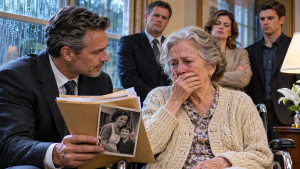
He reached into his briefcase and removed a faded photograph.
It showed a young woman standing outside a grocery store beside a thin boy holding a paper bag.
It was me.
And the boy was Daniel.
“You told me something I’ll never forget,” he said.
“You told me that being poor wasn’t something to be ashamed of, and that no child should ever have to beg for a meal.”
I began crying.
Daniel gently held my hand.
“That little boy grew up. He finished school, became a lawyer, invested in healthcare, and eventually built a company that now owns several nursing homes and medical facilities.”
I stared at him.
“You did all that?”
He smiled.
“Because somebody once believed I was worth saving.”
Then he looked around my small room.
His smile disappeared.
“Mrs. Harris, why are you living here?”
I lowered my head.
“My children say they can’t look after me anymore.”
He looked at the empty chair beside my bed.
“How often do they visit?”
I didn’t answer.
He understood.
Then he opened his briefcase again.
“I came here to thank you, but yesterday I discovered something about your family that I think you deserve to know.”
He placed a thick folder on my lap.
My name was printed across the front.
Beneath it were copies of legal documents, bank statements, and a property agreement.
My hands began trembling.
“Daniel, what is this?”
He took a deep breath.
“Mrs. Harris, your children didn’t place you here because they couldn’t afford to look after you.”
He paused.
“They placed you here because they wanted access to something you still own.”
And when he turned to the first page, I saw my late husband’s name.
## PART 2: THE DOCUMENT THEY HID FROM ME
I stared at the folder.
My husband, William, had passed away only three months earlier.
Before his death, he had owned a small commercial property in downtown Portland.
It wasn’t a mansion.
It wasn’t a fortune.
But the property had been in our family for almost thirty years.
William had always told me the same thing.
“Eleanor, whatever happens to me, never sign that building away. It’s your security for the rest of your life.”
After he died, Robert offered to help manage the paperwork.
He told me there were taxes, insurance payments, and legal matters to settle.
I trusted him.
He was my oldest child.
Daniel opened the folder.
“Your husband left the property entirely to you. The documents confirm that.”
I nodded.
“Yes. William wanted me to have it.”
“Do you know what your children have been doing with it?”
I shook my head.
Daniel showed me a copy of a proposed sale agreement.
The property was valued at nearly $1.8 million.
My mouth fell open.
“Why didn’t anyone tell me?”
“Because they were negotiating a sale without your informed approval.”
He turned another page.
There were emails between Robert and a real estate investor.
One message caught my attention.
It read:
“Once Mom is settled permanently, we’ll have enough time to complete the paperwork. She won’t be able to interfere.”
I felt something inside my chest collapse.
I read it again.
My own son had written those words.
Daniel placed another document in front of me.
“This is even more concerning.”
It was a proposed application for legal guardianship.
Robert had been collecting medical records and statements suggesting that I could no longer manage my financial affairs.
Linda had contacted an assisted-living facility to ask about long-term placement.
Thomas had provided a written statement about my supposed memory problems.
I looked up.
“I forget things sometimes. I’m seventy-one. But I’m not helpless.”
Daniel nodded.
“I know. And nothing I’ve seen establishes that you lack the ability to make your own decisions.”
I began shaking.
“Why would my children do this?”
He didn’t answer immediately.
Instead, he showed me a bank statement.
Over the previous six months, several withdrawals had been made from an account I had once shared with William.
The amounts were small at first.
Then they became larger.
Together, they totaled more than $86,000.
I recognized the account.
I had never authorized those withdrawals.
“Who took this money?”
Daniel pointed to the transaction records.
“Your son Robert had access to the account. We’re still verifying the circumstances, but the transfers appear to have benefited accounts connected to your children.”
I covered my face.
I had spent my entire life protecting them.
Now I was discovering that they might have been taking advantage of me.
Then Daniel said something that made my blood run cold.
“There’s another reason I came today.”
He took out his phone and played a recorded voicemail.
It was from Linda.
Her voice filled the room.
“Robert, we need to finish this before Mom starts asking questions. Thomas says the nursing home can provide another report about her condition. Once the guardianship is approved, everything becomes easier.”
The recording ended.
I couldn’t speak.
Daniel gently put his phone away.
“Mrs. Harris, I don’t want you to make any decisions while you’re frightened. But I do want you to understand that you have rights.”
I looked at him.
“What happens now?”
“First, we arrange an independent lawyer to represent you. We secure your financial records, review the property documents, and make sure nobody can make decisions on your behalf without proper legal authority.”
I wiped my tears.
“Will my children know?”
Daniel nodded.
“They may already suspect someone is investigating.”
At that moment, my phone began ringing.
The screen displayed Robert’s name.
I stared at it.
For three weeks, I had waited for that call.
Now that it had finally come, I was afraid to answer.
Daniel looked at me.
“You’re allowed to take your time.”
I pressed the green button.
“Hello, Robert.”
His voice sounded unusually cheerful.
“Mom! How are you feeling?”
“I’m all right.”
“Good. Listen, Linda and Thomas are coming tomorrow. We need you to sign a few documents so we can take care of Dad’s property.”
I glanced at the folder.
“What documents?”
He laughed nervously.
“Nothing complicated. Just some paperwork. Don’t worry your head about it.”
Then he added:
“Oh, and don’t tell anyone about the property. We want to keep things within the family.”
I looked at Daniel.
He silently shook his head.
I took a deep breath.
“Robert, I think I need to read everything first.”
There was a long silence.
Then his voice changed.
“Mom, why are you suddenly acting like you don’t trust us?”
Before I could respond, he hung up.
Daniel closed the folder.
“Now we know they’re aware something has changed.”
But he wasn’t finished.
He reached into his briefcase and removed one final envelope.
It had been delivered to his company’s legal department that morning.
And the name on the return address belonged to the man who had been negotiating to purchase my husband’s building.
Daniel looked directly into my eyes.
“Mrs. Harris, there’s something else you need to know. The buyer isn’t a stranger to your family.”
He turned the envelope over.
Written on the back were four words:
**THEY ALREADY RECEIVED THE MONEY.**
## PART 3: THE FAMILY SECRET THAT CHANGED EVERYTHING
I couldn’t breathe.
“Received what money?”
Daniel opened the envelope.
Inside was a copy of a private investment agreement.
The property had apparently been used as security for a proposed business transaction.
My children had told the investor that they were authorized to manage the building.
But I had never signed the agreement.
The investor had already transferred a substantial deposit to a company connected to Robert.
Daniel explained that the transaction was now under legal review.
“Your children may have exposed themselves to serious legal consequences,” he said. “But we need to establish exactly what happened before drawing conclusions.”
I stared at the papers.
“Can they take my house?”
“No one should be able to take your property without lawful authority. We’ll make sure your rights are protected.”
For the first time in months, I felt someone was standing beside me.
But I still had one question.
“Daniel, why are you doing all this? You already thanked me. You owe me nothing.”
He smiled sadly.
“Do you remember what happened after you gave me those sandwiches?”
I searched my memory.
He continued.
“You found out that I was sleeping behind the store. You contacted a local shelter and helped me get a place to stay. You even bought me a winter coat with your own money.”
I remembered.
It had been a freezing winter.
Daniel had been shivering beneath a cardboard box.
I had only done what I thought any decent person should do.
He reached into his wallet and removed a small photograph.
It showed a twelve-year-old boy wearing a blue winter coat.
“I kept this picture for forty years,” he said.
“You were the first adult who made me feel that my life mattered.”
I began crying again.
Daniel continued.
“I searched for you for years. When I finally found your name through an old school record, I wanted to surprise you. I never expected to find you living in a place where your own children barely visited.”
He stood up.
“Mrs. Harris, I can’t replace your family. But I can make sure you’re safe.”
Over the next several days, Daniel arranged an independent legal team to review my financial situation.
They discovered that several documents had been prepared using information I had never knowingly authorized.
My bank accounts were secured.
The proposed property transaction was challenged.
An independent doctor evaluated me and confirmed that I was capable of making my own personal and financial decisions.
I also received a full copy of my husband’s estate documents.
Everything William had left me was still legally mine.
Then, on Friday afternoon, my three children arrived together.
Robert entered first.
Linda followed, carrying a bouquet of flowers.
Thomas stood behind them.
“Mom!” Linda exclaimed, pretending to be delighted. “We’ve missed you.”
I looked at the flowers.
They were beautiful.
But I remembered the three empty chairs.
Robert placed a folder on the table.
“We brought the documents. If you sign them today, everything will be easier.”
I didn’t reach for the pen.
Instead, I said quietly:
“Before I sign anything, I want to ask you three questions.”
They exchanged glances.
“Why did you stop visiting me?”
Nobody answered.
“Why did you tell me you couldn’t afford the parking fees?”
Robert sighed.
“Mom, we’ve all been busy.”
I nodded.
“Then why were you preparing documents to take control of my property while telling everyone I couldn’t manage my own affairs?”
Their expressions changed.
Linda turned pale.
Thomas looked at Robert.
Robert immediately became defensive.
“Who told you that?”
I pointed toward the doorway.
Daniel entered, accompanied by my independent attorney.
Robert’s face turned red.
“This is a family matter!”
My attorney calmly replied:
“Your mother’s financial and legal rights are her own. She has every right to independent representation.”
Robert looked at me.
“Mom, you’re making a terrible mistake. We’re only trying to help you.”
I looked at the three people I had once considered the most important people in my world.
Then I said something I had never imagined saying to my children.
“I spent forty years making sure you never went without. But somewhere along the way, you began believing that everything I owned belonged to you.”
Nobody spoke.
I continued.
“I don’t need expensive gifts. I don’t need daily phone calls. I only wanted my children to sit beside me when I woke up from surgery—or visit me when I was lonely.”
My voice trembled.
“But you couldn’t even give me that.”
Linda started crying.
Thomas lowered his head.
Robert looked away.
I pushed their folder back across the table.
“I’m not signing anything today.”
My attorney explained that all proposed transactions would be reviewed independently and that any unauthorized transfers would be investigated.
My children left without another word.
I watched them disappear down the hallway.
It hurt.
More than I could describe.
But for the first time, I wasn’t afraid of losing everything simply because I had grown old.
Six weeks later, I moved into a small apartment near a beautiful garden.
Daniel’s company helped me find suitable accommodation, but I paid my own expenses and kept control of my finances.
I began attending a weekly community lunch program.
Sometimes I volunteered there, serving meals to elderly people and families who needed a little help.
One afternoon, Daniel visited.
He brought the old photograph of us outside Franklin grocery store.
“I have something for you,” he said.
It was a framed copy of the photograph, with a handwritten message beneath it:
**”To the woman who fed a hungry boy and unknowingly gave him a future. I never forgot.”**
I held the frame against my chest.
Then I asked him:
“Daniel, do you think I should forgive my children?”
He sat beside me.
“Forgiveness is your decision, Mrs. Harris. But forgiveness doesn’t mean giving someone permission to hurt you again.”
I looked out at the garden.
For years, I had believed that being a good mother meant giving everything, even when it left me with nothing.
Now I understood something different.
Love should never require you to surrender your dignity.
My children eventually began sending messages.
I answered some.
Others I left unanswered.
Perhaps one day, we would rebuild our relationship.
But it would have to begin with honesty, responsibility, and respect.
And every time I thought about that little boy behind the grocery store, I remembered something important:
Sometimes the person who remembers your smallest act of kindness will stand beside you when the people you sacrificed everything for walk away.
**THE END.**