My Husband Sold the Family Clock After My Mother’s Funeral — But the Man Who Bought It Returned Three Days Later With a Photograph That Changed Everything
PART 1 — THE EMPTY SPACE ABOVE THE FIREPLACE
The first thing I noticed after my mother’s funeral was that the grandfather clock was missing.
It had stood in our living room for forty-two years.
My father had bought it for my mother on their tenth wedding anniversary.
Every Sunday, she polished its wooden frame and carefully wound the brass mechanism.
When my father died, she refused to let anyone move it.
She used to say, “As long as that clock keeps ticking, a little piece of your father is still here.”
So when I returned from the funeral reception and saw an empty space above the fireplace, I immediately knew something was wrong.
My husband, Mark, was sitting at the kitchen table.
He didn’t look up.
“Where’s my mother’s clock?”
“I sold it.”
I stared at him.
“You did what?”
“It was old, Eleanor.”
“It belonged to my mother.”
“And now your mother is gone.”
His words felt like a slap.
I had spent the previous three weeks caring for my mother, arranging her medication, and sleeping beside her hospital bed.
Mark had complained every time I missed dinner.
Now he had sold the one thing she had asked me to protect.
“Who bought it?”
“An antique dealer.”
“Where?”
“I don’t remember.”
I knew he was lying.
My mother had left me a small inheritance, and Mark had been asking about it for months.
He said we needed to replace the roof and pay off some debts.
I had refused to touch the money until the estate was settled.
I suddenly wondered whether selling the clock had been another way of taking something from me.
I called my brother, David.
He was furious when I told him.
“Mom made you promise to keep that clock.”
“I know.”
“Then find out where Mark sold it.”
That evening, Mark finally admitted he had sold it to a collector named Mr. Harrison.
He had received $8,000.
I asked where the money was.
He said it had gone toward household expenses.
But our bank account showed no such payment.
The following morning, I visited the antique shop listed on the receipt I found in Mark’s jacket.
The owner confirmed the clock had been purchased.
He also told me something unexpected.
“The buyer asked us to contact him if anyone from your family came looking for it.”
He handed me a business card.
There was a handwritten message on the back.
“Please tell Eleanor that the clock has finally brought me to the family I’ve been searching for.”
I read it twice.
Then I called the number.
A man answered.
“Hello?”
“My name is Eleanor Parker.”
He became silent.
Then he asked:
“Did your mother ever tell you that she had a son before she married your father?”
My knees nearly gave way.
PART 2 — THE MAN IN THE PHOTOGRAPH
I sat in my car for several minutes before calling him back.
His name was Thomas Reed.
He was sixty-one years old.
He explained that he had been adopted as a baby and had spent most of his adult life searching for his birth mother.
His adoption records had listed a woman named Margaret as his biological mother.
But he had never known her married name.
Three months earlier, he had discovered an old photograph in his adoptive father’s belongings.
It showed a young woman standing beside a grandfather clock.
On the back was a handwritten note:
“To my little Thomas, so one day you’ll know where your story began.”
The woman in the photograph was my mother.
I could barely breathe.
Thomas told me he had recognized the clock when he saw it advertised by the antique dealer.
He purchased it immediately because he believed it might contain something that could help him find his birth family.
I asked him why he had written that the clock brought him to our family.
He answered quietly.
“Because I found a letter hidden inside it.”
I froze.
“What letter?”
“Your mother’s handwriting is on the envelope.”
I asked him to meet me.
We arranged to see each other that afternoon at a small café.
When Thomas arrived, he carried a brown folder.
He looked nervous.
I recognized my mother’s eyes in his face.
He placed an old envelope on the table.
My name was written across the front.
I opened it carefully.
Inside was a letter dated thirty-seven years earlier.
“Dear Eleanor,
If Thomas ever finds this letter, please don’t turn him away.
I was young when I gave birth to him.
My parents told me I had ruined my future and that the baby would have a better life with another family.
I believed them.
I told myself I was doing the right thing.
But I never stopped thinking about him.
Your father knew the truth.
He helped me keep a small photograph and this letter inside the clock because I was afraid I would lose the only memories I had.
I wanted to find Thomas, but every time I came close, fear stopped me.
If he ever comes home, please tell him I loved him.
Even when I couldn’t hold him, I loved him.
Mom.”
I couldn’t read the last line.
Thomas stared at the table.
“She knew about me?”
I nodded.
“She never stopped loving you.”
He wiped his eyes.
“Then why didn’t she find me?”
I reached across the table.
“I don’t know, Thomas.”
“But I wish she had.”
He told me that his adoptive parents had died several years earlier.
They had loved him deeply, but he had always felt that a missing piece of his life remained unanswered.
He had never wanted money or an inheritance.
He simply wanted to know where he came from.
Then he showed me another document.
It was a photograph of a small silver bracelet.
On the back was an engraving:
THOMAS — MAY 14.
I recognized it.
My mother had kept a matching photograph in her bedside drawer.
For thirty-seven years, she had carried that image.
I realized then that the clock hadn’t just been furniture.
It had been holding a part of my mother’s life that she had never found the courage to share.
But I still had one question.
“Why did you buy the clock instead of contacting the family through the dealer?”
Thomas looked at me.
“Because I wanted to be certain before I brought this into anyone’s life.”
Then he reached into the folder and showed me the original purchase receipt.
The clock had been sold for $8,000.
But the dealer’s records showed that Thomas had paid an additional $12,000 to restore it.
He had also paid to preserve the hidden compartment and its contents.
“I didn’t buy it because it was valuable,” he said.
“I bought it because it was the last thing she touched every Sunday.”
I began crying.
Then my phone rang.
It was Mark.
“Where are you?”
“Meeting someone.”
“Come home. We need to discuss the money.”
I looked at Thomas.
Then I answered:
“The money isn’t the most important thing anymore.”
PART 3 — THE CLOCK STARTS TICKING AGAIN
Thomas came home with me.
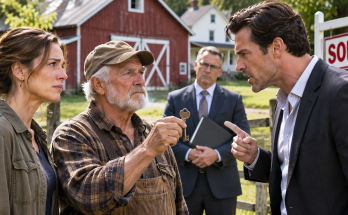
When Mark opened the door and saw the grandfather clock behind us, his expression changed.
“What is that doing here?”
I placed the restoration documents on the table.
“Thomas bought it.”
Mark frowned.
“Then he can keep it.”
Thomas stepped forward.
“I don’t want to keep something that belongs to your family.”
Mark looked confused.
Thomas continued.
“I’m Margaret’s first son.”
The room became silent.
Mark stared at me.
“Your mother had another child?”
“Yes.”
“And she never told us?”
“She told me today.”
Mark looked uncomfortable.
Then he turned toward Thomas.
“Well, that doesn’t change the fact that the clock was sold legally.”
I looked at him.
“That isn’t what this is about.”
Mark shrugged.
“Then what is it about?”
I took out the bank statement I had printed that morning.
The $8,000 from the sale had never gone toward our household expenses.
It had been transferred into an account Mark had opened without telling me.
He looked at the paper.
His face changed.
I asked him one question.
“Where is the money?”
He tried to explain.
He said he had intended to use it to settle a personal loan.
He said he had planned to tell me later.
But I had heard enough.
For months, he had treated my mother’s final days as an inconvenience.
Now he had sold her most treasured possession and hidden the money.
I told him I wanted the account records and the full amount returned.
Then I asked him to leave the room.
I needed time to decide what would happen to our marriage.
Mark walked away without another word.
Thomas stood beside the clock.
He gently opened the small hidden compartment.
Inside was another envelope.
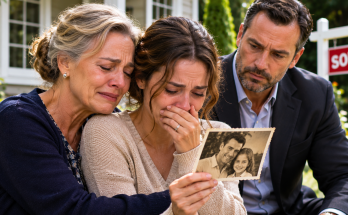
It contained a photograph of my mother holding a newborn baby.
On the back, she had written:
“My Thomas. The first person who taught me what love meant.”
Thomas held the photograph against his chest.
For several minutes, he couldn’t speak.
I placed my hand on his shoulder.
“You’re not alone anymore.”
He looked at me.
“Do you think I can call you my sister?”
I smiled through my tears.
“I think you’ve been my brother for sixty-one years.”
He laughed.
And then we both cried.
A few weeks later, Thomas returned with the restored clock.
The scratches had been carefully repaired.
The brass pendulum shone again.
He refused to accept any payment for the restoration.
Instead, he asked if we could place it in the living room where our mother had kept it.
We did.
David came over that afternoon.
He stared at Thomas for a long moment before walking forward and embracing him.
“Mom would have been so happy to see you.”
Thomas closed his eyes.
“I wish I had found her sooner.”
David answered:
“She would have wanted you to know that you were loved.”
That evening, the clock began ticking again.
Its familiar sound filled the house.
For the first time since the funeral, the living room didn’t feel empty.
I placed my mother’s photograph beside it.
Underneath, I put a small frame containing her letter.
Thomas visited every Sunday after that.
We learned about his childhood.
He learned about ours.
We discovered that he had inherited our mother’s love of gardening and our father’s habit of telling terrible jokes.
Mark and I eventually separated.
The money from the clock was returned, and I decided that I would no longer ignore the things that had been hurting me.
But the greatest change wasn’t losing a husband or finding a hidden brother.
It was discovering that my mother had left behind a piece of her heart that had been waiting for someone to find it.
On the first anniversary of her death, Thomas and I sat together beside the clock.
He listened to its steady ticking.
Then he whispered:
“Hello, Mom. I’m home.”
And I knew that somewhere inside that old wooden clock, a story that had been silent for thirty-seven years had finally found its ending.
THE END
Sometimes the most precious things we inherit aren’t objects or money. They’re the truths that help us understand the people we loved.
A hidden story can divide a family for years, but honesty and compassion can give people a second chance to belong.
If you discovered that your mother had secretly given up a child decades ago, would you welcome that person into your family without hesitation?