My Brother Sold Our Mother’s Beloved Farm While She Was in the Hospital—But the Old Caretaker Refused to Hand Over the Keys
PART 1 — THE SON WHO SOLD EVERYTHING
My mother had owned the family farm for forty-two years.
It was a beautiful property with a white farmhouse, a red barn, an orchard, and a small lake behind the fields.
My father had built the place with his own hands.
After he died, my mother refused to sell it.
She always said, “This land holds more memories than money could ever replace.”
My brother, Kevin, never understood that.
He lived in the city, drove expensive cars, and constantly complained that the farm was wasting his inheritance.
I was the one who visited our mother every weekend.
I repaired the fences, paid the workers, and took her to medical appointments.
Then, one winter morning, Mother suffered a stroke and was admitted to the hospital.
While I stayed beside her bed, Kevin called a family meeting.
He arrived with a real estate agent and announced that he had found a buyer for the farm.
I was furious.
“You can’t sell it without Mom’s permission.”
Kevin smiled.
“I’m handling the paperwork. You don’t understand business.”
I reminded him that Mother was still the legal owner.
He waved his hand dismissively.
“The buyer has already paid a deposit. We just need to finish the transfer.”
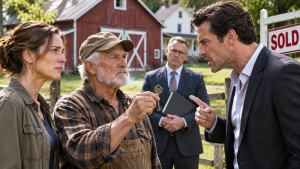
That afternoon, I drove to the farm and found a large SOLD sign beside the entrance.
The old caretaker, Samuel, was standing near the gate.
He had worked for our family for thirty years.
When I told him what Kevin had done, he shook his head.
“Your brother came here yesterday,” he said. “He brought a locksmith and demanded the keys.”
“What happened?”
Samuel looked toward the farmhouse.
“I refused.”
Then he reached into his coat and handed me a small brass key.
“Your father told me to give you this if anyone ever tried to sell the farm without your mother’s permission.”
I stared at it.
“What does it open?”
Samuel looked frightened.
“The room your father never allowed anyone to enter.”
PART 2 — THE ROOM BEHIND THE OLD BARN
The brass key opened a narrow wooden door behind the barn.
Inside was a small office filled with dusty shelves, old photographs, and boxes of documents.
I had never seen the room before.
Samuel explained that my father had built it shortly before he died.
He had asked Samuel to keep it locked until Mother was ready to see what was inside.
On the desk sat a brown envelope with my name written across it.
My hands trembled as I opened it.
Inside was a letter from my father.
He explained that the farm had been placed into a family trust years earlier.
My mother had the right to live there and manage the property during her lifetime.
But neither of her children could sell it or use it as collateral without following the trust’s legal requirements.
There was also a document naming an independent trustee.
I immediately contacted the attorney whose name appeared on the papers.
He confirmed that the trust was valid and that the attempted sale could not proceed without the required authorization.
But the letter contained something else.
My father had created a fund from the farm’s original timber business.
The money was intended to maintain the property and support the workers who had spent their lives caring for it.
The fund had been managed independently.
I looked at Samuel.
“Did Kevin know about this?”
Samuel shook his head.
“He knew your father had kept some papers here. That’s why he wanted the room opened.”
Suddenly, my phone rang.
It was Kevin.
“You need to stop interfering,” he shouted. “The buyer is coming tomorrow.”
I told him the sale was being reviewed by the trust’s attorney.
He went silent.
Then he said, “You have no idea what you’re doing.”
I looked at the old letter.
“Neither did you.”
The next morning, Kevin arrived at the farm with the buyer and two agents.
He walked straight toward the farmhouse, carrying a folder.
But Samuel was already waiting at the gate.
And behind him stood the attorney.
PART 3 — THE KEYS THAT WERE NEVER HIS
Kevin jumped out of his car.
“What is this?”
The attorney introduced himself and explained that the attempted sale had been placed on hold pending a formal review of the property’s ownership and trust restrictions.
Kevin became furious.
“You can’t stop this. I’m her son!”
The attorney calmly replied, “Being someone’s son does not give you authority to sell property you do not own.”
The buyer looked uncomfortable.
He asked Kevin whether he had disclosed the trust.
Kevin didn’t answer.
The attorney then showed him the original documents.
The farm was not part of Kevin’s personal inheritance to sell.
It was protected by the family trust.
The buyer immediately withdrew from the transaction until everything could be legally clarified.
Kevin turned toward me.
“You did this to embarrass me!”
I shook my head.
“No. Dad made these arrangements long before either of us knew what would happen.”
Then I showed him the letter.
Kevin read it silently.
For the first time, he seemed to understand that our father had anticipated exactly this kind of situation.
But I wasn’t finished.
I told Kevin that the financial records would also be reviewed because the deposit he had received from the buyer appeared to have gone into his personal account.
The attorney explained that any money received through an unauthorized transaction would need to be accounted for.
Kevin’s face changed.
He had expected to walk away with a fortune.
Instead, he was facing difficult questions about the money.
A week later, Mother was well enough to return home.
I helped her sit on the porch overlooking the orchard.
Samuel brought her favorite blanket.
She looked at the old farmhouse and began to cry.
“Your father would have been heartbroken if this place had disappeared.”
I held her hand.
“It hasn’t, Mom.”
Kevin eventually came to visit.
He apologized, although it took him a long time to admit that he had been wrong.
Mother didn’t immediately forgive him.
She simply told him that the farm was never meant to make either child rich.
It was meant to remind us where we came from.
Months later, we repaired the old barn and reopened the farm’s small roadside market.
Samuel continued working there.
Mother planted new apple trees beside the ones my father had planted decades earlier.
And I kept the brass key on a hook beside the kitchen door.
Not because I wanted to remember the betrayal.
But because it reminded me of something my father understood long before I did:
Some things are worth protecting, even when the people closest to you forget their value.