For twenty-four years, my father introduced my half-brother as his only child—until the morning he saw me step through the doors of a national security summit wearing the stars of a U.S. Army colonel. He laughed at my uniform, told me to stay away from his company’s government clients, and ordered me to pretend we had never met. Then a four-star general crossed the crowded reception hall, ignored my father completely, and walked straight toward me. “Colonel,” he said, “we’ve been waiting for you.” My father’s smile vanished when he realized the woman he had erased from his family was the person everyone else in the room had come to hear.
PART 1 — THE DAUGHTER HE ERASED
My name is Claire Bennett.
For twenty-four years, my father, Richard Bennett, had treated me as though I were an embarrassing chapter he had successfully closed.
When I was six, my parents divorced.
When I was eight, my father stopped coming to my school events.
At thirteen, I mailed him a birthday card.
It came back unopened.
By sixteen, I had stopped trying.
Meanwhile, my father built a powerful life.
He became the founder of Bennett Strategic Technologies, a defense-contractor company that grew from a small engineering firm into a multimillion-dollar corporation.
And while he built his empire, he built another family.
A wife named Meredith.
A son named Tyler.
At company banquets and charity events, Tyler was introduced proudly.
“Our only son.”
I heard those words more than once.
Eventually, they stopped hurting.
I had my own life.
I graduated from West Point.
I entered the Army.
I worked my way through increasingly difficult assignments.
I learned to lead people who were older than me.
I spent years earning every promotion.
By thirty-six, I had become a colonel.
My father still didn’t know.
Not because I wanted to hide it.
Because he had never bothered to ask.
Then came the National Defense Innovation Summit in Washington.
Senior military officers, lawmakers, diplomats, technology executives, and defense leaders were scheduled to attend.
I was there as part of a military delegation advising on a new secure communications initiative.
My invitation had been personally approved by the office coordinating the summit.
I expected a long day of meetings.
I did not expect my father to be standing in the reception line.
He was wearing a black tuxedo beside Meredith and Tyler.
Tyler was showing his mother a new watch.
Then he looked up.
His eyes landed on me.
He laughed.
“Well, look who’s here.”
My father turned.
For one second, he stared at me.
I saw genuine shock.
Then it disappeared.
“What are you doing here?”
I looked at him calmly.
“Good morning, Dad.”
Tyler looked at my uniform.
“Dad?”
He laughed.
“She’s actually calling you Dad.”
Meredith looked uncomfortable.
Richard stepped closer.
“This is a private business event for people connected to our contracts.”
“I know.”
“Then whatever brought you here, keep your distance.”
I looked at the silver eagle insignia on my uniform.
“You don’t have to worry about me.”
“I do.”
He lowered his voice.
“Important clients are here today. I don’t want family drama.”
I almost smiled.
“Family drama?”
He leaned closer.
“Pretend you don’t know us.”
After twenty-four years of rejection, I had imagined this moment many times.
In those fantasies, I would finally demand an explanation.
Instead, I simply nodded.
“All right.”
I turned away.
A young event coordinator tried to redirect me toward a secondary entrance.
“Military personnel check-in is across the hall.”
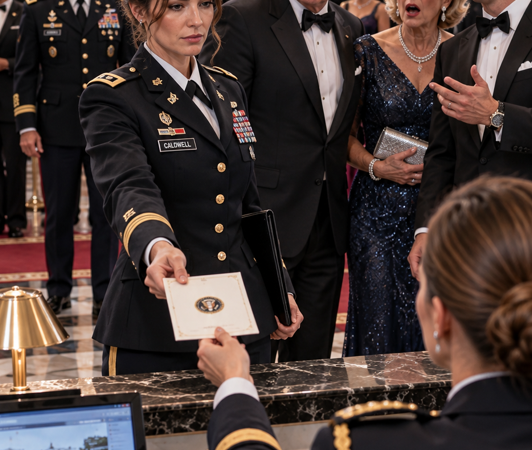
I handed her my invitation.
She scanned it.
Then looked at the screen.
Her expression changed.
“Oh.”
She immediately straightened.
“Colonel Bennett, I’m so sorry.”
“It’s fine.”
“No, ma’am. Your access is through the principal reception.”
I followed her.
Behind me, I heard Tyler laugh.
“See? Some military assistant got a fancy badge.”
Richard chuckled.
“I told you.”
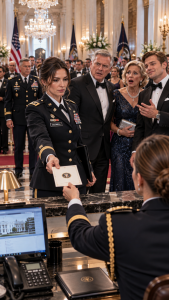
Then I reached the main checkpoint.
The officer scanned my identification.
A second later, she stopped.
“Colonel, please wait.”
She touched her earpiece.
“Command, Colonel Bennett has arrived.”
Silence.
Then:
“Understood.”
The officer stepped aside.
“General Marcus Rowan is coming to receive you.”
My father turned around.
His smile faded.
The doors at the end of the corridor opened.
A four-star general entered.
He walked past dozens of executives.
Past diplomats.
Past my father.
Straight toward me.
“Colonel Bennett,” he said warmly.
“General.”
He shook my hand.
“Thank you for coming. We need your briefing before the afternoon session.”
The entire reception area had gone quiet.
My father stared.
Tyler’s mouth was slightly open.
Meredith looked from me to Richard.
And I realized something.
My father had spent twenty-four years deciding that I wasn’t important.
He had no idea how important I had become to people who actually knew me.
PART 2 — THE NAME ON THE SCREEN
General Rowan led me into the conference room.
I took my seat beside officers from three branches of the military and several senior technology advisers.
The summit began.
For the next two hours, I presented the findings our team had spent months developing.
The room was focused.
Questions were direct.
I answered them.
After the briefing, one of the senior officials leaned toward me.
“Colonel Bennett, your team solved a problem we’ve been struggling with for almost a year.”
“Thank you, sir.”
Outside the room, Richard was waiting.
He approached me with an expression I hadn’t seen since childhood.
Uncertainty.
“So you’re really a colonel?”
I looked at him.
“Yes.”
“How long?”
“Several years.”
“And you never told me?”
I almost laughed.
“You never asked.”
He looked uncomfortable.
Tyler stepped in.
“So what? She wears a uniform.”
Richard immediately agreed.
“Exactly.”
I looked at Tyler.
“You’re right.”
Then I walked away.
But Richard followed.
“Claire.”
I stopped.
“What?”
“We should talk.”
“About what?”
“Your career.”
“What about it?”
He glanced around.
“My company is working on a major government contract.”
“I know.”
“And you are connected to the people evaluating it.”
“I advise a military program. I don’t award contracts.”
“I understand.”
“No, you don’t.”
His jaw tightened.
“This company supports hundreds of employees.”
“That has nothing to do with me.”
He lowered his voice.
“I am your father.”
I looked directly into his eyes.
“That’s something you should have remembered twenty-four years ago.”
He went silent.
Then Meredith approached.
She looked nervous.
“Claire, we’re not here to fight.”
“I know.”
“We only want what’s best for the family.”
I smiled sadly.
“You don’t get to use the word family only when you need something.”
Richard’s expression hardened.
“Be careful.”
“Why?”
“You’re speaking to your father.”
“No.”
I looked toward the conference room.
“I’m speaking to a businessman who spent decades pretending his daughter didn’t exist.”
Then I walked away.
I thought that was the end of it.
It wasn’t.
That afternoon, an internal review of Bennett Strategic Technologies began.
Not because of me.
Because auditors had discovered irregularities in one of the company’s subcontracting chains.
A procurement officer asked me to remain available as a military adviser.
I agreed.
As the review continued, more documents surfaced.
Payments to consulting firms.
Unusual subcontracting agreements.
Missing compliance records.
None of it was something I had personally investigated.
But my professional responsibilities required me to report what I knew.
When Richard learned about the review, he called me.
“You’re doing this.”
“No.”
“You’re trying to destroy me.”
“I have not accused you of anything.”
“You’re my daughter.”
“Now I’m your daughter?”
Silence.
He lowered his voice.
“Claire, please.”
It was the first time he had ever said please to me.
I closed my eyes.
“I hope you didn’t do anything illegal.”
“I didn’t.”
“Then you have nothing to fear.”
He hung up.
Three days later, General Rowan asked me to attend another meeting.
When I entered, Richard was already there.
This time, he wasn’t wearing a tuxedo.
He looked exhausted.
Tyler was beside him.
Meredith sat in the corner.
The general closed the door.
“Colonel Bennett, we’ve completed the first stage of the review.”
Richard stared at the table.
The general continued.
“There are serious questions surrounding the company’s financial disclosures.”
Tyler immediately interrupted.
“My father didn’t know about those.”
The general looked at him.
“We aren’t discussing your father’s intentions.”
He placed a folder on the table.
“We’re discussing the evidence.”
I looked at Richard.
He didn’t look back.
Then the general said something that changed the room.
“Colonel Bennett, your name appears in the original compliance reports.”
I frowned.
“My name?”
“Yes.”
Richard finally looked up.
“They used her credentials?”
The general nodded.
“They did.”
I felt the room go cold.
Someone had used my military identity to support documents connected to Bennett Strategic Technologies.
Documents I had never signed.
Documents I had never seen.
And suddenly the investigation wasn’t only about Richard’s company.
Someone had tried to connect me to it.
Someone had expected my father’s daughter to be expendable.
But they had made one mistake.
They forgot I knew how to investigate.
PART 3 — THE DAUGHTER WHO STOPPED HIDING
I spent the next several weeks cooperating with investigators.
I provided travel records.
Military records.
Emails.
Every document needed to prove I had never authorized the transactions.
Eventually, investigators traced the false approvals to a senior executive inside my father’s company.
That executive had been diverting contracts through shell vendors.
But there was another discovery.
Tyler’s private company had received payments from one of those vendors.
Richard had known about the payments.
He claimed he didn’t know where they originated.
Investigators were not convinced.
The family that had spent years treating me like an outsider was suddenly fighting to explain itself.
One evening, Richard asked to meet me.
We sat in a quiet room overlooking the city.
No lawyers.
No cameras.
No employees.
Just the two of us.
He looked older than I remembered.
“I failed you.”
I said nothing.
“I told myself I was protecting my reputation.”
Still nothing.
“When your mother left, I convinced myself that starting over meant leaving the past behind.”
“You didn’t leave the past behind.”
He looked at me.
“You abandoned it.”
He nodded.
“I know.”
“And then you built another family.”
His eyes filled with tears.
“I was ashamed.”
“Of me?”
“Of myself.”
That answer surprised me.
For years, I had imagined my father believed I wasn’t good enough.
Now I realized he had spent years running from the consequences of his own choices.
“I don’t hate you,” I said.
He looked at me.
“I don’t know if I can be your daughter in the way you want.”
“I understand.”
“But I can stop carrying your rejection.”
He nodded slowly.
That was the closest thing we had ever had to an honest conversation.
The investigation eventually cleared me completely.
The company faced regulatory consequences, leadership changes, and major financial losses.
Richard stepped down.
Tyler was forced to explain his involvement.
Meredith disappeared from public events.
And the family that had once mocked my uniform stopped laughing.
Months later, I returned to the same government building for another briefing.
This time, I entered through the same principal doors.
The same security officer recognized me.
“Welcome back, Colonel Bennett.”
“Good morning.”
As I walked through the reception hall, I noticed something unexpected.
My father was there.
He wasn’t attending a private event.
He wasn’t surrounded by executives.
He was simply waiting.
When he saw me, he stood.
“Claire.”
I stopped.
“I wanted to see you before you left.”
“Why?”
He reached into his pocket.
He pulled out an old envelope.
“My first letter to you.”
I stared at it.
“I wrote it twenty years ago.”
“You never sent it.”
“No.”
“Why?”
He swallowed.
“Cowardice.”
I took the envelope.
For a long moment, neither of us spoke.
Then he said,
“I can’t change what I did.”
“No.”
“But I can stop pretending it didn’t happen.”
I nodded.
“That matters.”
He smiled faintly.
“I’m proud of you.”
Those words should have healed everything.
They didn’t.
But they mattered.
Because this time, I didn’t need them.
I had already built a life without his approval.
I had earned my rank.
My reputation.
My friendships.
My place in the world.
And when the reception doors opened behind me, General Rowan called out:
“Colonel Bennett, we’re ready for you.”
I turned toward him.
Then I looked once more at my father.
“I have to go.”
He nodded.
“I know.”
I walked toward the conference room.
Not as the forgotten daughter of a wealthy businessman.
Not as the little girl waiting for her father to call.
But as a woman who had built a life he had never imagined.
For twenty-four years, my father believed erasing my name would make me disappear.
Instead, I became someone the world knew before he did.
And that was the greatest irony of all.
He spent his life trying to make me feel like I wasn’t important enough to belong at his table.
Years later, he watched me walk through a room where generals, diplomats, and executives stood to hear me speak.
I didn’t need revenge.
I didn’t need to embarrass him.
I didn’t even need his apology.
I only needed him to finally understand what I had learned long ago:
Being forgotten by someone who never knew your worth doesn’t make you worthless.
Sometimes it simply gives you the freedom to become someone they can never erase again.