Part 1 — The Piano Nobody Wanted
I bought the piano because nobody else wanted it.
It was sitting in the corner of an estate sale, covered with a faded white sheet.
The sign on it read:
$150 — MUST GO TODAY
The piano was old.
The wood was scratched.
Several keys were yellowed.
One of the pedals was broken.
But when I lifted the lid and pressed a key, it produced a surprisingly beautiful note.
I asked the estate-sale worker why it was so cheap.
She shrugged.
“The family just wants it gone.”
“Does it work?”
“Mostly.”
I had always wanted a piano.
So I paid the $150 and arranged for a delivery company to bring it to my house.
That evening, I cleaned it.
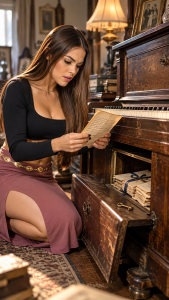
While wiping dust from the back panel, I noticed something strange.
One of the wooden panels didn’t sit correctly.
I pressed against it.
Nothing.
I tried again.
Click.
The panel moved.
Behind it was a narrow compartment.
I thought I’d found an old storage space.
Instead, I found a bundle of letters.
They were tied together with faded blue ribbon.
There were about twenty of them.
Each envelope had a date written on it.
The oldest was from 1947.
The newest was from 1953.
I opened the first one.
It was written by a woman named Eleanor.
The letter was addressed to someone named Thomas.
It wasn’t a love letter.
It was a confession.
Eleanor wrote about a wealthy family in the city and a large amount of money that had supposedly disappeared decades earlier.
She claimed the family patriarch had hidden the money before his death.
But according to the letter, the money wasn’t the real secret.
There had been valuable documents involved.
Documents that could prove several properties had been illegally transferred.
I read another letter.
Then another.
The story became clearer.
Eleanor had worked for the family.
Thomas had been the family’s piano tuner.
Together, they had discovered evidence of fraud.
They planned to expose it.
Then, suddenly, the letters stopped.
The final envelope was different.
It had no address.
Only one sentence written across the front:
“If you’re reading this, they never found the piano.”
I stared at those words.
Then I looked at the piano.
There was something else inside the compartment.
A small brass key.
And a handwritten note:
“The music will tell you where to look.”
I had no idea what that meant.
Until I sat down and played the piano.
One key sounded different from the others.
It produced a slightly duller note.
I pressed it again.
Then again.
Something clicked inside the piano.
A hidden drawer opened beneath the keyboard.
Inside was another envelope.
But this time, my name was written on it.
Part 2 — The Letters
I couldn’t understand how my name could be on a letter hidden inside a piano I’d purchased that afternoon.
I opened the envelope carefully.
Inside was a note.
“You probably bought this piano because you thought it was cheap.”
I stared at the handwriting.
It was old.
But the message had clearly been written for whoever eventually discovered the compartment.
The note continued:
“The piano belonged to my grandfather. He was Thomas.”
I froze.
Thomas.
The piano tuner from the letters.
I read the rest.
Thomas had kept the letters hidden because he believed someone was still searching for them.
The family involved in the fraud had powerful connections.
When Eleanor disappeared, Thomas realized the documents were too dangerous to keep at home.
So he hid them inside the piano.
The piano was eventually sold.
Then resold.
Then passed from one owner to another.
For decades, nobody knew what was inside.
Until me.
I searched the letters again.
There were references to several properties.
One address appeared repeatedly.
I recognized it.
It was a historic building downtown that had recently been sold for millions of dollars.
According to the letters, the property had originally belonged to Eleanor’s family.
It had supposedly been transferred through a forged document in 1951.
If the letters were authentic, the entire ownership history could be challenged.
I contacted an attorney.
He told me not to touch anything else until the documents could be authenticated.
The next morning, I brought him the letters.
He examined them carefully.
“These could be extremely valuable.”
“How valuable?”
“Potentially more than the piano.”
That wasn’t exactly what I wanted to hear.
“Why?”
“Because if these documents are authentic, they may establish a chain of evidence involving property fraud.”
He asked me where I got them.
I told him about the estate sale.
He immediately advised me to contact the estate’s executor.
I did.
The executor seemed shocked.
“I didn’t know there were letters inside the piano.”
“Did the family know about Thomas?”
“Yes.”
“Then why was the piano sold?”
He hesitated.
“Because nobody wanted it.”
I asked about the woman who had owned it.
Her name was Margaret.
She had recently died.
According to the executor, Margaret had no children.
But she had left one instruction in her will:
“Do not sell the piano until the family records have been reviewed.”
The executor admitted that instruction had been overlooked.
I asked him why.
He said the family had been dealing with dozens of belongings and wanted the house emptied quickly.
Then he said something that bothered me.
“Someone specifically asked whether the piano had been sold.”
“Who?”
“I don’t know.”
That evening, I returned home.
The piano was sitting in my living room.
The letters were locked in my desk.
I was about to go upstairs when I heard something.
A faint sound.
One piano key had moved.
I walked over.
The key was slowly vibrating.
I hadn’t touched it.
Then I noticed something underneath it.
A second brass key.
This one was smaller.
Attached to it was a tiny metal tag.
Three words were engraved on it:
STORAGE ROOM 17.
I searched the address from the letters.
It led to an old train station building that had been converted into private storage units.
I went there the next morning with my attorney.
Unit 17 was still registered under Margaret’s name.
The manager opened it.
Inside were several dusty boxes.
Most contained ordinary family belongings.
Then we found a wooden trunk.
Inside were property deeds.
Bank records.
Photographs.
And one newspaper from 1951.
The headline described the sudden disappearance of Eleanor.
But tucked inside the newspaper was another letter.
This one was written by Thomas.
It said:
“Eleanor did not run away.”
My heart sank.
Then I read the next line.
“She was taken because she knew where the original deed was hidden.”
My attorney looked at me.
“Where?”
I turned the page.
Thomas had written the answer.
But before we could read it, we heard someone outside the storage unit.
Someone was walking toward us.
Part 3 — What the Piano Was Hiding
The footsteps stopped outside.
My attorney closed the trunk.
The storage manager appeared.
“Everything all right?”
I nodded.
But something felt wrong.
The manager looked at the trunk.
Then at me.
“Did you find anything important?”
My attorney answered before I could.
“Just old family papers.”
The manager stared at us for several seconds.
Then he walked away.
We waited.
After he left, my attorney opened the letter again.
Thomas had written:
“The original deed was never kept in the storage room.”
Below that was a handwritten clue.
“Find the song Eleanor played when she said goodbye.”
We had no idea what that meant.
Until I remembered the piano.
The note said:
“The music will tell you where to look.”
I returned home.
I searched through the letters.
One mentioned a song Eleanor played whenever she was frightened.
Another mentioned the same melody.
I sat at the piano and played the sequence described in the letter.
Three keys.
Then two.
Then five.
When I pressed the final key, I heard a metallic click.
The bottom panel of the piano opened.
Behind it was a narrow metal tube.
Inside the tube was an old rolled document.
The original deed.
The ink was faded.
But the signatures were still visible.
The deed proved that the property had belonged to Eleanor’s family.
The later transfer documents were fraudulent.
My attorney immediately contacted the appropriate authorities and preservation specialists.
The documents were authenticated.
The story became much bigger than I had expected.
The property had changed hands several times over the decades.
Each transfer had relied on records that appeared legitimate.
But the original deed exposed the first fraudulent transfer.
Eleanor had discovered it.
Thomas had hidden the evidence.
And Margaret had spent the final years of her life preserving the trail.
The family that had benefited from the fraudulent transfers eventually faced a major legal dispute.
The property ownership was challenged.
Several historical records were corrected.
And Eleanor’s name was finally restored to the family history.
But there was still one question.
What happened to Eleanor?
My attorney found the answer in an old immigration record.
Eleanor had escaped the city in 1951.
She had changed her surname.
She moved across the country.
She married.
She had children.
And she lived quietly until she died decades later.
She had never disappeared mysteriously.
She had simply disappeared from the people who wanted to silence her.
The piano had traveled through several families before eventually ending up at Margaret’s estate.
And Margaret had apparently known exactly what it contained.
I eventually learned why she had left the instruction about the piano.
She didn’t want the evidence destroyed.
She wanted it to eventually reach someone who would care enough to investigate.
I kept the piano.
Not because it was valuable.
It wasn’t.
The legal experts estimated the piano itself was worth only a few hundred dollars.
But the letters and documents changed everything.
One afternoon, I sat down and played it.
The same old keys.
The same imperfect sound.
I thought about Eleanor.
Thomas.
Margaret.
Three generations of people who had protected the truth.
Then I noticed something I’d never seen before.
Inside the piano’s wooden frame was a tiny inscription.
It read:
“Some things are worth keeping, even when nobody understands why.”
I smiled.
The piano had cost me $150.
But what I found inside it was worth far more than money.
It gave a forgotten woman her story back.
And it taught me something I’ll never forget:
Sometimes the most valuable thing hidden in an old object isn’t treasure.
It’s the truth someone was brave enough to preserve.