Part 1 — “Grandma Would Have Wanted Me to Have It”
The day Grandma’s will was read, my sister, Claire, walked into the attorney’s office already expecting to be rich.
She sat beside me and smiled.
“Whatever Grandma left us, we’ll split it fifty-fifty,” she whispered.
I nodded quietly.
I had never cared much about the money.
Grandma had raised me after our parents divorced. She was the person who stayed when everyone else left.
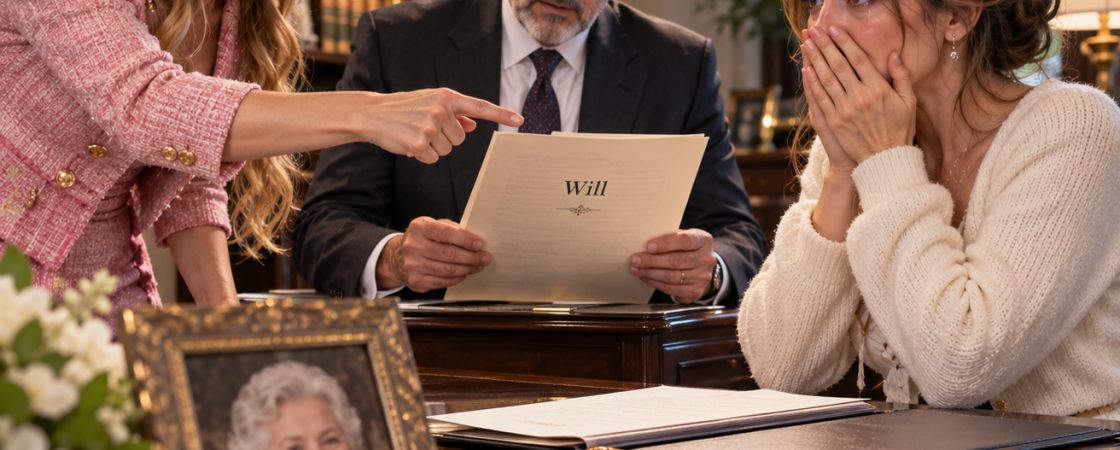
The attorney opened the envelope.
“According to your grandmother’s final will, her estate is being divided as follows…”
Claire leaned forward eagerly.
Then the attorney said my name.
“The family home, the investment accounts, and the majority of Grandma’s personal assets are being left to Emily.”
Claire’s smile disappeared.
“What?”
The attorney continued reading.
“Claire receives the jewelry box specified in the attached memorandum, but no financial inheritance.”
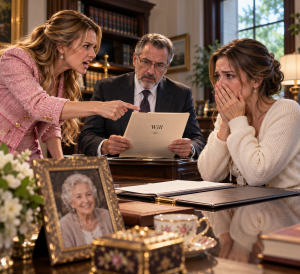
Claire jumped to her feet.
“That can’t be right!”
The attorney calmly placed the will on the table.
“It is legally valid.”
Claire turned toward me.
“You knew about this!”
“I didn’t.”
“You manipulated Grandma!”
I stared at her.
“I didn’t even know she had changed her will.”
Claire slammed her hand onto the table.
“I want half.”
The attorney shook his head.
“You cannot simply demand half of an inheritance.”
Claire pointed at me.
“She is my sister. Grandma would never have wanted her to keep everything.”
The attorney was silent for a moment.
Then he opened a second folder.
“There is actually a letter from your grandmother explaining her decision.”
Claire suddenly stopped arguing.
The attorney looked directly at her.
“And I strongly recommend that you read it before making any further accusations.”
He slid the envelope across the table.
Claire reached for it.
But before she opened it, the attorney said:
“There is one reason your grandmother specifically excluded you.”
Claire’s face went pale.
Part 2 — Grandma’s Letter
Claire slowly opened the envelope.
Inside was a handwritten letter.
Grandma had written it only two months before she died.
“My dear Emily, if you’re reading this, I am no longer here to protect you.”
My eyes immediately filled with tears.
Claire continued reading.
Grandma explained that she had watched both of us carefully over the years.
She knew I had helped pay her medical bills.
I had driven her to appointments.
I had repaired things around the house.
I had even turned down a promotion once because she needed someone to stay with her.
But Claire had rarely visited.
Still, that wasn’t why Grandma had excluded her.
The next paragraph changed everything.
Grandma wrote that several months earlier, she had discovered that money was missing from her account.
At first, she thought it was a banking mistake.
Then she found the records.
Several large withdrawals had been made while she was hospitalized.
The withdrawals had been authorized using information only a close family member would know.
Claire shook her head.
“No.”
The attorney placed copies of the bank records on the table.
Grandma had investigated quietly.
She discovered the money had been transferred into an account connected to a credit card company.
Claire stared at the documents.
“I didn’t steal anything.”
The attorney didn’t accuse her.
He simply said,
“Your grandmother believed otherwise.”
Claire looked at me.
“You think I stole from Grandma?”
“I never said that.”
The attorney opened another envelope.
“There is more.”
Inside was a handwritten list of dates and amounts.
Grandma had recorded every withdrawal.
Then she had written one final note:
“I confronted the person responsible. They promised me it would never happen again.”
Claire’s face suddenly changed.
The room became completely silent.
I looked at her.
“You knew about this?”
She whispered,
“I borrowed the money.”
“Borrowed?”
“I was going to pay it back.”
The attorney asked,
“How much?”
Claire looked down.
“About forty-eight thousand dollars.”
I couldn’t believe it.
But then the attorney pulled out one final document.
A repayment agreement.
It had Claire’s signature.
And the date was from three weeks before Grandma died.
Claire had apparently promised to repay everything.
She never did.
Then the attorney said something that made my stomach drop.
“Your grandmother didn’t exclude you because she hated you.”
He looked at Claire.
“She excluded you because she wanted to make sure the inheritance could never be used to cover that debt.”
Claire began crying.
But the attorney wasn’t finished.
“There was another reason.”
Part 3 — The Real Reason
The attorney opened Grandma’s final document.
It wasn’t about the money.
It was about the house.
Grandma had discovered that Claire had been telling relatives that the family home would eventually belong to her.
She had even tried to convince Grandma to sign papers giving her control over the property.
Grandma refused.
Instead, she quietly changed the estate plan.
She left the house to me because she knew I was the one who had promised to keep it in the family.
Then came the final sentence of her letter:
“I am not punishing Claire. I am protecting what I worked my entire life to preserve.”
Claire covered her face.
“I was desperate,” she whispered.
I looked at her.
“You should have told me.”
“I was embarrassed.”
“And Grandma?”
“She knew.”
The attorney nodded.
“She knew everything.”
Claire finally asked the question she’d been avoiding.
“Can I still get anything?”
The attorney explained that the will gave her the specific personal items Grandma had named, but not the financial assets or property.
Claire sat silently.
I could have walked away.
I could have kept everything and never spoken to her again.
Instead, I told her,
“I’ll help you repay what you owe.”
She looked at me in surprise.
“But I’m not giving you half of Grandma’s inheritance.”
Claire nodded through her tears.
“I understand.”
Months later, I moved into Grandma’s old house.
I kept her kitchen exactly the way she had left it.
Her favorite teacup still sat beside the window.
And above the fireplace, I placed a framed copy of her final letter.
Not because I wanted everyone to know I had inherited the house.
But because I finally understood what Grandma had really left me.
It wasn’t the money.
It wasn’t the property.
It was the responsibility to protect the family memories she had spent her entire life building.
And at the bottom of her letter, Grandma had written one final line:
“An inheritance isn’t what you receive after someone dies. It’s what they trusted you to protect while they were alive.”