Part 1 — The Confession
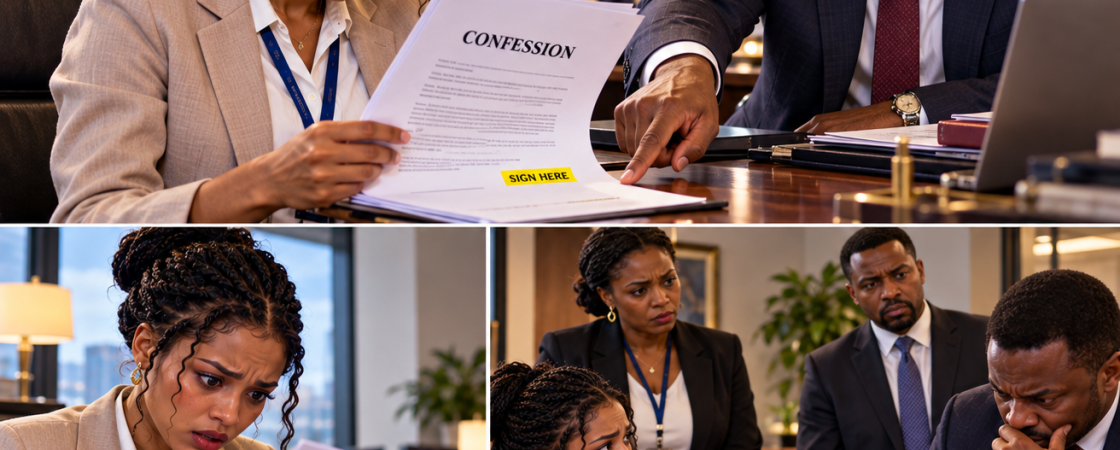
My boss called me into his office at 4:30 on Friday afternoon.
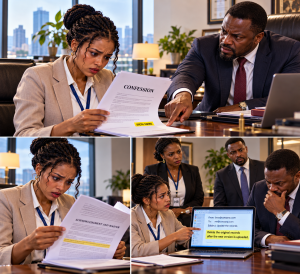
A document was sitting on his desk.
“Sign this.”
I picked it up.
It was a confession.
According to the document, I had admitted to altering company financial records and causing a major loss.
I looked at him.
“I didn’t do this.”
He leaned back.
“You can sign voluntarily, or we can make this much harder for you.”
“I want to speak with HR.”
“You can do that after you sign.”
I read the first page again.
It was written in formal legal language.
The document claimed that I had deliberately changed several financial records.
But I knew the records.
I had only followed instructions from my manager.
“I won’t sign something that isn’t true.”
His expression hardened.
“You have until five o’clock.”
I looked at the clock.
4:42 PM.
Then I noticed something.
The document was twelve pages long.
My boss had placed a sticky note on the first page.
SIGN HERE.
I turned to the final page.
My boss immediately reached across the desk.
“Don’t worry about that.”
I looked at him.
“Why not?”
“It’s just standard language.”
I smiled.
“Then you won’t mind if I read it.”
He became visibly uncomfortable.
I turned to the last page.
There was a section titled:
ACKNOWLEDGMENT AND WAIVER
I read the first paragraph.
Then the second.
My eyes widened.
I looked up at him.
“You want me to waive my right to challenge this confession?”
“Just sign it.”
I kept reading.
Then I found something even more important.
The final page referenced an attached investigation report.
I had never been given the report.
I looked at my boss.
“Where is the investigation?”
He didn’t answer.
I closed the document.
Then I said:
“Before I sign anything, I think you should read the last page yourself.”
Part 2 — The Last Page
My boss stared at me.
“What are you talking about?”
I turned the document around and pointed to the final paragraph.
It stated that by signing, I would acknowledge that I had received and reviewed the company’s internal investigation.
I hadn’t.
Then I noticed the date.
The investigation was supposedly completed three days earlier.
But the records I had worked on weren’t even finalized until yesterday.
That meant something was wrong.
I asked:
“Who conducted this investigation?”
“Myself and HR.”
“Then where is the report?”
He became irritated.
“Stop asking questions and sign.”
I pulled out my phone.
“I’d like to document that you’re asking me to sign a statement admitting wrongdoing without giving me the investigation.”
His expression changed.
“Put your phone away.”
“No.”
He stood up.
“You’re making a serious mistake.”
I looked at the clock.
4:51 PM.
Then someone knocked on the door.
It was the HR director.
She stepped inside.
“What’s happening?”
My boss pointed at me.
“She refuses to sign the confession.”
The HR director looked at the document.
“Who prepared this?”
My boss hesitated.
“I did.”
She picked it up.
Then she turned to the last page.
Her expression changed.
“This says the employee received the investigation report.”
My boss nodded.
“She has.”
I looked at him.
“No, I haven’t.”
The HR director turned toward him.
“Where is the report?”
He didn’t answer.
She looked through the document.
“There’s another problem.”
She pointed to a paragraph near the bottom.
“This says the employee voluntarily accepts responsibility.”
Then she looked at me.
“Did you ever admit responsibility?”
“No.”
The HR director looked at my boss.
“Then this document can’t be represented as a completed confession.”
My boss became angry.
“You don’t understand the situation.”
“Then explain it.”
He couldn’t.
I pulled a second folder from my bag.
“I think I can.”
Inside were copies of emails between my boss and me.
One email contained his original instructions.
Another contained the exact financial changes he was now accusing me of making.
And there was one final email.
It had been sent the day before.
My boss had written:
“Delete the original records after the new version is uploaded.”
The HR director stared at the message.
“Did you write this?”
My boss went silent.
I looked at him.
“You forgot one thing.”
“What?”
“I kept copies.”
Part 3 — The Confession He Never Got
The company launched a formal investigation.
The original records were recovered from the system backup.
The audit trail showed that the changes had been made using my boss’s account.
My emails showed that I had followed his instructions.
And the confession he had demanded from me contained statements that contradicted the company’s own records.
The HR director later told me something that surprised me.
“My boss had been trying to make you take responsibility before the audit was completed.”
“Why?”
“He knew the audit would show who actually made the changes.”
Everything suddenly made sense.
He wasn’t trying to document the truth.
He was trying to create a version of the truth before the evidence arrived.
My boss was removed from the project while the investigation continued.
I was completely cleared.
But the document he had demanded I sign became important evidence itself.
Because of the last page.
The waiver showed exactly what he had been trying to make me surrender.
My job.
My reputation.
And my ability to challenge the accusation.
Months later, I was offered a promotion.
I accepted, but I remembered that Friday afternoon.
My boss had been confident.
He thought the first page would scare me into signing.
He never expected me to read the entire document.
Especially the part he thought I would ignore.
And that’s what saved me.
He wanted me to sign his version of the truth.
Instead, the last page helped expose why he needed me to sign it.