Part 1 — The Drawings
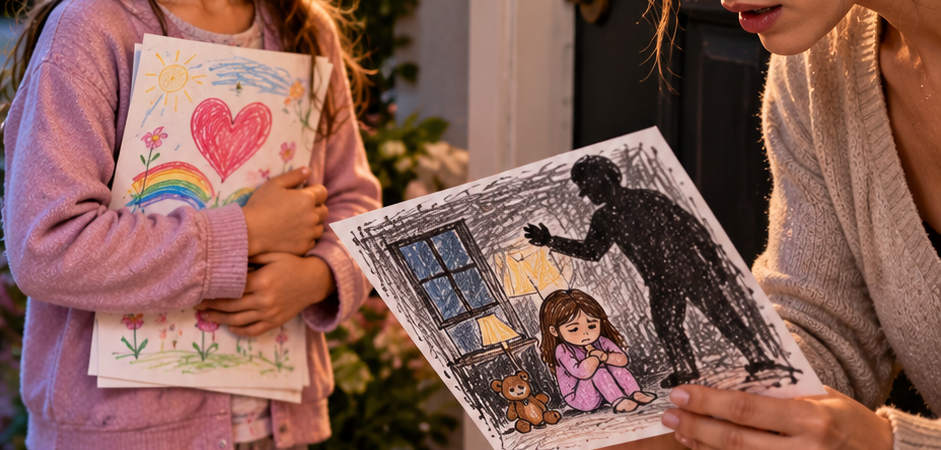
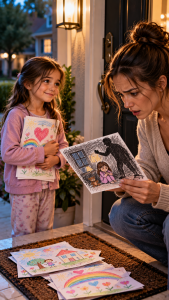
The first drawing appeared on my doorstep on a Tuesday morning.
It was made with crayons.
A bright yellow sun.
A blue house.
Three flowers.
And a little girl standing beside a woman.
At the bottom, the girl had written:
“This is my family.”
I smiled when I saw it.
I assumed one of the neighborhood children had left it there by accident.
But the next morning, another drawing appeared.
This one showed the same house.
Except there was something strange.
The windows were colored completely black.
I didn’t think much of it.
Until the little girl appeared at my door that afternoon.
She was around seven years old.
She stood several feet away, holding another piece of paper.
“Is this yours?” she asked.
“No. Is it yours?”
She nodded.
“Why do you keep leaving them here?”
She looked toward the house next door.
Then she whispered:
“Because my mom doesn’t want me to talk to people.”
I crouched down.
“Are you okay?”
She smiled nervously.
“Yes.”
But she didn’t sound convincing.
She handed me another drawing.
This one showed a bedroom.
A little girl was sitting on a bed.
There was a large black shape outside the door.
And beside the door was a clock.
The hands pointed to 11:30.
I looked at her.
“What happens at 11:30?”
She immediately took the drawing back.
“I have to go.”
She ran toward her house.
That evening, I couldn’t stop thinking about it.
At exactly 11:30 PM, I heard something next door.
A loud crash.
Then a woman’s voice.
Then silence.
I looked through my window.
The lights in the house next door were off.
The following morning, another drawing was waiting outside my door.
This time, there were no flowers.
No sunshine.
No smiling faces.
Just a dark house.
And a little girl standing behind a window.
She had drawn herself with one hand raised against the glass.
Underneath, in shaky handwriting, were four words:
“Please call someone.”
I immediately went next door.
I knocked.
A woman answered.
She smiled politely.
“Can I help you?”
I looked behind her.
The little girl was standing at the top of the stairs.
Our eyes met.
She quickly shook her head.
No.
Don’t say anything.
The woman noticed.
“What do you want?”
I held up the drawing.
“Your daughter left this at my door.”
The woman’s smile disappeared.
She took the paper from my hand.
Then she closed the door.
I stood there confused.
A few seconds later, I heard the little girl whisper from inside:
“Don’t leave me.”
Part 2 — What the Drawings Were Saying
I called the police.
When they arrived, the woman insisted everything was fine.
Her daughter was safe.
There was no emergency.
The officers spoke with the girl separately.
When she came outside, she wouldn’t say anything.
She just looked at me.
Then she slipped a folded piece of paper into my hand.
I waited until the officers left.
Then I opened it.
It was another drawing.
This time, the picture showed the inside of the house.
There was a staircase.
A bedroom.
A locked door.
And a small rectangle beneath the stairs.
She had drawn an arrow pointing toward it.
I realized something.
The drawings weren’t random.
She was trying to show me the house.
I studied every picture she had left.
The black windows.
The locked door.
The staircase.
The clock.
The hidden space beneath the stairs.
I compared them with the view from my own window.
The layout matched.
That evening, I heard another crash.
Then I heard the little girl crying.
I called the police again.
This time, they returned with additional officers.
The mother opened the door.
She became angry when she saw me.
“You need to stop interfering with my family.”
One officer asked if they could speak with her daughter.
She refused.
That raised concerns.
The officers entered the home to make sure the child was safe.
A few minutes later, one of them called me over.
They had found something.
Beneath the staircase was a small storage area.
Inside was a locked wooden box.
The mother claimed she didn’t know how it got there.
The officers opened it.
Inside were dozens of the girl’s drawings.
But they weren’t drawings of imaginary things.
They were pictures of real events.
Arguments.
Broken furniture.
The girl hiding under her bed.
A man standing outside the house late at night.
And one drawing showed the mother crying while a strange man stood behind her.
The officers asked the girl who the man was.
She finally spoke.
“He comes when Dad isn’t home.”
Everyone became silent.
The girl’s mother started crying.
She told the officers that her husband had been controlling and violent.
She had been afraid to tell anyone.
The man in the drawings wasn’t her husband.
He was someone connected to him.
Someone who had been threatening the family.
The girl had been drawing everything because she didn’t know how else to ask for help.
Then she handed the officer one final drawing.
It showed the little girl standing outside my house.
She was holding a piece of paper.
Behind her was a large black shadow.
The officer asked:
“Who is that?”
The girl pointed toward the street.
“He was watching our house.”
The police immediately checked the neighborhood cameras.
They found footage of a man repeatedly sitting in a parked car near the house.
But there was something more disturbing.
He had also been watching my house.
Part 3 — The Drawing That Saved Them
The police identified the man.
He had a connection to the girl’s father.
He had been helping him intimidate the family after the mother tried to leave.
The father had been away for several days, but he was expected to return.
The police arranged protection for the mother and daughter.
The little girl was finally allowed to tell the truth without being afraid.
She explained why she had started leaving drawings at my door.
“I knew you were nice.”
I asked her how she knew.
She smiled.
“You always say hello to me.”
That simple answer broke my heart.
She had been looking for someone she trusted.
And because she couldn’t safely speak, she used drawings.
The investigators found enough evidence to intervene before the situation became worse.
The mother and daughter eventually moved to a safer home.
Before they left, the little girl came to my door one last time.
She was holding a drawing.
It showed two houses.
One was dark.
The other was bright.
Between them stood a little girl holding hands with a woman.
Above them was a huge yellow sun.
I smiled.
“What does this one mean?”
She said:
“It means we’re safe now.”
Then she gave me a hug.
I kept that drawing.
Months later, I heard from her mother.
They were doing well.
The little girl had started attending a new school.
She had also joined an art class.
Her mother told me something I’ll never forget.
“She still draws every day.”
I asked what she was drawing.
“She mostly draws flowers now.”
I smiled.
The little girl who once used drawings to ask for help was finally drawing things because she wanted to.
I kept every picture she had left at my door.
The first one.
The dark house.
The bedroom.
The hidden space.
And the final picture.
Sometimes I look at them together.
At first, they seemed like simple children’s drawings.
But they weren’t.
They were a language.
A frightened child had found the only way she could communicate safely.
And someone finally listened.
The most important drawing wasn’t the one that revealed what was happening inside her house.
It was the one she drew afterward—when the house was finally safe.