
Part 1 — The Empty Seat
I still remember the empty chair.
It was graduation day.
My mother sat in the audience holding a bouquet of flowers.
My friends were surrounded by their families.
Parents were taking photographs.
Everyone was smiling.
Except me.
My father’s seat was empty.
He had promised me he would come.
For months, he’d told me:
“I wouldn’t miss it for anything.”
But three days before graduation, he called.
“I can’t come.”
I laughed because I thought he was joking.
“Dad, you’re coming.”
“No.”
His voice sounded different.
“Why?”
“I just can’t.”
“Are you sick?”
“No.”
“Then what’s wrong?”
He didn’t answer.
I remember standing in my bedroom, still wearing my graduation gown, staring at the wall.
“You promised.”
“I know.”
“Why won’t you come?”
He whispered:
“Someday you’ll understand.”
Then he hung up.
I didn’t speak to him for weeks.
Eventually, we started talking again.
But I never forgave him.
For twenty years, I believed my father simply didn’t care enough about me.
I built my career.
Got married.
Had children.
My father remained part of my life, but there was always a distance between us.
Whenever I mentioned graduation, he changed the subject.
Then, twenty years later, he died.
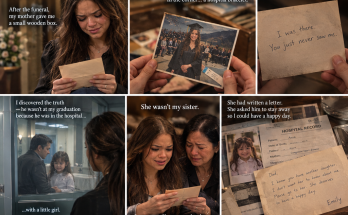
After the funeral, my mother handed me a small wooden box.
“This belonged to your father.”
Inside were old photographs.
My childhood drawings.
My first school report.
And an envelope.
My name was written on it.
I opened it.
Inside was a photograph of my graduation ceremony.
I was standing on the stage.
My mother was in the audience.
But my father wasn’t.
Then I noticed something strange.
In the corner of the photograph was a hospital bracelet.
I turned it over.
On the back, my father had written:
“I was there. You just never saw me.”
Part 2 — What He Never Told Me
I immediately called my mother.
“What does this mean?”
She went silent.
“Mom?”
Finally, she said:
“Your father didn’t tell you because he made me promise.”
“Promise what?”
“That I would never tell you unless he died.”
My heart started pounding.
“What happened that day?”
My mother began to cry.
On graduation morning, my father had actually left home early.
He had bought flowers.
He had a camera.
And he had written me a letter.
He planned to surprise me.
But on the way to the university, he received a phone call.
My younger brother had been involved in a serious accident.
He was in the hospital.
My father rushed there.
The doctors said my brother needed emergency surgery.
My father stayed beside him.
He never told me because he didn’t want my graduation day to become the day I remembered my brother almost dying.
“But why didn’t he tell me afterward?” I asked.
My mother wiped her eyes.
“Because your father believed you would blame yourself.”
I couldn’t speak.
She handed me another envelope.
It contained the letter my father had written to me twenty years earlier.
I opened it.
“My daughter,
I’m sorry I won’t be sitting in the audience today.
I know you will be disappointed.
But I need you to know something.
I have never been more proud of you.”
I kept reading.
“Today isn’t about me.
It’s about everything you’ve accomplished.
Please don’t let my empty chair make your achievement feel smaller.”
Then came the sentence that broke me.
“If you ever think I wasn’t there because I didn’t care, please remember that sometimes a father has to choose between being physically present and protecting the people he loves.”
I put the letter down.
My mother reached into the wooden box again.
There was another photograph.
This one showed my father sitting beside my brother in a hospital room.
He was still wearing the suit he’d planned to wear to my graduation.
And beside him was the bouquet of flowers he had bought for me.
They were sitting in a hospital vase.
My father had written underneath:
“For my daughter, even if I can’t give them to her today.”
I started crying.
For twenty years, I had been angry at him.
For twenty years, he had carried the guilt of missing that day.
And neither of us had known the whole truth.
But my mother wasn’t finished.
“There is something else.”
She handed me a final envelope.
“This was written only a few months before he died.”
Part 3 — The Empty Chair
I opened the final letter.
My father’s handwriting had become shaky.
“I don’t know if I will have the courage to tell you everything myself.”
He explained that after my graduation, he had wanted to tell me the truth.
But my brother’s recovery had been difficult.
Then came financial problems.
Then other family responsibilities.
Every time he tried to explain, he convinced himself there would be a better moment.
Years passed.
The secret became harder to reveal.
He wrote:
“Eventually, I realized something terrible.”
“I had allowed one painful misunderstanding to become twenty years of silence.”
He apologized.
Not for missing my graduation.
But for letting me believe that his absence meant I wasn’t important.
Then he wrote:
“You were never second to anyone.”
I pressed the letter against my chest.
The man I had spent twenty years resenting had spent those same twenty years believing he’d failed me.
My mother then gave me the final photograph.
It showed my father outside the hospital on graduation day.
He was standing beside his car.
Still holding the flowers.
The university was visible in the distance.
He had apparently driven there after my brother’s surgery.
He had arrived too late.
The ceremony was already over.
But he had stood outside anyway.
My father had never entered.
He simply stood there and watched students leave.
On the back of the photograph were seven words:
“I wish she knew I was there.”
I cried harder than I had at his funeral.
Not because I was angry.
Because I finally understood.
My father had missed one of the most important moments of my life.
But he hadn’t missed it because he didn’t love me.
He missed it because someone else he loved was fighting for his life.
And instead of telling me, he carried the burden alone.
A few months later, I returned to my university.
I walked across the same campus where I had graduated twenty years earlier.
I found the place where my family had taken photographs.
Then I sat down on a bench.
I took my father’s old letter from my bag.
For the first time, I didn’t see the empty chair as proof that he had abandoned me.
I saw it as proof that he had been somewhere else, making a choice he thought would protect our family.
I wish he had told me.
I wish I had asked more questions.
I wish we had twenty years back.
But we didn’t.
So I did something my father never got to do.
I forgave him.
And before leaving, I placed a single flower on the bench.
The same kind of flower he had bought for me twenty years earlier.
Then I whispered:
“Dad, I finally understand.”
And for the first time since my graduation day…
the empty chair didn’t hurt anymore.