MY BROTHER SOLD MY MOTHER’S HOUSE—THEN THE BUYER KNOCKED ON MY DOOR
PART 1 — THE HOUSE WASN’T HIS TO SELL
The first thing the buyer said to me was:
“I’m sorry, but your mother told me you would already know.”
I stared at him through my doorway.
“I don’t know you.”
He held up a set of keys.
“These belong to the house on Willow Street.”
My heart stopped.
That was my mother’s house.
The house where I had grown up.
The house she had spent thirty-five years paying for.
The house my brother, Daniel, had promised me he would never sell.
“My brother sold it?”
The man nodded.
“Three weeks ago.”
I felt dizzy.
“My mother died four months ago.”
“I know.”
“Then why did Daniel sell the house?”
The man hesitated.
“Because he told me he inherited it.”
I laughed bitterly.
“He didn’t.”
The buyer reached into his coat and pulled out a folder.
“That’s why I’m here.”
Inside was a copy of the sale agreement.
Daniel’s signature was at the bottom.
So was my mother’s.
I stared at it.
“That isn’t her signature.”
The man looked at me.
“That’s what I thought.”
He turned to another page.
“This is the document your brother used to prove ownership.”
I read it.
A transfer of the property from my mother to Daniel.
Dated two years before her death.
But there was something wrong.
My mother had been in the hospital that entire month.
She couldn’t even hold a pen.
I looked at the buyer.
“Where did you get this?”
“From your brother.”
Then he handed me a small envelope.
My name was written on it in my mother’s handwriting.
My hands began shaking.
I opened it.
Inside was one sentence:
“If Daniel ever sells the house, look beneath the kitchen floor.”
I drove to the house that night.
The buyer had agreed to let me inside.
Everything was exactly as I remembered.
The blue curtains.
The old dining table.
My mother’s clock.
Then I noticed something strange.
One floorboard in the kitchen was newer than the others.
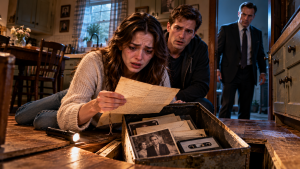
I lifted it.
Beneath it was a metal box.
Inside were bank statements, photographs, and an old cassette tape.
I found a cassette player in the pantry.
I pressed PLAY.
My mother’s voice filled the room.
“If you’re hearing this, Daniel has finally done what I feared.”
I stopped breathing.
“He thinks the house is the important thing.”
“It isn’t.”
“The important thing is what your father hid inside it.”
I stared at the walls.
My father had died twenty years earlier.
My mother continued:
“Your father didn’t die in an accident.”
The cassette clicked.
Then the lights went out.
And someone whispered from the hallway:
“You shouldn’t have found that.”
PART 2 — WHAT MY FATHER KNEW
I grabbed my phone and turned on the flashlight.
Nobody was in the hallway.
But the front door was open.
I called the police.
Then I called Daniel.
He answered immediately.
“Where are you?”
“In Mom’s house.”
Silence.
Then:
“You need to leave.”
“Why?”
“Because you don’t understand what you’re looking for.”
“You forged Mom’s signature.”
“I didn’t.”
“You sold her house.”
“I had to.”
“For what?”
He hung up.
The next morning, I took the documents to an attorney.
She examined the transfer papers for less than ten minutes.
“This signature was copied.”
“Can you prove it?”
“Yes.”
“But there’s something else.”
She pointed to the property records.
“Your mother never owned this house outright.”
I stared at her.
“What?”
“Your father placed the property in a family trust before he died.”
“Who controls the trust?”
She looked at me.
“You.”
I couldn’t speak.
My father had created the trust twenty years earlier.
He had named my mother as the lifetime beneficiary.
After her death, the property was supposed to transfer to me.
Daniel had never owned it.
Not legally.
He had sold something that never belonged to him.
But why?
That evening, I listened to the cassette again.
My mother’s voice continued.
“Your father discovered that someone inside his company was stealing money.”
“He confronted the person.”
“Then he died.”
I froze.
The person wasn’t named.
Instead, my mother said:
“Your father knew he was going to be killed.”
“He left the evidence inside the house.”
“The evidence is why they wanted the house.”
Suddenly, everything made sense.
Daniel hadn’t sold the house for money.
Someone had paid him to find what was hidden inside.
I searched the metal box again.
Behind the bank statements was a photograph.
My father was standing beside three men.
One was a former business partner.
Another was a lawyer.
The third man was Daniel.
But the photograph had been taken when Daniel was only seventeen.
On the back, my father had written:
“I trusted the wrong son.”
I couldn’t breathe.
Daniel had known.
For twenty years.
I called him.
This time, he answered.
“Tell me the truth.”
He was silent.
“Dad knew you were involved.”
“I was seventeen.”
“You knew what they were doing.”
“I didn’t understand.”
“You helped them.”
“I was scared!”
His voice broke.
Then he whispered:
“They threatened Mom.”
I froze.
“What?”
“They said if I didn’t cooperate, they’d hurt her.”
“Why didn’t you tell me?”
“Because they were watching you too.”
I sat down.
For years, I had believed Daniel was simply selfish.
Maybe he had been afraid.
But fear didn’t explain the forged documents.
“Who is behind this now?”
Daniel took a long breath.
“The lawyer.”
“Which lawyer?”
He gave me the name.
It was the same attorney who had handled my father’s estate.
The same man who had prepared the fake property transfer.
And according to Daniel…
he was still alive.
PART 3 — THE LAST PAGE
The lawyer arrived at my mother’s house the next morning.
He didn’t come alone.
Two men waited outside.
He walked into the kitchen and smiled.
“You’ve found the box.”
I didn’t answer.
He looked around.
“Your father was a stubborn man.”
“What did you do to him?”
He sighed.
“He refused to cooperate.”
“You killed him.”
“I didn’t personally kill anyone.”
The words were cold.
“But I knew what would happen.”
My hands tightened.
“Why did you want the house?”
He smiled.
“Because your father kept something here.”
“What?”
“A ledger.”
He wanted the original records proving that millions of dollars had been stolen from the company.
The ledger could expose everyone involved.
My father had hidden it.
My mother had protected it.
And now they believed I had it.
I looked at Daniel.
He was standing behind them.
His face was pale.
The lawyer smiled.
“Your brother has been very helpful.”
Daniel suddenly stepped forward.
“No.”
The lawyer turned.
“I’ve done enough.”
He pulled out his phone.
“I recorded everything.”
The lawyer’s expression changed.
Daniel had secretly recorded their conversations for months.
Every threat.
Every payment.
Every instruction.
Every admission about my father’s death.
He had finally decided to stop running.
The police arrived minutes later.
The men outside were arrested.
The lawyer was taken away.
And Daniel…
sat on the kitchen floor and cried.
“I should have told you years ago.”
I sat beside him.
“Yes.”
“I was scared.”
“I know.”
“I thought keeping quiet would protect Mom.”
“It didn’t.”
He nodded.
“No.”
We eventually discovered that my father had hidden the original ledger somewhere neither of us expected.
Inside the old kitchen clock.
The same clock my mother had kept running for twenty years.
The ledger contained everything.
Names.
Dates.
Payments.
Bank accounts.
And one final handwritten note from my father.
It was addressed to both of us.
“My children,
If you found this together, then perhaps I was wrong to think fear would always divide you.
Daniel, you made terrible choices because you were afraid.
And you must live with them.
But fear does not have to be the last choice you make.
To my daughter:
Never let anyone convince you that protecting your family means protecting their secrets.
Sometimes the greatest way to love your family is to tell the truth.”
I read the letter twice.
Then I handed it to Daniel.
He couldn’t finish it without crying.
Months later, the case against the people involved in my father’s death went to court.
The house was returned to me.
But I couldn’t live there.
Too many memories lived inside those walls.
So I sold it.
Before leaving, I stood in the kitchen one final time.
I touched the old floorboard where Mom had hidden the box.
Then I looked at the clock.
It had stopped at exactly 8:17.
The time my father had died.
I replaced the batteries.
The second hand began moving again.
Tick.
Tick.
Tick.
For the first time, it felt like the house was breathing.
Daniel stood beside me.
“What are you going to do now?”
I looked around the kitchen.
“Start over.”
He nodded.
“Can I?”
I looked at him.
“Start over?”
“With you.”
I didn’t answer immediately.
Then I said:
“You can try.”
We walked out together.
I locked the front door.
And as we reached the end of the driveway, I looked back one last time.
The curtains moved in the upstairs window.
For a second, I thought I saw my mother’s silhouette.
She smiled.
Then the curtain fell still.
I never saw her again.
But I finally understood her final message.
The house was never what she wanted me to save.
She wanted me to save the truth.
And sometimes…
the greatest inheritance a parent can leave behind isn’t money, property, or a family name.
It’s the courage to stop being afraid of what the truth will cost.