PART 1 — The Map in the Old Box
My grandfather never talked about the war.
Not because he was ashamed.
Because he believed some memories belonged only to the people who lived them.
Whenever I asked about his Army years, he would smile and say:
“The past has a way of finding you when you’re ready.”
I never understood what he meant.
Until after he passed away.
While cleaning his house, my family found an old wooden box hidden in the back of his closet.
Inside were his military belongings.
A worn uniform.
A few photographs.
His old watch.
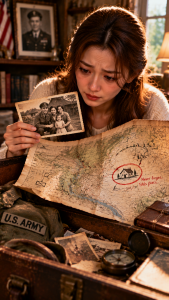
And a folded Army map.
The map was covered with markings.
Lines.
Coordinates.
Notes written in my grandfather’s handwriting.
At first, I thought it was simply a battlefield map from his service.
I almost put it away.
Then I noticed something strange.
In the corner of the map was a small circle drawn in red ink.
A tiny house symbol was marked in the middle.
Underneath it, my grandfather had written:
“Never forget this place.”
I stared at the words.
Why would a battlefield map have a house marked on it?
I looked closer.
The location wasn’t near any military position.
It was in a remote area.
A place I had never heard of.
Then I found another clue.
Tucked inside the fold of the map was a photograph.
It showed my grandfather as a young soldier.
Standing beside him was a family I didn’t recognize.
A woman.
A man.
And a little girl.
On the back of the photograph, my grandfather had written:
“The people who reminded me what I was fighting for.”
My heart started racing.
Who were these people?
Why had my grandfather hidden this map for decades?
And what was the house circled in red?
PART 2 — The House on the Map
I spent weeks trying to uncover the meaning behind the map.
I searched old military records.
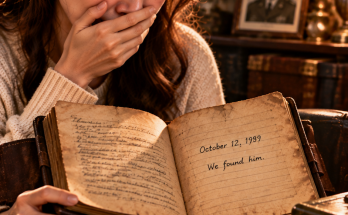
I looked through my grandfather’s journals.
Eventually, I found a small notebook hidden beneath his old uniform.
Most of it contained ordinary memories.
Names of soldiers.
Places he had visited.
Dates from his service.
But one section caught my attention.
The heading said:
“The House in the Valley.”
I began reading.
My grandfather wrote about a mission during his deployment.
His unit had moved through a remote area when they discovered a small house.
Inside lived a family who had been caught in the middle of the conflict.
The family had nowhere to go.
No food.
No way to leave.
My grandfather’s unit helped them survive.
They brought supplies.
Protected the area.
And helped them reach safety.
Then I found the sentence that made me stop.
“The little girl gave me a drawing and told me never to forget their home.”
I looked at the old photograph again.
The little girl.
The same girl standing beside my grandfather.
I turned the page.
The final entry about the family said:
“I promised I would return someday.”
But he never did.
Life moved on.
He came home.
Raised a family.
And carried the memory quietly.
I looked at the map again.
The red circle wasn’t marking a battlefield.
It was marking a promise.
But there was one question left.
Did the house still exist?
PART 3 — The Place He Never Forgot
I followed the coordinates from the map.
After hours of searching, I found the location.
The area had changed.
The roads were different.
The landscape looked unfamiliar.
But eventually, I found it.
A small house surrounded by trees.
The same house from the photograph.
I stood there holding my grandfather’s map.
An elderly woman opened the door.
I showed her the photograph.
Her hands immediately went to her face.
“Where did you get this?”
“My grandfather.”
She looked at the photograph again.
Then she smiled.
“Thomas.”
She remembered him.
Her name was Anna.
She was the little girl from the picture.
She told me about the soldier who helped her family decades earlier.
“He told me one day he would come back.”
I looked down.
“He wanted to.”
Anna smiled.
“I know.”
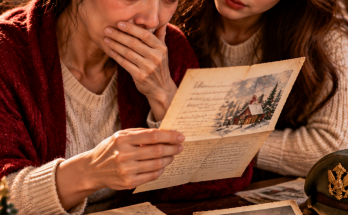
She explained that years later, my grandfather had sent letters.
He never forgot them.
He asked about their family.
He wanted to know they were safe.
Before I left, Anna gave me something.
A small wooden box.
Inside was a drawing.
A child’s drawing.
It showed a soldier standing beside a house.
At the bottom were the words:
“Thank you for protecting our home.”
I held it carefully.
For my entire life, I thought my grandfather left me an old Army map.
But it wasn’t just a map.
It was proof of a promise.
A reminder of a moment when he chose kindness during a difficult time.
When I returned home, I placed the map beside his photograph.
Underneath it, I wrote:
“Some people leave behind medals. Others leave behind the lives they changed.”
My grandfather’s greatest story wasn’t written on a battlefield.
It was written at a small house circled in red.
A place he never forgot.
A promise he carried until the end.