PART 1 — The House She Wouldn’t Sell
My grandmother made me promise something when I was twelve years old.
She took my hands, looked directly into my eyes, and said:
“No matter what happens, never sell this house.”
I laughed because I thought she was being dramatic.
The house was old.
The roof leaked.
The pipes rattled at night.
Half the windows wouldn’t close properly.
But my grandmother loved it.
“This house has protected our family for generations,” she always told me.
I never understood what she meant.
Then, at eighty-seven, she died peacefully in her bedroom.
After the funeral, the house became mine.
My mother immediately told me to sell it.
“It’s worth a fortune now,” she said. “You could buy a beautiful modern house.”
I almost agreed.
The realtor estimated the property was worth nearly $600,000.
I started packing.
Then I found a small envelope inside my grandmother’s desk.
My name was written on it.
Inside was a handwritten note.
“Before you sell this house, lift the floorboard beneath the old rocking chair.”
I froze.
The rocking chair had belonged to my great-grandfather.
It had sat in the same corner for as long as I could remember.
I moved it aside.
At first, I saw nothing unusual.
Then I noticed one wooden board looked slightly different.
I grabbed a screwdriver.
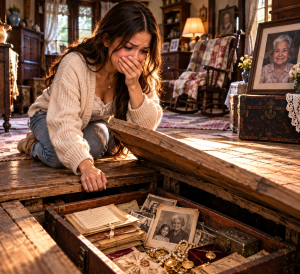
After several minutes, the board finally lifted.
Beneath it was a dark hollow space.
And inside that space…
was an old wooden chest.
My heart started pounding.
The chest was locked.
But taped underneath the floorboard was another note.
“The key is where I kept your first birthday photograph.”
I ran upstairs.
I searched through my grandmother’s bedroom until I found the photograph.
Behind the frame was a tiny brass key.
I returned downstairs.
The key fit.
The chest opened with a loud crack.
Inside were stacks of letters.
Old photographs.
Bank documents.
Jewelry.
And dozens of envelopes with different names written on them.
But one photograph immediately caught my attention.
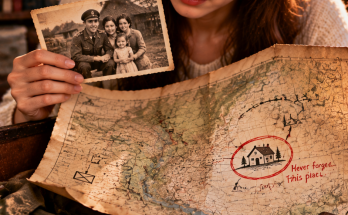
It showed my grandmother when she was young.
She was standing beside a man I’d never seen before.
On the back, she had written:
“The man who saved us.”
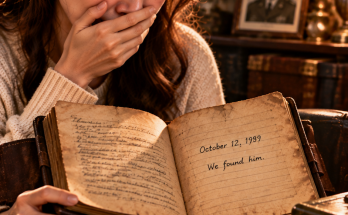
Then I found a letter dated forty-three years earlier.
The first sentence made my blood run cold.
“If you’re reading this, someone has finally discovered what is buried beneath the house.”
I looked down at the floor.
There was another compartment beneath the chest.
And this one was much larger.
PART 2 — What My Grandmother Had Hidden
I called my mother.
She told me not to touch anything.
“Your grandmother had secrets,” she said.
“What kind of secrets?”
She didn’t answer.
That frightened me more than anything else.
I moved the chest aside and examined the second compartment.
There was another wooden panel.
I lifted it.
Beneath it was a narrow staircase leading into darkness.
I grabbed a flashlight.
At the bottom was a small underground room.
It looked like someone had lived there decades ago.
There was an old desk.
A metal filing cabinet.
A bed.
And shelves filled with boxes.
On the desk was a photograph of my grandmother.
But she wasn’t alone.
She was standing beside the same mysterious man from the photograph.
This time, I noticed something I’d missed before.
She was holding a baby.
I stared at the baby’s face.
Then I noticed the date.
1971.
My mother was born in 1971.
I searched through the boxes.
Inside one was a birth certificate.
The mother’s name was my grandmother.
The father’s name was the mysterious man.
But the baby’s name wasn’t my mother’s.
It was a name I’d never heard before.
I kept searching.
Then I found a letter from my grandmother.
She had written that she had been protecting someone.
A young man had come to her house decades ago after witnessing a crime involving powerful local businessmen.
He had evidence.
They wanted the evidence destroyed.
My grandmother hid him beneath the house.
She helped him escape town.
But before he left, he entrusted her with something.
A large amount of money.
He told her to use it to protect his daughter.
His daughter was the baby in the photograph.
My grandmother had raised that child in secret.
But there was another shocking detail.
The child had eventually been adopted by another family.
I read the name again.
My hands began shaking.
It was my mother.
My grandmother wasn’t my mother’s biological mother.
She was her grandmother.
Which meant the family story I’d grown up hearing was a lie.
I kept searching for answers.
Then I found a final box.
Inside was a newspaper clipping.
The headline was about a man who had disappeared forty-three years earlier.
The man from my grandmother’s photographs.
The article claimed he had fled the country.
But tucked behind the newspaper was a letter.
“He never fled.”
I read the rest.
He had died shortly after leaving the house.
My grandmother had kept the truth hidden because she believed revealing his identity would put her daughter in danger.
Then I found something else.
A bank statement.
There had been a secret account in my grandmother’s name.
It contained over $1.8 million.
The money had been untouched for decades.
But why?
Then I found the final document.
A legal agreement.
The house wasn’t simply a house.
It had been placed into a family trust.
And the trust contained one condition:
The property could never be sold until the rightful heir was found.
I stared at the signature.
The rightful heir wasn’t my mother.
It wasn’t me.
It was someone else.
Someone my grandmother had spent forty years searching for.
And beneath the name was a note:
“My granddaughter deserves to know that she has a brother.”
PART 3 — The Family My Grandmother Protected
I thought it was impossible.
I had grown up as an only child.
My mother had never mentioned a brother.
But the documents were real.
My grandmother had been searching for him for decades.
He was the child of the mysterious man in the photographs.
And somehow, my mother had never known the complete story.
I contacted an attorney who specialized in old family trusts.
He helped me trace the records.
Three weeks later, we found him.
His name was Michael.
He lived in another state.
I called him.
When I explained who I was, he became completely silent.
Then he asked:
“Did your grandmother leave you the house?”
“Yes.”
He took a long breath.
“She promised me she would.”
I asked what he meant.
Michael told me that he’d been separated from his biological family as a baby.
He had spent his entire life believing his parents had abandoned him.
But years earlier, my grandmother had found him.
She had secretly visited him several times.
She wanted to tell him everything.
But she was afraid.
She believed someone was still watching the family.
Before she died, she sent Michael one final letter.
He showed it to me.
It said:
“The house belongs to both of you.”
I couldn’t stop crying.
All those years, I had thought my grandmother was simply sentimental about an old house.
But she had been protecting a family secret.
The house had been a hiding place.
A safe place.
A place where she had protected people who had nowhere else to go.
And underneath the floor, she had preserved the evidence so that one day the truth could finally be known.
Michael and I returned to the house together.
We stood in the old living room.
The same room where my grandmother had rocked me as a child.
I looked at the old rocking chair.
Then I finally understood why she had always told me never to sell the house.
It wasn’t because of the money.
It wasn’t because of the walls.
It was because the house contained our family’s history.
The parts everyone had tried to forget.
We decided not to sell it.
Instead, we repaired the roof.
Fixed the windows.
Restored the old floors.
And kept the hidden room exactly as we found it.
Months later, I framed my grandmother’s photograph and placed it above the fireplace.
Underneath it, I put a small brass plaque.
It said:
“She kept the house because she knew someday we would need to come home.”
And every Sunday, Michael and I sit in that old living room together.
Sometimes we talk.
Sometimes we don’t.
But whenever the floorboards creak beneath our feet, I think about my grandmother.
And I realize she was right.
Some houses aren’t meant to be sold.
Some houses are meant to keep the truth safe until the family is finally ready to hear it.