PART 1 — The Dog Tags
My father never talked about the Army.
Not once.
Whenever I asked him about the years before he married my mother, he would simply say:
“That’s a part of my life I’d rather leave behind.”
After he died, I spent weeks helping my mother clean out his garage.
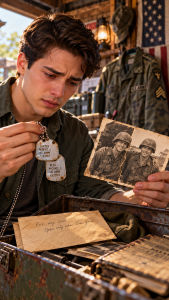
One afternoon, I opened an old metal toolbox.
Underneath a collection of rusty tools was a small cloth pouch.
Inside were two Army dog tags.
I recognized my father’s name on one.
But the second tag belonged to someone else.
SERGEANT MICHAEL REED.
I had never heard that name.
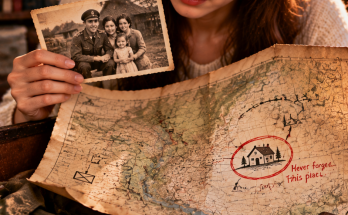
Under the tags was a faded photograph of my father standing beside another young soldier.
Both were wearing Army uniforms.
On the back, Dad had written:
“The man who saved my life.”
I stared at the photograph.
Then I noticed something strange.
The photograph had been torn in half.
Someone had been removed from the picture.
I searched through the toolbox again.
At the very bottom was an envelope.
My father’s handwriting covered the front.
“For my son. Open only when I’m gone.”
My hands started shaking.
Inside was a single page.
“If you’re reading this, then you finally found the tags.”
The letter explained that my father had served overseas with Sergeant Michael Reed.
During one mission, something went terribly wrong.
Michael had saved my father’s life.
But he never came home.
I kept reading.
Then I reached a sentence that made my heart stop.
“Everyone believes Michael died that night.”
Underneath it, Dad had written:
“That’s not what happened.”
PART 2 — The Soldier Who Disappeared
I spent the next several days searching for information about Michael Reed.
Military records confirmed that a Sergeant Michael Reed had served with my father.
But his file contained very little information.
His final status was listed as:
Missing in Action.
Not killed.
Not confirmed dead.
Missing.
I called an old veterans’ organization and eventually found someone who remembered him.
His name was James Walker.
He had served with my father and Michael.
When I showed him the photograph, James became silent.
“Where did you get that?”
“My father.”
James looked at the dog tags.
“He kept those for decades?”
“Yes.”
James sighed.
“Then he never told you what happened.”
“What happened?”
James explained that during their final operation, my father had been injured.
Michael went back for him.
He carried my father to safety before the unit was forced to withdraw.
But when the soldiers returned later, Michael was gone.
There was no body.
No equipment.
No clear explanation.
The Army searched for him.
Eventually, he was listed as missing.
“But my father wrote that Michael didn’t die.”
James looked at me.
“Your father believed Michael survived.”
“Why?”
“Because he received a message.”
“What message?”
James reached into an old folder.
He pulled out a photocopy of a handwritten note.
It contained only a few words:
“Tell Robert I kept my promise.”
My father’s name was Robert.
I stared at the note.
“Who sent this?”
James shook his head.
“We never found out.”
Then he told me something even stranger.
Three years after Michael disappeared, my father received a photograph in the mail.
The photograph showed an older man standing outside a small building.
The face was partially hidden.
But my father had written one sentence across the back:
“That’s Michael.”
I looked at James.
“Where is that photograph?”
“I don’t know.”
I returned home and searched my father’s belongings again.
Finally, I found another envelope hidden behind an old Army field manual.
Inside was the photograph.
I looked closely.
The man was older.
Gray at the temples.
But I could see the resemblance.
Then I noticed something in the background.
A sign above the building.
It showed the name of a small town.
And underneath the photograph, my father had written:
“I promised him I would never tell anyone where he was.”
I turned the photograph over.
There was one final line.
“But if I’m gone, he deserves to know his name was never forgotten.”
I immediately booked a flight.
I had to find Michael Reed.
PART 3 — The Man My Father Never Forgot
The town was several states away.
It was small and quiet.
I showed the photograph to an elderly shopkeeper.
He looked at it for several seconds.
Then he pointed down the street.
“He lives three blocks that way.”
My heart began pounding.
I found a small house with an American flag hanging beside the front door.
I knocked.
An elderly man opened it.
He had white hair and walked with a cane.
I showed him my father’s photograph.
The man’s eyes immediately filled with tears.
“Robert.”
I nodded.
“My father.”
He stepped backward.
“Come inside.”
His name was Michael Reed.
He had survived.
But he had been severely injured and spent years recovering.
Eventually, he had chosen to remain away from his old life.
“Why didn’t you come home?” I asked.
Michael looked down.
“I tried.”
He explained that after the mission, he had been transferred through several medical facilities.
By the time he was stable enough to return, he learned that his unit had already reported him missing.
He contacted my father.
They secretly stayed in touch for decades.
“Why did he keep it secret from us?”
Michael smiled sadly.
“Because I asked him to.”
“Why?”
“I didn’t want your family to live with the fear of someone coming after you.”
I stared at him.
“What were you afraid of?”
Michael shook his head.
“Some parts of that mission were never meant to leave the battlefield.”
Then he reached behind a cabinet.
He pulled out a small wooden box.
Inside was the other half of the photograph.
The half that had been torn away.
He placed it beside my father’s photograph.
Together, they formed a complete picture.
My father and Michael stood shoulder to shoulder, both young soldiers, both smiling.
On the back was a handwritten message.
My father’s handwriting.
“Brothers aren’t always born into the same family.”
Michael handed me the dog tag.
“I think your father wanted you to have this.”
I held it tightly.
For decades, I had thought my father had simply refused to talk about his Army service.
Now I understood.
He wasn’t hiding a shameful past.
He had been protecting a promise.
A promise to the soldier who had saved his life.
Before I left, Michael gave me one final letter.
It was written by my father only months before his death.
“If my son ever finds you, tell him this: I survived because Michael refused to leave me behind.
I spent the rest of my life trying to make sure he was never forgotten.”
I looked at Michael.
“You were his best friend, weren’t you?”
He smiled.
“No.”
He looked down at the photograph.
“I was his brother.”
I took the dog tags home and placed them beside my father’s photograph.
For the first time, I finally understood why Dad had never talked about the Army.
Some memories aren’t painful because of what happened.
They’re painful because of the people you promised never to forget.