PART 1 — The Last Page
My father never talked about the Army.
Not because he hated his service.
Because there was one memory he refused to revisit.
Every time I asked about his years as a soldier, he would say:
“Some things are better left in the past.”
I thought he was protecting himself from painful memories.
I never imagined he was protecting a secret.
After my father passed away, I began sorting through his belongings.
In an old wooden chest beneath his bed, I found something I had never seen before.
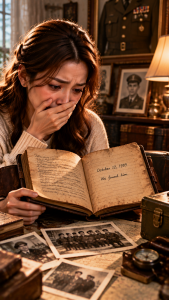
A military journal.
The cover was worn.
The pages were yellowed.
His name was written across the front:
SERGEANT ROBERT CARTER
I sat down and started reading.
The early pages were ordinary.
Training exercises.
Names of friends.
Descriptions of places he had served.
But as I continued, the entries became different.
More serious.
More personal.
One entry caught my attention.
“Day 47 — We are closer than ever. Someone has been here before us.”
I turned the page.
Then another.
The handwriting became rushed.
The final pages were only a few short sentences.
The last entry was dated:
October 12, 1989
Below the date were only three words.
“We found him.”
I stared at the sentence.
That was it.
No explanation.
No name.
No details.
Just three words.
I looked through the following pages.
There were none.
The journal ended there.
I searched online.
I searched military records.
But I couldn’t find anything connected to that date.
Then I noticed something hidden inside the back cover.
A folded piece of paper.
It wasn’t my father’s handwriting.
It was a note.
It said:
“If Robert’s journal is ever found, the truth should finally be known.”
At the bottom was a name.
Captain James Walker.
I had never heard of him.
But my father had written one sentence about him earlier in the journal:
“James knows what happened.”
PART 2 — The Man Who Knew the Truth
I spent weeks searching for Captain James Walker.
Eventually, I found him.
He was living quietly in a small town.
When I showed him my father’s journal, he became silent.
“Where did you get this?”
“My father’s things.”
He looked at the final page.
The words seemed to bring back decades of memories.
“We found him.”
He whispered the sentence.
Then looked at me.
“You have no idea what those words mean.”
I sat down.
“Then tell me.”
James opened an old military folder.
Inside were photographs.
Maps.
Reports.
One photograph showed my father standing with several soldiers.
James pointed to a man in the picture.
“That was Daniel.”
“Who was he?”
James hesitated.
“The soldier we were looking for.”
I looked confused.
“Looking for?”
James explained that years earlier, a soldier from their unit had disappeared during a mission.
His name was Daniel Reed.
Everyone believed he had been killed.
But my father never accepted that.
“He believed Daniel was still alive.”
“Why?”
“Because your father found evidence that someone had seen him after the disappearance.”
James explained that my father spent years searching.
Quietly.
Without telling anyone.
Then, on October 12, 1989, my father wrote:
“We found him.”
I looked at James.
“Did they find Daniel?”
He nodded.
“Yes.”
My heart started racing.
“Was he alive?”
James looked down.
“Yes.”
“Then why did nobody know?”
James took a deep breath.
“Because Daniel didn’t want to be found.”
I didn’t understand.
“He was afraid?”
“No.”
James looked at the journal.
“He was protecting someone.”
“Who?”
James opened another document.
It was a letter written by Daniel.
The first line said:
“Robert, thank you for keeping my secret.”
PART 3 — The Soldier Who Chose Silence
Daniel had survived.
But after the mission, he discovered information that changed everything.
He learned that people connected to the operation were still searching for him.
Returning home could put others in danger.
So he disappeared.
Not because he wanted to leave.
Because he believed staying away would protect the people he loved.
My father found him years later.
And instead of bringing him back publicly, he respected his choice.
James showed me the final letter my father received.
It said:
“Robert,
You spent years trying to find me when everyone else gave up.
But finding me was never the hardest part.
The hardest part was accepting why I couldn’t come home.”
I looked at James.
“Why didn’t my father tell our family?”
James smiled sadly.
“Because your father kept promises.”
I read another line from Daniel’s letter:
“Tell Robert that he did not fail me. He saved me twice.”
“Twice?”
James nodded.
“The first time was on the battlefield.”
“And the second?”
“He gave Daniel the chance to live the life he chose.”
I returned home and opened my father’s journal again.
The final page no longer looked mysterious.
Those three words had haunted me:
“We found him.”
But now I understood.
My father wasn’t writing about finding a missing soldier.
He was writing about finding a friend.
A brother.
Someone he had refused to forget.
I placed the journal beside my father’s photograph.
For years, I thought the unfinished story meant something terrible had happened.
But the truth was different.
The journal stopped because my father finally found the answer he had spent years searching for.
And sometimes, the greatest discoveries aren’t about what happened.
They’re about the people we refuse to leave behind.
The last words in my father’s Army journal were only three words.
“We found him.”
But those three words carried a lifetime of loyalty, friendship, and a promise that was never broken.**