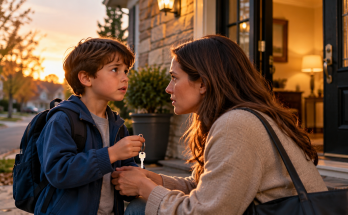
PART 1 — The Christmas Dinner That Broke My Silence
The moment my mother looked at my six-year-old son and said, “Children like you should be grateful anyone invites them,” the entire Christmas dining room went silent.
My son, Noah, stopped cutting his turkey.
He was six years old, wearing a navy-blue sweater I had spent three evenings searching for because he wanted to look handsome for Grandma’s Christmas dinner.
He had even practiced saying, “Merry Christmas, everyone!” in front of the bathroom mirror.
Now he stared down at his plate, his little fingers tightening around his fork.
I felt something inside me crack.
“Mom,” I said quietly, “he’s a child.”
My mother, Margaret, lifted her wineglass.
“And I’m teaching him manners. Someone has to.”
Across the table, my older sister, Vanessa, covered a smile with her napkin. Her husband pretended to be fascinated by the gravy boat.
Nobody defended my son.
Nobody except my husband, Daniel, who immediately put down his fork.
“That’s enough, Margaret.”
My mother turned toward him with a look of exaggerated surprise.
“Oh, please. I was speaking to my own grandson. Or is he not allowed to hear the truth anymore?”
Noah’s eyes filled with tears.
He looked at me and whispered, “Mommy, did I do something bad?”
That question hurt more than anything my mother had said.
I pulled him out of his chair and wrapped my arms around him.
“No, sweetheart. You did absolutely nothing wrong.”
My mother sighed dramatically.
“This is exactly your problem, Emily. You make him believe the world owes him kindness. That’s why he’ll never be strong.”
I stared at her.
For thirty-four years, I had swallowed her insults.
When she criticized my clothes, I changed them.
When she mocked my career, I worked harder.
When she called my wedding small and embarrassing, I smiled through the photographs.
When she told relatives that Daniel was beneath our family, I pretended not to hear.
I had convinced myself that keeping the peace was the same thing as being a good daughter.
But watching my little boy struggle not to cry, I finally understood something.
My silence wasn’t protecting my family.
It was teaching my son that he had to accept cruelty from people who claimed to love him.
I stood up.
“Everyone, please excuse us.”
My mother laughed.
“Oh, don’t start another dramatic performance. Sit down, Emily. The children haven’t even opened their presents.”
I walked toward the Christmas tree, where a mountain of brightly wrapped gifts sat beneath the branches.
I collected Noah’s presents one by one.
The remote-control car he had wanted for months.
The dinosaur building set.
The little red bicycle my father had promised to help him ride in spring.
My mother watched me with growing irritation.
“What on earth are you doing?”
“Taking my son home.”
“You cannot be serious.”
“I’ve never been more serious in my life.”
She pushed her chair backward.
“You’re going to ruin Christmas because I corrected a child?”
“No,” I replied, turning to face her. “I’m leaving because you humiliated him, and you expected me to pretend it was normal.”
My sister finally spoke.
“Oh, Emily. Don’t make this about abuse. Mom is just blunt.”
Daniel stepped beside me and took two of the gift bags.
“Then perhaps she can be blunt without being cruel.”
My mother’s face turned red.
“You ungrateful people! After everything I’ve done for this family!”
I looked around the table.
Twenty-three relatives sat watching us.
Twenty-three people who had heard every word.
Twenty-three people who had chosen silence.
Then my mother said the one thing that made my decision permanent.
“If you walk out of this house, don’t bother coming back. And don’t expect a single dollar from this family when you finally need help.”
I paused at the doorway.
Then I said, “You don’t need to worry about your money, Mom. From today onward, Noah and I won’t need anything from you.”
I took my son’s hand and walked outside with Daniel.
Behind us, my mother shouted that I would regret this before New Year’s.
I didn’t answer.
But as we drove away through the falling snow, Noah finally began to cry.
“Mommy?”
“Yes, baby?”
“Will Grandma still love me if I don’t go back?”
I reached into the back seat and squeezed his little hand.
“You never have to earn love by letting someone hurt you.”
Daniel glanced at me, his eyes shining.
Neither of us spoke for the rest of the drive.
That night, after Noah fell asleep, I sat at our kitchen table and opened an email I had received three days earlier.
It was from a lawyer named Thomas Reed.
His subject line read:
CONFIDENTIAL: Final Documents Regarding the Estate of Arthur Bennett.
Arthur Bennett was my grandfather.
My mother’s father.
The man who had died eight months earlier, leaving behind a business empire that my mother had always claimed belonged to her.
I had ignored the lawyer’s earlier calls because I couldn’t bear another argument with my mother.
Now, with the Christmas tree glowing in the next room, I opened the email.
The first sentence made my heart pound.
Dear Ms. Bennett, following the completion of the estate review, we need to discuss a matter that directly concerns you and your son.
I read it twice.
Then my phone began vibrating.
Mom.
I declined the call.
It rang again.
And again.
Finally, a message appeared.
Emily, please call me immediately. We need to discuss something important before New Year’s.
For the first time in my life, I wondered whether my mother was afraid of losing me.
Or whether she was afraid of what I might discover.
PART 2 — The Secret My Grandfather Left Behind
The following morning, I called Thomas Reed.
He answered before the first ring had finished.
“Ms. Bennett, thank you for getting back to me. I’ve been trying to reach you for several weeks.”
“What does this have to do with my son?”
There was a pause.
“Your grandfather specifically mentioned Noah in his final instructions.”
I sat down.
“My grandfather died before Noah turned two. He barely knew him.”
“Your grandfather knew more than you may realize.”
Thomas explained that my grandfather, Arthur, had spent the final year of his life reviewing the ownership of several family properties and a charitable foundation he had established decades earlier.
My mother had told everyone that the estate would pass directly to her.
Apparently, that wasn’t true.
“Your grandfather amended his estate plan shortly before his death,” Thomas continued. “The documents identify you as the principal beneficiary of a substantial family trust. Noah is named as its protected secondary beneficiary.”
I couldn’t speak.
My grandfather had been the only person in my family who never made me feel inferior.
When I was a teenager, he used to take me to his old workshop and teach me how to repair broken clocks.
“People are like clocks, Emily,” he’d tell me. “They may look fine on the outside while something inside has stopped working. Never judge a person by the family they come from.”
He had also been the only relative who attended my small college graduation when my mother decided to take Vanessa shopping instead.
“What exactly is in the trust?” I asked.
Thomas told me there were commercial properties, investment accounts, and shares in a company my grandfather had founded.
He would provide the precise figures during our meeting.
But one detail troubled me.
“Your mother has been communicating with our office,” he said carefully. “She was under the impression that she would manage the trust.”
“Why?”
“Because she submitted documents claiming your grandfather intended to appoint her as trustee.”
My stomach tightened.
“Did he?”
“No. The signed documents name an independent fiduciary. Your mother has no authority over the trust.”
I looked toward the living room, where Noah was playing with his new dinosaur set.
“So why is she calling me?”
Thomas hesitated.
“Because yesterday, she learned that the estate review had been finalized.”
Suddenly, the frantic calls made sense.
But there was more.
At two that afternoon, I met Thomas in his downtown office.
He placed a sealed envelope on the desk.
“This letter was written by your grandfather. He instructed us to give it to you once the estate was settled.”
My hands trembled as I opened it.
My dear Emily,
If you are reading this, then I have kept my promise to protect what matters most to me.
I know your mother has spent years making you feel that love must be earned and that family loyalty means accepting whatever she decides.
I wanted to intervene. More than once, I nearly did.
But I made the mistake of believing you needed to discover your own strength.
I am sorry I waited so long.
Tears blurred the page.
The letter continued.
There is something you must know. Your mother has told people that I considered you irresponsible and unfit to manage your own affairs. That is not true.
In fact, you were the only person in this family who never asked me for money, never tried to impress me, and never treated my final years as an opportunity.
That is why I made my decision.
I pressed the letter to my chest.
Then I read the final paragraph.
Protect Noah from anyone who believes a family name makes cruelty acceptable. And remember this: the inheritance is not a reward for being my granddaughter. It is a responsibility entrusted to you because I believe you will use it with compassion.
When I finished reading, Thomas quietly handed me a tissue.
“How much?” I whispered.
He turned a document toward me.
The trust’s estimated value was nearly eighteen million dollars.
I stared at the number.
Eighteen million.
My husband and I had spent the past two years carefully budgeting for our mortgage, childcare, and Noah’s school expenses.
We weren’t poor, but we had worked for everything we owned.
Meanwhile, my mother had spent years implying that Vanessa was the family’s future and I was its disappointment.
Now I understood why she had been so determined to control the estate.
Thomas wasn’t finished.
“There is another issue,” he said. “Your grandfather left records suggesting that several properties were transferred out of his company shortly before his death. Those transfers are being reviewed.”
“By whom?”
“An independent accounting firm. Some of the transactions may have been legitimate. Others require clarification.”
I felt cold.
“Does my mother know?”
“She knows we are reviewing them.”
My phone vibrated on the desk.
A message from my sister.
Mom says you’ve stolen Granddad’s money. Call her before you make this worse.
Then another arrived.
You have no idea what you’re getting yourself into.
I looked at the documents before me.
For years, I had been frightened of disappointing my family.
Now I was frightened of what they might have done.
That evening, my mother arrived at our house without warning.
She wore a cream-colored coat and carried a box of expensive chocolates, the kind she usually brought when she wanted to appear generous in front of other people.
“Emily,” she said, forcing a smile. “Can we talk privately?”
I remained in the doorway.
“Noah is eating dinner.”
“Then we’ll talk after he’s asleep.”
“What do you want?”
Her smile vanished.
“You need to tell that lawyer you refuse the trust.”
I stared at her.
“Excuse me?”
“Your grandfather was confused at the end. Those documents don’t reflect what he really wanted.”
“Then why did he sign them?”
“Because people around him influenced him!”
“Who?”
She looked away.
For one brief moment, I saw something I had never seen in her before.
Fear.
Then she straightened her coat.
“You have no idea how complicated the family finances are. If you take control, people could lose everything.”
“Which people?”
“Your sister. Her children. Me.”
There it was.
Not concern for me.
Not grief for her father.
Fear for herself.
I stepped back.
“If the transactions were legitimate, the accountants will confirm that.”
Her eyes hardened.
“You would destroy your own mother over money?”
“No,” I said. “I’m asking questions because you told me to leave your house if I wouldn’t accept your behavior. I’m simply doing what you asked me to do. I’m making decisions without you.”
She stared at me for several seconds.
Then she whispered, “You will regret humiliating me.”
She walked away without the chocolates.
I closed the door.
But before I could turn around, my phone rang.
It was Thomas.
“Emily, the accounting firm has just uncovered a document we need you to see immediately.”
“What is it?”
“A transfer agreement bearing your grandfather’s signature. The date is six weeks before his death.”
“And?”
“The signature appears authentic, but the transfer was never completed properly. Your mother may have received money under that agreement.”
I gripped the counter.
“How much?”
Thomas gave me the amount.
My breath caught.
It was more than two million dollars.
Then he said the words that changed everything.
“The agreement also contains a handwritten note from your grandfather. It suggests the money was supposed to be used for a very specific purpose.”
“What purpose?”
“To establish a permanent fund for children born prematurely who need financial assistance.”
I thought of the weeks I had spent beside Noah’s incubator.
The bills.
The fear.
The families I had seen sitting alone in the hospital cafeteria, wondering how they would afford another week of treatment.
My grandfather hadn’t simply left me money.
He had left me a mission.
And someone might have taken the money meant to fund it.
PART 3 — The New Year’s Eve Nobody Expected
On December 31, my mother invited the entire family to her house.
She called it a reconciliation dinner.
I called it a trap.
Vanessa phoned me that morning.
“Please come,” she said. “Mom says she wants to apologize.”
“Does she?”
“She says things got out of hand.”
I almost laughed.
“Did she mention Noah?”
Silence.
“Vanessa?”
“She says you misunderstood her.”
Of course she did.
But I agreed to attend for one reason.
Thomas had advised me not to accuse anyone publicly while the financial review was ongoing. However, the independent accounting firm had completed enough of its work to clarify several important facts.
I wasn’t going to make a dramatic accusation.
I was going to insist that the truth be heard.
That evening, Daniel and I arrived with Noah.
My mother greeted us at the door wearing a silver dress and a carefully practiced smile.
“Oh, Emily. I’m so happy you came.”
She bent toward Noah.
“Hello, darling.”
Noah moved behind my leg.
My mother noticed.
Her smile tightened.
“Children can be so sensitive.”
Daniel’s hand found mine.
We entered the dining room.
Twenty-three relatives sat around the same table where my mother had humiliated Noah seven days earlier.
This time, however, a man in a dark suit sat beside my uncle.
Thomas Reed.
My mother froze when she saw him.
“What is he doing here?”
I removed Noah’s coat.
“He’s here because the family has some questions about Granddad’s estate.”
My mother laughed too loudly.
“This is a private family dinner.”
Thomas calmly placed a folder on the table.
“I’m afraid several matters concerning the estate require clarification.”
My sister looked between us.
“Emily, what have you done?”
“Nothing,” I answered. “I’ve simply stopped ignoring what everyone else wants me to ignore.”
Thomas explained the finalized trust arrangements.
He confirmed that my grandfather had deliberately chosen me as the primary beneficiary and that Noah had been named as a protected secondary beneficiary.
Then he outlined the purpose of the charitable fund.
The room grew silent.
My uncle stared at my mother.
“You told us Arthur had abandoned that idea.”
My mother lifted her chin.
“He changed his mind.”
“The signed records say otherwise,” Thomas replied.
He did not accuse her of a crime. He did not speculate about her intentions. He simply described the documents and the financial transactions that still required proper accounting.
Then he placed copies of the transfer agreement before the relevant family members.
The two-million-dollar transfer had been described in the records as funding for the premature-infant assistance program.
The accounting firm had traced part of the money into accounts associated with family property expenses. The remaining amount was still being investigated.
My mother went pale.
“That money was used to protect the family’s assets!”
“Then the records can establish that,” I said. “But the money cannot simply disappear because you believe you deserve it.”
Vanessa stared at the papers.
“You told me Granddad gave you that money to save the company.”
“I was saving this family!” my mother snapped.
“By hiding the agreement?” my uncle asked.
My mother slammed her hand on the table.
“I did everything for all of you! And this is how you repay me?”
Nobody answered.
For the first time, her anger had nowhere to land.
She turned toward me.
“You planned this. You waited until I was surrounded by everyone, and then you brought a lawyer to destroy me.”
I shook my head.
“No. You chose to humiliate a six-year-old child because you believed nobody would challenge you. I left because I wanted my son to grow up knowing that love doesn’t require him to accept cruelty.”
I looked around the table.
“And now we’re discussing Granddad’s estate because the records raised questions that need answers. Those are two separate things. I’m not going to use his money to punish you, and I’m not going to ignore the truth to protect you.”
My mother stared at me as though I had become a stranger.
Perhaps I had.
Not because I had inherited eighteen million dollars.
But because I had finally stopped asking her permission to be a person.
Then Noah tugged on my sleeve.
“Mommy?”
I knelt beside him.
“What’s wrong, sweetheart?”
He looked toward his grandmother.
“Can I give Grandma her present?”
The entire room went still.
My mother blinked.
“You brought me a present?”
Noah nodded.
At home, he had insisted on wrapping a small box himself. Inside was a painted wooden ornament shaped like a star. He had made it at school, carefully decorating it with gold glitter.
I helped him hand it over.
My mother opened the box.
For a moment, she looked genuinely shaken.
Noah spoke softly.
“I made it for you because Mommy says Christmas is about love.”
My throat tightened.
My mother held the ornament in her palm.
Then she looked at the little boy she had wounded.
“I didn’t deserve this,” she whispered.
“No,” I said quietly. “You didn’t.”
She began to cry.
For the first time, I didn’t rush to comfort her.
I didn’t tell her everything was fine.
I didn’t erase what had happened simply because she was upset.
Instead, I sat beside my son and let her face the consequences of her own words.
Later that night, after the accounting firm outlined the remaining steps and Thomas explained the process for resolving the estate questions, my mother approached me in the hallway.
“Emily, can we start over?”
I looked at her.
“Maybe. But not by pretending nothing happened.”
She nodded, wiping her eyes.
“I don’t know how to fix this.”
“Start by apologizing to Noah without blaming him. Then tell the truth about the money. After that, we’ll see what happens.”
She looked down at the ornament in her hand.
“I will.”
I didn’t promise to forgive her.
Forgiveness was not a deadline she could set for me.
But I left the door open to the possibility that she might finally learn how to change.
By the end of January, the trust was being administered independently, and the financial review had established a clear process for resolving the disputed transactions. Any money owed to the charitable fund would have to be accounted for and addressed through the proper legal channels.
I used part of the resources available to me to work with the trustees on establishing the assistance program my grandfather had envisioned.
Its first purpose was simple: helping families of premature babies with transportation, temporary accommodation, and essential expenses while their children received hospital care.
At the opening meeting, I stood beside a photograph of my grandfather and held Noah’s hand.
I thought of the frightened mother I had once been, sitting beneath fluorescent lights and praying that my tiny son would be strong enough to come home.
I wished someone had told me then that asking for help wasn’t weakness.
That a child’s worth was never measured by size, money, or family status.
And that being a good daughter did not mean allowing someone to be a cruel grandmother.
A few months later, my mother visited our home.
She brought no expensive gifts and made no comments about Noah’s clothes, his size, or his behavior.
She sat on the floor and let him show her his dinosaur collection.
When he asked her to play, she listened.
It wasn’t a miracle.
Trust did not return in a single afternoon, and I still maintained boundaries that protected my family.
But this time, I watched her actions instead of believing her promises.
As I tucked Noah into bed that night, he asked, “Mommy, are we going to Grandma’s house next Christmas?”
I kissed his forehead.
“Maybe, sweetheart. If it’s a place where you feel safe and loved.”
He smiled sleepily.
“Okay. Because I like Christmas best when everyone is nice.”
I turned off his lamp and stood in the doorway for a moment.
My grandfather had left me a fortune, but the greatest gift had nothing to do with money.
It was the realization that I could end a painful family pattern without becoming cruel myself.
I could protect my child without teaching him to hate.
I could leave a room where he was being humiliated, even if everyone inside that room called me selfish.
And I could love my mother without giving her unlimited access to hurt us.
That Christmas, I had walked out of my mother’s house believing I was losing my family.
By New Year’s, I understood that I was building one.
And for the first time in my life, I knew the difference.