Part 1 — The Little Boy Who Begged a Police Officer to Come Inside His House
I had spent nine years as a school resource officer in West Portland, and I thought I understood the different ways children asked for help.
Some cried over bullies.
Some lied because they were afraid of getting in trouble.
Others stayed silent, hoping their problems would disappear before anyone noticed.
But on a chilly October afternoon, a little boy approached me with a request I would remember for the rest of my life.
“Officer Dunham, will you please walk me home?”
His name was Noah Bennett.
He was seven years old, small for his age, with messy brown hair, a faded sweater, and a navy-blue backpack that hung almost to his waist.
While the other children rushed toward their parents, Noah stood beside the school fence, watching me with a seriousness no child his age should have carried.
“Where’s your mom?” I asked.
“She isn’t coming.”
“Your dad?”
“He’s home.”
I smiled gently. “Then why do you need me to walk you there?”
Noah looked down at his shoes.
“Because I need you to see something.”
There was something unusual about the way he said it.
He wasn’t asking me to protect him from a monster under his bed.
He wasn’t trying to get out of homework.
He sounded like someone who had rehearsed a difficult conversation a hundred times and was terrified of getting the words wrong.
I crouched beside him.
“Are you in trouble, Noah?”
He shook his head.
“Is someone hurting you?”
He hesitated.
Then he glanced toward the street and whispered, “I don’t know if it’s hurting when everybody says it’s normal.”
Those words made my smile disappear.
I asked the school secretary to contact his listed guardian and explain that I would accompany him home. Then I radioed my patrol partner, Officer Reyes, to let him know where I was going.
Noah watched every step I took, as if he were afraid I might change my mind.
We walked past small houses with peeling paint, fallen autumn leaves, and porches where old rocking chairs sat empty.
For nearly ten minutes, he said nothing.
Then he asked, “Officer, if a grown-up tells you something is a family secret, does that mean you have to keep it?”
“No,” I answered carefully. “Some things are private, but if someone is unsafe, getting help is more important than keeping a secret.”
He nodded, but he didn’t look relieved.
“My dad says people who ask questions destroy families.”
I glanced at him.
“What do you think?”
Noah tightened his grip on one backpack strap.
“I think families are supposed to make you feel safe.”
I had heard adults say that sentence during investigations.
Hearing it from a seven-year-old made it feel different.
When we reached his house, I recognized it immediately. I had driven past it dozens of times. The lawn was unkempt, the front curtains were closed, and a porch light flickered even though the afternoon sun hadn’t disappeared.
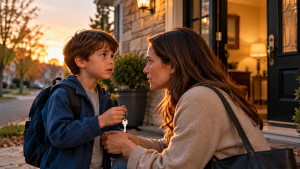
Noah took a key from his pocket.
His hand trembled.
He reached toward the lock, then suddenly turned to face me.
“Officer Dunham, before I open this door, you have to promise me something.”
I knelt in front of him.
“I’ll listen to you, Noah. And I’ll do what I can to keep you safe.”
His eyes filled with tears.
“No. You have to promise that if you see what I see, you won’t make me come back tomorrow and pretend everything is fine.”
For a moment, I couldn’t answer.
Then I looked at the front door, at the tiny hand holding the key, and at the boy who had spent his entire walk home preparing himself for what might happen next.
I had no idea what waited inside that house.
But I knew one thing.
Whatever Noah was about to show me, he had been carrying it alone for far too long.
And when the door finally opened, I heard a voice from somewhere inside say five words that made Noah immediately step behind me.
“You weren’t supposed to bring anyone.”
Part 2 — The Secret Behind the Closed Door
The voice belonged to a woman.
A moment later, a middle-aged woman appeared at the end of the hallway, wearing an old cardigan and holding a dish towel in her hands.
She looked at me, then at Noah.
Her expression changed from surprise to fear.
“Who is this?” she asked.
“Officer Dunham,” I replied. “I’m here with Noah. He asked me to walk him home.”
The woman pressed her lips together.
“Noah, go to your room.”
He didn’t move.
“Sweetheart, I said go to your room.”
Noah’s fingers closed around the sleeve of my uniform.
“Please don’t make me go upstairs,” he whispered.
I stepped slightly to the side, keeping my voice calm.
“Ma’am, before he goes anywhere, I’d like to understand why he was afraid to come home.”
She gave a short, uncomfortable laugh.
“Afraid? He’s a dramatic child. His father and I are trying to teach him discipline.”
“Where is his father?”
“In the kitchen.”
A chair scraped across the floor.
A man appeared in the doorway, wearing work trousers and a gray sweatshirt. His face tightened when he saw my uniform.
“What is this about?”
“Your son asked me to accompany him home,” I explained. “He seems distressed, and I’d like to make sure everything is okay.”
The man looked directly at Noah.
“What have you been telling people?”
Noah immediately lowered his eyes.
That reaction told me more than the question itself.
“I’m asking you a question,” his father said.
I raised one hand gently.
“Let’s give him a moment. He can speak without being pressured.”
The father exhaled sharply and stepped back.
I asked Noah whether he wanted to tell me what had frightened him.
He shook his head, then pointed toward a narrow door beneath the staircase.
“Can you look in there?”
His grandmother, the woman in the hallway, became visibly tense.
“That’s just storage,” she said quickly.
Noah looked at me.
“They tell me I’m imagining things. But I hear someone crying in there every night.”
The house fell silent.
His father folded his arms.
“It’s an old house. Pipes make noises. Children hear things.”
“Then you won’t mind if we check the room,” I said.
He didn’t answer immediately.
Instead, he looked at his mother.
It was only a glance, but it carried the kind of understanding people share when they have agreed on a story before anyone asks a question.
I requested permission to inspect the room. When the adults began arguing about whether it was necessary, I did not force my way inside. I stepped back, contacted my supervisor, and followed the appropriate safeguarding procedures.
While we waited, Noah sat on the bottom stair.
“Did I do something bad?” he asked.
“No,” I told him. “Asking for help isn’t bad.”
He stared at the floor.
“Grandma says if people find out, our family will break apart.”
“Sometimes adults say frightening things because they’re afraid of consequences. That doesn’t make a child responsible for fixing their problems.”
Noah’s eyes filled again.
Then he whispered something I hadn’t expected.
“There’s someone else in this house.”
I looked toward the staircase.
“Who?”
He swallowed hard.
“My little sister.”
I hadn’t seen another child in the house.
“What’s her name?”
“Lily. She’s four.”
“Where is she now?”
“In the room upstairs. Dad says she’s sick and has to stay there.”
My attention sharpened.
“Have you seen her today?”
Noah shook his head.
“Not since yesterday morning.”
Before I could ask another question, footsteps sounded overhead.
A small voice called from behind a closed door.
“Noah?”
The boy sprang to his feet.
“Lily!”
He started toward the stairs, but his father moved in front of him.
“Stay where you are.”
Noah froze.
Then, with tears running down his face, he turned to me.
“That’s why I needed you,” he said. “They keep telling me she’s fine, but she keeps calling for me.”
At that moment, my radio crackled.
My supervisor was on the way, along with the appropriate child welfare support.
I looked at the adults, then at the staircase.
This was no longer a question of a child being frightened of his own imagination.
A four-year-old was calling for help, and the adults responsible for her had not explained why she was being kept apart from her brother.
I asked the father to tell me what was happening upstairs.
He stared at me for several seconds.
Then he said, “If you go up there, you’re going to ruin everything.”
Noah took a shaky breath.
“Officer,” he whispered, “please don’t let them tell you she’s not my sister.”
I turned toward him.
“What do you mean?”
He looked at the upstairs door.
Then he revealed the secret that had made him ask a police officer to walk him home.
“Because Dad says Lily isn’t really part of our family anymore.”
Part 3 — The Truth That Changed Two Children’s Lives
For several seconds, nobody spoke.
Noah stood beside the staircase, trembling, while his father insisted that the situation was being misunderstood.
“She’s my daughter,” he said. “I know what’s best for her.”
His grandmother nodded quickly.
“Lily has been difficult lately. We’re handling it as a family.”
But Noah was crying now.
“She asks for me every night,” he said. “She thinks I stopped loving her.”
I knelt beside him.
“Why would she think that?”
“Because Dad told her I didn’t want to see her anymore.”
The words came out in a rush, as if he had been holding them inside for months.
“I never said that. I never said I didn’t want her.”
His voice broke.
“I just want to play with her again.”
I felt my chest tighten.
Children often understand more than adults realize, but they don’t always have the language to explain what they’re witnessing.
Sometimes they blame themselves for decisions they had no part in making.
Sometimes they accept an adult’s explanation because they have no other source of truth.
And sometimes they ask for help in the only way they know how.
By finding someone who might finally listen.
When my supervisor arrived, we spoke separately with the adults and followed the appropriate child-protection procedures.
The little girl was eventually brought downstairs with a trusted professional present.
Lily was pale and frightened, clutching a stuffed rabbit against her chest.
The moment she saw Noah, she ran to him.
He dropped to his knees and wrapped his arms around her.
“I didn’t leave you,” he whispered. “I promise I didn’t leave you.”
Lily buried her face in his shoulder.
“I thought you forgot me.”
“No. Never.”
I turned away for a moment, giving the children privacy while the adults continued speaking with the professionals.
What we learned over the following hours was more complicated than Noah’s frightened words had suggested.
His parents had been separating, and his father had been trying to control how the children would be divided between households.
Arguments had become increasingly frequent.
Lily had been struggling emotionally, and instead of seeking appropriate help, the adults had begun isolating her and telling both children conflicting stories.
Noah had been warned not to discuss the situation with teachers or neighbors.
He had been told that if he did, he might never see his sister again.
That threat had kept him silent until the day he finally decided he couldn’t bear it anymore.
There was no single conversation that could repair what had happened.
There was no magical promise that would make the children feel safe overnight.
But that afternoon, the adults could no longer dismiss their fears as childish imagination.
A child welfare assessment was initiated, and the family was connected with the appropriate services to determine a safe arrangement for both children.
Noah and Lily were placed with a trusted relative while the situation was assessed.
Before we left, Noah approached me.
“Officer Dunham?”
“Yes, buddy?”
“Are you going to tell my dad I made everything worse?”
I crouched in front of him.
“You didn’t make this happen, Noah. You told someone you were worried about your sister. That’s what you were supposed to do.”
He looked down at his shoes.
“But what if my family never becomes normal again?”
I took a breath before answering.
“I can’t promise you exactly what will happen next. But you and Lily deserve to be safe, to be heard, and to know that none of this is your fault.”
He thought about that for a long time.
Then he reached for his sister’s hand.
As they walked toward the waiting car, Lily held Noah’s fingers tightly, as though she had finally found something she was afraid of losing.
I watched them leave and thought about the question he had asked me at the front door.
He hadn’t asked me to solve every problem in his family.
He hadn’t asked me to punish anyone.
He had asked me not to let the adults send him back to school the next morning and pretend nothing had happened.
He wanted one person to believe him.
One person to take his fear seriously.
One person to understand that a child can love his family and still need protection from what is happening inside it.
Years in uniform had taught me that some of the most important moments in this job don’t begin with a siren or an emergency call.
They begin with a quiet voice at the edge of a schoolyard.
A small hand reaching for yours.
And a question that takes everything a child has to ask.
“If I tell you the truth, will you still help me?”
Noah taught me that day that children shouldn’t have to prove they deserve to feel safe.
Sometimes, the bravest thing a seven-year-old can do is tell the truth.
And sometimes, the most important thing an adult can do is stop, listen, and refuse to look away.