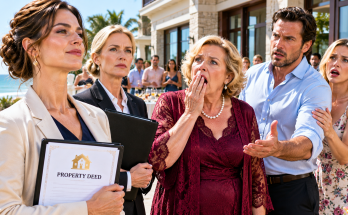
My Father Kicked Me Out of the Family Mansion After My Wife Died—Then My Daughter Found a Letter Proving the House Had Never Belonged to Him
Part 1: The Night My Father Threw Us Out
My father stood at the front door of our family mansion, holding my late wife’s photograph in one hand and my suitcase in the other.
“You have one hour to leave,” he told me. “You and your daughter are no longer welcome here.”
My seven-year-old daughter, Emma, clutched my coat and began to cry.
I had just buried my wife, Claire, three days earlier.
And the man throwing us out was my own father.
He believed I was too broken to fight back. He believed grief had made me weak. Most importantly, he believed the secret he had hidden for twenty years would remain buried forever.
He was wrong.
My name is Daniel Brooks. I had moved into my father’s mansion with my wife and daughter two years earlier, when Claire became seriously ill. My father, Richard, insisted that we stay because he wanted to help.
“We’re family,” he said. “This house is big enough for everyone.”
At the time, I believed him.
After Claire died, everything changed.
My father began complaining about Emma’s crying, the toys in the hallway, and the photographs of Claire I kept on the walls.
“Life goes on,” he told me. “You can’t expect everyone to live inside your grief.”
I tried to keep the peace for Emma’s sake.
Then, three days after the funeral, my father called me into his study.
He sat behind his enormous wooden desk with a document in front of him.
“I’ve decided it’s time for you to move out.”
I stared at him.
“Dad, Claire’s funeral was three days ago.”
“And I gave you enough time to grieve.”
“Where are Emma and I supposed to go?”
“That isn’t my problem anymore.”
I couldn’t believe what I was hearing.
My father had built his reputation on being a generous businessman and a devoted family man. Relatives praised him at every holiday dinner. Neighbors called him a pillar of the community.
But I had seen another side of him whenever someone challenged his authority.
He wanted obedience, not discussion.
“Please,” I said. “Give me a few weeks to find somewhere suitable for Emma.”
He pushed the document toward me.
“Sign this first. It confirms that you have no claim to this property and will leave without making trouble.”
I glanced at the paper but didn’t touch it.
“Why would I have a claim to your house?”
My father smiled.
“Exactly. So sign it.”
Something about his expression unsettled me.
Before I could respond, Emma appeared in the doorway holding her mother’s favorite blue scarf.
“Grandpa,” she whispered, “can we stay until Mommy comes home?”
My father looked away.
“Your mother isn’t coming home, sweetheart.”
Emma’s face crumpled.
I pulled her into my arms.
“That’s enough,” I said.
My father stood.
“Then get out.”
We packed what we could carry. I took Emma’s clothes, her schoolbag, a few family photographs, and Claire’s jewelry box. Everything else had to remain behind.
As I carried our suitcases toward the front door, my father called after me.
“Don’t come back expecting help.”
I turned toward him.
“You won’t have to worry about that.”
We spent our first night in a small hotel on the other side of town.
Emma fell asleep with her mother’s scarf wrapped around her hand. I sat by the window, wondering how a man could watch his own granddaughter lose her mother and then throw her out of the only home she remembered.
The next morning, I began calling rental agencies.
While searching through Claire’s jewelry box for her wedding ring, Emma discovered a small envelope tucked beneath the velvet lining.
“Daddy, what’s this?”
The envelope had my name on it in Claire’s handwriting.
Inside was a letter dated six months before her death.
Daniel, if your father ever tries to force you out of the mansion, don’t argue with him. Find the original property documents in the old library. Your father has hidden something from you, and it concerns the house, your grandfather, and the promise he made before I became part of this family.
I read the letter twice.
Claire had never told me she knew anything about the mansion’s ownership.
At the bottom, she had written one final sentence:
The house belongs to the person your father has spent twenty years trying to silence.
I looked at Emma.
Then I called my father’s office.
He answered immediately.
“What do you want?”
“I need to collect a few things from the library.”
“No.”
“Dad, they’re my personal belongings.”
“Everything you left behind belongs to this house now.”
He hung up.
I sat motionless, holding Claire’s letter.
My father had spent years telling everyone the mansion was his greatest achievement.
But my wife had known something he didn’t want me to discover.
And for the first time since her death, I had a reason to stop grieving long enough to fight.
Part 2: The Documents Hidden Behind the Bookshelf
I contacted a lawyer named Helen Morris, who had helped Claire prepare her personal affairs before she died.
When I showed Helen the letter, she became unusually quiet.
“Your wife asked me to keep a copy of certain records,” she explained. “She believed you might need them one day.”
“What records?”
Helen opened a cabinet and removed a thick folder.
Inside were copies of old property deeds, correspondence between my grandfather and my father, and a trust agreement dated twenty years earlier.
I recognized my grandfather’s signature immediately.
He had died when I was a teenager. He was the one person in our family who had never treated money as a reason to control others.
Helen explained that the mansion had originally belonged to my grandfather. Shortly before his death, he had transferred the property into a family trust with specific conditions.
The trust was designed to protect the house for future generations.
My father had been appointed to manage the property temporarily, but he had never been given unrestricted ownership.
According to the agreement, I was the designated future beneficiary once I reached the required age, provided certain conditions were met.
I stared at the document.
“Are you saying my father never owned the mansion?”
“Not in the way he has claimed,” Helen replied. “He has managed it for years, but the trust documents determine the actual rights to the property. We need to verify the original records before drawing final conclusions.”
I felt dizzy.
For twenty years, my father had told relatives that he had built the family fortune himself. He had hosted charity dinners in that mansion and boasted about its value.
But my grandfather had placed it in a trust meant to protect me and the generations after me.
Helen turned another page.
There was a letter from my grandfather explaining why he had made the arrangement.
Richard has always believed that ownership gives him authority over everyone around him. I want the family home to remain a place of security, not a weapon. Daniel must never be forced out because he disagrees with his father.
My hands began to tremble.
My father had thrown me and Emma out of a house that my grandfather had specifically intended to protect us.
But that wasn’t the worst part.
The folder contained a series of letters showing that my father had tried to change the trust years earlier.
He had asked a lawyer to remove my name as the future beneficiary and replace it with his own. The request had been rejected because the agreement did not permit the change without additional legal steps and independent approval.
A later letter showed that my father had attempted again.
Then I found a note from Claire.
She had discovered the documents while helping my grandfather organize his papers years before she became ill. She had kept quiet because she wanted to avoid a family conflict, but she had asked Helen to preserve everything.
Helen pointed to one final document.
It was a recent request submitted by my father asking for permission to sell the mansion.
The trust’s administrators had refused because the proposed sale did not meet the agreement’s conditions.
My father had apparently been planning to sell the property anyway.
If the sale went through, he could face serious legal consequences.
Suddenly, his demand that I sign the document made sense.
He wanted me to confirm that I had no claim to the house before he tried again.
“He knows the trust exists?” I asked.
“He knows there are restrictions,” Helen replied. “What he doesn’t know is that Claire preserved copies of the original correspondence.”
I looked down at the letter my wife had written.
Even while fighting her illness, she had been trying to protect our daughter’s future.
I felt grief rise in my throat.
“Why didn’t she tell me?”
“Perhaps she wanted to spare you the conflict while she was ill,” Helen said. “But she made sure the evidence would survive.”
Helen advised me not to return to the mansion or confront my father without a clear legal plan. She would contact the appropriate professionals, verify the trust records, and determine what action could be taken.
I agreed.
But that evening, my father called.
His voice was unusually friendly.
“Daniel, perhaps I was too harsh yesterday. Come home tomorrow. We can discuss things like adults.”
I didn’t answer immediately.
“What’s changed?”
“Nothing. I’m your father.”
“Then why did you make Emma leave?”
He sighed.
“Don’t bring the child into this.”
“She was already in it. You made sure of that.”
My father lowered his voice.
“Come tomorrow, and we’ll settle everything. Bring the paper I asked you to sign.”
I understood what he wanted.
He still believed I knew nothing.
“Fine,” I said. “I’ll come.”
When I told Helen, she advised me to bring no signed documents and to keep the meeting focused on the facts.
The following morning, I returned to the mansion.
My father was waiting in the study. The same document lay on his desk.
“Sign it,” he said. “Then we can put this unpleasantness behind us.”
I placed Claire’s letter beside it.
His face changed.
“Where did you get that?”
“From my wife’s jewelry box.”
He grabbed the letter and read it.
For the first time in my life, I saw genuine fear in my father’s eyes.
“You had no right to go through private family records,” he snapped.
“Those records concern my family and my future.”
He stood so quickly that his chair struck the wall.
“You don’t know what you’re doing.”
“Then explain it to me.”
He stared at me for several seconds.
Finally, he said, “Your grandfather was old and confused when he signed those papers.”
“Then why have you spent twenty years trying to change them?”
He said nothing.
I placed the trust agreement on the desk.
“My lawyer has the records. The original documents are being verified. If you want to explain yourself, now would be a good time.”
My father looked at the door.
Then he whispered the words that changed everything.
“Your grandfather didn’t choose you because he loved you more. He chose you because he knew what I had done.”
I froze.
“What did you do?”
My father opened his mouth, but before he could answer, someone knocked at the study door.
It was Helen.
And she had brought the one document my father had hoped would never be found.
Part 3: The Truth My Grandfather Left Behind
Helen entered the study carrying a sealed envelope and a certified copy of the trust agreement.
My father stared at her.
“You have no right to be here.”
“I represent Daniel in this matter,” she replied calmly. “And the trust’s administrators have authorized a review of the records.”
She placed the documents on the desk.
The first confirmed that the mansion had been transferred into the family trust years earlier. The second showed that my father’s repeated requests to change the arrangement had not been approved.
The third was a letter from my grandfather.
It was addressed to my father and dated several months before his death.
I read it aloud.
Richard, I gave you responsibility for managing this house because I trusted you to protect it. Instead, you have treated it as proof that you are more important than the people who live inside it. I will not allow Daniel to inherit the same fear that has controlled this family for years.
My father slammed his hand against the desk.
“That’s enough!”
I continued.
If you attempt to remove Daniel from the property or pressure him into surrendering his rights, the trust administrators must review your conduct and determine whether you should continue managing the estate.
The room fell silent.
My father sank into his chair.
Helen explained that the trust administrators would now review his actions, including the proposed sale and the circumstances surrounding my eviction. The legal outcome would depend on the original trust terms and the applicable law, but my father’s claim that I had no possible interest in the property was not supported by the records.
For years, he had presented himself as the unquestioned owner.
Now his own family’s documents were challenging that story.
But I still wanted an answer to one question.
“Why did you throw Emma and me out?”
My father stared at the floor.
Then he finally admitted that he had wanted me to sign away any potential rights before the trust administrators reviewed the sale proposal. He believed that if I surrendered my claim voluntarily, he could make decisions about the property without interference.
“And Claire?” I asked. “Did you know she had found these documents?”
He nodded.
“She confronted me shortly before she died. She said she wouldn’t let me take the house away from you.”
I felt as though the room had tilted.
“My wife was dying, and you were arguing with her about a house?”
“She didn’t understand the financial pressure I was under.”
“No,” I said. “She understood exactly what you were doing.”
My father looked older than I had ever seen him.
He tried to explain that he had spent years maintaining the mansion, paying staff, and preserving the family’s reputation. He insisted that he had earned the right to decide what happened to it.
But the records told a different story.
My grandfather had entrusted him with responsibility—not unlimited power.
And when that responsibility became inconvenient, he had tried to erase the person the trust was meant to protect.
I left the study without signing anything.
Over the following weeks, the trust administrators completed their review. My father’s authority over the property was suspended while they investigated the proposed sale and his attempts to change the agreement. The final decision followed the trust’s terms, not my father’s demands.
The mansion was secured for its intended purpose, and my rights under the trust were formally recognized.
I didn’t move back immediately.
I rented a small house for Emma and me while the legal matters were resolved. It was simpler than the mansion, but it was filled with something we had been missing: peace.
Emma planted flowers beside the front steps and chose a yellow blanket for the living room. Every night, we read one of her mother’s favorite stories.
One evening, she asked me whether we would ever see Grandpa again.
I thought carefully before answering.
“I don’t know, sweetheart. He hurt us, and he has to take responsibility for that. But you don’t have to hate him just because I’m upset with him.”
“Can he say sorry?”
“Yes. And if he does, we’ll decide what happens next.”
Months later, my father sent a letter.
He admitted that he had allowed pride and fear to control him. He apologized for throwing us out and for treating Emma as though she were an inconvenience.
He did not ask me to sign anything.
He did not demand that I return.
For the first time, he simply asked whether I would be willing to speak with him.
I agreed to one meeting in a public place, with clear boundaries. We spoke for an hour. He listened more than he talked, although I knew one conversation could not undo years of control.
I didn’t promise him forgiveness that day.
I promised only that I would consider whether trust could be rebuilt through his actions.
Eventually, Emma and I returned to the mansion—not because my father had allowed us back, but because the trust had been created to protect the family’s future, and the legal review confirmed the rights I had been denied.
I kept Claire’s photograph above the fireplace.
Beneath it, I placed a copy of my grandfather’s letter.
Emma asked why I wanted everyone to see it.
“So we remember what this house is supposed to mean,” I told her.
“What does it mean?”
I knelt beside her.
“It means a home should protect the people inside it. It should never be used to frighten them into obeying someone.”
She smiled and ran toward the garden.
I watched her for a long time.
My father had believed that the mansion made him powerful. He thought owning the biggest house meant he could decide who belonged and who didn’t.
But my grandfather had understood something my father never learned.
A family home is not a throne.
And the person who holds the keys does not automatically own the hearts of everyone who lives there.
My father tried to throw us out to protect his secret. Instead, he revealed the truth that finally gave my daughter and me a place where we could belong without fear.