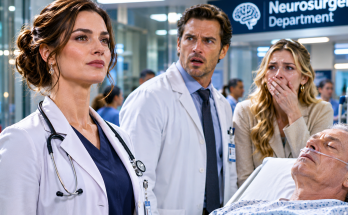
My Husband Left Me After I Worked Three Jobs to Make Him a Surgeon—He Said I Wasn’t Educated Enough to Be His Wife. Twelve Years Later, He Walked Into My Operating Room and Discovered Who Was Holding His Future in Her Hands
PART 1 — The Wife He Was Ashamed Of
“Elena, I need you to understand something. I’m becoming a successful surgeon, and I can’t spend the rest of my life carrying someone who never finished college.”
My husband, Nathan, said those words while placing divorce papers on our kitchen counter.
It was three days before Christmas.
Outside, snow covered the streets of Cleveland, Ohio.
Inside, I stood wearing my warehouse uniform, still holding the lunch container I had prepared for him.
I thought he was joking.
He wasn’t.
“Nathan, what are you talking about?”
He loosened his expensive tie.
“I’m talking about our future. We don’t have the same ambitions anymore.”
I stared at him.
“Who paid your medical school tuition when your scholarship ran out?”
He sighed.
“Don’t start counting everything you’ve done for me.”
“Who worked overnight shifts so you could study?”
“Elena, please.”
“Who sold her grandmother’s jewelry to pay for your examination fees?”
He slammed his hand against the counter.
“That’s exactly the problem! You make everything about sacrifice!”
I went silent.
For six years, I had worked two jobs to help him become a doctor.
I worked at a warehouse during the day and cleaned offices at night.
On weekends, I baked cakes and sold them to neighbors.
I had abandoned my nursing program because we couldn’t afford both our education and our living expenses.
Nathan had promised it would only be temporary.
“Once I become a surgeon, we’ll have a beautiful life,” he used to tell me.
I believed every word.
But now he was wearing a designer watch I had helped him afford, standing in the apartment I had paid for, and telling me I was no longer suitable for his future.
“Is there another woman?” I asked.
He looked toward the window.
Her name was Lauren.
She was the daughter of a wealthy hospital executive.
She had attended expensive universities, traveled internationally, and moved comfortably among the people Nathan now wanted to impress.
He didn’t deny it.
“Lauren understands my career,” he said.
I felt my heart sink.
“And I didn’t?”
He looked at me coldly.
“You work in a warehouse, Elena. What could you possibly understand about my world?”
Those words hurt more than the divorce papers.
Then he pushed an envelope toward me.
“There’s twenty-five thousand dollars inside. Take it and start over. I don’t want arguments or embarrassment.”
I looked at the envelope.
It was supposed to be a generous offer.
But I remembered every night I had worked until my hands hurt.
Every meal I had skipped.
Every examination I had postponed.
I didn’t touch the money.
Instead, I called a divorce attorney the next morning.
Her name was Rebecca Lawson.
She advised me to review every financial document before signing anything.
I followed her advice.
The divorce took several months.
I protected my savings and received the share of our marital assets that I was legally entitled to.
Nathan moved on with Lauren.
His mother called me once.
“Some women simply aren’t meant to stand beside successful men,” she said.
I didn’t argue.
I had finally learned that I didn’t need to convince anyone of my value.
After the divorce, I returned to the nursing textbooks I had stored in a cardboard box.
I was thirty-one.
My dream wasn’t dead.
It had simply been waiting.
A few weeks later, I received an opportunity to work as a medical support coordinator for a nonprofit organization in rural Montana.
The job provided housing and helped me reconnect with the medical world.
I packed my belongings, took the money I had saved, and left Ohio.
I wasn’t running away.
I was finally going somewhere for myself.
PART 2 — THE DREAM HE THOUGHT I HAD LOST
Montana was different from anything I had known.
The medical organization served small communities where patients sometimes traveled hours to reach a clinic.
I coordinated appointments, organized medical supplies, and helped arrange emergency transportation.
I watched doctors work through freezing temperatures, difficult roads, and shortages of equipment.
One evening, a young boy was brought to the clinic after a serious accident.
The medical team worked urgently while I helped coordinate communication with the regional hospital.
His condition stabilized, and he was transferred for specialist care.
That night, I couldn’t stop thinking about how much I wanted to be part of that work.
The following morning, I approached the clinic director, Dr. Margaret Lewis.
“I want to return to school,” I told her.
She looked at me carefully.
“What do you want to study?”
“Nursing first. And eventually, if I can, medicine.”
She smiled.
“Then why are you waiting?”
I laughed nervously.
“Because I’m thirty-one, and I don’t know whether I can afford to start again.”
She placed a hand on my shoulder.
“You’re not too old to build a future.”
I applied to a university program.
I studied while working.
I completed my undergraduate education and eventually earned admission to medical school.
The years were difficult.
There were examinations that kept me awake all night.
There were clinical rotations that left me physically exhausted.
There were moments when younger students seemed far ahead of me.
But I never forgot why I had started.
I wanted a career that belonged to me.
After medical school, I completed surgical training and eventually specialized in neurosurgery.
I became particularly interested in emergency brain surgery and complex neurological trauma.
My work took me to several hospitals.
I learned from exceptional surgeons, led difficult cases, and gradually became known for my calm decisions under pressure.
I also met Daniel Brooks.
He was a paramedic who had spent years working in emergency response.
He never asked me to make my career smaller so he could feel important.
He never treated my success as a threat.
He simply supported me.
We married several years later.
For the first time, I understood that love wasn’t supposed to feel like an examination I had to pass.
Then, twelve years after Nathan divorced me, I received an unexpected offer.
Lakeview Medical Center in Cleveland was searching for a new director of its neurosurgical department.
The hospital had expanded its emergency services and wanted someone with extensive surgical experience and leadership skills.
I applied.
After several interviews, I was offered the position.
I accepted.
I would be returning to the city where my marriage had ended.
But I wasn’t returning as the woman who had been told she wasn’t good enough.
I was returning as Dr. Elena Carter.
On my first morning, the hospital president welcomed me.
“Dr. Carter, we’re excited to have you leading this department.”
We walked through the main corridor toward the surgical wing.
Then I heard a familiar voice.
“Lauren, I told you the appointment was supposed to be this morning.”
I turned.
Nathan stood near the elevators.
He looked older.
His hair had begun thinning, and the confidence he once carried seemed less certain.
Lauren stood beside him, holding a handbag and looking worried.
Nathan glanced toward me.
His face froze.
“Elena?”
I nodded.
“Good morning, Dr. Parker.”
He looked at the hospital president.
The president smiled.
“Dr. Parker, I don’t believe you’ve met our new director of neurosurgery.”
He gestured toward me.
“Dr. Elena Carter.”
Nathan stared at my white coat.
Then at my identification badge.
Then back at my face.
Before he could speak, a nurse rushed toward us.
“Doctor! We have an emergency transfer from the highway. Severe head trauma, possible intracranial bleeding. The patient is deteriorating.”
The president turned toward me.
I immediately followed the nurse.
Nathan called after me.
“Elena!”
But I didn’t stop.
Someone needed a surgeon.
And I was exactly where I needed to be.
PART 3 — THE SURGEON HE NEVER BELIEVED I COULD BECOME
The emergency patient was a sixty-eight-year-old businessman named Richard Hayes.
He had suffered a serious accident and arrived with a dangerous brain injury.
The emergency team had already begun stabilizing him.
I reviewed the scans with the neurosurgical team.
The bleeding was putting pressure on critical areas of the brain.
We needed to act quickly.
“Prepare the operating room,” I instructed.
“Notify anesthesia, arrange blood products, and bring the senior surgical team in.”
Everyone moved.
Nathan stood near the corridor entrance, watching.
He was no longer looking at me as the warehouse worker he had divorced.
He was watching me lead the department he had once hoped to impress.
Lauren approached him.
“Who is she?”
He swallowed.
“She’s my ex-wife.”
Lauren looked confused.
“Your ex-wife is the new neurosurgery director?”
He didn’t answer.
Inside the operating room, the team worked carefully.
The procedure was complex.
The injury required immediate surgical intervention, and every decision mattered.
I remained focused on the patient.
There was no room for old memories.
No room for anger.
No room for revenge.
There was only a human life in front of me.
After several hours, the bleeding was controlled.
The operation was completed successfully.
The patient was transferred to intensive care for close monitoring.
When I stepped outside, Nathan was waiting.
He approached slowly.
“Elena.”
I removed my surgical cap.
“Dr. Parker.”
He looked uncomfortable.
“Can we talk?”
I nodded toward a quiet consultation room.
He followed me inside.
For several seconds, he said nothing.
Then he finally whispered:
“I didn’t know.”
I looked at him.
“What didn’t you know?”
“That you became a doctor.”
I gave a small smile.
“You never asked.”
He looked down.
“I heard you moved away. I thought you were working in administration.”
“I did. For a while.”
He stared at my coat.
“You’re leading the department now?”
“Yes.”
He sat down.
Then he spoke quietly.
“I owe you an apology.”
I waited.
He continued.
“When I became a doctor, I started believing that my career made me better than the people who helped me get there.”
I said nothing.
“I was ashamed of where I came from. I thought being with Lauren’s family would make me more important.”
He rubbed his forehead.
“I was wrong about you. I was wrong about everything.”
I looked at him for a long moment.
“Do you remember the Christmas when you gave me divorce papers?”
He nodded.
“I remember.”
“I had saved money for months to buy you a car. I wanted you to be safe driving to the hospital.”
His eyes filled with tears.
“I didn’t know.”
“You didn’t ask.”
He covered his face.
“I’m sorry, Elena.”
I believed that he regretted what he had done.
But regret didn’t erase the years I had lost.
And it didn’t mean I had to return to the past.
I stood.
“I hope you become a better man, Nathan. But I don’t need an apology to continue living my life.”
He looked up.
“Can you forgive me?”
I paused.
“Forgiveness isn’t the same as going back.”
Then I left the room.
Later that evening, I visited Richard Hayes in intensive care.
His condition had stabilized, and the medical team was cautiously optimistic about his recovery.
His daughter thanked the entire team.
I told her the nurses, anesthesiologists, and other surgeons deserved recognition too.
As I walked back toward my office, I passed the hospital’s large glass windows.
The city lights were glowing outside.
I remembered the young woman who had once sat in a tiny apartment, holding divorce papers and wondering whether her life was over.
She had believed she had lost everything.
But she hadn’t.
She had lost a marriage.
She had lost years of her dreams.
Yet she had never lost the ability to begin again.
The next morning, the hospital president introduced me to the full medical staff.
He spoke about my training, my surgical experience, and the plans we would develop to improve emergency neurological care.
Everyone applauded.
I smiled.
Not because Nathan had seen me succeed.
Not because I had finally reached a position he once thought was beyond my ability.
But because I had become someone I once thought I would never have the chance to be.
My husband once told me I was only a warehouse worker and that I didn’t belong in his world.
Twelve years later, I returned wearing a white coat, leading the department where he worked.
I didn’t become a doctor to make him regret leaving me.
I became one because I finally understood that my dreams deserved the same sacrifice I had once given to his.