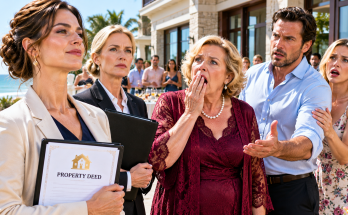
My Mother Gave My Late Husband’s Restaurant to My Sister Behind My Back—Then the Old Manager Handed Me a Key and Said, “Your Husband Knew This Day Would Come”
Part 1: The Restaurant That Was Supposed to Be Mine
The morning after my husband’s funeral, my mother called a family meeting and announced that my younger sister would be taking over his restaurant.
She said it while I was still wearing black.
My sister, Vanessa, sat beside her in a cream-colored dress, smiling as though she had just won a prize. My father stared at his coffee. Nobody asked how I was coping with the loss of the man I had loved for twelve years.
I was too shocked to speak.
My husband, Daniel, had spent fifteen years building a small neighborhood restaurant into one of the most successful family-owned businesses in our city. He had started with six tables, a borrowed oven, and a handwritten menu. By the time he died unexpectedly, the restaurant employed twenty-three people and had become a place where customers celebrated birthdays, anniversaries, and new beginnings.
I had helped him build it.
I managed the books, negotiated with suppliers, handled payroll, and worked beside him during the busiest weekends. When our daughter was born, I returned to work just weeks later because we couldn’t afford to lose the business’s momentum.
My mother, Eleanor, had always insisted that Daniel’s restaurant was a family achievement.
But apparently, when Daniel died, the definition of family changed.
“Vanessa has the personality for this,” my mother explained. “She’s outgoing, ambitious, and knows how to deal with people.”
I looked at my sister.
Vanessa had never worked a full shift in the restaurant. She had visited occasionally, taken photographs of expensive meals, and complained whenever Daniel asked her to help clear a table.
“Daniel and I built that restaurant together,” I said quietly.
My mother sighed.
“You were his wife, not his business partner.”
The words cut deeper than I expected.
My father finally looked up.
“Your mother is trying to prevent the business from falling apart. You have a child to raise. You don’t need the burden of running a restaurant.”
I stared at him.
“What happens to the employees? What happens to Daniel’s plans?”
Vanessa reached across the table and patted my hand.
“Don’t worry, Claire. I’ll take care of everything. You can visit whenever you want.”
Visit?
I had spent years waking before dawn, balancing accounts at midnight, and sacrificing weekends to keep that restaurant alive. Now my sister was speaking as though I were a distant relative asking for a table.
I left the meeting before I said something I would regret.
For the next several days, I focused on my daughter, Lily. She was ten and had lost the person she trusted most in the world. I didn’t want her to hear adults fighting over money while she was still trying to understand why her father wasn’t coming home.
But the restaurant situation became impossible to ignore.
Vanessa changed the staff schedule without consulting me. She announced expensive renovations. She even removed Daniel’s photograph from the entrance because she said it made the restaurant look old-fashioned.
When I objected, she told me I was clinging to the past.
Then, one rainy afternoon, I received a message from the restaurant’s longtime manager, Mr. Harris.
Please come to the restaurant after closing. Alone. There is something Daniel asked me to give you if anything ever happened to him.
I drove there that evening.
The dining room was dark except for a small light above the counter. Mr. Harris stood beside the old wooden cash register Daniel had refused to replace.
He looked exhausted.
“I’m sorry for your loss,” he said.
“Thank you. What did Daniel leave for me?”
Mr. Harris reached into his jacket and placed a small brass key in my palm.
I recognized it immediately.
It was the key to Daniel’s private office—a room he had kept locked even when we worked together every day.
“He told me to give you this if someone tried to take the restaurant away from you,” Mr. Harris explained.
My heart began to race.
“Who would try to take it away from me?”
He looked toward the front windows, where Vanessa’s new sign was being installed.
“Your sister isn’t the first person who wanted control of this business.”
He handed me a sealed envelope.
Inside was a short letter written in Daniel’s handwriting.
Claire, if you’re reading this, someone has tried to make decisions about the restaurant without understanding what it truly is. Open the bottom drawer of my desk. Don’t sign anything until you’ve read what’s inside.
I stared at the letter.
Then Mr. Harris said something that made my blood run cold.
“Your husband discovered what your mother and sister had been planning months before he died.”
I looked toward the locked office door.
“What were they planning?”
Mr. Harris lowered his voice.
“To sell something that never belonged to them.”
Part 2: The Drawer Beneath the Desk
I unlocked Daniel’s office for the first time since his funeral.
The room smelled faintly of coffee and the cedarwood polish he had always used on his desk. His notebooks were stacked neatly beside the computer. A photograph of Lily, taken on her first birthday, stood beside a small ceramic bowl filled with coins.
I had to sit down.
For a moment, I could almost imagine Daniel returning from the kitchen, wiping his hands on a towel and asking why I was working so late.
Then I remembered the letter.
I pulled open the bottom drawer.
Inside was a thick folder containing property records, business correspondence, and a series of emails printed on paper. At the top was a document bearing the name of an independent company I had never heard of.
I called Mr. Harris back into the office.
He explained that Daniel had separated ownership of the restaurant’s building from the restaurant’s daily operations several years earlier. The arrangement had been made after a difficult financial period, when a former investor had tried to force Daniel to sell.
Daniel had worked with an attorney to protect the property and ensure that the business could survive changes in management.
The building was held through a legally structured company. Daniel’s ownership interest and succession arrangements were documented separately from the restaurant’s operating accounts.
My mother and sister could not simply declare themselves owners because they were relatives.
I turned to the emails.
Six months before Daniel died, Vanessa had contacted a commercial property broker. She had asked about the value of the building and whether it could be sold quickly.
My mother’s name appeared in a later email.
She had told Vanessa that Daniel was too protective of the restaurant and that, if anything happened to him, they could persuade me to accept a payout rather than fight for control.
Another email contained a draft agreement offering me a sum of money in exchange for giving up any claims I might have to the business.
The amount was insulting.
It was less than a year’s profit, and it ignored the years of work I had invested.
I read the document twice.
They had planned to push me aside before Daniel’s funeral.
But one page remained at the bottom of the folder.
It was a letter from Daniel’s attorney confirming that the restaurant’s ownership arrangements had been updated. The document did not automatically make me the owner of every part of the business, but it established that my rights and responsibilities had to be handled according to the company’s records and legal agreements.
There was also a written instruction from Daniel requesting that Mr. Harris protect the employees and preserve the business while the estate was being settled.
I felt tears gathering in my eyes.
Even when he was alive, Daniel had worried that someone might try to turn his life’s work into a quick payday.
He had tried to protect us without frightening me with the possibility.
I called the attorney listed in the folder the next morning.
After reviewing the documents, she confirmed that my mother’s announcement had no power to transfer the restaurant’s ownership. Vanessa had been given authority to help with some daily operations, but she had not been granted the right to sell the building or change the ownership arrangements.
The attorney also discovered that Vanessa had already signed a preliminary agreement with a developer to explore a sale.
It wasn’t a completed sale, but it was serious enough to require immediate attention.
I felt sick.
“Why would she do this?” I asked.
The attorney paused.
“You’ll need to ask her. But there is something else. The developer has been told that the property can be transferred without your involvement. That representation may be incorrect.”
I closed my eyes.
My mother had told everyone she was protecting the family. Vanessa had said she was preserving Daniel’s legacy.
But behind those words, they were trying to sell the place he had spent fifteen years building.
I arranged a meeting with the attorney, Mr. Harris, and the company’s independent adviser. We reviewed the documents and took steps to prevent any unauthorized transaction while the ownership and estate issues were clarified.
Then I called Vanessa.
“We need to talk about the restaurant.”
She laughed.
“Finally. I was wondering when you’d stop sulking.”
“I know about the developer.”
The laughter vanished.
“What developer?”
“The one you signed a preliminary agreement with.”
She was silent for several seconds.
Then she said, “You have no idea what you’re talking about.”
“I have the emails.”
Her voice sharpened.
“Those were private business discussions. You don’t understand the financial side of this.”
“I handled the books for years, Vanessa.”
“You handled invoices. Daniel made the real decisions.”
The cruelty in her voice surprised even me.
I asked her to meet me at the restaurant that afternoon.
She arrived with my mother.
Vanessa sat across from me and placed a document on the table.
“Sign this,” she said. “You’ll receive money, and we can stop fighting.”
I looked at the agreement.
Then I looked at my mother.
“Did you know she was planning to sell the building?”
My mother folded her hands.
“We were trying to protect you from financial stress.”
“By selling the business behind my back?”
“Vanessa deserves a chance to succeed,” she replied. “You have Lily. You should focus on being a mother.”
I pushed the document away.
“Being Lily’s mother doesn’t erase the work I did with Daniel.”
Vanessa stood.
“If you refuse, you’ll lose everything.”
I looked her in the eyes.
“No. I think that’s what you were counting on.”
She stormed out.
My mother followed her, but not before turning back to whisper, “You’re making a terrible mistake.”
I remained seated until the restaurant was empty.
Then Mr. Harris approached with one more envelope.
“Daniel asked me to hold this until you understood the first documents,” he said.
I opened it.
Inside was a handwritten note and a copy of an old agreement between Daniel and the restaurant’s first investor.
The note contained a sentence that changed everything.
The person who saved this restaurant before it became successful deserves to know the truth about who really gave us our beginning.
I read the first page of the agreement.
Then I understood why my mother had been so determined to keep me away from Daniel’s office.
The restaurant’s history was not what my family had told me.
And the person who had made it possible for Daniel to open his doors had been hiding in plain sight for years.
Part 3: The Truth Behind the Restaurant
I spent the next morning with Daniel’s attorney, going through the old agreement line by line.
The story began fifteen years earlier, before Daniel had a successful restaurant, before we owned a home, and before anyone in my family believed he would amount to anything.
At the time, Daniel was a talented cook working long shifts at a hotel kitchen. He had a dream of opening a restaurant where families could afford a good meal without feeling unwelcome.
Banks refused to lend him money.
Investors wanted control.
My parents told me he was wasting his potential.
But someone had believed in him.
That person was my late grandmother, Rose.
She had quietly lent Daniel the money he needed to open the restaurant. She did not want publicity or repayment on a strict schedule. She wanted him to build something meaningful.
The old agreement showed that the loan had been converted into a protected ownership interest when the restaurant became profitable. The arrangement had been documented legally, but most of the family had never known the details.
My grandmother had insisted that her contribution be used to protect the business for the family members who had actually built and sustained it.
Daniel had later updated the company’s documents to reflect that arrangement.
And he had made sure I was protected.
I remembered my grandmother visiting the restaurant during its first year. She sat at the smallest table near the kitchen and told Daniel that the place smelled like hope.
My mother had always claimed that she was the one who helped Daniel get started.
Now I understood why she had never wanted anyone to inspect the original records.
She had taken credit for a contribution that had never been hers.
But there was another revelation.
The attorney showed me a letter my grandmother had written shortly before she died.
It explained that she had watched my mother repeatedly try to control the family’s money and decisions. She feared that the restaurant would eventually become another tool for deciding who was worthy of the family name.
She had structured her contribution to prevent that.
I want this business to reward hard work, not manipulation, she had written. If the people who built it are ever pushed aside, the documents should speak when they cannot.
I sat quietly, remembering the warmth of her voice.
She had known my mother better than I had.
That afternoon, the attorney arranged a formal meeting with Vanessa and the developer. Mr. Harris attended as the restaurant’s longtime manager, and an independent adviser explained the ownership records.
Vanessa arrived confident, carrying the same agreement she had tried to make me sign.
The developer, however, looked uncomfortable.
He had been told the property could be sold without my involvement. Now he was being shown documents that required the transaction to be reviewed before anything could proceed.
The adviser explained that the preliminary agreement did not transfer ownership and that any sale would have to comply with the company’s legal arrangements.
Vanessa turned toward me.
“You did this to embarrass me.”
“No,” I said. “You signed an agreement you didn’t have the authority to complete.”
My mother interrupted.
“This family should be able to settle its own business privately.”
The attorney answered calmly.
“Family relationships do not replace legal ownership records.”
For once, my mother had nothing to say.
The proposed sale was halted while the relevant parties reviewed the documents. Vanessa’s authority to make major decisions was suspended pending a formal assessment of her actions.
The business remained open.
The staff kept their jobs.
And the restaurant’s future would be decided according to the agreements Daniel had carefully put in place—not according to who could shout the loudest at a family meeting.
I did not celebrate.
I was too busy missing my husband.
That evening, I went into Daniel’s office and sat at his desk. I opened the final letter he had written to me.
Claire, if you’ve reached this point, then you already know what matters. The restaurant is not the building, the money, or the sign above the door. It’s the people who come here because they feel welcome. It’s the staff who work hard to support their families. It’s the life we built together.
I pressed the letter against my chest.
He had understood something I had almost forgotten while fighting my family.
The restaurant had never been just a business.
It was the place where Daniel and I had fallen in love, where we had celebrated Lily’s first birthday, and where my grandmother had sat quietly watching a young man turn a dream into something real.
I decided not to sell.
Instead, I worked with the manager and the legal advisers to establish a stable plan for the restaurant’s future. We repaired the dining room, restored Daniel’s photograph to the entrance, and kept the menu he had created.
Lily helped me place a small framed picture of her father near the counter.
“Will people remember Daddy?” she asked.
I kissed the top of her head.
“Every day, sweetheart.”
Months later, Vanessa sent me a letter apologizing for trying to push me aside. She admitted she had wanted the success and recognition without understanding what Daniel had sacrificed to build the business.
I read the letter, but I did not rush to forgive her.
My mother also tried to reconcile. She said she had believed she was protecting the family, but she finally acknowledged that she had treated my grief as an opportunity to make decisions for me.
I told them both the same thing.
“If we are going to have a relationship, it must be built on honesty. You don’t get to rewrite the past just because the truth is uncomfortable.”
Some wounds take longer to heal than others.
But the restaurant survived.
On the anniversary of Daniel’s death, I arrived early and opened the doors myself. The morning sunlight fell across the tables he had chosen, and the smell of fresh bread filled the room.
Mr. Harris placed a cup of coffee beside me.
“Daniel would be proud,” he said.
I looked at the brass key resting on my desk.
For weeks, I had thought it represented a secret.
Now I understood that it represented trust—the trust Daniel had placed in me to protect what we had built together.
My mother had believed she could give my husband’s legacy to my sister with one family announcement.
She had forgotten the people who had built the restaurant, the documents that protected it, and the woman who had stood beside Daniel long before anyone called him successful.
Most importantly, she had forgotten that grief does not erase a person’s strength.
I didn’t save the restaurant because I wanted to defeat my family. I saved it because my husband had built a place where people belonged—and I refused to let his final legacy become another family’s weapon.