My Brother Sold the Vineyard Our Mother Left Me and Ordered Me Off the Property—Then a Stranger Arrived With Her Final Letter and Exposed the Betrayal Behind His Million-Dollar Deal
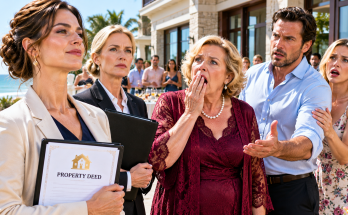
“Get off this property before I have security drag you out!” my brother shouted, throwing my suitcase onto the gravel driveway in front of forty-two guests. My sister-in-law stood beside him, smiling as she announced that the vineyard was already sold. I had spent fifteen years helping our mother build that estate, and now my own family was treating me like a stranger. But just as I reached for my suitcase, a black car stopped at the gate. An elderly attorney stepped out, carrying a sealed envelope with my mother’s handwriting. He looked at my brother and said, “Before you celebrate this sale, perhaps you should explain why you tried to sell a property you don’t own.”
Part 1: The Daughter Who Was Pushed Out
My name is Sophia Bennett, and I grew up among the grapevines of Rosewood Vineyard, a beautiful estate nestled in the hills of California.
My mother, Eleanor Bennett, had inherited a small piece of farmland from her parents. Over the years, she transformed it into a successful vineyard with a tasting room, a restored farmhouse, and a reputation for producing exceptional wines.
My older brother, Nathan, never shared her passion for the work.
He preferred luxury cars, expensive restaurants, and business deals that promised quick profits. I preferred the vineyard.
After college, I returned home and worked beside our mother. I helped manage the employees, improve the guest experience, and develop relationships with local restaurants. While Nathan moved between business ventures, I spent long days in the fields learning every part of the operation.
Mother often told me, “A place becomes valuable because of the people who care for it, not just because of the money it can make.”
When she became seriously ill, I took responsibility for the vineyard’s daily operations.
Nathan visited occasionally, usually asking about revenue, land values, and whether the property could be developed into a luxury resort.
Mother always refused.
“This land is our family’s history,” she would tell him. “It isn’t something to sell whenever you need money.”
After she died, her attorney read the will.
Nathan inherited several investment accounts and a commercial property. I inherited Rosewood Vineyard, including the farmhouse and the land associated with the business.
The documents were clear, properly executed, and legally recorded.
Nathan appeared disappointed but said little during the meeting.
His wife, Vanessa, was less subtle.
“You inherited the entire vineyard?” she asked me afterward.
“Yes.”
“And Nathan is supposed to accept that?”
“He received his own inheritance.”
She smiled tightly.
“I’m sure there will be a way to make this fair.”
I should have recognized the warning.
For the next six months, Nathan and Vanessa repeatedly asked me to sell the vineyard.
They argued that maintaining the property was expensive and that a developer had offered enough money to make all of us wealthy.
I refused.
The developer wanted to replace the vineyards with luxury homes, a private club, and a hotel complex. The plan would destroy much of the farmland our mother had spent decades cultivating.
Nathan accused me of being sentimental.
“You can’t live in the past forever, Sophia.”
“I’m not living in the past. I’m protecting what Mother built.”
Vanessa began telling relatives that I was hoarding the inheritance and preventing Nathan from receiving what he deserved.
Eventually, she stopped pretending the disagreement was about fairness.
One Friday afternoon, I returned from a meeting with our wine distributor and discovered several unfamiliar cars parked outside the farmhouse.
Nathan stood on the terrace with a group of investors.
Vanessa was holding a bottle of champagne.
“What is happening?” I asked.
Nathan approached me with a stack of documents.
“We’re finalizing the sale.”
I stared at him.
“You cannot sell Rosewood Vineyard. You don’t own it.”
He laughed.
“The buyer believes the family has agreed.”
“The family doesn’t own my property. I do.”
Vanessa stepped forward.
“You should have accepted our offer when we gave you the chance.”
I looked at the documents in Nathan’s hand.
One page described him as the authorized seller of the estate. Another contained a signature resembling mine.
I had never signed either document.
“Who signed this?” I demanded.
Nathan snatched the papers back.
“That isn’t your concern anymore.”
I felt a chill run down my spine.
“It’s my property. Everything concerning it is my concern.”
His expression changed.
“Then perhaps you should leave.”
I stared at him.
“What?”
“You heard me. The new owners will be taking control soon. Pack your belongings and go.”
I refused to move until I had spoken with my attorney.
Nathan called security anyway.
Two guards approached while Vanessa carried my suitcase toward the front steps. She threw it onto the gravel driveway, scattering a few of my clothes across the ground.
Forty-two guests watched from the terrace.
Some looked uncomfortable. Others whispered among themselves.
Nathan pointed toward the gate.
“Get off this property.”
I looked at my brother, the boy who had once helped me pick grapes beside our mother.
“Are you really doing this?”
He looked away.
Vanessa crossed her arms.
“You should have thought about that before refusing to cooperate.”
I bent to retrieve my belongings, struggling to keep my hands steady.
Then a black sedan pulled up beside the gate.
An elderly man in a charcoal suit stepped out, carrying a leather briefcase.
I recognized him immediately.
Mr. Harrison had been our mother’s attorney for more than thirty years.
He walked straight toward Nathan.
“Nathan Bennett,” he said calmly, “I understand you’ve announced the sale of Rosewood Vineyard.”
Nathan straightened his jacket.
“That’s correct. We’re finalizing the transaction.”
Mr. Harrison opened his briefcase.
“Then I suggest you stop immediately.”
Nathan frowned.
“Excuse me?”
The attorney removed a sealed envelope.
“This letter was left by your mother with specific instructions. I was to deliver it if anyone attempted to sell the vineyard without Sophia’s authorization.”
Vanessa’s smile disappeared.
Nathan stared at the envelope.
“What letter?”
Mr. Harrison looked him directly in the eyes.
“The one that explains why your mother made absolutely certain that this property could never be sold by you.”
Part 2: The Letter That Stopped the Sale
Mr. Harrison asked everyone to gather inside the farmhouse.
Nathan protested, but the attorney explained that the documents concerned the ownership of the estate and the proposed sale. The prospective buyers, who had been invited to celebrate the deal, agreed to wait while the ownership question was clarified.
I followed them into the old dining room.
The walls were lined with photographs of my mother standing among the vines. I could almost hear her voice reminding us to be careful with the furniture and never leave wine glasses on the antique table.
Mr. Harrison placed the sealed envelope beside a copy of the recorded deed.
He opened the letter and began reading.
My dearest Sophia, if this letter has been opened, someone has attempted to sell Rosewood Vineyard without your consent. I hope I am wrong about who it might be, but I cannot leave you unprepared.
My throat tightened.
Mother had known that this might happen.
The letter explained that she had been approached by the same development company nearly two years before her death.
The company wanted to purchase the vineyard for a luxury resort project. It had offered a substantial sum, but the proposed development required clearing much of the land and changing the property’s agricultural use.
Mother had refused.
Afterward, she discovered that someone had continued discussing the project with the developer while claiming to represent the family.
She never identified the person in the letter.
Instead, she instructed Mr. Harrison to preserve the correspondence and ensure that the ownership records were protected.
“I wanted to believe that everyone would respect my decision,” the letter continued. “But if they do not, the documents in the archive will show what actually happened.”
Mr. Harrison placed several additional files on the table.
They included correspondence between the development company and Nathan, as well as a draft proposal describing him as the person responsible for securing the vineyard.
Nathan immediately became defensive.
“I was only discussing a possible business opportunity. I never promised that I owned the property.”
Mr. Harrison examined the paperwork.
“Some of these documents describe you as the authorized seller. Others suggest that the buyer expected the transfer to proceed based on your representations. Those claims need to be investigated.”
Vanessa interrupted.
“Everyone knew Nathan was handling the sale!”
I turned toward her.
“Everyone except the actual owner.”
She looked at Nathan, silently asking him to respond.
He said nothing.
Mr. Harrison then showed us a draft agreement containing a signature attributed to me.
My stomach dropped.
“That isn’t my signature.”
The attorney nodded.
“We have not yet determined how this document was prepared, but we will preserve the original and have it examined. No transfer can proceed without valid authorization from the owner.”
The prospective buyer’s representative stood up.
“Our company will suspend the transaction until the ownership and document questions are resolved.”
Nathan’s face reddened.
“You can’t do that! We’ve already discussed the financial arrangements.”
“The proposed sale depends on valid authority to transfer the property,” the representative replied. “We cannot proceed while that is in question.”
Vanessa grabbed Nathan’s arm.
“Tell them what we agreed!”
He pulled away.
“Not now.”
I watched them, finally understanding how far the situation had gone.
My brother had spent months telling me that selling the vineyard was the only sensible option. His wife had spread rumors about me to our relatives. They had treated my refusal as an act of betrayal.
Yet neither of them had ever produced a legitimate reason why they had the right to sell the land.
Mr. Harrison turned to me.
“Sophia, your mother was very clear. Rosewood Vineyard was left to you, and the estate records support that ownership. No sale should proceed without your informed authorization.”
I nodded.
“I will not sell it.”
Nathan slammed his hand against the table.
“You’re destroying a deal worth millions!”
“No,” I replied. “I’m refusing to let you sell something that belongs to me.”
He stared at me as if he had never heard me speak before.
Then Mr. Harrison opened the final file.
Inside was a letter from our mother to the development company, written several months before her death.
It stated that she had formally withdrawn permission for further negotiations and had instructed her attorneys to contact her directly if anyone attempted to reopen the proposal.
The letter had been delivered and acknowledged.
Nathan had known that the negotiations were not authorized to continue on his behalf.
I looked at him.
“You knew she had refused.”
He said nothing.
The silence was answer enough to tell me that our disagreement had never been as simple as he claimed.
I had thought he was trying to persuade me to make a bad decision.
Now I realized he had been acting as though my decision did not matter at all.
I left the dining room with Mr. Harrison and asked him to make sure the estate’s records, business accounts, and legal documents were secured.
The prospective buyer departed without completing the transaction.
The champagne remained unopened.
And for the first time since our mother’s funeral, I felt that the truth was finally catching up with my brother.
Part 3: The Vineyard That Refused to Be Sold
The weeks after the attempted sale were difficult.
My attorney formally notified the development company that I was the sole owner of Rosewood Vineyard and had not authorized the proposed transaction.
The company suspended its plans and cooperated with requests to preserve relevant correspondence.
The disputed documents were submitted for independent review, and the lawyers involved began examining who had prepared them and how they had been circulated.
I did not publicly accuse Nathan of forgery or fraud. Those were serious questions that required evidence and proper legal procedures.
I simply made sure that no one could sell, transfer, or encumber my property without my authorization.
Nathan called repeatedly.
At first, he demanded that I reconsider the sale.
Then he blamed Vanessa for pushing the deal too quickly.
Finally, he asked me to meet him alone.
I agreed to meet at a small café in town.
He arrived without his usual expensive watch and looked older than I remembered.
“I never thought it would go this far,” he said.
I stirred my coffee.
“You threw me out of the house Mother left me.”
“I was under pressure. Vanessa had already told everyone the deal was happening.”
“You could have told them the truth.”
He lowered his eyes.
“I thought the money would solve everything. I thought we could sell the vineyard, divide the benefits, and move on.”
“But you didn’t own it.”
“I know.”
For a moment, I saw the brother I had grown up with. The one who used to carry baskets of grapes beside me and sneak into the kitchen for our mother’s homemade bread.
Then I remembered the suitcase on the gravel driveway.
“Why did you let Vanessa treat me that way?”
He looked down at the table.
“I didn’t want to admit that I had made a mistake.”
“That isn’t an answer.”
He swallowed.
“I wanted the deal to succeed. I thought if I pressured you enough, you would eventually agree.”
I listened quietly.
At least he was finally telling the truth.
But an apology could not erase the months of pressure, the false claims, or the humiliation he had caused.
“I love you, Nathan,” I said. “But I cannot trust you with my property or my future simply because we share a family name.”
He nodded slowly.
“I understand.”
We left the café without making promises we could not keep.
The legal review continued, and the proposed sale was eventually abandoned. The development company decided not to pursue the vineyard while the ownership dispute remained unresolved.
Rosewood stayed mine.
I returned to the estate and began repairing the damage caused by months of uncertainty. I hired additional staff, improved the tasting room, and created a program that allowed local students to learn about agriculture and sustainable winemaking.
I also restored the old farmhouse kitchen where my mother had taught me to cook.
Every morning, I walked through the vines before the staff arrived.
The quiet helped me remember why I had fought so hard to keep the property.
It wasn’t because I wanted to defeat my brother.
It was because the vineyard represented a lifetime of work, a family’s history, and a promise I had made to my mother.
Several months later, Mr. Harrison returned with a final document from my mother’s estate archive.
It was a handwritten note addressed to both of us.
My children, I hope you will always remember that money can divide a family when people begin to believe that love entitles them to ownership of someone else’s life. Nathan, you have your own gifts and opportunities. Sophia, you have been entrusted with this land. Neither inheritance makes one of you more important than the other.
I read the note twice.
My mother had not wanted us to compete.
She had wanted us to understand that our separate responsibilities were not an insult to either of us.
I placed the letter in a frame in the farmhouse library.
Not as a reminder of what Nathan had done, but as a reminder of what I wanted to preserve.
The following spring, Rosewood Vineyard hosted its first community harvest festival in my mother’s honor. Neighbors gathered among the vines, children painted small wooden signs, and local musicians played on the lawn.
For the first time in months, the estate felt alive again.
Near sunset, I stood beside the oldest grapevine on the property and watched the golden light settle over the hills.
I remembered the day Nathan had thrown my suitcase onto the driveway. I remembered the attorney arriving with the sealed letter. I remembered how easily I could have surrendered just to stop the arguments.
But I hadn’t.
I had protected the land, honored my mother’s wishes, and learned that loving someone did not mean allowing them to take whatever they wanted.
Nathan and I remained distant, though we slowly began speaking again. I did not pretend that everything was forgiven, and he no longer asked me to sell the vineyard.
That was enough for a beginning.
My brother believed the vineyard was a fortune waiting to be divided. My mother understood that it was a responsibility waiting to be honored.
The truth did not make our family perfect, and it did not undo the pain we had caused each other.
But it stopped a sale that should never have happened and gave me the chance to protect what mattered.
As I walked back toward the farmhouse, I felt the evening breeze move through the vines.
I finally understood my mother’s greatest lesson:
An inheritance is not proof that you are loved more than someone else. It is a responsibility to care for what has been entrusted to you—and the courage to say no when someone tries to take it away.