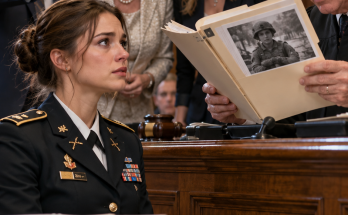
PART 1 — They Called Me Charity in Front of Their Wealthy Guests
The moment I stepped into the dining room of my adoptive family’s lakeside mansion, my mother raised her champagne glass and announced, “Everyone, meet the girl my husband insisted on rescuing.”
The guests laughed.
I stood in the doorway wearing my faded military uniform, holding a battered duffel bag that had traveled with me through two deployments and fourteen months away from home.
My adoptive mother, Eleanor Whitmore, barely glanced at me.
“Don’t look so offended, Natalie,” she said sweetly. “We all have our little responsibilities in life.”
My sister, Madison, swirled the wine in her glass and smiled.
“Some people inherit fortunes. Others inherit problems.”
Another wave of laughter traveled around the table.
I didn’t respond.
I had learned a long time ago that silence could reveal more than an argument ever would.
My father, Richard Whitmore, had adopted me when I was five years old, after finding me alone in a children’s shelter following the death of my biological parents.
He had been the first person to call me his daughter.
He taught me how to ride a bicycle, stayed beside me through childhood nightmares, and drove three hours to attend my military graduation even when his doctors warned him not to travel.
Eleanor had never forgiven him for bringing me into their lives.
She made sure I understood that in a thousand little ways.
Madison received a luxury car for graduating college.
I received a message telling me to stop asking for things.
Madison’s failed business venture was described as an unfortunate learning experience.
When I turned down a lucrative civilian position to remain in the military, Eleanor told her friends I had chosen a career suitable for someone without ambition.
Yet none of them knew what Richard had quietly done before his death.
And none of them knew why I had returned home that afternoon.
I had received a short message from his longtime attorney, Daniel Mercer.
Please come home as soon as possible. Your father’s final instructions must be carried out in person.
I had barely finished reading it when Eleanor tapped her champagne glass again.
“Since we’re discussing family matters,” she announced, “we should settle the future of this property.”
She gestured toward the enormous windows overlooking the lake.
The mansion, the private dock, the surrounding woodland, and the guest cottages were worth an estimated eighteen million dollars.
“Madison will eventually take over the estate,” Eleanor continued. “And my nephew, Christopher, will manage the family investments.”
Christopher, who had been sitting beside the fireplace, nodded confidently.
“What about me?” I asked.
The room became quiet.
Eleanor looked genuinely surprised that I had spoken.
“You?”
She laughed.
“Darling, you have a government paycheck. You don’t need a mansion.”
Madison leaned toward her husband.
“Besides, Natalie has never been involved in our financial decisions.”
I looked at the folder beside Eleanor’s plate.
It carried the name of a private investment company I had never heard of.
“What decisions?” I asked.
Christopher cleared his throat.
“We’re reorganizing the family’s property holdings. It’s a routine legal matter.”
“Then why is my name on that folder?”
For the first time, nobody laughed.
Eleanor quickly pulled the folder toward herself.
“You must have misunderstood something.”
I watched her fingers tighten around the papers.
My father had taught me to notice details long before the military taught me to question orders.
And the detail I noticed now was simple.
They weren’t surprised that I had returned.
They were frightened that I had returned before they were ready.
That evening, Eleanor summoned me to her private sitting room.
A contract lay on the coffee table.
“Your signature is all we need,” she said.
The document transferred my interest in several family properties to a company controlled by Christopher.
In exchange, I would receive a payment of ten thousand dollars.
I read the agreement twice.
Then I noticed the property schedule attached to the back.
It listed a commercial waterfront development, three rental buildings, and the very mansion where we were sitting.
The estimated combined value exceeded twenty-six million dollars.
“Why would I sign away all this property for ten thousand dollars?”
Eleanor’s expression hardened.
“Because you owe us.”
“For what?”
“For everything Richard gave you.”
I closed the folder.
“Richard gave me a home. He never asked me to pay him back.”
Eleanor stood.
“Sign it, Natalie. Don’t make this ugly.”
I slid the contract back across the table.
“No.”
Her face changed instantly.
“Then you can leave this house tonight.”
I picked up my duffel bag.
As I reached the door, she called after me.
“You’ll come crawling back when you realize you have nothing!”
I stopped for a moment.
Then I turned around.
“You might want to ask your lawyer who actually owns this house.”
Her smile vanished.
Because at that exact moment, a black sedan pulled into the driveway.
Daniel Mercer stepped out carrying a leather briefcase.
He walked past Eleanor without greeting her, came straight toward me, and whispered four words that made my heart stop.
“Your father left proof.”
And when he opened his briefcase, I finally understood why my family had been so desperate for my signature.
PART 2 — The Lawyer Opened a File My Mother Had Tried to Destroy
Daniel drove me to his office that night.
He didn’t ask about my deployment or why I was carrying everything I owned in a single bag.
Instead, he locked the office door, closed the blinds, and placed three thick binders on his desk.
“Your father started preparing for this possibility almost six years ago,” he explained.
“Preparing for what?”
“For the day Eleanor tried to remove you from the estate.”
I stared at him.
Richard had never told me that he was worried about his wife.
He had always tried to keep peace within the family, even when Eleanor made it nearly impossible.
Daniel opened the first binder.
Inside were property deeds, bank statements, corporate filings, and copies of documents signed by my father.
The first surprise was that the mansion had never belonged to Eleanor personally.
Richard had transferred it into a family trust years earlier.
The second surprise was even bigger.
The trust also controlled the waterfront development, several rental properties, and a commercial portfolio worth more than twenty-six million dollars.
But the most important document was missing.
“The original trust amendment is in a secure location,” Daniel said. “Your father instructed me not to reveal its contents until you appeared in person.”
“Why me?”
“Because the amendment concerns your position as the principal beneficiary.”
I felt my stomach tighten.
“Are you saying my father left me the estate?”
“I’m saying you need to understand what happened before you make that assumption.”
Daniel explained that, shortly before his death, Richard had discovered unusual withdrawals from the company’s accounts.
Hundreds of thousands of dollars had been moved through several related businesses.
Some payments were described as maintenance expenses.
Others were labeled consulting fees.
But the companies receiving the money shared the same registered address.
And several were connected to Christopher.
Richard had begun investigating quietly.
Then he became seriously ill.
Within weeks, he was gone.
After his funeral, Eleanor took control of the household records and told everyone that Richard had left the family finances in order.
Daniel had never believed her.
“Your father was worried that the estate was being used to secure debts that had nothing to do with the family,” he said.
I remembered the contract Eleanor had placed in front of me.
The transfer wasn’t merely an attempt to give Christopher more influence.
It would have allowed him to move valuable property out of the trust while leaving the existing debts behind.
If I had signed, I might have surrendered my legal protections without realizing what I was accepting.
“What happens now?” I asked.
Daniel leaned back in his chair.
“We verify the records, protect the trust, and determine who authorized those transactions.”
He opened another file.
A single bank statement had been highlighted in yellow.
The amount was $3.2 million.
The recipient was a company called Northbridge Holdings.
I recognized the name immediately.
It appeared on the contract Eleanor had wanted me to sign.
“Who owns Northbridge?” I asked.
Daniel turned the page.
“Christopher’s business partner.”
“And who guaranteed their loans?”
Daniel didn’t answer immediately.
He simply placed another document in front of me.
My name appeared near the bottom.
But the signature beside it wasn’t mine.
Someone had copied my name onto a preliminary financing agreement while I was overseas.
I felt a cold stillness settle over me.
The document had been prepared months before my return.
Someone had apparently intended to use my inheritance, my military salary, and my clean credit history to make a failing business appear financially secure.
“Has this been submitted to the bank?” I asked.
“That’s what we’re investigating.”
I stood and walked toward the window.
For years, I had believed Eleanor’s cruelty was personal.
Now I understood that her contempt had served another purpose.
If everyone believed I was an unwanted charity case, nobody would question why I had been excluded from the family’s financial decisions.
Nobody would expect me to know what I owned.
And nobody would believe me if I challenged her.
Daniel closed the binder.
“There is one more thing.”
He reached into his safe and removed a sealed envelope bearing Richard’s handwriting.
I recognized it immediately.
My father had written my name across the front.
Daniel placed it in my hands.
“Your father asked me to give you this only after you learned about the forged signature.”
My fingers trembled as I opened it.
Inside was a letter.
Natalie, if you’re reading this, someone has tried to use your name without your permission.
I need you to understand something I should have told you years ago.
I didn’t adopt you because I felt sorry for you.
I adopted you because you were my daughter from the moment I met you.
And I built this trust to make sure nobody could ever convince you otherwise.
At the bottom of the page was one final sentence.
The person responsible for what happened to the estate is not the person you suspect.
I read it twice.
Then Daniel’s office phone rang.
He listened silently for several seconds before his expression changed.
“What do you mean the original deed has disappeared?”
He hung up and looked at me.
“Someone entered the storage facility this afternoon.”
“What did they take?”
Daniel swallowed.
“Your father’s original trust amendment.”
Then he turned his computer toward me.
The security camera showed a person entering the building with an access card issued under a false name.
The image was grainy, but the person’s face was visible.
I recognized the watch first.
Then the posture.
Then the unmistakable silver hair.
It was Eleanor.
But she hadn’t been alone.
Standing beside her was a man I had not seen in years.
My biological father’s older brother.
The uncle everyone had told me was dead.
PART 3 — The Real Owner Walked Into the Mansion With the Original Deed
For several seconds, I couldn’t speak.
My biological uncle, Michael Hayes, had disappeared when I was a child.
My adoptive father had told me that Michael had moved overseas and cut contact with the family.
Later, Eleanor said he had died in an accident.
I had never seen a death certificate.
I had simply believed what I had been told.
Now he was standing beside her in a security recording, carrying the same black leather case he used to bring whenever he visited my biological parents.
“Who is he?” Daniel asked.
“My uncle.”
Daniel’s face went pale.
“That’s impossible.”
“Why?”
He opened a separate file and pulled out a document that Richard had obtained shortly before his death.
Michael Hayes had been listed as a witness to an old property agreement involving my biological family.
The agreement had never been completed because my parents died unexpectedly.
But one clause had survived.
It established a contingent interest in a small waterfront parcel that later became part of Richard’s larger development.
Richard had purchased the surrounding land legally, but he had preserved the original agreement because he believed the unresolved claim needed to be investigated.
That parcel was now worth millions.
And Michael had apparently returned to claim it.
“Why would Eleanor help him?” I asked.
Daniel looked at the forged guarantee on his desk.
“Because someone may have promised him a share of the estate in exchange for helping her transfer the assets.”
The next morning, we went to the mansion.
I didn’t arrive alone.
Daniel came with two independent attorneys and a court-appointed financial examiner who had agreed to review the disputed records.
Eleanor was hosting another gathering in the dining room.
When she saw me enter, she immediately stood.
“What are you doing here?”
I placed a copy of the trust documents on the table.
“I’m here to discuss the estate.”
She laughed nervously.
“You have no authority to discuss anything.”
Daniel stepped forward.
“Actually, Mrs. Whitmore, that is precisely what we need to establish.”
Christopher rose from his chair.
“This is a private family matter.”
“The moment someone forges a beneficiary’s signature on a financing document, it stops being merely a family matter,” Daniel replied.
The room fell silent.
Eleanor looked at me with open fury.
“You have no idea what you’re doing.”
“Then explain the $3.2 million transfer.”
Her lips parted, but no words came out.
I placed the next document on the table.
“And explain why someone tried to transfer trust property for ten thousand dollars.”
Christopher suddenly reached for the papers.
The financial examiner stopped him.
“Please leave the documents where they are.”
Then the front door opened.
Michael Hayes walked into the room.
He looked older than I remembered, with deep lines around his eyes and a careful, almost practiced smile.
“Natalie,” he said. “You’ve grown up.”
I stared at him.
“You were supposed to be dead.”
His smile faded.
“Your mother and father made some mistakes. Richard tried to correct them, but he didn’t understand the entire agreement.”
“My parents are dead. You disappeared. And now you’re here helping Eleanor take the estate?”
“I came to claim what was promised to me.”
“By whom?”
He glanced at Eleanor.
That single glance told me more than any confession could have.
Daniel placed a final document on the dining table.
It was the original trust amendment, recovered that morning after an emergency court order required the parties to disclose all disputed estate records.
Eleanor stared at it.
“You can’t use that,” she whispered.
Daniel unfolded the document.
“Richard Whitmore executed this amendment before two independent witnesses and had it formally recorded. Its authenticity has been verified.”
He turned to the final page.
The amendment named me as the controlling beneficiary of the family trust.
It also established that the mansion, the waterfront properties, and the associated investment holdings could not be transferred to an outside party without my written consent.
But there was another clause.
If anyone attempted to obtain my signature through fraud, concealment, or coercion, the trustees were required to suspend the proposed transaction and initiate an independent review of the estate’s finances.
Eleanor sank into her chair.
Christopher looked toward the exit.
The examiner asked him to remain available for questions concerning the company accounts.
Then Daniel read the final paragraph.
“Mr. Whitmore further directed that no beneficiary’s inheritance be reduced because of debts incurred by another beneficiary without their informed written consent.”
I looked at Eleanor.
For years, she had told me I owed the family everything.
Now the documents showed that she had tried to make me responsible for debts I had never created.
Michael stepped forward.
“This doesn’t settle my claim.”
“No,” Daniel replied. “That will be determined through the proper legal process.”
For the first time, Michael looked uncertain.
I turned toward Eleanor.
“You said I wasn’t really family.”
She stared at the floor.
“You said my father rescued me because he felt sorry for me.”
My voice remained steady.
“But he never treated me like charity.”
I picked up the original letter Richard had left me.
“He treated me like his daughter.”
Nobody spoke.
I could have shouted.
I could have listed every humiliation, every cruel remark, and every time she had made me feel like an unwanted guest in my own home.
Instead, I gave Daniel the documents and stepped away from the table.
The financial review eventually uncovered unauthorized transfers and irregular loan documentation.
The disputed transactions were referred to the appropriate authorities, and the estate’s assets were protected while the claims were investigated.
Christopher’s company lost access to the trust’s properties.
Michael’s ownership claim went through a separate legal proceeding.
And Eleanor was no longer able to make financial decisions on behalf of the estate.
I did not throw her out into the street.
I did not destroy her belongings.
I simply insisted that every future decision be made according to the law and the trust Richard had created.
Months later, I returned to the lake house alone.
The dining room had been cleared.
The chandelier still sparkled above the polished table.
Outside, the lake shimmered beneath the afternoon sun.
I stood beside the window where my father used to sit and watch the boats pass.
For the first time since his death, the house felt peaceful.
On the table lay a small envelope Daniel had delivered that morning.
Inside was one final note from Richard.
Natalie, money can buy a house, but it cannot make a family.
Never spend your life trying to earn a place in a room where people have already decided you don’t belong.
You were my daughter before you inherited a single dollar.
And you will still be my daughter when every dollar is gone.
I folded the letter carefully and placed it in my pocket.
Then I walked toward the front door, where my old military duffel bag rested beside the stairs.
I had come home believing I needed to prove I deserved a place in my father’s family.
I left understanding something far more important.
I had never needed their permission to belong.