PART 1 — THE DAUGHTER THEY NEVER RESPECTED
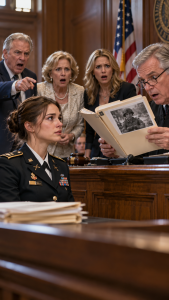
MY PARENTS SPENT MY ENTIRE LIFE TREATING ME LIKE THE FAMILY DISAPPOINTMENT—UNTIL MY GRANDMOTHER LEFT ME $4.7 MILLION AND THEY DRAGGED ME INTO COURT TO STEAL IT… BUT WHEN THE JUDGE OPENED MY FILE, HE LOOKED AT MY MILITARY RECORD, FROZE, AND ASKED, “WAIT… YOU’RE THE JAG OFFICER WHO SAVED THAT ENTIRE UNIT?”
For most of my life, I had learned one painful lesson: being part of a family didn’t necessarily mean being loved by one.
My parents, Patricia and Michael, had always made that distinction painfully clear.
My older brother received praise for the smallest accomplishments.
My younger sister was treated like a princess whose every mistake deserved forgiveness.
And me?
I was the daughter they remembered only when they needed something.
When I graduated, they barely acknowledged it.
When I left home to build my career, my father called my decision selfish.
When I stopped begging for their approval, my mother told relatives that I had become cold and arrogant.
I never corrected their stories.
I simply built a life far away from their expectations.
There was one person who never made me feel invisible.
My grandmother, Evelyn.
She noticed the sacrifices I made, the exhaustion I concealed, and the quiet determination that kept me moving forward.
She never demanded that I explain every detail of my work.
She only reminded me that I should never allow anyone to convince me that my life had less value than theirs.
When she passed away, I lost the one person who had always believed in me without conditions.
Then her attorney called.
Grandma had left me $4.7 million.
Her estate plan was clear, carefully prepared, and legally documented.
I was the sole beneficiary.
I didn’t celebrate.
I didn’t announce the news to my family.
I simply wanted to honor the woman who had given me something far more valuable than money: the feeling that I mattered.
But my parents discovered the inheritance before I could finish grieving.
Within days, their attitude changed completely.
My mother called me several times, suddenly speaking in a sweetness I hadn’t heard since childhood.
My father began talking about family obligations and how the money should be divided among everyone.
I politely refused.
Grandma had made her decision.
That was when the kindness disappeared.
A lawsuit arrived at my door.
My parents accused me of manipulating my grandmother, isolating her from her family, and taking advantage of her final years.
Their attorney went even further, questioning my mental fitness and demanding that the court reconsider the inheritance.
They wanted the entire estate examined.
They wanted my grandmother’s wishes overturned.
And they wanted me to surrender the money before the hearing even began.
For the first time in years, I felt something stronger than disappointment.
I felt determined.
They had spent decades mistaking my silence for weakness.
Now they were about to discover how badly they had misunderstood me.
PART 2 — THE COURTROOM HUMILIATION
The morning of the hearing, I arrived at the courthouse carrying a small folder and wearing a simple dark suit.
I deliberately left my military decorations at home.
I wasn’t there to impress anyone.
I was there because my grandmother’s final wishes deserved to be respected.
My professional life was something my parents had never bothered to understand.
I served as a Judge Advocate General officer in the United States military.
My work involved military law, complex investigations, and protecting the legal rights of people whose lives could be changed by a single decision.
Some of my assignments were classified.
Some of the people I had helped could never publicly discuss what happened.
My parents knew I worked in the military.
They knew almost nothing else.
They had never asked about my responsibilities, my accomplishments, or the cases that had shaped my career.
To them, I was still the difficult daughter who had refused to live according to their wishes.
When Patricia and Michael entered the courtroom with their attorney, my mother looked me up and down.
She gave a small, contemptuous laugh.
“Honestly, I can’t believe she thinks she deserves all that money,” she whispered loudly enough for the people nearby to hear.
My father didn’t bother lowering his voice.
“She has never been capable of making sensible decisions,” he announced.
Their attorney smiled confidently.
He appeared convinced that a few carefully chosen accusations would persuade the judge to question my grandmother’s intentions.
When the hearing began, he presented their case with theatrical certainty.
He claimed I had influenced Evelyn’s decisions.
He suggested that my grandmother had been vulnerable.
He described me as emotionally unstable, financially inexperienced, and incapable of managing a multimillion-dollar inheritance.
I sat perfectly still.
My attorney had already submitted the relevant documents, including the estate records, evidence of my grandmother’s independent legal advice, and statements confirming that she had understood the consequences of her decisions.
I didn’t need to shout over my parents.
The truth was already in the file.
Then Judge Whitmore began reviewing the documents.
At first, his expression remained neutral.
He turned one page.
Then another.
Suddenly, he stopped.
His eyes narrowed at a document attached to the back of the file.
He read it again.
Then he looked toward the court clerk and quietly asked for confirmation of a detail.
The clerk leaned forward.
A few seconds later, the judge removed his glasses.
My father’s smile began to fade.
My mother shifted nervously in her seat.
“What is it?” their attorney whispered to the judge.
Judge Whitmore didn’t answer him immediately.
Instead, he looked directly at me.
“Miss,” he said slowly, “may I ask you a question about your professional background?”
“Of course, Your Honor.”
He glanced down at the page again.
Then his expression changed completely.
“Your record indicates that you served as a JAG officer in a highly sensitive military case. Is that correct?”
“Yes, Your Honor.”
He paused.
“Were you involved in the operation that resulted in the legal exoneration of the service members who had been wrongly accused after that overseas incident?”
I held his gaze.
“Yes, Your Honor. I was part of the legal team.”
A murmur spread across the courtroom.
My parents looked at each other, confused.
They had never heard of the case.
They had never asked about it.
But Judge Whitmore recognized the significance of the record.
He had encountered the case during his earlier legal career, when the investigation had become an example of how careful legal work could prevent innocent people from losing their careers and freedom.
He looked back at the documents.
Then he spoke a sentence that made the entire room fall silent.
“Wait a moment… you’re the JAG officer who helped clear that entire unit?”
PART 3 — THE SECRET THEY NEVER BOTHERED TO LEARN
For several seconds, nobody moved.
My mother’s mouth hung open.
My father stared at me as if I had suddenly become a stranger.
Their attorney stopped arranging his papers.
Judge Whitmore continued reading.
The military documents did not prove that I automatically deserved my grandmother’s inheritance.
They proved something much more relevant to the accusations being made against me.
They showed a documented professional history of responsibility, legal judgment, and handling complicated matters under strict rules.
More importantly, the judge had now identified an obvious problem with my parents’ argument.
They had portrayed me as incapable of understanding serious decisions without producing credible evidence to support that claim.
Their accusations had been dramatic.
Their documentation was another matter.
Judge Whitmore turned toward my parents’ attorney.
“Counsel, you have made several serious allegations regarding this woman’s judgment and capacity. What independent evidence do you have that contradicts the estate documentation before this court?”
The attorney stood.
He began discussing the family’s concerns, repeating claims about my relationship with Evelyn and suggesting that my grandmother had become too dependent on me.
The judge interrupted.
“Concern is not proof. Where is your evidence that the will was improperly executed or that your client’s mother lacked the capacity to make this decision?”
The attorney hesitated.
My father leaned forward.
“But we’re her parents!” he exclaimed. “Surely we have a right to that money!”
Judge Whitmore looked at him firmly.
“Being a parent does not automatically entitle someone to inherit from an adult child—or to overturn a parent’s valid estate plan simply because they disagree with it.”
My mother shook her head in disbelief.
“She was our daughter before she was anything else,” she protested. “We raised her!”
I finally spoke.
“Yes, you did.”
My voice was quiet, but everyone could hear me.
“And I spent most of my life hoping that would mean something to you.”
My mother looked away.
I continued.
“You never asked what I did in the military. You never asked why I worked so hard or what my grandmother and I talked about. You didn’t come to me because you were worried about my future.”
I took a breath.
“You came because you discovered how much she had left me.”
My father’s face reddened.
“This isn’t about family feelings,” he snapped. “It’s about fairness.”
“No,” I replied. “It’s about Grandma’s decision.”
I placed my hands on the table.
“She knew exactly what she was doing. She chose her attorney. She signed her documents. She made her wishes clear. You may not like her decision, but that doesn’t mean you get to replace it with your own.”
Judge Whitmore reviewed the estate records once more.
After hearing both sides, he ruled that my parents had not established a sufficient basis to overturn the inheritance. The court rejected their challenge, subject to the terms of the final order and any applicable legal procedures.
The $4.7 million estate remained mine under my grandmother’s will.
My mother stared at the judge.
My father sat motionless.
Their attorney quietly gathered his papers.
I felt no desire to celebrate their defeat.
I felt relief.
Outside the courtroom, my mother hurried after me.
“Please,” she said, her voice suddenly trembling. “We can talk about this. We’re still a family.”
I turned toward her.
For one brief moment, I remembered the little girl who had waited for her parents to attend school ceremonies, who had hoped for a proud smile, and who had convinced herself that working harder might finally make her worthy of their attention.
Then I remembered the lawsuit.
The accusations.
The way they had looked at me in court.
“Being family should have mattered before the money,” I told her.
My father approached, but I raised my hand gently.
“I won’t use Grandma’s inheritance to punish you. I won’t argue with you in public. And I won’t pretend that what happened never happened.”
I looked at both of them.
“But you don’t get to decide my worth anymore.”
Then I walked away.
In the months that followed, I used a portion of the inheritance to establish a legal assistance fund for military families who couldn’t afford representation during difficult proceedings.
It was the kind of work Grandma Evelyn had always encouraged me to pursue: helping people who felt powerless find someone willing to stand beside them.
I kept the rest of my life private.
I didn’t need my parents to understand my career.
I didn’t need strangers to applaud my achievements.
And I no longer needed to prove that I deserved a place in my own family.
Grandma had left me $4.7 million.
But her greatest gift wasn’t the money.
It was the reminder that the people who underestimate you do not get to define you—and the people who abandon you when you have nothing cannot automatically claim you when you finally have something.
What would you have done in my place? Would you have forgiven your parents after they tried to take your grandmother’s inheritance, or would you have walked away for good?