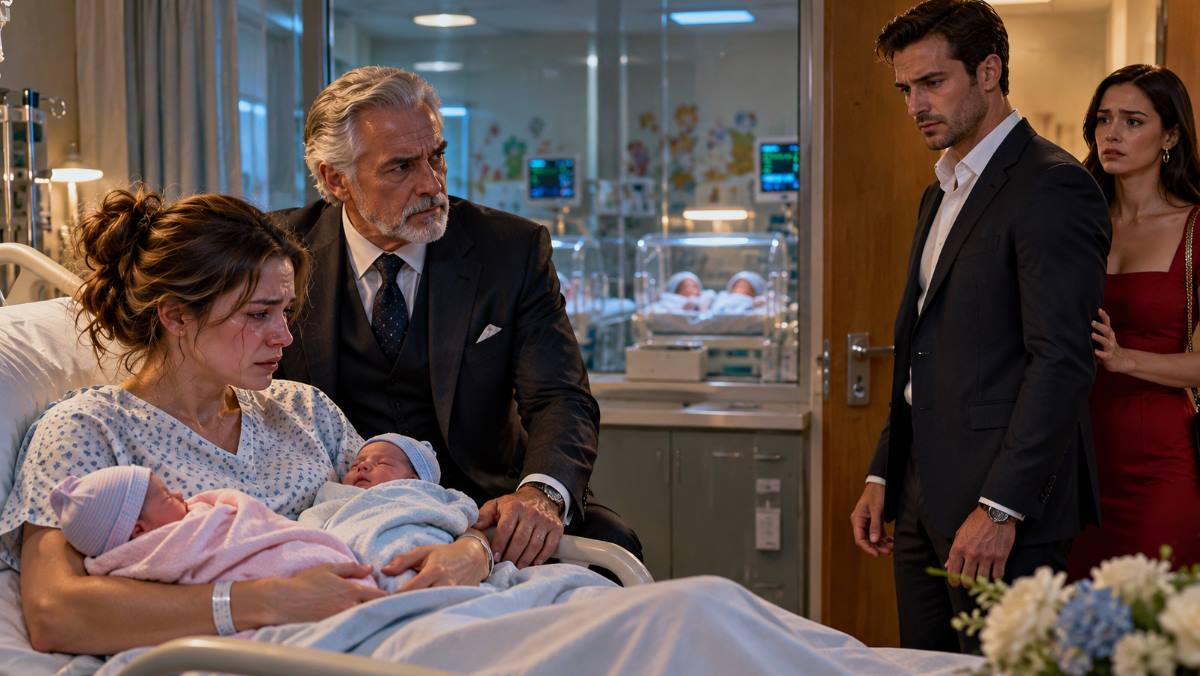
# My Husband Celebrated His Secret Son While I Fought to Deliver Our Twins—Then Ten Helicopters Arrived at the Hospital
## PART 1 — The Night I Stopped Waiting for My Husband
At 2:16 in the morning, a nurse asked me whether my husband was on his way.
I looked at the empty chair beside my hospital bed and lied.
“He’s coming.”
I had been saying those words for nearly twelve hours.
Outside the maternity ward, rain streaked the windows of St. Catherine’s Medical Center.
Inside, machines measured the lives of the two children I had carried beneath my heart for thirty-six weeks.
My daughter had been kicking so hard that morning that I had laughed while brushing my teeth.
My son had been quieter, usually settling whenever I placed my palm against my stomach.
I had imagined Donovan standing beside me when they were born.
I had imagined him crying when he heard their first cries.
I had imagined his mother, Margaret, arriving with flowers and insisting that she had known all along that her grandchildren would be beautiful.
Those ordinary dreams had seemed so important when I made them.
Now, every contraction reminded me that I had mistaken promises for certainty.
My name is Eleanor Whitmore.
For three years, I had been Eleanor Reed, the wife of a man who insisted that our marriage would work only if we built a life independent of my family’s money.
Donovan had said it was important that people respect him for who he was.
I had agreed.
I sold the small apartment I owned before our wedding.
I transferred most of my personal investments into a trust I established for our future children.
I stopped attending family board meetings.
I even allowed my grandfather to believe that I was happy living quietly outside the world in which I had been raised.
My grandfather, Arthur Whitmore, had built a global logistics company from a single freight depot.
By the time I married Donovan, the company owned shipping terminals, aircraft maintenance facilities, and distribution centers across several continents.
The newspapers called Arthur a billionaire.
I called him Grandpa.
He had never liked Donovan.
Not because Donovan was poor.
My grandfather had never cared about that.
He disliked the way Donovan talked about people who couldn’t help him.
“You learn a great deal about a man,” Grandpa once told me, “by watching how he treats a waiter who brings the wrong order.”
I had laughed at the time.
Donovan had been standing beside me.
He had not laughed.
I thought my grandfather was being unfair.
I wanted to believe that a person could become better when someone trusted him enough.
So I married Donovan.
When he asked me to keep my family connections private, I agreed.
When he said he wanted us to start without financial advantages, I agreed.
When he complained that my grandfather’s security staff made him feel like a visitor in his own marriage, I asked Grandpa to stop sending drivers.
I wanted a normal home.
I wanted a husband who loved me without measuring the distance between himself and my inheritance.
For a while, our life almost resembled what I had hoped for.
Donovan made breakfast on Sundays.
He complained about the apartment’s unreliable elevator.
He bought a secondhand bookshelf and spent an entire afternoon assembling it incorrectly.
When I discovered that he had put the shelves upside down, I laughed so hard that I had to sit on the floor.
He kissed my forehead and promised to repair it.
I believed him.
Then his work began taking more of his time.
He became a regional executive at a hospitality investment firm, traveling frequently and taking calls at odd hours.
He started guarding his phone.
He changed the password on our shared tablet.
He began referring to my pregnancy as a period when we needed to be especially careful with expenses.
I noticed these things.
I did not want to become the suspicious wife who treated every delayed message as evidence of betrayal.
When I asked about the new woman who frequently appeared in his business photographs, he told me she was his regional secretary.
Her name was Vanessa Cole.
“She handles half the problems that would otherwise ruin my schedule,” he said.
“Then I hope you’re paying her well.”
He smiled.
“That’s my practical girl.”
I had loved being called that once.
By the end of my pregnancy, the words sounded different.
The night my contractions began, Donovan was not home.
He had left before sunrise, wearing the navy suit I had carefully steamed the previous evening.
He said a shipment dispute required him to travel to London.
I asked whether he would be back before the delivery.
He kissed my cheek while checking his watch.
“Of course.”
“You promised you’d be there.”
“And I will.”
He was gone before I could ask him to repeat the promise.
At noon, my contractions became regular.
At one, I called him.
At two, he sent a message saying his flight had been delayed.
At four, my doctor told me to come to the hospital.
At five, a nurse wheeled me into a delivery room.
At six, Donovan stopped responding.
At seven, his mother sent a message asking whether the babies had arrived.
I told her they hadn’t.
She replied with a thumbs-up symbol.
I stared at it for a long time.
Then another contraction forced the phone from my hand.
My nurse, Carla, picked it up and placed it on the bedside table.
“Let’s concentrate on you and the babies,” she said.
I nodded.
She was young, with a small silver ring on her right hand and a habit of explaining every medical procedure before she touched anything.
When I asked her whether my husband had called the hospital, she checked the system.
“No, sweetheart.”
I tried to smile.
“He’s probably on a plane.”
Carla didn’t challenge me.
She simply adjusted the blanket over my knees.
At eight thirty, the obstetrician explained that the twins’ positions made a vaginal delivery increasingly difficult.
She wanted to monitor them closely.
If their heart rates deteriorated, we would need an emergency cesarean delivery.
I signed the preliminary consent forms.
My hand shook so badly that I had to write my name twice.
At nine, I called Donovan again.
His phone was switched off.
I called his mother.
Her phone was switched off too.
I called the hotel where he had claimed to be staying.
The receptionist told me there was no reservation under his name.
I asked whether he might have booked under his company.
She checked again.
There was no reservation.
For several minutes, I sat perfectly still.
I did not cry.
I did not shout.
I simply looked at the empty chair beside my bed and realized that I had no idea where my husband was.
Then my phone lit up.
A notification appeared from Margaret’s social media account.
She had posted a video.
The caption read, A special birthday for our special little man.
I opened it.
The video showed a private celebration in a luxury hotel ballroom.
Gold balloons floated above a table covered with white roses.
A small boy stood in front of a birthday cake.
He looked about one year old.
Donovan stood behind him, smiling.
His arm rested around Vanessa’s waist.
Margaret leaned toward the child and fastened a gold cross around his neck.
Then she kissed his cheek.
“Grandma’s precious boy,” she said.
Donovan lifted the toddler into his arms.
“Let’s show everyone how Daddy does birthdays.”
The guests laughed.
Vanessa leaned against him.
He kissed her.
Not a polite kiss on the cheek.
Not the kind of gesture that could be explained away as a misunderstanding.
He kissed her as a man kisses the woman with whom he has built a private life.
My phone slipped against the blanket.
For a moment, the room seemed to tilt.
I had seen Donovan lie about business dinners.
I had seen him conceal expenses.
I had seen him look me in the eye and insist that my suspicions were unfair.
But I had never imagined that he had another child.
I had never imagined that his mother knew.
And I had never imagined that the people celebrating his secret family would include the woman who had promised to welcome my children into hers.
The monitor beside my bed continued its steady rhythm.
My daughter moved beneath my ribs.
I placed my hand over her.
“I’m sorry,” I whispered.
Carla entered carrying a tray of supplies.
She noticed my expression immediately.
“What happened?”
I handed her the phone.
She watched the video without speaking.
When it ended, she placed the phone face down.
“Oh, Eleanor.”
I tried to laugh.
It came out as a broken breath.
“He told me he was going to London.”
Carla pulled a chair beside the bed.
“Do you want me to call someone for you?”
I thought of Grandpa.
For three years, I had avoided asking him for anything.
I had convinced myself that independence meant refusing help, even when help was offered without conditions.
He had sent me messages on every birthday.
He had called whenever a storm threatened our region.
He had asked whether Donovan was treating me well.
I always answered that everything was fine.
The last time we spoke, he had said, “You don’t have to prove your strength by making yourself unreachable.”
I had changed the subject.
Now, with my husband absent and my children at risk, I reached for the phone.
My fingers trembled as I opened Grandpa’s contact.
I did not write a long explanation.
I did not mention the hotel.
I did not mention Vanessa.
I sent only six words.
Grandpa, I need you. Please come.
Then I put the phone down.
For the first time that night, I stopped waiting for Donovan.
I began waiting for the person who had never asked me to earn his love.
## PART 2 — Ten Helicopters Above the Hospital
The first sign that Grandpa had received my message was not a phone call.
It was the sudden appearance of his chief of staff in the doorway.
Julian Mercer had worked for my grandfather for twenty-two years.
He was a tall man with a carefully trimmed beard, a charcoal overcoat, and the kind of quiet expression that made people lower their voices around him.
I had last seen him at my wedding.
He entered the room carrying no flowers, no gifts, and no questions about Donovan.
He looked at me first.
“Eleanor.”
My eyes filled immediately.
“Julian.”
He crossed the room and took my hand.
“Your grandfather is on his way.”
I tried to sit up.
“Is he angry?”
Julian’s expression softened.
“Not with you.”
That answer hurt more than I expected.
For years, I had feared that Grandpa would consider my marriage a mistake and treat my return as proof that he had been right.
Instead, Julian asked whether I was comfortable.
He asked whether the babies were stable.
He asked whether the doctors needed anything from the family.
Then he moved to the corner and began making calls.
I heard fragments of conversations.
The hospital’s administration.
The attending obstetrician.
A security coordinator.
Someone arranging transportation from the airport.
He never raised his voice.
He never threatened anyone.
But the hospital’s atmosphere changed.
A senior administrator arrived within minutes.
Two additional nurses appeared.
The obstetrician returned with another specialist.
Carla looked at the new staff and whispered, “Your grandfather doesn’t waste time.”
I managed a weak smile.
“He never has.”
Outside, the rain intensified.
The first helicopter appeared above the hospital shortly after ten thirty.
Its rotor blades sent a low vibration through the windows.
I turned my head toward the sound.
A second aircraft followed.
Then a third.
Within minutes, several helicopters circled toward the private landing area on the hospital’s upper medical transport platform and a nearby designated landing zone.
The hospital had coordinated the arrivals with emergency services and its aviation partners.
There were ten aircraft in total.
They had not come to attack anyone.
They had come because Grandpa’s security and medical transport teams had mobilized together, bringing his family physician, additional specialists, legal representatives, and members of his personal staff.
The sight was extraordinary.
Hospital workers stopped in corridors to watch.
Patients’ relatives stepped toward the windows.
Someone in the lobby began filming.
A nurse laughed nervously and said, “I’ve never seen anything like this.”
Neither had I.
The aircraft settled one after another, their lights cutting through the wet darkness.
The doors opened.
People stepped out carrying medical equipment, document cases, and umbrellas.
Then I saw him.
Arthur Whitmore emerged from the last helicopter wearing a dark wool coat over his suit.
His silver hair was damp from the rain.
He looked older than he had at my wedding.
He also looked furious.
Not the explosive anger of a man who wanted to punish someone.
It was the controlled anger of a man who had discovered that someone he loved was in danger and had arrived determined to make sure she was safe.
He walked through the hospital entrance with Julian beside him.
Two security officers followed at a respectful distance.
The chief administrator hurried forward.
“Mr. Whitmore, we’ve arranged access to the maternity ward.”
Grandpa stopped.
“My granddaughter is not a business appointment.”
The administrator went quiet.
“She is a patient,” Grandpa continued. “Please tell me what her doctors need, and let them do their work.”
Then he turned toward the elevator.
I heard his footsteps before I saw him.
When he entered my room, I tried to smile.
“Hi, Grandpa.”
He crossed the floor so quickly that I barely had time to open my arms.
He bent beside my bed and held me carefully.
For a moment, he said nothing.
Then he pressed his forehead against mine.
“You should have called me.”
I started crying.
“I thought I could handle it.”
“I know.”
“I didn’t want you to think you’d been right about Donovan.”
He pulled back enough to look at me.
“Eleanor, I would rather be wrong about every man in the world than have you believe you must suffer alone to protect my pride.”
I covered my face.
He sat beside me and held my hand until the next contraction began.
When the obstetrician entered, Grandpa immediately stood.
“Tell me what is happening.”
She explained that one twin’s heart rate had become concerning.
The team was preparing for an emergency cesarean delivery.
There was no time to waste.
Grandpa listened without interrupting.
“Whatever resources you require, use them,” he said. “But the decisions about her medical care belong to her and her doctors.”
The obstetrician nodded.
Then she turned to me.
“Eleanor, we need to move now.”
I looked at Grandpa.
“Will you stay?”
He squeezed my fingers.
“I’ll be right here.”
The team began preparing the bed.
Carla adjusted the blankets.
A nurse checked my identification.
Another confirmed the consent forms.
The room filled with purposeful movement.
I was frightened, but I was no longer alone.
As they wheeled me toward the operating room, I heard Grandpa speaking to Julian.
“Find Donovan.”
I turned my head.
“Grandpa, please don’t do anything reckless.”
He came alongside the bed.
“I will not interfere with your doctors or create a scene inside this hospital.”
He paused.
“But I will not allow anyone to use my granddaughter’s vulnerability as an opportunity to hide what they have done.”
I nodded.
Then the operating room doors closed between us.
The next hours became a blur of bright lights, careful instructions, and the reassuring voices of medical professionals.
I remember asking whether the babies were all right.
I remember the anesthesiologist explaining what I would feel.
I remember Carla standing near my shoulder.
Then I heard a cry.
It was small and furious.
A nurse announced that my daughter had arrived.
I began to sob.
A second cry followed.
My son.
For a few precious seconds, I forgot Donovan existed.
I asked whether they were breathing.
I asked whether I could see them.
The doctor assured me that both babies were receiving the care they needed.
They were premature, and they would need monitoring in the neonatal intensive care unit.
But they were alive.
My children were alive.
When I finally saw them, they lay in separate warmers beneath soft lights.
My daughter had a narrow face and a determined little mouth.
My son had a tuft of dark hair that stuck upward.
I touched one tiny hand through the opening in the incubator.
“Hello,” I whispered.
“I’ve been waiting for you.”
Grandpa stood behind the glass, one hand resting against the wall.
For the first time since he had arrived, his composure broke.
He wiped his eyes with the back of his hand.
Then he looked at me.
“You did it, sweetheart.”
I shook my head.
“We did it.”
He smiled.
“No. You did the hardest part.”
While I recovered, Julian brought me a report from the security team.
Donovan had not been in London.
His company had no record of the supposed emergency trip.
His assistant confirmed that he had taken personal leave for the birthday celebration.
The event had been booked weeks earlier.
Vanessa’s name appeared on the guest list.
So did Margaret’s.
A photographer had been hired.
A private dining room had been reserved.
The birthday cake had been ordered in advance.
None of it had been spontaneous.
I read the report slowly.
The affair had not been a single mistake.
The secret child had not been an accidental discovery.
My husband had built an entire second life while I was preparing to give birth to his first children with me.
And his mother had helped him celebrate it.
I placed the papers on the table.
“Does he know the babies were born?”
Julian hesitated.
“Not yet.”
“Tell him.”
“Do you want to speak to him?”
I looked toward the neonatal unit.
“No.”
I had imagined confronting Donovan with tears in my eyes.
I had imagined demanding explanations.
I had imagined him apologizing and begging me to believe that the affair meant nothing.
But now, with my children sleeping in warmers and my body exhausted from surgery, I understood something I had not understood before.
His explanations would not change what he had done.
His regret would not turn the missed hours into hours he had spent beside me.
And no apology could make him the man I had believed I married.
I looked at Julian.
“Tell him that his children are alive and that they are receiving medical care.”
Julian nodded.
“Anything else?”
“Yes.”
I took a breath.
“Tell him that if he wants to be their father, he will have to start by telling the truth.”
Julian left to make the call.
Grandpa sat beside me.
For a while, we listened to the rain.
Then he asked whether I wanted him to arrange a private recovery room.
I looked at the ordinary hospital bed, the folded blanket, and the small vase of flowers Carla had brought from the staff room.
“No,” I said.
“I want to stay where my children can be brought to me.”
He nodded.
“Then that is where you will stay.”
Outside, the helicopters had departed for their designated facilities.
Inside, the hospital returned to its usual rhythm.
But nothing about my life would ever return to what it had been that morning.
The next afternoon, Donovan finally arrived.
He came wearing the same navy suit from the birthday video.
His tie was crooked.
His hair was uncombed.
He looked as if he had spent the night arguing with people who had stopped believing him.
When he saw Grandpa standing beside my hospital room, he froze.
When he saw Julian and the security coordinator behind him, he stopped walking.
Then he looked through the glass toward the neonatal unit.
His face changed.
“Eleanor,” he said.
I remained seated beside the window.
“You’re late.”
He opened his mouth.
For the first time since I had known him, he seemed unable to find a sentence that could make the truth sound better.
## PART 3 — The Names on the Birth Certificates
Donovan stood in the doorway as if he expected someone to invite him inside.
Grandpa did not move.
I did not move either.
Finally, Donovan looked at me.
“Can we talk privately?”
“No.”
His eyes flicked toward Julian.
“This is a family matter.”
I almost laughed.
“You made it a family matter when you celebrated your other child while I was in surgery.”
He flinched.
“I didn’t know the delivery had become an emergency.”
“You knew I was in labor.”
“I thought the doctors had everything under control.”
“They did.”
I let the silence settle.
“They had everything under control except the husband who promised to be there.”
Donovan rubbed his face.
“Eleanor, I know how this looks.”
I looked at him for a long moment.
“How does it look?”
He glanced toward the hallway.
“Can we please not do this here?”
“You chose a hotel ballroom for your celebration. You chose a private party for your son. You chose to turn off your phone. You chose to let your mother tell me you were unavailable.”
His expression tightened.
“I made mistakes.”
“Did you make a mistake when you booked the party?”
He said nothing.
“Did you make a mistake when you lied about London?”
His jaw shifted.
“Did you make a mistake when you told me I was paranoid for asking about Vanessa?”
He looked down.
I continued.
“Or was the mistake only that I found out?”
Grandpa stood quietly beside the window.
He did not interrupt.
He had always believed that people should be allowed to reveal themselves through their own answers.
Donovan finally looked at me.
“I love you.”
I had once waited years to hear those words spoken without conditions.
Now they sounded like an attempt to stop a door from closing.
“You may have loved me in the way you understood love,” I said. “But you did not protect our marriage. You did not respect me. And you did not show up when I needed you.”
He took a step toward the bed.
Julian moved slightly, not threatening him, simply making it clear that he could not crowd me.
Donovan stopped.
“I want to see the babies.”
“They are in the neonatal unit.”
“I know.”
“Have you washed your hands and spoken with their nurse?”
He blinked.
“No.”
“Then start there.”
He looked surprised.
Perhaps he had expected me to deny him access entirely.
Perhaps he had expected Grandpa to have him removed.
But I was not interested in turning my children into weapons.
They had done nothing wrong.
Neither had the little boy in the birthday video.
He was a child who deserved to be loved, protected, and told the truth when he was old enough to understand it.
I would not punish him for his father’s choices.
I would not allow Donovan to use that child’s existence as an excuse to neglect mine either.
The nurse escorted Donovan to the neonatal unit and explained the rules.
He washed his hands.
He listened to the instructions.
He stood beside the incubators, staring at the two small babies who had arrived while he was celebrating another child’s birthday.
When he returned, his eyes were red.
“They’re so small,” he whispered.
“Yes.”
“Are they going to be okay?”
“The doctors are watching them carefully.”
He sat down.
For several seconds, he seemed unable to speak.
Then he said, “I want to make this right.”
I folded my hands in my lap.
“What does that mean?”
“I’ll end things with Vanessa.”
I looked at him.
“Are you saying that because you want to end the affair, or because you think ending it will persuade me to stay?”
He opened his mouth.
Closed it.
Then looked toward Grandpa.
“I know I have to earn back your trust.”
“You cannot earn back the years you spent lying,” I said. “You can only decide what kind of person you will be from now on.”
He swallowed.
“I want to be a father to them.”
“Then be one.”
He looked startled by the simplicity of my answer.
“That’s all?”
“No.”
I leaned forward carefully.
“You will be honest about your finances. You will disclose the arrangements you made for Vanessa and her child that affect our household. You will cooperate with the lawyers. You will not use the children to pressure me into staying married. And you will never tell them that I kept you away if the truth is that you chose not to show up.”
He stared at me.
“You’ve already spoken to lawyers?”
“Yes.”
“When?”
“While you were deciding whether your party was more important than your wife.”
His face reddened.
“I didn’t know you were going to take it this far.”
I felt something inside me settle.
There it was.
Not remorse for the choices he had made.
Fear of the consequences.
“Donovan, you took it this far when you built a second family and expected me to remain unaware.”
He looked toward Grandpa.
“Mr. Whitmore, surely you understand that marriages are complicated.”
Grandpa regarded him calmly.
“Of course.”
Donovan seemed relieved.
Then Grandpa continued.
“Complicated marriages do not excuse simple dishonesty.”
Donovan looked away.
Grandpa did not threaten him.
He did not mention his company’s lawyers or the influence he could bring to bear.
He simply said, “My granddaughter has made her position clear. You should listen to her.”
The following weeks were difficult.
My daughter, whom I named Clara, needed additional support with feeding.
My son, Benjamin, had trouble maintaining his temperature and remained under observation longer than his sister.
I learned the rhythms of the neonatal unit.
The quiet alarms.
The soft blankets.
The nurses who could recognize a baby’s cry before looking at the name above the incubator.
I learned how to express milk while recovering from surgery.
I learned to sleep in short intervals.
I learned that fear could become so familiar that it stopped announcing itself.
Grandpa visited every day.
Sometimes he brought soup from the little restaurant near his hotel.
Sometimes he brought nothing at all and simply sat beside me.
He never asked me to return to the family business.
He never told me that he had warned me about Donovan.
He never demanded that I admit he had been right.
Instead, he learned the names of the nurses.
He asked the doctors questions and listened carefully to their answers.
He brought a small notebook in which he recorded each baby’s feeding schedule.
One afternoon, I found him standing outside the neonatal unit, studying the chart the nurse had given him.
“You know,” I told him, “you can just ask them if you need help.”
He looked up.
“I spent forty years managing shipping schedules. I refuse to be defeated by two babies and a bottle.”
I laughed.
It was the first genuine laugh I had managed since the delivery.
He smiled as if he had been waiting for it.
Meanwhile, Donovan began meeting with the lawyers.
The financial review revealed that he had used money from our shared household account to cover several expenses connected to Vanessa’s apartment.
He had also charged business travel to accounts he had represented as ordinary corporate expenses.
The amounts were not enough to destroy his company.
They were enough to demonstrate that the deception had been systematic.
Donovan argued that he had been trying to keep his personal life separate from his professional responsibilities.
The lawyers asked why he had told me he was in London.
He had no convincing answer.
Margaret called me twice.
The first time, she said the birthday video had been taken out of context.
The second time, she said Donovan had always been generous and that I should consider how difficult it would be for the children if their parents separated.
I listened until she finished.
Then I asked her one question.
“When you saw that I was in labor, why did you turn off your phone?”
She began to cry.
“I didn’t know it would become so serious.”
“You knew I was having twins.”
“Yes, but—”
“You knew I was alone.”
She said nothing.
I waited.
Finally, she whispered, “I didn’t know what to do.”
I looked at Clara sleeping in my arms.
“You could have answered the phone.”
Margaret cried harder.
I did not comfort her.
I did not insult her either.
I simply ended the call.
For the first time in my adult life, I understood that compassion did not require me to make another person’s discomfort disappear.
When the twins were finally discharged, Grandpa arranged for a comfortable car to take us home.
I chose the apartment where I had lived with Donovan.
I wanted the children to come home to familiar surroundings, and I was not ready to make any more decisions than necessary.
Donovan had moved into a temporary residence while we worked through the separation.
He asked whether he could visit the twins.
I agreed to a schedule arranged through our lawyers.
He arrived on time for the first visit.
He arrived twenty minutes late for the second.
For the third, he brought two expensive gifts that the babies were far too young to use.
I thanked him for coming and asked him to follow the feeding instructions.
He seemed disappointed that I did not praise him.
But he returned the following week.
And the week after that.
Sometimes he was awkward.
Sometimes he was impatient.
Sometimes he sat quietly beside the crib and watched Benjamin sleep.
I did not mistake those moments for redemption.
I did not assume he would become a different man overnight.
But I allowed the possibility that his relationship with his children might be better than the marriage he had broken.
Vanessa eventually contacted me through her attorney.
She said Donovan had told her that our marriage was effectively over and that I had agreed to remain married for financial reasons.
She had believed him.
She also admitted that she had known about my pregnancy.
I read her statement twice.
I did not reply immediately.
There was no answer that would make us friends.
There was no need to turn our pain into a competition.
She had participated in a deception.
She had also been given lies that made it easier for her to accept what she wanted to believe.
Neither fact erased the other.
I sent a short response through the lawyers, asking that all future communication concerning the children remain factual and respectful.
Then I turned my attention back to the life in front of me.
Three months later, Clara slept through the night for the first time.
Benjamin followed two weeks afterward.
I celebrated both milestones with a quiet dinner at home.
Grandpa came over carrying a small cake from the bakery I had loved as a child.
He had remembered.
After dinner, he asked whether I had considered returning to the family company.
I looked at him.
“I thought you wanted me to stay away from all that.”
“I wanted you to have a choice.”
He set his teacup down.
“You left because you believed you had to choose between your family and your marriage. I don’t want you to make the same mistake in the opposite direction.”
I thought about that for a long time.
Then I told him I wanted to return gradually.
Not as the heiress who had once attended meetings without understanding what the workers did.
I wanted to visit the shipping depots.
I wanted to meet the people who kept the business moving.
I wanted to learn how the company could provide better parental leave and emergency support for employees who found themselves alone during medical crises.
Grandpa listened without interrupting.
When I finished, he smiled.
“That sounds like a worthwhile place to begin.”
Six months after the twins were born, I attended my first board meeting.
I wore a simple navy suit.
I carried a notebook.
I did not bring a security entourage.
I did not make a speech about betrayal.
I spoke about staffing, family leave, and the importance of emergency planning.
When one executive suggested that extended parental leave would be too expensive, I asked him to calculate the cost of replacing experienced employees who left because they could not care for their families.
He had no answer.
Grandpa sat at the far end of the table, listening.
He did not speak for me.
He did not need to.
After the meeting, he walked beside me through the corridor.
“You were clear,” he said.
“I was nervous.”
“Both things can be true.”
I smiled.
For years, I had believed strength meant never needing anyone.
Now I understood that strength could also mean accepting help without surrendering control of my life.
The divorce took longer than I expected.
There were negotiations, difficult conversations, and days when the past seemed determined to follow me into every room.
I grieved the marriage I had believed I had.
I grieved the husband I had imagined raising our children.
I grieved the version of myself who had thought that if she were patient enough, loving enough, and undemanding enough, no one would ever have a reason to leave.
But I stopped blaming that woman.
She had been trying to build a home.
She had not been foolish for wanting love.
Donovan’s choices belonged to him.
My response belonged to me.
On the twins’ first birthday, I did not arrange a lavish celebration.
We held a small gathering in the garden of my grandfather’s house.
There were sandwiches, fruit, a homemade cake, and a table covered with paper decorations.
The children wore matching cream outfits.
Clara grabbed frosting with both hands.
Benjamin fell asleep before anyone finished singing.
Grandpa laughed until he had to remove his glasses.
Donovan arrived for his scheduled visit and stood near the garden gate for a moment before approaching.
He had brought a small wooden toy for each child.
He greeted them gently.
He asked whether he could hold Benjamin.
I handed the baby to him.
For a few minutes, Donovan looked like the father I had once imagined.
Then Clara began crying, and he looked helplessly toward me.
I showed him how to settle her.
He followed my instructions.
It was an ordinary moment.
It did not repair our marriage.
It did not erase the hotel video.
It did not transform his absence during my labor into something forgivable.
But it reminded me that the children did not need me to turn every moment with their father into a judgment about our past.
They needed adults who could put their well-being ahead of their pride.
After Donovan left, I sat on the garden steps with Grandpa.
The afternoon sun warmed the stones.
Clara slept against my shoulder.
Benjamin rested in his stroller.
Grandpa looked at the children, then at me.
“Do you regret coming back?”
I considered the question.
I regretted the years I had spent afraid to ask for help.
I regretted believing that silence was the price of being loved.
I regretted the pain my children would one day have to understand.
But I did not regret loving Donovan.
Love had not been the mistake.
Believing love required me to abandon myself had been.
“No,” I said at last.
“I regret what happened. But I don’t regret finding my way home.”
Grandpa nodded.
He reached over and squeezed my hand.
For the first time in years, I felt no need to prove anything to him.
I was his granddaughter.
I was Clara and Benjamin’s mother.
I was a woman rebuilding her life after a betrayal she had never deserved.
And I no longer needed anyone’s permission to stand in that truth.
The helicopters had arrived in the middle of the night, carrying people and resources when I had been too frightened to ask for more than one person’s help.
They had made headlines.
They had startled the hospital staff.
They had forced Donovan to confront the fact that I had never been as powerless as he assumed.
But the real rescue had not come from the sky.
It had begun when I stopped waiting for an absent man to decide whether I mattered.
It continued when I signed my own name on the consent forms.
It grew when I allowed my grandfather to sit beside me without feeling ashamed.
And it became real when I brought my children home and began building a life in which their safety would never depend on someone else’s willingness to keep a promise.
I could not give Clara and Benjamin a perfect family.
I could give them a mother who told the truth.
I could give them a home where love did not have to be purchased with silence.
And I could teach them, through the choices I made every day, that dignity was not something a husband, a mother-in-law, or a billionaire grandfather could grant or take away.
It was something they were entitled to carry into every room.
Even when no one was waiting for them.
Even when the person who should have been there had chosen somewhere else.
Even when the doors closed.
Because sometimes the most important moment in a person’s life is not when someone powerful arrives to save them.
It is the moment they realize they are allowed to save themselves.