On My 76th Birthday, My Son Sold My Buick for $4,200 Because He Thought I Was Too Old to Drive—So I Rode a $389 Red Tricycle Straight to His Office and Asked Him One Question He Wasn’t Ready to Answer
## PART 1
Brian reached across my birthday cake with his palm facing upward, waiting for me to surrender my car keys.
For a moment, I thought he was joking.
We were sitting in a supper club near the highway, where the smell of grilled steak mingled with the sweetness of the chocolate cake his wife had ordered for my seventy-sixth birthday.
A small candle flickered between us, and a waitress was approaching with two cups of coffee.
My son didn’t even glance at the cake.
“Mom, hand over the keys,” he said.
His voice carried the firm, impatient tone of a parent correcting a disobedient child.
I looked at his outstretched hand, then at his face.
“Why?”
“Because you shouldn’t be driving anymore.”
I felt something tighten in my chest.
“Since when?”
“Since you hit that mailbox.”
I stared at him.
The mailbox.
That was what my son had decided would determine the rest of my life.
Two weeks earlier, during a particularly heavy rainstorm, I had misjudged the distance between my Buick and my neighbor’s mailbox while backing out of my driveway.
The damage had been minor, and I had immediately apologized to my neighbor.
I paid thirty-eight dollars to replace the damaged mailbox, and the matter was settled before the rain stopped.
I even told Brian about it myself because I believed honesty was the foundation of a good relationship between a mother and her son.
Apparently, he had interpreted my honesty as an opportunity.
“It was an accident,” I reminded him.
“Accidents happen when people aren’t paying attention.”
“It was raining so hard I could barely see the end of my driveway.”
“That’s exactly my point, Mom.”
He leaned forward, lowering his voice as though the restaurant’s other customers might be interested in our conversation.
“I’m doing this for your safety.”
I glanced toward the window.
Outside, my blue Buick was nowhere to be seen, but I assumed Brian had parked it somewhere else.
Then he pushed a folded piece of paper across the table.
“I’ve already sold the car.”
For several seconds, I couldn’t make sense of the words.
“You’ve done what?”
“I sold the Buick this afternoon.”
I looked at him, waiting for the familiar smile that would tell me he was teasing.
It never came.
“Who gave you permission to sell my car?”
“Our names are both on the title, Mom.”
He said it as if that settled everything.
After my husband, John, died eleven years earlier, Brian had suggested adding his name to the title with the word “or” between our names.
He explained that it would make future paperwork easier if something happened to me.
At the time, I thought he was being thoughtful.
I signed the documents without imagining that one day he would use them to make a decision about my life without even discussing it with me.
Brian reached into his jacket and produced a cashier’s check.
“Four thousand two hundred dollars,” he said.
“That’s what I got for it.”
He placed the check beside my untouched slice of cake.
“I found someone in Janesville who needed a reliable car, and he picked it up at four thirty.”
I looked at the check.
Then I looked at my son.
He was fifty years old, a successful insurance salesman, a husband, and a father.
He had spent decades building a career advising other people about protecting their property and planning for unexpected circumstances.
Yet he had apparently decided that his own mother did not deserve a conversation before he sold the car she used to buy groceries, visit friends, attend church, and drive herself to medical appointments.
“Did you tell the buyer that I didn’t agree to this?” I asked.
Brian’s jaw tightened.
“Mom, don’t make this more difficult than it needs to be.”
“I asked you a question.”
“The paperwork was legal.”
“That isn’t what I asked.”
He looked away.
The silence between us grew longer than either of us seemed comfortable with.
I wanted to raise my voice.
I wanted to remind him that I had taught him how to tie his shoes, stayed awake through childhood fevers, worked extra shifts to buy his school clothes, and sat in the front row at his graduation even when my feet were swollen from standing all day.
I wanted to tell him that I had never once made a decision about his life simply because I thought he was too young to make it himself.
But I knew how the scene might look to strangers.
An elderly woman arguing with her son in a restaurant.
A birthday dinner turning into a public confrontation.
A woman in her seventies becoming emotional because someone had taken away her car.
I could already imagine the sympathetic looks people might exchange.
Perhaps they would think Brian was a patient son trying to protect a confused old woman.
Perhaps they would assume my anger proved his point.
After thirty-one years working as a telephone operator, I had learned something about voices.
People often heard what they expected to hear rather than what someone was actually saying.
So I took a slow breath.
Then I removed the Buick key from my ring and placed it on the white tablecloth.
“There,” I said quietly.
Brian’s shoulders relaxed.
“Thank you, Mom.”
I looked at the birthday cake between us.
“You don’t have to thank me.”
He seemed surprised by my response.
I picked up my fork and cut a small piece of cake, although I had lost my appetite.
Brian began explaining that he would arrange transportation whenever I needed it.
He said I could call him before appointments, and he would help me get groceries.
He mentioned that his wife could drive me to church on Sundays if I gave her enough notice.
Every suggestion sounded reasonable when considered separately.
Together, they amounted to a life in which I would need permission, scheduling, and someone else’s approval to do the simplest things.
“What if you are busy?” I asked.
“We’ll figure something out.”
“What if I want to visit Wilma on a Tuesday afternoon?”
“Just let me know.”
“What if I want to go somewhere without planning it three days ahead?”
He sighed.
“Mom, you’re seventy-six.”
I folded my napkin and placed it beside my plate.
“And that means?”
“It means you have to be realistic.”
I looked directly at him.
“Realistic about what?”
“About your limitations.”
The words hurt more than I expected.
Not because I believed I had no limitations, but because my son had decided what those limitations were without asking me anything.
I had driven for more than fifty years.
I had never caused a serious accident.
I had never driven under the influence of alcohol.
I had never ignored a traffic signal or deliberately endangered another person.
I had made one mistake in the rain, paid for the damage, and accepted responsibility.
Now Brian was treating that mistake as proof that I could no longer be trusted with my own decisions.
“Have you considered that I might want to speak with a doctor about my driving before making such a decision?” I asked.
His expression hardened.
“I don’t think we need to get into all that.”
“Why not?”
“Because I’m trying to prevent something terrible from happening.”
“And I’m trying to understand why you think you can decide everything for me.”
He pushed his chair back slightly.
“Can we please not do this tonight?”
I studied his face.
There was a time when that expression would have made me immediately soften.
When Brian was a boy, he sometimes came home from school with his shoulders hunched and his eyes fixed on the floor.
I could never stand seeing him unhappy.
I would sit beside him, ask what had happened, and do whatever I could to make the world feel safe again.
Even when he became an adult, I found myself trying to smooth over disagreements before they became uncomfortable.
Perhaps I had spent too many years protecting him from the consequences of his own decisions.
Perhaps I had mistaken keeping the peace for keeping a relationship healthy.
Or perhaps I was simply a mother who had loved her son so completely that she had forgotten love did not require obedience.
When the waitress returned, Brian asked for the bill.
He paid it before I could reach for my purse.
Then he collected his jacket and stood beside the table.
“Come on, Mom.”
I followed him outside.
The evening air was cool, and the restaurant’s lights reflected off the wet pavement.
For one foolish moment, I looked toward the parking lot expecting to see my Buick.
Instead, there was an empty space where I had parked it earlier that afternoon.
Brian had driven his own vehicle to the restaurant.
He opened the passenger door for me and waited until I was seated.
The drive home took fifteen minutes.
He spent most of it talking about work, a difficult client, and a meeting scheduled for the following morning.
I answered when necessary, but I barely heard him.
I was thinking about the Buick.
I was thinking about the empty carport waiting for me at home.
Most of all, I was thinking about the strange distance that had appeared between my son and me.
When we arrived, Brian carried my purse to the front door.
“Call me if you need anything,” he said.
“I will.”
He hesitated, perhaps expecting me to argue again.
Instead, I gave him a small smile.
“Thank you for bringing me home.”
He kissed my cheek and walked back to his car.
I watched his taillights disappear down the street.
Then I closed the door.
The house was quiet.
I walked through the kitchen, past the calendar hanging beside the refrigerator, and looked out the window toward the carport.
The concrete was bare.
A dark stain from years of motor oil marked the place where the Buick had stood.
My rolled-up garden hose rested against the wall.
Everything else was exactly where I had left it.
I stood there for a long time.
Then I switched off the kitchen light and went to bed.
I did not cry that night.
I had spent thirty-one years answering telephone calls from strangers who were frightened, angry, lonely, or desperate for someone to listen.
I had learned how to keep my voice steady even when my heart was breaking.
But I had never expected to need that skill with my own son.
The next morning, I woke before sunrise.
For a few seconds, I forgot what had happened.
Then I remembered the birthday dinner, the check, and Brian’s hand reaching across the table.
I got dressed, made a pot of coffee, and sat beside the kitchen window.
At eight thirty, I called my friend Wilma.
“Are you busy this morning?” I asked.
“Depends,” she replied.
“Are you planning to rob a bank?”
I laughed for the first time since the previous evening.
“No, but I do need a ride.”
“Where to?”
“A bicycle shop.”
There was a brief silence.
“Are you finally buying that exercise bike you’ve been talking about?”
“No.”
“What, then?”
“A tricycle.”
Wilma began laughing so hard that I had to hold the receiver away from my ear.
When she finally caught her breath, she asked whether I was serious.
“Completely.”
“Well,” she said, “give me twenty minutes.”
And for the first time since Brian had taken my keys, I felt something other than sadness.
I felt the beginning of a plan.
## PART 2
The bicycle shop stood near the edge of town, between a hardware store and a small building that sold farm supplies.
Wilma pulled into the gravel parking lot just after nine in the morning.
I climbed out of her Ford, buttoned my cardigan against the chilly breeze, and looked through the shop window.
There it was.
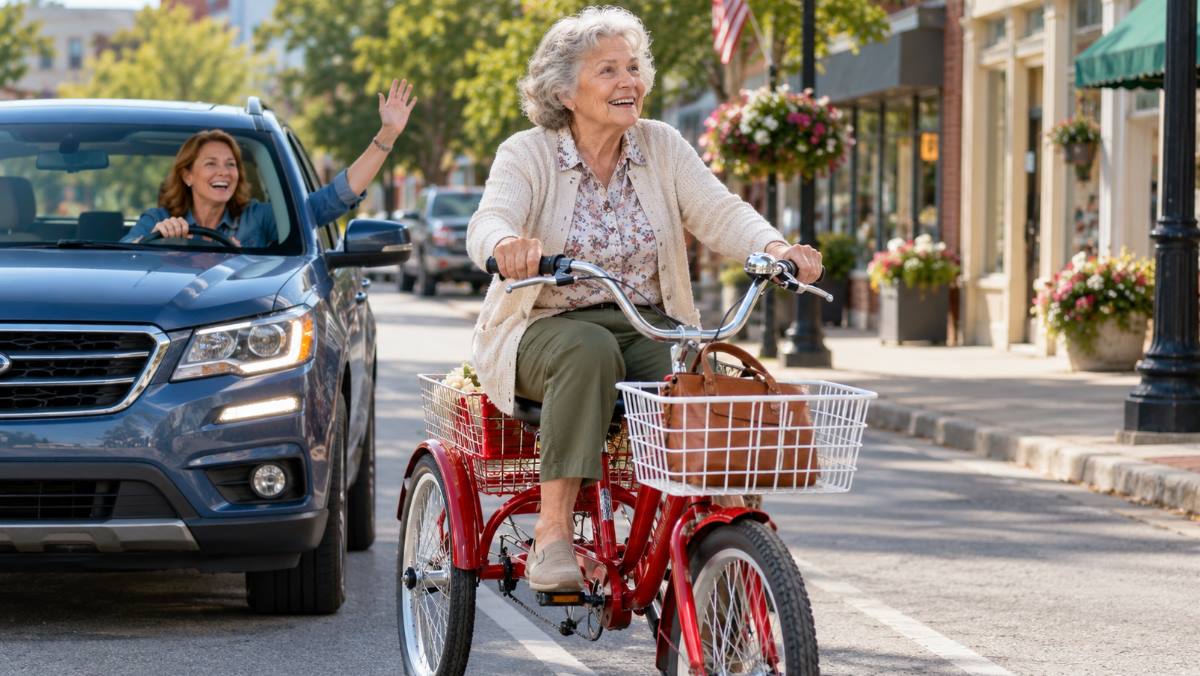
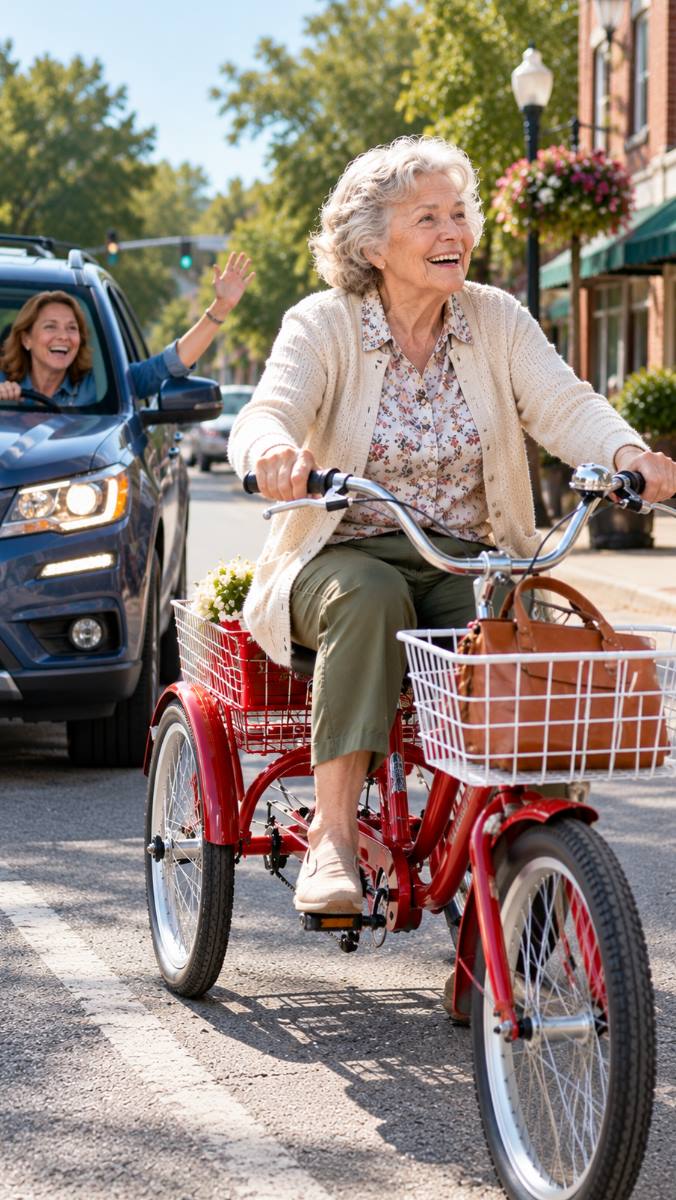
A bright red three-wheeled bicycle with a wide seat, upright handlebars, and a metal basket mounted above the rear wheels.
It looked cheerful, sturdy, and completely unashamed of being different.
“I’d like that red one,” I told the young employee who came outside to greet us.
He was probably in his early twenties, with dark hair, a faded work shirt, and a rag tucked into his back pocket.
“Good morning, ma’am,” he said.
“Have you ridden a bicycle like this before?”
“Not since John F. Kennedy was in the White House.”
He smiled, unsure whether I was joking.
“I’ll take that as a no.”
“You would be correct.”
He introduced himself as Eli and rolled the tricycle out of the shop.
He checked the tires, adjusted the seat, and showed me how the brakes worked.
Then he lowered the seat a little further.
“Try that.”
I climbed onto it carefully.
My feet touched the ground, and I gripped the handlebars.
The tricycle felt strange at first because I had spent so many years sitting behind a steering wheel.
Eli held the back of the seat while I pushed the pedals.
“Take your time,” he said.
I moved forward a few feet before stopping abruptly.
“Well, that was graceful.”
Wilma laughed from beside the shop entrance.
Eli smiled.
“You’re doing fine.”
He walked beside me as I practiced turning around the gravel parking lot.
When I leaned too far to one side, he reminded me to keep my body upright.
“Don’t try to balance it like a regular bicycle,” he explained.
“Guide it the way you’d steer a shopping cart.”
I followed his instructions.
Slowly, the movement began to feel more natural.
I made one circle around the lot, then another.
On the third attempt, I rang the small chrome bell attached to the handlebars.
Its bright little sound carried across the parking lot.
For some reason, I found myself smiling.
It reminded me of the bicycle Brian had received for his ninth birthday.
He had been terrified of falling, and I had spent an entire Saturday running beside him in our old neighborhood.
He would pedal three or four feet, panic, and put both feet down.
Then he would insist that he had failed.
I kept telling him to try again.
I had run beside him until my legs ached and my back hurt.
Eventually, he managed to ride halfway down the street without stopping.
When he realized I was no longer holding the seat, he turned around with the biggest grin I had ever seen.
“Mom, look at me!”
I could still hear his voice.
I could still see the pride on his face.
Back then, I would never have imagined that one day he would be the person telling me what I was no longer allowed to do.
Eli’s voice brought me back to the parking lot.
“Ready to try one more time?”
I nodded.
This time, I pedaled around the entire lot without stopping.
When I returned to the entrance, Eli clapped his hands.
“That was excellent.”
“I believe you may be exaggerating.”
“Not even a little.”
He adjusted the handlebars one final time and checked the brakes again.
Then he helped me place my purse inside the basket.
The price tag read three hundred eighty-nine dollars.
I looked at it carefully.
The money would come from the proceeds of the Buick, which Brian had already handed me in the form of a cashier’s check.
The irony was not lost on me.
My son had sold my car because he believed I was too old to drive.
Now I was using part of that money to purchase a different way of getting around town.
It was not what I would have chosen under ordinary circumstances.
I would have preferred to keep my Buick.
I would have preferred a conversation with my son instead of a decision made behind my back.
But I was beginning to understand that I did not have to surrender every part of my independence simply because someone had taken one part away.
I paid Eli for the tricycle.
As he handed me the receipt, he reached into a small drawer beneath the counter and removed a polished chrome bell.
“I want you to have this one, too,” he said.
I looked at the bell already attached to the handlebars.
“What’s wrong with the one you installed?”
“Nothing.”
“Then why do I need another?”
He shrugged.
“Everyone deserves a little something extra now and then.”
I thanked him and asked how much I owed.
He shook his head.
“Nothing, ma’am.”
I looked at the young man for a moment.
He had no reason to know what had happened to me the night before.
He did not know about the empty carport or the cashier’s check beside my birthday cake.
He did not know that a simple act of kindness from a stranger was doing more to restore my dignity than all my son’s assurances about keeping me safe.
Yet he had offered me something without making me feel helpless.
He had taught me how to use the tricycle without taking control away from me.
He had helped when I needed help, then stepped aside when I was ready to try on my own.
I placed the extra bell in my purse.
“Thank you, Eli,” I said.
“You’re welcome.”
Wilma offered to drive me home, but I shook my head.
“I’d like to ride it.”
She glanced at the tricycle, then at the road.
“All the way?”
“Why not?”
“Because Main Street is two miles away, and I don’t want to have to explain to your family why I let you pedal home on something with three wheels.”
I laughed.
“Then follow me.”
Wilma studied my face.
Perhaps she noticed that I was not merely being stubborn.
Perhaps she understood that I needed to do this for myself.
Finally, she climbed into her Ford.
“Fine,” she called through the open window.
“But if you start racing trucks, I’m turning around.”
I pushed off from the parking lot and began pedaling.
Wilma followed a safe distance behind me, her hazard lights blinking.
The morning traffic was light.
The sky had cleared after the previous night’s rain, and the sunlight fell across the road in bright patches.
At first, I concentrated so hard on steering that I barely noticed anything around me.
I watched the pavement.
I watched the intersections.
I slowed whenever I approached a driveway.
At every turn, I remembered Eli’s instructions and kept my body upright.
The tricycle moved steadily beneath me.
Its three wheels gave me a feeling of stability I had not expected.
I was not fast.
I was not trying to be fast.
I was simply moving forward under my own power.
As I passed the feed mill, an older gentleman standing near the entrance lifted his hat.
I waved and rang my bell.
He grinned.
A woman walking her dog gave me a thumbs-up.
I returned the gesture.
By the time I reached the first traffic light, my legs were beginning to ache.
I stopped at the curb and took a drink of water from the bottle in my basket.
Wilma pulled alongside me and lowered her window.
“How are you holding up?”
“Better than I expected.”
“You sure you don’t want to put that thing in the back of my car?”
I glanced at the tricycle.
Then I looked down the road toward town.
“No, thank you.”
She smiled.
“That’s what I thought you’d say.”
The light changed, and I continued pedaling.
I passed the bank where John and I had once opened our first joint savings account.
I passed the little bakery where Brian used to beg me for cinnamon rolls after school.
I passed the park where my husband had taught our son to throw a baseball.
Every familiar place seemed to hold a piece of my life.
For years, I had driven past those places without thinking about how fortunate I was to reach them whenever I wanted.
Now each block felt like a small victory.
I was tired when I finally reached the center of town.
My knees ached, and my cardigan had slipped off one shoulder.
I stopped near the sidewalk, straightened my clothes, and checked the basket to make sure my purse was secure.
Wilma pulled up beside me.
“We look like we’re leading a funeral procession,” she said.
I laughed.
“More like a celebration parade.”
She shook her head affectionately.
“You’re something else.”
I resumed pedaling.
The bank came and went.
Then the grocery store.
Then the small office building where my dentist worked.
I could have turned toward home at any point.
No one was forcing me to continue.
That was precisely why I kept going.
I wanted to know that the decision belonged to me.
By the time I reached Brian’s insurance office, the muscles in my thighs were burning.
I slowed near the curb and carefully brought the tricycle to a stop.
The building stood on a busy corner, with large windows facing Main Street and a modest sign above the entrance.
Inside, people moved between desks and meeting rooms.
A receptionist sat near the front window.
I placed one foot firmly on the pavement and looked through the glass.
Brian’s office was at the back.
I could see him standing beside a desk, speaking with a man in a gray jacket.
He was wearing the dark business suit he had worn to my birthday dinner, though his tie was now a different color.
I straightened my cardigan.
Then I rang the bell.
The receptionist looked up.
She glanced at the tricycle, then at me.
Her expression changed from curiosity to astonishment.
She stood so quickly that her chair rolled backward.
A moment later, Brian turned toward the window.
At first, he seemed unable to understand what he was seeing.
His eyes moved from the red tricycle to the basket, then up to my face.
He stopped speaking.
The man beside him followed his gaze.
Brian said something to him, placed a folder on the desk, and hurried toward the front entrance.
He came outside without even removing his business tie.
“Mom!”
His voice was so loud that two pedestrians turned around.
“What are you doing here?”
I smiled.
“Good morning, Brian.”
He stared at the tricycle.
Then he looked at the road behind me.
Then he looked back at my face.
“You rode that thing all the way here?”
“Yes.”
“From the bicycle shop?”
“Yes.”
“Through Main Street traffic?”
“Brian, I didn’t pedal across the ocean.”
He ignored the joke.
“You could have gotten yourself killed!”
People on the sidewalk began slowing down.
A delivery driver standing near a parked truck turned to watch us.
The receptionist remained visible through the window, watching with wide eyes.
Brian stepped closer.
“Mom, do you have any idea how dangerous that was?”
I placed my hand over the bicycle bell.
I had not come to humiliate him.
I had not come to make a scene.
I had not even come to demand that he return the Buick.
I had come because there was something I needed him to understand.
“Brian,” I said quietly, “I’m not here to fight with you.”
He looked at me, breathing hard.
“And I don’t expect you to return the Buick.”
His expression shifted.
For the first time since he had come outside, he seemed unsure what to say.
I looked into his eyes.
“There’s just one thing I need to ask you.”
## PART 3
Brian glanced toward the people gathering near the office entrance.
“Mom, can we talk about this inside?”
I remained seated on the red tricycle.
“Of course.”
He opened the office door and stepped aside.
I wheeled the tricycle onto the sidewalk beside the entrance, then carefully climbed off.
My legs trembled slightly from the ride, and I steadied myself against the handlebars.
Brian reached out instinctively.
I noticed the movement.
For a moment, his hand hovered beside my elbow.
Then he stopped, as though he had suddenly realized that helping me and taking control of me were not necessarily the same thing.
“Do you need a hand?” he asked.
“Thank you,” I replied.
“I’ve got it.”
He nodded and held the door while I guided the tricycle inside.
The receptionist stood beside her desk, looking as though she wanted to ask a dozen questions but knew better than to ask even one.
Brian directed me toward a small conference room.
I parked the tricycle against the wall and sat in a chair near the window.
He closed the door behind us.
For several seconds, neither of us spoke.
I could hear the faint sound of phones ringing in the main office.
A printer started, stopped, and started again.
Brian stood with his hands on his hips.
“Mom, that ride was a terrible idea.”
I looked at him calmly.
“Was buying a tricycle a terrible idea, or was coming here a terrible idea?”
“Both.”
“Then I suppose we disagree.”
He dragged a chair away from the table and sat down.
“You scared me.”
That answer surprised me.
I had expected another lecture about traffic, my age, or the danger of falling.
Instead, he looked genuinely frightened.
I studied his face.
“Why?”
“Because you’re seventy-six, and you rode a bicycle through town.”
“I rode a three-wheeled bicycle.”
“That doesn’t make it safe.”
“No,” I agreed.
“It doesn’t make it automatically dangerous, either.”
He rubbed his forehead.
“Mom, please don’t turn this into an argument about whether you’re capable of taking care of yourself.”
I folded my hands in my lap.
“Brian, you turned it into that argument when you sold my car.”
He opened his mouth, then closed it again.
I waited.
At last, he said, “I thought I was doing the right thing.”
“I believe you thought that.”
“Then why are you acting like I betrayed you?”
I looked at him for a long moment.
“Because you made a decision about my life without giving me the chance to be part of it.”
He shifted in his chair.
“I was worried.”
“Then you should have told me.”
“I did tell you.”
“No, Brian.”
I kept my voice steady.
“You told me what you had already decided.”
He looked down at the table.
I remembered the birthday dinner, the check, and his outstretched hand.
I remembered how carefully I had placed the key on the tablecloth because I did not want anyone to think I was becoming unreasonable.
I remembered thanking him for bringing me home.
“I understand that you were frightened by the mailbox accident,” I continued.
“I understand that you worry about what might happen if I make another mistake.”
He nodded quickly, as if he hoped I would stop there.
“But you didn’t ask me whether I was frightened, either.”
He looked up.
“You didn’t ask whether I had been thinking about the accident or whether I wanted to discuss my driving with a doctor.”
I paused.
“You didn’t ask whether I had noticed any changes in my vision, my reaction time, or my ability to concentrate.”
He stared at me.
“You simply decided that my age was enough.”
“That’s not fair.”
“Then tell me what part isn’t fair.”
He leaned back and crossed his arms.
I could see him searching for an answer.
Perhaps he wanted to say that he was my son and had a responsibility to protect me.
Perhaps he wanted to explain that the title gave him the ability to sell the car.
Perhaps he wanted to remind me that he had been trying to prevent a tragedy.
All those things might have been true from his perspective.
But none of them answered my question.
Finally, he said, “I didn’t want you to get hurt.”
I nodded.
“I know.”
“Then you should understand why I did it.”
“I understand why you were worried.”
I leaned forward slightly.
“But worrying about someone doesn’t give you the right to take away their voice.”
His expression tightened.
“Mom, you make it sound like I stole something from you.”
I looked toward the window.
Outside, a man was walking past with a paper coffee cup in his hand.
A woman was helping a child climb into the back seat of a parked car.
A delivery truck rolled through the intersection.
The world continued moving, indifferent to the fact that my son and I were struggling to understand each other.
Then I turned back to him.
“You did take something from me.”
He stared at me.
“You took the Buick,” I said.
“But you also took the opportunity to decide what happened next.”
Brian’s face changed.
He looked suddenly younger, almost like the boy who used to come to me after a bad day at school.
For the first time, I wondered whether he was beginning to hear what I had been trying to tell him.
I reached into my purse and removed the cashier’s check.
I placed it on the table between us.
“Do you know what I did with some of this money?”
He glanced at the check.
“I suppose you bought that tricycle.”
“I did.”
He shook his head.
“I still can’t believe you rode it here.”
I smiled faintly.
“Neither could I, until I did it.”
He almost smiled back, but the expression faded before it reached his eyes.
I continued.
“The young man at the bicycle shop helped me learn how to ride it.”
“Good.”
“He adjusted the seat, explained how to turn, and walked beside me while I practiced.”
Brian nodded.
“He sounds like a good kid.”
“He was.”
I rested my hands on the table.
“And do you know what he didn’t do?”
Brian waited.
“He didn’t tell me I was too old to try.”
The room became quiet.
“He didn’t grab the handlebars every time I made a mistake.”
I looked directly at my son.
“He didn’t decide that because I needed help learning something, I should never be allowed to do it.”
Brian lowered his eyes.
I could see the words landing one by one.
Not as accusations, but as reminders of the difference between protecting someone and controlling them.
“I know you love me,” I said.
“I have never doubted that.”
His eyes lifted toward mine.
“But love cannot mean that I have to give up every decision that makes you uncomfortable.”
He swallowed.
“I don’t want you to think I don’t respect you.”
“Then show me that you do.”
He looked away again.
I had expected anger when I arrived at his office.
I had prepared myself for another lecture.
I had even imagined him telling me that the tricycle proved I was too stubborn to make sensible decisions.
Instead, he sat silently, looking at the check.
At last, he asked, “What do you want me to do?”
There it was.
The question I had hoped he would ask from the beginning.
I took a breath.
“First, I want you to understand that I am not asking you to pretend I am still twenty-five.”
He nodded slowly.
“I know I am seventy-six.”
“I know my balance isn’t what it used to be, and I know my knees hurt when the weather changes.”
I smiled a little.
“And I know that sometimes I forget why I walked into a room.”
He let out a quiet breath that might have been the beginning of a laugh.
“That happens to me, too.”
“Then perhaps we’re both human.”
For the first time that morning, he smiled.
It was a small smile, but it reminded me of the boy who used to sit beside me at the kitchen table and tell me about his day.
I continued before either of us could escape into easier conversation.
“If you are worried about my driving, let’s arrange an honest assessment with a qualified professional.”
He nodded.
“If there are restrictions I need to follow, I’ll listen.”
“Okay.”
“If there are lessons I should take or changes I should make, I’ll consider them.”
He leaned forward.
“That’s all I wanted.”
“No, Brian.”
I said it gently, but firmly.
“That isn’t all you wanted.”
He fell silent.
“You wanted the problem to disappear, so you removed the car.”
I paused.
“You didn’t ask me what I wanted.”
He looked down at his hands.
“And you didn’t give me a chance to show you that I could make a responsible decision.”
For several seconds, he did not move.
Then he rubbed his eyes.
“I’m sorry, Mom.”
The words were quiet.
They were not dramatic.
They did not erase the empty carport or return the Buick to my driveway.
But they were the first words he had spoken since my birthday that acknowledged I was a person whose feelings mattered.
I felt the tension in my shoulders begin to ease.
“Thank you.”
He looked at me.
“Are you going to forgive me?”
I reached across the table and covered his hand with mine.
“I have loved you your entire life, Brian.”
His eyes became wet.
“That’s not the same as saying what you did was all right.”
He nodded.
“I know.”
“And forgiveness doesn’t mean you get to make the same decision again.”
“I understand.”
I studied his face, looking for the impatience I had seen at the restaurant.
It was still there, perhaps, but it had softened into something more thoughtful.
He glanced toward the conference room door.
“Would you like me to drive you home?”
I looked through the window at my red tricycle.
“Thank you, but I think I’ll ride it.”
He started to object.
I saw the words forming on his lips.
Then he stopped.
“Would you like me to follow you?”
I considered the offer.
“That would be fine.”
He nodded.
“I’ll get my car.”
Before we left, Brian walked with me to the entrance and helped hold the door open.
He did not take the handlebars away from me.
He did not tell me to sit down or insist that I wait while he made the arrangements.
He simply stood beside me while I checked the brakes and secured my purse in the basket.
When I climbed onto the seat, he watched carefully.
“Be careful at the intersections,” he said.
“I will.”
“And take your time.”
“I intend to.”
He hesitated.
Then he leaned down and kissed my cheek.
“I’m sorry I ruined your birthday.”
I touched his hand.
“You didn’t ruin my birthday.”
He looked surprised.
“You certainly made it memorable,” I added.
He laughed, and this time the sound was genuine.
We left the office together.
I pedaled slowly along the sidewalk while Brian followed in his car at a respectful distance.
At each intersection, I stopped and looked both ways.
I did not rush.
I did not try to prove that I was invincible.
I simply paid attention and rode carefully.
When I reached the corner near the bakery, I rang the bell.
Brian’s car rolled behind me, and I could see him smiling through the windshield.
For the first time in days, I felt that we were moving in the same direction.
Not because he was deciding where I should go.
Not because I was doing whatever he wanted.
But because we were finally learning how to respect each other as adults.
When I arrived home, Brian parked beside the empty carport and got out.
He looked at the tricycle, then at the dark stain on the concrete where my Buick had once stood.
“I really am sorry,” he said again.
I wheeled the tricycle toward the carport.
“I believe you.”
He stood there for a moment, looking as though he wanted to say more.
Then he asked whether we could have lunch together later in the week.
I smiled.
“Call me and ask.”
He understood the difference this time.
“I will.”
After he left, I parked the tricycle beside the garden hose and went inside.
The house was still quiet.
The carport was still empty.
My Buick was still gone.
Nothing about the previous evening had magically changed.
Yet I no longer felt as though the decision had been taken entirely out of my hands.
I had learned how to ride something new.
I had spoken honestly to my son.
And I had reminded both of us that growing older did not mean becoming invisible.
That afternoon, Wilma called to ask how my visit to Brian’s office had gone.
“Did you give him a piece of your mind?” she asked.
“Not exactly.”
“What did you do?”
“I asked him one question.”
“And?”
“He finally listened to the answer.”
Wilma chuckled.
“Well, I suppose that red tricycle has already paid for itself.”
I looked out the kitchen window toward the carport.
The little chrome bell caught the afternoon sunlight.
“Not quite,” I said.
“I think it has a few more miles left in it.”
Over the following days, Brian called more often.
Sometimes he asked whether I needed groceries.
Sometimes he asked how my knees were feeling.
Once, he asked whether I had thought any more about the driving assessment.
I told him I had, and that I planned to arrange one.
He did not argue when I said I wanted to make the appointment myself.
We were not suddenly a perfect family.
Trust did not return simply because he had apologized.
There were still moments when his worry made him impatient, and moments when my pride made me reluctant to accept help.
But we began to talk about those moments instead of pretending they did not exist.
The tricycle became part of my routine.
I rode it to the grocery store when the weather was pleasant.
I visited Wilma when she was home.
I pedaled to the bakery for cinnamon rolls, sometimes buying an extra one for Brian when I knew I would see him.
I learned which streets were quietest and which intersections required more patience.
I wore a bright jacket when the sky was cloudy, checked the brakes regularly, and never rode when the road conditions made me uncomfortable.
I did not confuse independence with recklessness.
I simply refused to confuse age with helplessness.
A few weeks later, Brian came over for coffee.
He stood near the kitchen window, watching me put the tricycle away after returning from the grocery store.
“Mom?”
I turned toward him.
“Yes?”
“I’ve been thinking about what you said.”
I set my purse on the counter.
“Which part?”
“About asking you before deciding what’s best for you.”
I waited.
“I should have talked to you about the car.”
“Yes, you should have.”
He nodded.
“And I should have given you a chance to decide what to do next.”
I felt a warmth in my chest that had nothing to do with the coffee.
“Yes,” I said again.
He looked at me.
“I can’t promise I’ll never worry about you.”
“I would be disappointed if you stopped.”
“But I’ll try to remember that worrying doesn’t mean I get to take over.”
I smiled.
“That sounds like a good place to start.”
He pulled out a chair and sat down.
For a while, we talked about ordinary things.
He told me about work.
I told him Wilma had nearly bought a tricycle of her own after watching me ride mine through town.
We laughed about the idea of two old women racing each other to the bakery.
Before Brian left, he paused beside the door.
“Would you like me to look into getting you another car?”
I considered the question.
Once, I might have answered immediately.
I might have accepted the offer simply because it was easier than explaining that I needed time to think.
Instead, I smiled.
“Let me decide what I want first.”
Brian nodded.
“Of course, Mom.”
Then he hugged me.
It was not a grand reconciliation.
It was not a promise that he would never make another mistake.
It was something smaller and, in its own way, more meaningful.
My son had finally understood that helping me did not require taking my choices away.
That evening, I sat beside the window with a cup of tea and watched the sun settle behind the houses across the street.
The red tricycle rested in the carport, its chrome bell shining faintly in the fading light.
I thought about John, about the life we had built, and about the boy I had once run beside while he learned to ride his first bicycle.
I wished John had been there to see what happened.
He would probably have laughed at the sight of me pedaling down Main Street while Wilma followed behind with her hazard lights flashing.
Then he would have reminded me to wear my gloves when the weather turned cold.
I could almost hear his voice.
I smiled to myself.
At seventy-six, I understood that independence did not mean doing everything alone.
It meant being allowed to decide when to accept help, when to ask for advice, and when to try something new.
It meant being treated like a person, even when other people were afraid for you.
And it meant remembering that a mistake, however embarrassing, did not erase a lifetime of experience.
My son had sold my Buick for four thousand two hundred dollars because he believed he knew what was best for me.
I had bought a three-wheeled bicycle for three hundred eighty-nine dollars because I wanted to decide what came next.
The difference between those two decisions was worth far more than the money.
The next morning, I opened the carport door, wheeled my red tricycle into the sunshine, and placed my purse in the basket.
Then I climbed onto the seat, rang the little chrome bell, and began pedaling toward town.
I was seventy-six years old.
I was not twenty-five, and I did not need to pretend otherwise.
But I was still here, still learning, still making decisions, and still entitled to a life that belonged to me.
And as the bell rang brightly along the quiet street, I realized that the most important thing I had reclaimed was never the car.
It was my right to be heard.