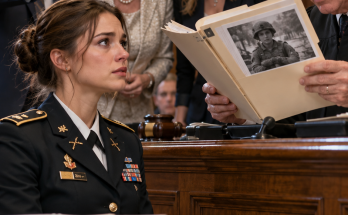
PART 1 — THE LITTLE GIRL WHO KNEW TOO MUCH
The morning my husband demanded our house, our savings, and full custody of our six-year-old daughter, he walked into the courtroom believing he was about to destroy me.
He had no idea that the little girl sitting beside me was carrying a secret that could destroy everything he had carefully built.
My name is Natalie Brooks, and until three months earlier, I had believed my marriage to Richard Brooks was the kind of love people spent their entire lives searching for.
We had been married for nine years.
We owned a beautiful two-story house outside Cincinnati, had comfortable savings, and shared a daughter named Lily, whose favorite things in the world were strawberry pancakes, bedtime stories, and a small gray teddy bear she called Mr. Buttons.
Richard was a successful real estate developer who knew how to charm strangers, impress business partners, and make every room feel as though he belonged in it.
But behind our front door, the man I loved had become someone I barely recognized.
He started coming home after midnight.
He changed the passwords on our joint accounts.
He took business calls in the garage and lowered his voice whenever I walked past.
Then, one Tuesday evening, he placed a thick envelope on the kitchen counter and told me our marriage was over.
“I think we both know this hasn’t been working for a long time,” he said, adjusting his expensive watch.
I stared at him, waiting for some sign that the man standing in front of me remembered the promises we had made.
Instead, he pushed the envelope toward me.
Inside were divorce papers.
“I want the house,” he continued. “I want primary custody of Lily. You can have whatever money my attorney decides is fair.”
I looked at him in disbelief.
“Richard, this is our daughter’s home.”
“Exactly,” he replied. “And she needs stability.”
The irony was so cruel that I almost laughed.
For months, I had been the one getting Lily ready for school, taking her to the pediatrician, helping her with her letters, and sitting beside her bed whenever a nightmare woke her.
Richard had become a visitor in his own family.
Yet he spoke as though I were the stranger.
When I asked whether there was another woman, he looked directly into my eyes.
“No.”
He said it so confidently that, for one terrible moment, I wondered whether my suspicions had been wrong.
Then I remembered the perfume on his shirts.
The unexplained hotel charges.
The messages he deleted whenever I entered the room.
I said nothing.
I had learned that Richard became most dangerous when he believed he had already won.
Two weeks later, his attorney filed a petition accusing me of financial irresponsibility, emotional instability, and deliberately interfering with Richard’s relationship with Lily.
He also demanded exclusive possession of our house.
The document included statements from Richard’s mother, Margaret, who claimed I was frequently distracted and had become incapable of providing our daughter with a proper routine.
His business assistant, Vanessa Cole, supplied a declaration describing herself as a close family friend who had witnessed Richard’s devotion to Lily.
Vanessa.
The same woman whose name appeared on a reservation for a luxury hotel suite Richard had supposedly visited for a business conference.
The same woman whose expensive handbag I had discovered in the trunk of his car.
And the same woman who had recently begun wearing a diamond necklace almost identical to the one Richard had once promised to buy me for our tenth anniversary.
I finally understood why he wanted the divorce settled so quickly.
He wasn’t simply leaving me.
He was preparing to replace me.
And he wanted to take our daughter and our home with him.
On the morning of the hearing, I dressed in a simple navy-blue suit and tied Lily’s hair with a pink ribbon.
She wore a cream cardigan over a pale blue dress and carried Mr. Buttons against her chest.
“Mommy,” she whispered while we waited outside the courtroom, “will the judge make me go somewhere I don’t know?”
I knelt in front of her.
“I don’t know what the judge will decide, sweetheart, but you can always tell the truth about how you feel.”
She glanced toward the corridor where Richard stood speaking with his attorney.
Then she hugged her teddy bear more tightly.
“Even if Daddy gets angry?”
My stomach tightened.
“Even then.”
She nodded, but she didn’t look reassured.
When we entered the courtroom, Richard was already seated beside his attorney, a polished man named Martin Hale.
Richard wore a charcoal suit and a confident smile.
His mother sat behind him, clutching a leather handbag.
Vanessa sat beside her, wearing a cream jacket and the diamond necklace I recognized immediately.
When Richard noticed me looking, he leaned toward his attorney and whispered something.
They both smiled.
Judge Eleanor Whitmore entered moments later.
She was a silver-haired woman in her early sixties whose calm expression made even the most impatient attorneys sit straighter.
After reviewing the paperwork, she addressed Richard’s attorney.
“Mr. Hale, your client is requesting exclusive possession of the marital residence and primary physical custody of the minor child?”
“Yes, Your Honor.”
“And the basis for this request?”
Martin stood.
He described Richard as a responsible father who had maintained financial stability while I had supposedly become unpredictable and distracted.
He presented selected bank statements, photographs of a cluttered kitchen taken during a difficult week, and declarations suggesting that Lily would benefit from living with her father.
Richard sat motionless, wearing the expression of a man listening to a story he had rehearsed many times.
Then Martin made his final argument.
“My client believes the child deserves a stable environment without unnecessary conflict. He is prepared to assume full responsibility for her education, housing, and daily needs.”
I wanted to stand up and ask why a man who had barely attended a single parent-teacher meeting suddenly wanted to become the only parent in his daughter’s life.
But I kept my hands folded in my lap.
I had spent the previous six weeks examining our financial records.
Richard had transferred money from our joint accounts into two companies I could not initially identify.
One company had no visible employees.
The other shared a mailing address with Vanessa’s brother’s accounting firm.
I had also discovered that Richard had listed our house as collateral for a business loan without telling me.
But I had no intention of making accusations I couldn’t support.
I would let the evidence speak for itself.
Judge Whitmore turned toward me.
“Mrs. Brooks, do you wish to respond?”
“Yes, Your Honor.”
Before I could say another word, Lily tugged gently at my sleeve.
I leaned toward her.
“What’s wrong, sweetheart?”
She looked at the judge, then at her father.
Her little fingers disappeared inside Mr. Buttons.
For a moment, I thought she was searching for the teddy bear’s missing button.
Instead, she pulled out a tiny purple phone.
I stared at it.
I had never seen that phone before.
Lily stood on her small shoes, holding it with both hands.
“Your Honor?”
The judge looked down at her.
“Yes, sweetheart?”
Lily swallowed nervously.
“Daddy said Mommy must never know I have this.”
Richard’s confident smile vanished.
His attorney immediately rose.
“Your Honor, I must object. The child is far too young to understand—”
“Please sit down, Mr. Hale,” Judge Whitmore said.
Her voice was quiet, but nobody moved.
Lily looked at me, her eyes filling with tears.
“Mommy, I’m sorry I didn’t tell you.”
I reached for her hand.
“You don’t have to apologize for anything, baby.”
She turned back toward the judge.
“Daddy told me to keep a secret because he said it would help our family.”
Richard suddenly stood.
“Lily, put that away.”
His voice cracked through the courtroom.
She flinched.
Judge Whitmore’s expression hardened.
“Mr. Brooks, you will remain seated.”
Lily’s hands trembled as she pressed the phone against her chest.
“There are voices on it,” she whispered. “And Daddy said if anyone heard them, everything would be ruined.”
The entire courtroom became still.
Judge Whitmore leaned forward.
“Lily, can you tell me where those recordings came from?”
Lily looked at her father one last time.
Then she whispered six words that changed the entire hearing.
“Daddy hid it in my teddy.”
And when the judge asked her to explain, Lily began to cry.
Because the secret inside that little purple phone wasn’t simply about another woman.
It was about something Richard had planned long before he filed for divorce.
Something that involved our house.
Our money.
And a decision he had already made about our daughter’s future.
PART 2 — THE RECORDING THAT CHANGED EVERYTHING
Judge Whitmore asked the court clerk to bring Lily a chair.
She didn’t question the little girl like a witness being cross-examined.
Instead, she spoke gently, allowing Lily to sit beside me while a court-appointed child advocate came forward.
“Lily,” the judge said, “nobody here is going to punish you for telling the truth. You can take your time.”
Lily wiped her cheeks with the sleeves of her cardigan.
Richard had gone pale.
His attorney leaned close to him and whispered urgently, but Richard barely seemed to hear him.
Vanessa was no longer looking at me.
She was staring at the purple phone.
The child advocate asked Lily how she had found it.
Lily explained that several weeks earlier, she had been visiting her father at his apartment.
He had given her Mr. Buttons and told her to keep the teddy bear close because it was a special gift from him.
That night, while Lily was looking for the bear’s missing button, she discovered a small pocket hidden inside its lining.
The phone was inside.
“Did your father tell you to record anything?” the advocate asked carefully.
Lily shook her head.
“He told me not to touch it. But sometimes it made noises, and I heard Daddy talking.”
“What did you hear?”
Lily looked down at her shoes.
“He said Mommy would lose the house.”
Richard slammed his hand against the table.
“This is ridiculous!”
The judge struck her gavel.
“One more interruption, Mr. Brooks, and I will have the bailiff remove you from the proceedings.”
Richard fell silent.
The judge turned back to Lily.
“Would you like the adults here to listen to what you found?”
Lily nodded.
The phone was handed to the court’s technical staff, who checked the device and explained that any recordings would need to be reviewed for authenticity and relevance before being relied upon as evidence.
One file, however, was clearly labeled with a date.
It was from the previous month.
The recording began with the sound of a door closing.
Then Richard’s voice filled the courtroom.
“Once the transfer goes through, Natalie won’t have enough money to fight me.”
A second voice answered.
It was Vanessa.
“What about the house? You told me it would be ours by summer.”
Richard gave a short laugh.
“It’s already secured against the loan. If the company defaults, the lender takes it. Natalie won’t understand what happened until it’s too late.”
I felt as though the floor had disappeared beneath my feet.
Our house.
The place where Lily had taken her first steps.
The place where I had measured her height against the kitchen doorway every birthday.
Richard had risked losing it without telling me.
The recording continued.
Vanessa’s voice became sharper.
“And Lily?”
Richard paused.
“She’s the reason Natalie won’t fight too hard. If I get custody, Natalie will have to negotiate with me for everything.”
A few people in the gallery gasped.
Richard’s attorney immediately objected to the use of the recording, questioning its authenticity and the circumstances under which it had been obtained.
Judge Whitmore agreed that the recording could not be treated as conclusive proof without proper examination.
But she also ordered the relevant material preserved and directed the parties to address the apparent financial issues through appropriate legal procedures.
The judge then looked at Richard.
“Mr. Brooks, did you discuss transferring marital assets or placing the family residence at risk?”
Richard swallowed.
“My conversations have been taken out of context.”
“Then you will have an opportunity to provide the context.”
Martin Hale stood and requested a recess.
Judge Whitmore granted a brief one.
As the courtroom emptied, Richard turned toward me.
“You have no idea what you’ve just done,” he hissed.
I stood between him and Lily.
“Don’t speak to her like that.”
He stared at me with an expression I had never seen before.
“You think this changes anything? You can’t afford to fight me.”
For the first time in months, I wasn’t afraid of his confidence.
“Maybe,” I replied. “But now I know what I’m fighting.”
His face tightened.
Then his attorney pulled him away.
While Lily sat with the advocate, I called the attorney I had consulted privately the previous week.
Her name was Claire Bennett.
I had not hired her at the beginning because I wanted to understand the financial situation before spending money we might need for Lily’s future.
Now I told her everything.
Within minutes, Claire was on her way to the courthouse.
When the hearing resumed, she formally requested permission to represent me in the ongoing proceedings and asked the court to preserve the relevant financial records while the disputed transfers were investigated.
Judge Whitmore approved the necessary procedural steps.
Then Claire placed a folder on the table.
Inside were bank statements, loan documents, property records, and copies of company filings.
I had spent nights tracing transactions, comparing dates, and matching payments against Richard’s business expenses.
The pattern was unmistakable.
For nearly a year, money had been moved from accounts associated with our household into a series of businesses connected to Richard’s real estate operations.
Some payments were listed as renovation costs.
Others were described as consulting fees.
Several appeared to have no supporting invoices.
And one transfer had been made just three days before Richard filed for divorce.
Claire explained that these records raised questions requiring independent review.
Martin attempted to dismiss them as ordinary business transactions.
But then Claire produced a document that made him stop speaking.
It was a loan agreement connected to our house.
Richard had signed it months earlier.
The agreement listed a company I had never heard of as the primary beneficiary of a substantial loan secured against the property.
My signature appeared on the accompanying authorization.
Except I had never signed it.
I looked at Richard.
He wouldn’t meet my eyes.
Claire did not accuse him of forgery in open court.
Instead, she asked for the original documents to be preserved and for the signature to be independently examined.
Judge Whitmore ordered that the disputed records be secured and directed both parties to refrain from transferring or encumbering disputed marital assets without further court approval.
Richard’s attorney looked furious.
Vanessa looked frightened.
And Margaret, Richard’s mother, had begun whispering frantically to the woman seated beside her.
Then Lily tugged at Claire’s sleeve.
She had been sitting quietly with the advocate, listening to the adults speak.
“Excuse me,” she whispered. “Can I tell you one more thing?”
Claire crouched beside her.
“Of course.”
Lily looked at the judge.
“Daddy said Grandma knew about the house.”
Margaret’s head snapped up.
“That is not true!”
Lily recoiled.
Judge Whitmore immediately instructed the adults to remain calm.
The child advocate asked Lily whether she could explain what she meant without being pressured.
Lily nodded.
“Daddy was talking on the phone at Grandma’s house. He said Grandma had already signed the paper.”
Margaret’s face drained of color.
Richard turned toward his mother.
For one terrible second, neither of them spoke.
Then Margaret whispered, “Richard, you told me she would never find out.”
The words escaped before she could stop them.
Every head in the courtroom turned toward her.
Martin Hale slowly closed his briefcase.
And for the first time that morning, Richard looked less like a powerful businessman and more like a man who had just realized his own family was no longer willing to protect him.
But the most shocking revelation had not yet emerged.
Because when Claire examined the remaining documents, she discovered that the company receiving the money had been registered under a name that connected directly to Vanessa.
And the person who had authorized its first major transfer was not Richard.
It was someone whose signature appeared on the same document as mine.
Someone who had been sitting behind him throughout the entire hearing.
His mother.
PART 3 — THE WOMAN WHO REFUSED TO LOSE HER DAUGHTER
The courtroom remained silent for several seconds after Margaret’s admission.
Then Judge Whitmore asked her to speak with her own attorney before making any further statements.
Margaret looked toward Richard, waiting for him to rescue her.
He didn’t.
For years, she had defended her son against every criticism.
When he missed Lily’s school performances, Margaret said he was busy building a future for his family.
When he returned home after midnight, she insisted that successful men carried responsibilities their wives could never understand.
When I questioned the money disappearing from our accounts, she accused me of being ungrateful.
Now she sat in a courtroom where the truth was finally catching up with the stories she had told herself.
During the next hour, Claire presented the financial records in a careful sequence.
She did not claim that every transfer was unlawful.
She did not ask the judge to punish anyone based on an unverified recording.
Instead, she demonstrated why the transactions needed independent examination and why Richard’s request for immediate control of the house and custody of Lily should not be decided on the assumptions in his original petition.
The documents showed that the company receiving the disputed funds had been registered by Vanessa Cole.
Its mailing address was linked to a business owned by her brother.
The loan against our house had been arranged through a broker who had worked with Richard for years.
And the authorization bearing my name had been submitted electronically on a date when I had been attending a conference hundreds of miles away.
Claire requested a forensic review of the disputed signature and electronic records.
The judge granted the request.
Richard’s attorney tried to argue that the financial issues had nothing to do with custody.
Claire agreed that the two questions needed to be assessed separately.
Then she presented Richard’s own written messages concerning Lily.
In one message to Vanessa, he had written:
Once custody is settled, Natalie will have no choice but to accept whatever property arrangement I offer.
In another, he had discussed moving Lily to a private school near the apartment he planned to share with Vanessa.
There was nothing wrong with a parent considering a different school or a new home.
But Richard had already made those plans without discussing them with me, and his statements suggested that custody was being treated as leverage in a financial dispute.
Judge Whitmore leaned back in her chair.
“Mr. Brooks, a child is not a bargaining instrument in a property disagreement.”
Richard stared at the table.
For the first time, he had no polished answer.
The judge then turned to Lily’s advocate.
After speaking with Lily privately and following the appropriate procedures, the advocate reported that Lily had expressed anxiety about being asked to keep secrets and had become worried about upsetting her father.
The advocate recommended that neither parent discuss the litigation with Lily or pressure her to make statements.
Judge Whitmore agreed.
She ordered that all contact between Lily and both parents remain focused on her welfare, with any temporary parenting arrangements subject to further review.
She also declined to grant Richard immediate exclusive possession of the house.
Instead, she ordered that the disputed property and financial issues be preserved for further proceedings and that neither party make unilateral changes affecting the residence or major marital assets.
The custody decision would be based on evidence about Lily’s best interests, not on who had more money or the more expensive attorney.
Richard’s face had become rigid.
He had entered the courtroom expecting me to leave without my home or my daughter.
Now the judge was asking difficult questions he could not answer with charm.
But Vanessa had still said nothing.
Until Claire asked her about the company she had registered.
Vanessa stood reluctantly.
“My brother helped me set it up,” she said.
“For what purpose?” Claire asked.
“It was supposed to handle consulting work.”
“Did it provide those services to Mr. Brooks’s companies?”
Vanessa hesitated.
“I don’t know all the details.”
“Did you receive payments from the company?”
Her eyes darted toward Richard.
“I received some money.”
Richard suddenly rose.
“Vanessa, don’t answer another question.”
Judge Whitmore’s voice cut through the room.
“Mr. Brooks, sit down.”
Vanessa’s hands shook.
“I thought the money was legitimate,” she whispered. “Richard told me everything had been approved.”
Richard stared at her in disbelief.
She continued, her voice growing weaker.
“He said Natalie had already agreed to the financial arrangement.”
I felt a strange stillness settle over me.
For months, I had imagined confronting Vanessa.
I had imagined asking her why she had accepted gifts from my husband while sitting across from me at family dinners.
But now, watching her struggle to explain herself, I realized that the most painful betrayal had not been the affair.
It was the way Richard had treated the people around him as pieces he could move whenever he wanted.
He had told Vanessa one story.
He had told his mother another.
He had told the court a third.
And he had expected our six-year-old daughter to remain silent about all of them.
Judge Whitmore adjourned the hearing and scheduled further proceedings after the disputed records could be reviewed.
Before we left, she made one final statement.
“Whatever the adults in this family may have done, the child must not be made responsible for exposing it. She deserves protection, stability, and the freedom to love both parents without fear.”
I held Lily’s hand as we walked out.
She carried Mr. Buttons beneath one arm and the little purple phone in a sealed evidence bag held by the appropriate court personnel.
Outside the courthouse, the autumn wind lifted strands of her hair.
“Mommy?” she asked.
“Yes, sweetheart?”
“Are we going to lose our house?”
I knelt in front of her.
“I can’t promise exactly what will happen with the house, baby. But I promise we’re going to face it together.”
She studied my face.
“And am I in trouble because I told the judge?”
I pulled her into my arms.
“No, Lily. You are not in trouble.”
She began to cry against my shoulder.
“I didn’t want you to be sad.”
That sentence hurt more than anything Richard had said in court.
I had spent so much time trying to protect my daughter from the truth that I had failed to recognize how much fear she was already carrying.
I held her until her breathing slowed.
“You don’t have to protect Mommy from grown-up problems,” I whispered. “That’s our job. Yours is to be a little girl.”
She nodded against my shoulder.
Three months later, the independent review of the disputed documents uncovered serious inconsistencies in the authorization submitted in my name.
The findings were referred to the appropriate authorities, and the parties were required to address the financial issues through the proper legal process.
The court did not decide custody based on the recordings alone.
Instead, after reviewing the broader evidence and the recommendations concerning Lily’s welfare, the judge established a parenting arrangement that preserved Lily’s relationship with both parents while imposing clear boundaries and requiring further review.
Richard’s request for immediate sole custody was denied.
The property dispute also remained subject to further proceedings, but the court’s preservation orders prevented him from simply transferring the house or the disputed assets while the matter was unresolved.
Vanessa stopped attending family gatherings.
Margaret eventually sent me a letter.
She apologized for believing Richard’s version of events without asking me what had happened.
I did not immediately forgive her.
Some wounds need more than a letter.
As for Richard, he continued to insist that everything had been misunderstood.
Perhaps, in his mind, he still believed that.
But I no longer needed him to admit the truth before I could begin rebuilding my life.
I returned to work, found a smaller home for Lily and me, and started putting aside money for the future.
Every evening, we read stories together.
Sometimes Lily chose fairy tales.
Sometimes she wanted stories about brave little girls who found their way home after getting lost in the woods.
And sometimes she simply wanted to sit beside me with Mr. Buttons tucked between us.
I kept the purple phone out of her sight while the legal process continued.
It was never a trophy.
It was never something I wanted her to remember as the thing that saved her mother.
Because Lily had not been responsible for saving me.
She had been a frightened child who stumbled across a secret she did not understand.
The responsibility belonged to the adults who had placed her in that position.
One evening, several weeks after the hearing, Lily climbed into my lap and asked a question I will never forget.
“Mommy, if Daddy said something that wasn’t true, does that mean he doesn’t love me?”
I took a long breath before answering.
“People can love someone and still make terrible choices, sweetheart. But love should never make you feel responsible for keeping secrets that frighten you.”
She considered that for a moment.
Then she rested her head against my chest.
I watched the sunset through the living-room window and understood something I had failed to understand throughout my marriage.
I had spent years believing that a family was held together by a house, shared money, and promises made in beautiful rooms.
But none of those things could make a home safe.
A home was built by the people who protected a child’s peace, who told the truth even when it was difficult, and who never asked a little girl to carry the weight of adult secrets.
Richard had entered that courtroom believing he could take everything from me.
He had expected my fear to silence me.
He had expected his money to defeat me.
And he had expected our daughter to remain quiet.
But the smallest voice in that courtroom had revealed the biggest truth of all.
The greatest betrayal was not that my husband had planned to take my house.
It was that he had tried to make our six-year-old daughter believe that protecting his lies was her responsibility.
And from that day forward, I made one promise to Lily that I would never break.
She would never have to choose between telling the truth and being loved.