PART 1
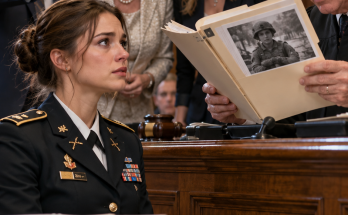
The moment I walked into the courtroom carrying a battered leather briefcase, my father-in-law burst out laughing.
“Where’s your lawyer, Natalie?” Richard Whitmore called from across the aisle.
He didn’t bother lowering his voice.
“My son is paying three of the most expensive attorneys in this city to represent him, and you couldn’t even afford one?”
His wife, Eleanor, covered her smile with a delicate hand.
Beside them, my husband, Daniel, adjusted his navy-blue tie and glanced at me with the same expression he had worn the night he told me our marriage was over.
Pity mixed with contempt.
For seven years, I had mistaken that expression for love.
I stood near the defense table without answering.
The courtroom smelled of polished wood, old paper, and expensive perfume.
Behind the judge’s bench, the American flag hung beside a dark wooden seal.
A dozen reporters occupied the back row because Daniel Whitmore wasn’t just a wealthy businessman.
He was the heir to Whitmore Capital, a financial empire his father had spent four decades building.
And I was the woman his family had spent the past six months trying to destroy.
“Your Honor,” Daniel’s lead attorney, Gregory Shaw, announced as he rose, “we respectfully request that these proceedings continue without unnecessary delays. Mrs. Whitmore has chosen to represent herself despite the complexity of the financial matters before this court.”
He paused just long enough to glance at me.
“We believe she lacks the necessary experience to challenge our client’s evidence.”
A few people in the gallery whispered.
I placed my briefcase on the table and sat down.
They thought I was frightened.
They thought I was broke.
They thought the woman who had spent years organizing charity dinners, managing their family’s private events, and smiling through their insults had finally run out of options.
They were wrong about all three.
Three months earlier, Daniel had come home carrying a bottle of champagne.
He placed it on the kitchen counter, loosened his tie, and announced that he wanted a divorce.
“I think we’ve grown apart, Natalie.”
I stared at him from across the kitchen island.
“Grown apart?”
He nodded as though he were discussing a minor adjustment to a business contract.
“My father believes it’s best if we settle everything quickly.”
I almost laughed at that.
For seven years, I had helped Daniel prepare for investor meetings, reviewed the numbers he brought home, and questioned the inconsistencies he insisted were too complicated for me to understand.
When his father suffered a financial setback, I had quietly helped Daniel restructure several obligations.
When an overseas investment threatened to collapse, I spent three sleepless nights tracing transactions until we found the problem.
Daniel had accepted my help without asking how I knew what to look for.
He had never been interested in my professional past.
He only knew that I had once worked in government service before leaving to support his career.
He never asked why I had kept my old credentials locked away.
He never asked why I still received occasional calls from former colleagues.
And he never asked why I could read a financial statement faster than some of the executives he admired.
Then he slid a document across the counter.
“You’ll receive a reasonable settlement,” he said. “You should sign it and move on.”
I read the first page.
Then the second.
By the third, my hands had gone cold.
According to the agreement, I was entitled to almost nothing.
Daniel claimed the assets belonged exclusively to his family, the properties were held in trusts I had no right to challenge, and the money I had contributed over the years was merely part of my marital responsibilities.
But the worst discovery came two days later.
I found a reference to an $8 million transfer in a financial schedule attached to the divorce proceedings.
The money had supposedly been moved into a legitimate investment account.
Yet the account number was incomplete, the receiving institution was misidentified, and the transaction date contradicted another document Daniel had submitted.
It was a small inconsistency.
The kind most people would overlook.
I had built my career on noticing things other people overlooked.
Before I became Natalie Whitmore, I had been Natalie Brooks, a federal financial investigator and a military-trained legal officer who had assisted with complex fraud investigations.
I had left that world because I wanted a family.
I had believed that love meant trusting the person beside me.
Now I understood that trust without honesty could become a weapon.
I hired no attorney.
Instead, I requested the records I was legally entitled to obtain, organized the financial documents, and examined every statement Daniel’s attorneys had submitted.
The deeper I looked, the more troubling the inconsistencies became.
There were transfers through shell companies.
There were signatures that appeared on documents after the dates their supposed signatories had resigned.
And there was one account that seemed to connect Daniel’s company to a private entity controlled by his father.
I didn’t know the entire truth yet.
But I knew the $8 million hadn’t simply disappeared.
Someone had worked very hard to make it look as though it had.
Now, standing before Judge Margaret Ellis, I watched Gregory Shaw straighten his papers.
“Your Honor, we are ready to proceed.”
The judge looked toward me.
“Mrs. Whitmore, are you certain you wish to represent yourself?”
“Yes, Your Honor.”
“Do you understand the risks?”
“I do.”
Daniel leaned toward his attorney and whispered something.
His father laughed again.
Judge Ellis raised her eyes.
“Mr. Whitmore, this is a courtroom, not a private dining room. You will conduct yourself accordingly.”
Richard’s smile faded.
Then the judge turned to me.
“Before we begin, I have one question about the financial disclosure submitted by your husband’s company.”
I looked up.
She held a document in her hand.
“Mrs. Whitmore, can you explain why eight million dollars appears in the company’s outgoing ledger but nowhere in its reported assets?”
For the first time that morning, nobody laughed.
I slowly unlocked my briefcase.
“Yes, Your Honor,” I replied.
“But I believe the more important question is why the money was transferred into an account that your court records identify as belonging to a company that supposedly ceased to exist four years ago.”
Gregory Shaw stopped moving.
Daniel’s face lost its color.
And my father-in-law, the man who had mocked me for arriving without an attorney, suddenly leaned toward his legal team.
“Find out what she has,” he whispered.
Unfortunately for him, I had brought only the first folder.
And it contained the one document his family had never expected me to find.
PART 2
Judge Ellis instructed the clerk to mark my document as an exhibit.
I placed the first folder on the table and opened it to a page highlighted with three small yellow tabs.
“I would like to establish three facts before discussing the transfer,” I said.
Gregory Shaw rose immediately.
“Objection, Your Honor. Mrs. Whitmore is attempting to introduce financial records without a qualified expert to interpret them.”
I turned toward him.
“I haven’t interpreted anything yet, Mr. Shaw. I’ve identified the dates, account numbers, and signatures appearing on the documents your client submitted.”
The judge looked at the papers.
“Overruled for now. Proceed carefully, Mrs. Whitmore.”
I nodded.
Then I began.
The first document showed that $8 million had left a Whitmore Capital subsidiary on March 14.
The second showed that the receiving company had been dissolved years earlier.
The third was a corporate authorization bearing Daniel’s signature.
Daniel shook his head.
“This is ridiculous,” he muttered.
His attorney touched his arm, warning him to remain silent.
I continued.
“Your Honor, the defense claims this transfer was a legitimate investment. However, the receiving account was opened under the name of a company called Northbridge Holdings.”
I handed the clerk a copy of the relevant filing.
“According to the public corporate record, Northbridge Holdings was dissolved four years before the transfer occurred.”
Gregory stood again.
“An administrative dissolution does not necessarily mean an entity cannot conduct business under every circumstance.”
“Agreed,” I replied. “Which is why I obtained the subsequent filings.”
I turned to the next page.
“Those filings show that the company was never reinstated. Its registered address belonged to a commercial mail service, and its listed director was a man who died eleven months before the transfer.”
A murmur swept through the gallery.
Judge Ellis examined the document.
“Mr. Shaw, did your firm verify the status of this company before representing the transfer as a legitimate investment?”
He hesitated.
“Our client provided documentation supporting the transaction.”
“That wasn’t my question.”
The attorney swallowed.
“No, Your Honor. We relied on the materials supplied by our client.”
I watched Daniel.
His expression had changed.
He no longer looked amused.
He looked angry.
And underneath the anger, I saw something I hadn’t seen in years.
Fear.
My father-in-law leaned toward him and whispered urgently.
Daniel shook his head.
I turned to the final page.
“There is one additional problem. The authorization submitted by Mr. Whitmore bears the signature of a director who had already resigned. The electronic filing metadata also indicates that the document was created several weeks after the date printed on it.”
Gregory’s face tightened.
“Your Honor, we object to any suggestion of forgery based on metadata alone.”
“I have not alleged forgery,” I said. “I am asking the court to order an independent examination because the documents contradict one another.”
Judge Ellis studied me for a moment.
Then she looked toward the defense table.
“Mr. Shaw, I suggest you discuss this with your client before making any further representations about these records.”
The judge ordered the relevant financial disclosures preserved and directed the parties to address the discrepancies at the next hearing.
It wasn’t a verdict.
It wasn’t a finding of fraud.
But it was the first time anyone in that courtroom had treated my questions as something worth answering.
During the recess, Daniel cornered me in the corridor.
“What are you doing?” he demanded.
I closed my briefcase.
“Answering the questions you were supposed to answer in your financial disclosure.”
“You’re trying to destroy my family.”
“No, Daniel. I’m trying to understand where eight million dollars went.”
He lowered his voice.
“You have no idea who you’re dealing with.”
For seven years, those words would have frightened me.
That morning, they only made me tired.
“I know exactly who I’m dealing with,” I said. “That’s why I’m here.”
He stared at me, then glanced toward the courtroom doors.
“My father will never let you get away with this.”
I looked him in the eye.
“Your father has spent years believing money can make every problem disappear. Perhaps it’s time someone showed him the difference between buying silence and proving the truth.”
I walked away before he could answer.
That afternoon, I received a call from an unfamiliar number.
The woman on the other end introduced herself as Claire Bennett, a former compliance officer at Whitmore Capital.
“I heard what happened in court,” she said.
I remained silent.
“I shouldn’t be calling you. I signed a confidentiality agreement when I left the company.”
“Then you should speak to an attorney before sharing anything confidential.”
She paused.
“I already did. I’m not calling to give you company records. I’m calling because I think you should know that the transfer you found wasn’t the only one.”
I sat down.
“How many were there?”
“I don’t know the total. But I remember a series of payments approved under a special authorization code.”
“What code?”
She gave me four letters and two numbers.
I wrote them on a notepad.
I recognized the format immediately.
It was a legacy internal control code used by a financial subsidiary before its operations were reorganized.
“Who had access to it?” I asked.
“Very few people. Daniel had access to the reporting system. Richard had authority to approve certain transactions. And one other person had access to the original authorization records.”
“Who?”
Claire took a breath.
“Your husband’s younger sister, Emily.”
I frowned.
Emily had always been the quietest member of the Whitmore family.
She rarely attended business events and had left the company two years earlier after a disagreement with her father.
I had assumed she wanted nothing to do with the family business.
“Why would she have access?”
“Because she helped create the internal controls that tracked those transfers. And the day she resigned, she warned the board that some transactions were being approved outside the normal review process.”
My fingers tightened around the phone.
“Did anyone investigate?”
“No. Her report was closed.”
“Who closed it?”
Claire didn’t answer immediately.
Then she said, “Richard Whitmore.”
The line went quiet.
I looked at the notes in front of me.
The missing money.
The dissolved company.
The suspicious authorization.
And now a suppressed internal report.
For the first time, I began to suspect that my divorce case was only the smallest part of a much larger problem.
That evening, I received an envelope at my apartment.
There was no return address.
Inside was a single page containing a handwritten message.
If you want to know where the money went, ask your husband why his father ordered the original audit destroyed.
At the bottom was a name.
Emily Whitmore.
I read the message twice.
Then my phone rang.
It was Daniel.
His voice sounded different now.
Less arrogant.
More desperate.
“Natalie, listen to me. Whatever Emily has told you, don’t believe her.”
“Why?”
“Because she was the one who signed the original authorization.”
I went completely still.
Before I could respond, Daniel said something that changed the entire direction of my investigation.
“She didn’t just know about the eight million dollars. She was the last person who saw the original records before they disappeared.”
PART 3
I met Emily Whitmore two days later in a small café far from her family’s offices.
She arrived wearing a plain gray coat, carrying no handbag, and looking over her shoulder before she entered.
She had her father’s sharp eyes but none of his confidence.
“Thank you for coming,” she said.
“I nearly didn’t.”
“I wouldn’t have blamed you.”
I sat across from her.
“Did you authorize the transfer?”
She looked down at her hands.
“I authorized a preliminary investment review. I did not authorize the money to be released.”
“Who did?”
“My father had final approval authority. Daniel’s credentials were used to submit the payment.”
“Were they used by Daniel?”
Emily’s eyes filled with tears, but she didn’t answer.
That silence told me she was afraid of something more complicated than an accusation.
She finally explained that the original transaction had been presented as a temporary investment in a distressed company.
The proposal was supposed to pass through three independent reviews.
Instead, the review process had been bypassed.
The funds were transferred to Northbridge Holdings, then moved through two additional companies.
When Emily discovered that the recipient company had no legitimate operations, she raised concerns.
Her father told her the transaction was part of a confidential restructuring.
She requested supporting records.
He refused.
When she escalated the issue to the board, her report was closed, and she was told to resign.
“Why didn’t you go to the authorities?” I asked.
“I was twenty-nine, Natalie. My father controlled the company, my job, and most of the people I trusted. He told me that if I accused him publicly, he’d make sure I was blamed for the entire transaction.”
She looked at me.
“I was afraid.”
I understood that fear more than I wanted to admit.
“But why contact me now?”
“Because I saw the court filing. Your husband claimed the money was a legitimate investment, and your father-in-law’s lawyers were using that claim to argue that the company had no financial obligations to you.”
She reached into her coat and placed a small notebook on the table.
“I kept a record of the dates when I raised concerns. I didn’t take confidential company files, and I can’t prove where every dollar went. But I can tell you who received my reports and when they were closed.”
I opened the notebook.
The dates matched the timeline I had reconstructed.
More importantly, one entry showed that Emily’s final report had been forwarded to an outside auditor before the internal investigation was terminated.
The auditor’s name was Daniel’s own former chief financial officer.
A man who had abruptly resigned six weeks after the transfer.
I looked up.
“Do you know where he is?”
Emily nodded.
“He contacted me last month. He said he would cooperate with an independent investigation, but only if someone could establish that the original records hadn’t been altered.”
I closed the notebook.
“Then we need to do this properly.”
Over the next several days, I worked through the court’s permitted discovery process and requested the records relevant to my divorce case.
I also consulted an independent attorney about how to refer potential financial misconduct to the appropriate authorities without compromising the proceedings.
I had represented cases before.
I understood that suspicion was not proof, and a compelling story was not a substitute for admissible evidence.
The documents had to speak for themselves.
And they did.
The outside auditor confirmed that the eight-million-dollar transaction had been flagged before his resignation.
His archived correspondence showed that he had requested an explanation for the transfer.
The response he received came from Richard Whitmore.
It instructed him to classify the transaction as a restructuring expense and close the review.
The auditor refused.
Two weeks later, he was removed from the account.
The records did not establish who ultimately benefited from every transfer, but they showed that the transaction had been mischaracterized and that warnings had been ignored.
That was enough to justify a formal referral for independent investigation.
The next hearing arrived on a cold Monday morning.
This time, Richard Whitmore didn’t laugh when I entered the courtroom.
Daniel sat between his three attorneys, staring at the table.
Judge Ellis reviewed the newly submitted exhibits.
“Mr. Shaw,” she said, “your client’s earlier filings represented the disputed transfer as a completed and legitimate investment. The supplemental records raise substantial questions about that characterization.”
Gregory stood.
“Your Honor, we request additional time to examine the documents.”
“You will have an opportunity to respond,” the judge said. “But I also want an explanation for the discrepancy between the original authorization and the accounting treatment.”
Richard suddenly leaned forward.
“This is a private family matter,” he interrupted. “It has nothing to do with my daughter-in-law’s settlement.”
Judge Ellis looked directly at him.
“Mr. Whitmore, the court will determine what is relevant to these proceedings. You will not dictate the scope of my questions.”
His face reddened.
I stood.
“Your Honor, I would like to clarify one point. I am not asking this court to decide whether anyone committed a crime. I am asking that the financial representations used to determine my marital settlement be verified before they are accepted as accurate.”
The judge nodded.
“That is a reasonable request.”
I placed one final document before the clerk.
It was the correspondence between the outside auditor and Richard Whitmore.
The room became silent as the relevant passage was read aloud.
The message showed that Richard had been warned about the questionable transfer and had instructed the auditor to close the review.
Daniel stared at his father.
“You told me the audit had cleared everything,” he whispered.
Richard didn’t look at him.
“Be quiet.”
But Daniel had already begun to understand.
For years, his father had assured him that the company’s financial problems were temporary, the transactions were legitimate, and every concern had been resolved.
Now the records suggested that Daniel had signed documents he never properly verified, while his father had controlled the response to the warnings.
Neither fact established criminal guilt by itself.
Both demanded answers.
Judge Ellis ordered the disputed financial records preserved, required corrected disclosures where necessary, and set a further hearing to determine the consequences for the divorce settlement.
She also noted that questions about possible financial misconduct belonged with the appropriate investigative authorities, not to a shortcut judgment in a divorce proceeding.
Richard turned toward his lawyers.
“Do something,” he hissed.
For once, none of them seemed eager to speak.
Then Judge Ellis looked at me.
“Mrs. Whitmore, I understand you have prior legal experience.”
“Yes, Your Honor.”
“Why didn’t you disclose that earlier?”
I paused.
“Because I believed the case should be decided on the evidence, not on my résumé.”
The judge studied me for a moment.
Then she nodded.
“An admirable principle. Continue to observe it.”
I returned to my seat.
The case wasn’t over.
There would be more hearings, more financial examinations, and more difficult questions.
But the family that had assumed I was powerless could no longer dismiss me as an unrepresented woman who didn’t understand what she was signing.
The following month, Daniel’s legal team agreed to reopen the financial settlement discussions.
The parties negotiated a revised agreement after an independent review of the marital assets, and the disputed corporate records were handled separately through the appropriate legal channels.
I did not receive a magical fortune overnight.
I did not watch my father-in-law led away in handcuffs.
Real justice rarely arrives in a single dramatic moment.
Instead, I received something far more important.
A fair opportunity to establish what belonged to me.
A formal record of the financial discrepancies.
And the freedom to walk away from a marriage in which my silence had been mistaken for weakness.
On the day the revised settlement was signed, Daniel asked to speak to me privately.
“I never thought you could do this,” he admitted.
I looked at him.
“That was the problem, Daniel. You never thought to ask who I was.”
He lowered his eyes.
“Do you hate me?”
“No,” I replied. “I simply don’t trust you anymore.”
I picked up my briefcase and walked out.
The courthouse doors opened onto a bright afternoon.
For the first time in years, I didn’t feel the need to explain myself to anyone.
My former in-laws had believed that arriving without an attorney meant arriving without power.
They had mistaken an empty chair beside me for an empty mind.
They had confused my decision to leave my career with an inability to defend myself.
And they had assumed that the quiet woman who spent seven years supporting their family would never challenge them.
They were wrong.
Because I hadn’t walked into that courtroom to prove I was smarter than my husband or more powerful than his father.
I had walked in to insist on something far simpler.
The truth deserved to be examined.
And I deserved to be heard.
The greatest mistake the Whitmore family made wasn’t underestimating my legal knowledge.
It was believing that because I had chosen a quiet life, I had forgotten how to stand up when everything was at stake.