PART 1 — The Necklace Behind the Glass
I had spent thirty years believing that every object had a price.
A diamond ring.
An antique watch.
A rare painting.
A forgotten piece of jewelry sitting inside a dusty display case.
Everything could be measured.
Everything could be bought.
That was the foundation of my success.
My name is Victor Hale, and I built my fortune by understanding one simple rule: emotions make people hold onto things, but money decides what happens next.
That afternoon, I walked into a small antique jewelry store in the old part of the city.
I wasn’t there to shop.
I was there because I had purchased several buildings nearby and wanted to meet the local business owners before making changes to the area.
The store was quiet.
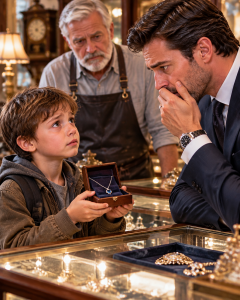
Old clocks ticked along the walls. Silver watches rested beneath glass. Gold chains hung like memories from another lifetime.
Then the bell above the door rang.
A little boy stepped inside.
He looked about eight years old.
His jacket was too thin for the cold weather. His shoes were worn. In his arms, he carried a small wooden box that looked older than he was.
Behind him, there was no parent.
No adult.
Just him.
The shop owner, Mr. Bennett, looked surprised.
“Can I help you, young man?”
The boy nodded nervously.
“Yes, sir.”
He opened the wooden box.
Inside was a simple silver necklace with a tiny blue stone attached.
Not expensive.
Not rare.
But carefully wrapped in a piece of cloth.
“I need to buy this back,” the boy said.
Mr. Bennett froze.
“Buy it back?”
The boy nodded.
“My mother sold it here three months ago.”
The shop owner looked uncomfortable.
“Son, that necklace was sold. It belongs to someone else now.”
The boy lowered his head.
“I know.”
Then he reached into his pocket.
He pulled out a handful of coins and a few folded bills.
He placed them on the counter.
“I saved everything.”
The coins rolled across the wooden surface.
A few people would have laughed.
But nobody in that room did.
Because the boy wasn’t pretending.
He was serious.
Mr. Bennett counted quietly.
“Forty-three dollars and fifteen cents.”
The boy looked up.
“How much more do I need?”
The shop owner sighed.
“Eighty dollars.”
The boy’s face changed for only a second.
A small crack of disappointment.
Then he nodded.
“I’ll get the rest.”
I watched him carefully.
I had seen adults negotiate million-dollar deals with less determination.
“What is your name?” I asked.
The boy turned toward me.
“Ethan.”
“And why is this necklace so important?”
He held the wooden box close.
“It was my dad’s last gift to my mom.”
The room became silent.
“My dad died when I was little,” he continued. “Mom wore this every day.”
He looked at the necklace.
“But when we needed money for my medicine, she sold it.”
I felt something shift inside me.
Because I understood losing things.
I had lost businesses.
Friends.
Family relationships.
But I had never seen a child trying to recover something his mother sacrificed for him.
“Your mother knows you’re here?” I asked.
Ethan shook his head.
“No.”
“Why not?”
“Because she would say it’s impossible.”
Then he reached into his pocket again.
This time, he pulled out a folded piece of paper.
He carefully handed it to me.
“What is this?”
“My promise.”
I opened it.
The handwriting was uneven.
A child’s handwriting.
At the top, it said:
“AGREEMENT TO PAY BACK WHAT I OWE.”
Below were lines showing every coin he planned to collect.
“I don’t want someone to just give it to me,” Ethan said.
“My mom says if someone helps you, you should respect them.”
I stared at the paper.
All my life, I had signed contracts prepared by lawyers.
Thousands of pages.
Millions of dollars.
But this small piece of paper felt heavier than all of them.
I looked at Mr. Bennett.
“How much exactly does he need?”
The owner answered quietly.
“Eighty dollars.”
I reached into my wallet.
But before I could take out money, Ethan stopped me.
“Wait.”
He looked worried.
“If you buy it… I still need to pay you back.”
I looked at him.
“You want to repay me?”
He nodded.
“Yes, sir.”
“Why?”
His answer was simple.
“Because my mom taught me that kindness should never become a debt someone carries alone.”
For the first time in years, I didn’t know what to say.
I placed the money on the counter.
Mr. Bennett unlocked the display case.
He picked up the necklace.
But before handing it to Ethan…
He stopped.
“Victor,” he said quietly.
“There’s something you should know.”
I looked at him.
“What?”
He stared at the necklace.
“Ethan’s mother came here yesterday.”
The boy turned around quickly.
“She did?”
Mr. Bennett nodded slowly.
“She asked me not to sell it to anyone.”
My eyes narrowed.
“Why?”
The old shop owner looked toward Ethan.
“Because she wanted her son to have it someday.”
Then he placed the necklace in my hand.
Not the boy’s.
Mine.
And whispered:
“Because what his mother told me before she left will change everything.”
PART 2 — The Secret His Mother Left Behind
I looked at the necklace resting in my palm.
It was nothing special according to the numbers.
A small silver chain.
A blue stone.
No diamonds.
No rare markings.
Yet everyone in that store looked at it like it was worth millions.
“Where is Ethan’s mother now?” I asked.
Mr. Bennett hesitated.
“She’s sick.”
The boy immediately looked down.
“She didn’t want me to know.”
Those words hurt more than anything else.
Because children should worry about homework.
Friends.
Dreams.
Not whether their mother would still be there tomorrow.
“What did she tell you?” I asked the shop owner.
Mr. Bennett walked to the back room and returned with an envelope.
“My store has been here for forty years,” he said.
“I’ve seen people sell things because they needed money.”
He looked at Ethan.
“But I’ve never seen someone leave something behind because they loved someone so much.”
He handed me the envelope.
On the front were three words:
For My Son
Ethan reached for it.
Then stopped.
“Should I open it?”
I looked at him.
“It’s yours.”
His hands trembled as he opened the letter.
Inside was a message from his mother.
And as he read, tears slowly filled his eyes.
The letter said:
“My sweet Ethan,
If you are reading this, it means you found the necklace.
I’m sorry I had to sell it.
I know how much it meant to me.
But you meant more.
Your medicine mattered more.
Your life mattered more.
Never believe that something is valuable because it costs money.
The most valuable things are the people who stay beside you.”
The boy pressed the letter against his chest.
I looked away.
I didn’t want him to see my eyes becoming wet.
Then I noticed something else inside the envelope.
A photograph.
It showed Ethan as a baby.
His mother was holding him.
And beside her was a man wearing the same necklace.
His father.
Mr. Bennett spoke quietly.
“She came here because she knew she might not have enough time.”
The boy froze.
“What do you mean?”
Nobody answered immediately.
Because sometimes the truth is heavier than silence.
I knelt down beside him.
“Ethan…”
He looked at me.
“Your mother loves you very much.”
He nodded.
“I know.”
“And she wanted you to have this.”
I gave him the necklace.
But he didn’t take it.
Instead, he pushed it back toward me.
“Please keep it.”
I was confused.
“Why?”
“Because you bought it.”
I smiled sadly.
“No, Ethan. It belongs to your family.”
He shook his head.
“No.”
His voice became softer.
“My mom always said good people appear when you need them most.”
He looked at me.
“I think she sent you.”
For years, people had called me successful.
Powerful.
Important.
But standing there with a child who owned almost nothing, I realized something.
I had spent my entire life collecting things.
And this little boy had spent his life protecting love.
I turned to Mr. Bennett.
“How much does Ethan’s mother owe?”
He looked surprised.
“Why?”
“Because I want to know.”
He checked the records.
Then his expression changed.
“Her hospital bills…”
He stopped.
“How much?”
He quietly told me.
And for the first time in my life…
Money finally felt small.
PART 3 — The Necklace That Changed Everything
Three weeks later, I returned to the neighborhood.
But this time, I wasn’t there as a businessman.
I was there as someone who finally understood what mattered.
I found Ethan sitting beside his mother’s hospital bed.
She looked tired.
But when she saw her son smiling, her entire face changed.
“Who are you?” she asked.
Ethan smiled.
“He helped us get your necklace back.”
She looked at me.
“You bought it?”
I shook my head.
“No.”
I placed the necklace in her hand.
“You never really lost it.”
Tears filled her eyes.
“I thought it was gone forever.”
I smiled.
“Some things are never meant to be sold.”
She held the necklace tightly.
Then she looked at Ethan.
“You did this?”
He nodded.
“I wanted you to have your memory back.”
His mother cried.
Not because of the necklace.
Because her son understood love.
Months passed.
Her health improved.
Ethan continued visiting me every weekend.
I taught him about business.
He taught me about kindness.
Years later, when people asked me about my greatest investment, they expected me to mention a company.
A building.
A successful deal.
But I always gave the same answer.
“The best thing I ever bought cost eighty dollars.”
They would laugh.
Until I explained.
I didn’t buy a necklace.
I bought a second chance.
A chance to remember that wealth isn’t measured by what you own.
It’s measured by what you’re willing to give when nobody is watching.
And sometimes…
The smallest hands can hold the biggest lessons.