PART 1 — The Daughter Nobody Wanted in the Front Row
My mother told security that I was “the family embarrassment” and demanded that they remove me from the front row of my younger brother’s Navy promotion ceremony.
My father laughed when they approached me.
My brother looked me straight in the eyes and whispered, “Please, Emily. For once in your life, don’t make this about you.”
I said nothing.
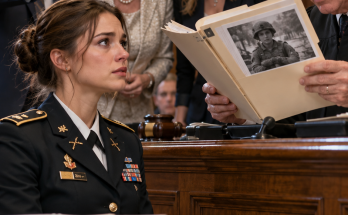
I simply stood up, smoothed the sleeves of my dark blue dress, and followed the security officer toward the back of the ceremony tent.
But before I could reach the last row, a decorated naval commander stepped down from the platform, crossed the entire room, and saluted me in front of hundreds of military personnel.
And that was only the beginning.
Because twenty minutes later, a government vehicle arrived carrying a man whose funeral my family had attended twelve years earlier.
And he had come to reveal why I had disappeared from their lives.
My name is Emily Carter.
I was thirty-nine years old, unmarried, and, according to my parents, the least successful person in our family.
My younger brother, Ryan, had always been their pride and joy.
He had graduated from the Naval Academy, completed the most demanding stages of his training, and earned a reputation as a disciplined officer.
Now, beneath the brilliant California sunshine at Naval Amphibious Base Coronado, he was about to receive a prestigious new assignment.
My mother, Patricia, had spent weeks planning what she would wear.
My father, Robert, had invited nearly everyone he knew.
And Ryan’s fiancée had hired a photographer to capture every important moment.
I had received my invitation only three days earlier.
It was a short message from Ryan.
Ceremony is Saturday at 10. Please come if you can.
No explanation.
No warmth.
Just an obligation.
Still, I came.
I had missed his graduation, his first promotion, and countless family celebrations during the sixteen years I had spent working under government assignments.
My parents called it running away.
They believed I had abandoned a promising career after leaving college and disappearing into a world of classified contracts and confidential travel.
Whenever relatives asked about me, my mother would smile sadly and say, “Emily never quite found her place.”
The truth was that I had found my place.
I simply wasn’t permitted to tell them where it was.
When I arrived at the ceremony, Ryan was standing beside the platform in his immaculate dress uniform.
His uniform was pressed perfectly, his medals aligned, and his expression serious.
I felt a quiet surge of pride.
That was my little brother.
The boy who used to sneak into my bedroom during thunderstorms because he was afraid of the lightning.
The boy I had protected when our father became angry over a failed exam.
The boy whose hand I had held when our grandfather died.
I walked toward the family seating area.
My mother noticed me first.
Her smile disappeared.
“Emily, what are you wearing?”
I glanced down at my simple navy dress.
“Clothes, Mom.”
“Don’t be clever. This is an important military occasion.”
“I know.”
She leaned closer.
“Then why do you always look as though you don’t belong anywhere?”
Before I could answer, my cousin Madison approached with a seating chart.
“Oh, good. You’re here,” she said, sounding surprised. “But there seems to have been a mistake.”
“What mistake?”
She pointed toward the last section.
“Your seat is over there.”
I looked at the first row.
My parents sat beside Ryan’s fiancée and her family.
There was one empty chair beside my mother.
“I thought I’d sit with you.”
Mom adjusted her pearl necklace.
“That seat is for someone important.”
The words landed harder than I wanted to admit.
I looked at my father.
He pretended to be fascinated by the ceremony program.
Then he chuckled.
“Don’t start another scene, Emily. Ryan has worked too hard for you to ruin his day.”
I swallowed my response.
“I came to congratulate him.”
“Then do it quietly,” Mom replied.
A security officer appeared moments later.
“Ma’am, could you please come with me?”
My mother raised her voice just enough for the nearby guests to hear.
“She isn’t part of the official family party. She’s always been the disappointing sister. We don’t want any confusion.”
Several people turned toward me.
Ryan heard her.
He walked over, his jaw tight.
“Emily, just go sit in the back, okay?”
I stared at him.
“Do you really want me to leave?”
He glanced toward his commanding officers.
“I want you to stop making everything difficult.”
For one painful second, I was twenty-three again, standing in our childhood kitchen while my family demanded to know why I had accepted a government assignment instead of returning to finish college.
I remembered promising Ryan that no matter how far away my work took me, I would always come back for the moments that mattered.
Apparently, he no longer remembered that promise.
I gave him a small nod.
“Congratulations on your achievement, Ryan.”
Then I followed the security officer.
I had almost reached the rear entrance when the ceremony’s master of ceremonies announced the arrival of Commander Daniel Brooks, the senior officer overseeing the event.
The conversations around the tent faded.
Commander Brooks took his position near the stage.
He began speaking about responsibility, courage, and the people who quietly carried the burdens that others would never understand.
I stopped walking.
Something about his words made my chest tighten.
Then he looked down at the official program.
His eyes moved across the audience.
Suddenly, he stopped speaking.
He looked directly at me.
His expression changed.
“Excuse me for one moment,” he said into the microphone.
He descended from the stage and began walking through the rows.
My father straightened his jacket, clearly expecting the commander to greet him.
But Commander Brooks walked straight past him.
He passed my mother.
He passed Ryan’s fiancée.
Then he stopped in front of me.
The security officer immediately stepped aside.
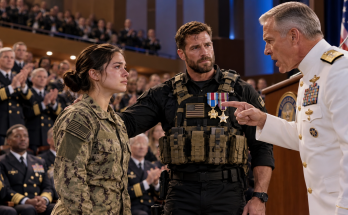
Commander Brooks stood at attention and raised his right hand in a formal salute.
“Commander Carter,” he said, his voice carrying across the silent tent. “We have been waiting for you.”
I returned the salute.
“Good morning, sir.”
My mother stood so abruptly that her chair scraped across the floor.
“Commander Carter?”
My father stared at me.
“Emily, what is this?”
Ryan looked as though someone had suddenly changed the language everyone was speaking.
Commander Brooks lowered his hand.
“Ma’am, your assigned seat is beside the reviewing officers. We were informed that you would arrive before the ceremony began.”
I glanced toward the empty chair near the platform.
A name card rested against its back.
COMMANDER EMILY CARTER.
My name.
My rank.
And an official designation beneath it that my family couldn’t read from where they stood.
Ryan stepped forward.
“Sir, there must be some mistake. My sister left college years ago. She works for a contractor.”
Commander Brooks looked at him calmly.
“Your sister’s educational history is not the subject of today’s ceremony, Lieutenant.”
Then he turned back to me.
“Ma’am, the second vehicle has just cleared the security checkpoint.”
My fingers tightened around the small clutch in my hand.
“Is he inside?”
“Yes.”
“And did he bring the authorization?”
Commander Brooks nodded.
“Signed personally by the Secretary of the Navy.”
My mother looked from him to me.
“Emily, what have you done?”
I met her eyes.
“For twelve years, I’ve done exactly what I was ordered to do.”
At that moment, the sound of a vehicle approaching echoed beyond the tent.
Every senior officer turned toward the entrance.
And I knew my life was about to change.
Because the man who had just arrived wasn’t supposed to be alive.
And he was the only person who could explain why I had spent twelve years being called a failure by the people I had secretly protected.
PART 2 — The Man Who Was Supposed to Be Dead
The black government vehicle stopped outside the ceremony tent.
Two uniformed personnel approached it.
One opened the rear passenger door.
A tall man emerged slowly, leaning on a polished cane.
His hair had turned almost completely silver.
A long scar ran from his left temple toward his cheek, and he walked with a noticeable limp.
But there was no mistaking his face.
Admiral Jonathan Mercer.
My father’s former commanding officer.
Ryan’s childhood hero.
And the man whose official memorial service had taken place twelve years earlier after his aircraft disappeared during an overseas operation.
My mother covered her mouth.
My father gripped the back of his chair.
Ryan whispered, “That’s impossible.”
The admiral paused near the entrance and surveyed the ceremony.
Then his eyes found mine.
For the first time that morning, my carefully controlled expression cracked.
I took one step forward.
He smiled faintly.
“Still standing straight, Carter?”
I managed a small smile.
“Someone taught me to.”
He gave a quiet laugh.
“I seem to remember you correcting my posture during a field exercise.”
“You were leaning on a broken railing.”
“And you were twenty-seven years old, arguing with an admiral.”
“You were also standing in the middle of a restricted landing zone.”
Several officers nearby tried not to smile.
My family stared at us as if we were strangers speaking a private language.
The admiral approached the platform.
Commander Brooks formally welcomed him.
Then Admiral Mercer asked for the microphone.
“Before this ceremony continues, there is something important that everyone present needs to understand.”
My father immediately stepped forward.
“Admiral, forgive me, but I believe there’s been a misunderstanding. My daughter has never held a senior military position. She left college and spent years working overseas.”
The admiral turned toward him.
“Robert Carter?”
“Yes, sir.”
“I remember you.”
My father’s expression brightened with relief.
“Of course, sir. We met several times when I was younger.”
“Yes,” Mercer replied. “You once told me that your daughter was too stubborn to follow instructions.”
My father gave an uncomfortable laugh.
“I suppose I did.”
The admiral’s face became serious.
“She followed an instruction that cost her twelve years with her family, her reputation, and nearly everything she had ever known.”
The tent fell silent.
My mother shook her head.
“What are you talking about?”
Admiral Mercer looked at me.
“Commander Carter was selected for a classified maritime recovery operation twelve years ago. During that mission, my aircraft went down, and the operation was compromised.”
He paused.
“The official report declared me dead. That report was necessary to protect the people involved and prevent an ongoing intelligence threat from discovering that I had survived.”
A murmur traveled through the audience.
Ryan stared at the admiral.
“But if you were alive, why didn’t you come home?”
“Because the people responsible for the operation’s failure were still looking for information they believed I possessed.”
He looked at me again.
“Commander Carter was among the few officers entrusted with protecting that information.”
I remembered the night everything changed.
A storm had battered the coast.
Our recovery team had received an emergency transmission from an aircraft that had vanished during a mission no one was supposed to know existed.
When we reached the wreckage, we found two survivors.
One was Admiral Mercer.
The other was a young intelligence specialist carrying evidence that could expose a network of compromised military communications.
We had been ordered to recover both.
The mission went wrong before dawn.
Our extraction route was discovered, and the team was forced to abandon its original plan.
I made a decision that saved the survivors but left me seriously injured.
Afterward, the admiral and I were moved through a secure medical facility under protected identities.
The intelligence investigation lasted years.
Whenever my family asked where I was, I gave them the only answer I was authorized to give.
“I can’t talk about my work.”
They heard indifference.
They imagined failure.
They never knew that every unanswered call was a choice I made to protect them from a danger they could not see.
Admiral Mercer continued speaking.
“Commander Carter led the final phase of the recovery operation and preserved evidence that ultimately allowed investigators to identify the people responsible.”
He looked toward the officers on the stage.
“Her actions were reviewed at the highest levels of the department. Her service remained classified until this morning.”
Then he turned toward Ryan.
“Your sister did not abandon her career, Lieutenant. She accepted an assignment that prevented a dangerous intelligence breach from spreading through multiple commands.”
Ryan’s face had lost all color.
My mother shook her head.
“But she could have told us something.”
“She was prohibited from doing so,” the admiral replied.
“Not even her own family?” she demanded.
“Especially not anyone whose connection to her could compromise the investigation.”
My father looked offended.
“Are you suggesting we would have endangered her?”
“No,” Mercer said. “I’m explaining why the rules existed.”
He turned back to the microphone.
“Today, Commander Carter has been formally cleared to resume public duties under her own name. Her service record is no longer restricted in the same way it once was.”
Applause began among the officers.
At first, it was scattered.
Then the entire front section rose to its feet.
I stood motionless.
I had spent twelve years being told to remain invisible.
Now hundreds of people were standing because I was finally allowed to be seen.
My mother sat down slowly.
Ryan approached me.
“Emily, I didn’t know.”
I looked at him.
“You never asked what I was doing. You decided you already knew.”
His eyes dropped.
“I thought you had given up.”
“I know.”
“I thought you were embarrassed by us.”
I let out a slow breath.
“I was never embarrassed by you, Ryan.”
He looked up.
“Then why didn’t you come home?”
“Because I couldn’t.”
For the first time that day, he seemed to understand that my silence had never been proof of indifference.
It had been the only protection I could offer.
Admiral Mercer placed a hand on my shoulder.
“There is one more thing,” he said.
I turned toward him.
“Sir?”
He reached into his uniform pocket and unfolded a sealed document.
“The review board has approved the release of a final report concerning the operation.”
My stomach tightened.
I knew the report existed.
But I had never seen its complete contents.
Mercer handed the document to Commander Brooks.
“There’s a section that directly concerns Commander Carter’s family.”
My father went completely still.
“Her family?”
The admiral nodded.
“During the investigation, we discovered that information about the operation had been leaked before the aircraft went down. The source was never conclusively identified.”
I felt the old tension return to my shoulders.
For twelve years, I had believed the investigation was finished.
Mercer looked at me with an expression I had never seen before.
Regret.
“Emily, the newly declassified evidence has changed our understanding of what happened.”
He lowered his voice.
“The person who provided the original information used a contact connected to your family.”
My mother stood again.
“That is ridiculous.”
The admiral didn’t answer her.
Instead, he handed me a second envelope.
My name was written across the front in handwriting I recognized immediately.
It belonged to my grandfather.
The man who had died before the mission.
The man who had always told me that the truth was worth more than a comfortable lie.
I opened the envelope.
Inside was a single sentence.
If Jonathan ever returns, ask him who ordered the mission to be changed.
I looked up sharply.
“Admiral, what does this mean?”
Mercer glanced toward the officers guarding the entrance.
Then he said six words that made the blood drain from my face.
“Your grandfather knew who betrayed us.”
PART 3 — The Truth My Family Had Hidden for Twelve Years
For several seconds, I couldn’t move.
My grandfather had been dead for nearly thirteen years.
He had been the only person in my family who never called me a disappointment.
When I left for my first government assignment, he had walked me to my car and handed me a small brass compass.
“People will tell you that the easiest road is the safest,” he had said. “Remember, Emily, the truth doesn’t always point toward comfort.”
I had kept that compass through every move, every deployment, and every night I wondered whether my family would ever understand me.
Now his final message sat in my trembling hand.
I turned toward Admiral Mercer.
“Did you know he had information?”
“Not until the review team located the original correspondence last month.”
“Why wasn’t it found earlier?”
“Because it had been filed under a name that wasn’t connected to your grandfather.”
He looked toward the platform.
“The new report identifies the contact who requested the mission change. But the evidence alone doesn’t establish whether that person acted deliberately or was manipulated by someone else.”
My father suddenly spoke.
“This is absurd. Whatever happened twelve years ago has nothing to do with our family.”
Mercer regarded him carefully.
“Then you shouldn’t have any objection to the investigation continuing.”
My father said nothing.
My mother looked at the envelope in my hand.
“Emily, please don’t turn this into some family scandal.”
I almost laughed.
For years, she had used that same phrase whenever I challenged her version of events.
Don’t make a scene.
Don’t embarrass your father.
Don’t turn this into a scandal.
The rules had always been simple.
Everyone was allowed to hurt me.
I was expected to remain quiet about it.
I slipped my grandfather’s note into the envelope.
“I haven’t accused anyone of anything, Mom.”
“Then why are you looking at us like that?”
“Because I’m trying to understand why you’re afraid of a question.”
Her mouth opened, but no answer came.
Commander Brooks approached with the official report.
“Admiral, the review board has authorized the summary to be read in the presence of Commander Carter.”
Mercer nodded.
The commander unfolded the document.
“Twelve years ago, a change to the recovery route was requested through an administrative contact associated with a civilian logistics office. The request exposed the operation’s revised timing to an unauthorized party.”
He paused.
“The contact was subsequently linked to a company that had received payments through several intermediaries. One of those intermediaries had professional ties to Robert Carter.”
My father’s face became rigid.
Ryan turned toward him.
“Dad?”
“It’s a common name,” my father said quickly. “There are thousands of people in logistics.”
Commander Brooks continued.
“The report does not establish that Robert Carter knew the purpose of the transaction. It does establish that the payment records require further review.”
My mother looked as though the ground had shifted beneath her.
“Robert, what is he talking about?”
My father raised his voice.
“I worked with hundreds of people over the years. I have no idea what this is supposed to mean.”
I watched him closely.
I wanted to believe him.
Despite everything, he was still my father.
But I had learned a long time ago that loyalty without questions could become another form of blindness.
I stepped toward him.
“Dad, did you ever work with a company called Meridian Maritime Consulting?”
He looked at me.
Only for a second.
But it was enough.
His expression changed before he could control it.
Ryan noticed, too.
“You know that company?”
My father straightened his jacket.
“I said I don’t remember every company I dealt with.”
The admiral spoke calmly.
“No one here is declaring you guilty of anything, Robert. The investigators will examine the records and determine what happened.”
Then he looked at me.
“Commander Carter, you are not required to participate in the inquiry beyond the scope of your official duties.”
I understood what he was offering.
I could step away.
I could allow the investigators to handle the evidence without becoming personally involved.
I could protect myself from another painful confrontation with my family.
For years, I had wanted nothing more than to be free of the suspicion that surrounded my name.
But my grandfather’s words returned to me.
The truth doesn’t always point toward comfort.
“I’ll cooperate fully,” I said.
My father looked at me with disbelief.
“After everything I’ve done for you?”
I turned toward him.
“What have you done for me, Dad?”
His face reddened.
“I raised you.”
“Yes. You did.”
“I put a roof over your head.”
“Yes.”
“I gave you every opportunity.”
I nodded slowly.
“And when I chose a career you didn’t understand, you told everyone I had failed.”
He looked away.
“When I couldn’t explain my assignments, you accused me of lying.”
My voice remained steady.
“When I came home after my first injury, you told me I was being dramatic because I wouldn’t explain where I had been.”
My mother lowered her eyes.
I had never spoken those words aloud in front of them.
Not once.
“And today,” I continued, “you let security remove me from my brother’s ceremony because you were afraid I would embarrass you.”
Ryan stepped forward.
“Emily, please.”
I turned toward him.
“No, Ryan. You asked me not to embarrass you. You never asked whether I was okay.”
His eyes filled with tears.
“I was wrong.”
For the first time in years, my brother wasn’t trying to defend himself.
He was listening.
He took a shaky breath.
“I remember when you left,” he said. “Dad told me you had chosen your career over us. Mom said you didn’t want to be part of the family anymore.”
I looked at him.
“I never said that.”
“I know.”
He swallowed.
“I should have called more. I should have asked questions instead of believing everything they told me.”
I didn’t immediately forgive him.
Love doesn’t erase years of hurt simply because someone finally understands it.
But I reached out and squeezed his hand.
“You can start by being honest with me from now on.”
He nodded.
“I will.”
Behind us, the ceremony was still waiting to continue.
The officers had returned to their positions.
The reviewing platform stood beneath the American flag.
And Admiral Mercer was watching me with quiet pride.
He approached one last time.
“Emily, there’s something I should have told you earlier.”
I raised my eyes.
“What is it, sir?”
He looked toward the empty chair beside the platform.
“Your grandfather contacted me shortly before he died. He believed someone had used your father’s professional connections to gain access to information they had no right to possess.”
I felt a chill pass through me.
“Did he know who?”
“Not conclusively. But he left instructions that, if I ever returned, I was to make sure you received his final letter.”
I looked down at the envelope.
“There was only one sentence inside.”
Mercer nodded.
“The original letter was longer. The rest was held with the investigation files.”
He signaled to an officer, who approached carrying a sealed folder.
I opened it carefully.
The first page was a handwritten letter.
My grandfather’s familiar handwriting filled the paper.
My dearest Emily,
If you are reading this, then the day has finally come when you no longer have to carry every unanswered question alone.
I know your father believes your work has taken you away from the family. I know your mother worries about what people will say. And I know Ryan is too young to understand why you cannot tell him everything.
But I want you to remember something.
You were never a disappointment to me.
I stopped reading.
My vision blurred.
For twelve years, I had carried the suspicion that my family might never be proud of me.
I had accepted loneliness as part of my duty.
I had convinced myself that I no longer needed their approval.
Yet those simple words from my grandfather broke through every defense I had built.
I wiped my eyes and continued.
There is one thing I ask of you. When the truth comes out, do not allow anger to make your decisions. Find the facts. Protect the innocent. And remember that a family is not defined by the people who share your name, but by the people who stand beside you when the truth becomes difficult.
I folded the letter carefully.
My mother was crying.
My father stood silent.
Ryan stepped away from the family row and came to stand beside me.
Not in front of me.
Not behind me.
Beside me.
Then Admiral Mercer raised his hand toward the platform.
“Ladies and gentlemen, before we resume the ceremony, I would like to recognize an officer whose service has remained out of public view for far too long.”
He turned toward me.
“Commander Emily Carter, would you please join us?”
I walked toward the stage.
This time, no one asked me to move to the back.
No one questioned whether I belonged.
As I reached the platform, the officers rose to their feet.
One by one, they saluted.
I returned each salute with the same quiet respect I had carried through twelve difficult years.
Ryan stood among them, his eyes shining.
My mother watched with tears running down her face.
My father remained seated for a moment longer.
Then, slowly, he stood.
I didn’t need him to apologize in front of hundreds of people.
I didn’t need the ceremony to make me important.
I had already earned my place long before anyone in that tent knew my name.
What I needed was for the truth to remain the truth, even when it was uncomfortable.
And that was what I intended to protect.
The investigation into the old mission would continue.
My father’s connections would be examined.
The evidence would determine what happened, not suspicion, family loyalty, or the desire to save face.
As for Ryan, he walked with me after the ceremony ended.
“I don’t expect you to forgive me today,” he said.
I looked at my younger brother.
“No. But I hope you’ll give me a reason to trust you again.”
He nodded.
“I will.”
Then he hesitated.
“Emily?”
“Yes?”
“I’m proud of you.”
For a moment, I couldn’t answer.
Not because I needed those words to know my worth.
But because I had waited so long to hear them from him.
I finally smiled.
“Thank you, Ryan.”
That afternoon, I left Coronado carrying my grandfather’s letter in my bag and the old brass compass in my pocket.
The truth about the mission was finally coming to light.
The people responsible would have to answer for their actions.
And my family would have to decide whether they wanted to face the truth or keep hiding behind the comfortable story they had told themselves for twelve years.
For the first time in my life, I wasn’t going to make that decision for them.
I had spent twelve years protecting people who didn’t understand my silence.
Now I would protect the truth, even if it changed everything.
And as I walked toward the waiting government vehicle, Admiral Mercer called after me.
“Commander Carter?”
I turned.
He smiled.
“Your grandfather would have been proud.”
I looked down at the compass in my hand.
Then I looked back at the American flag fluttering above the ceremony grounds.
“I hope so, sir,” I replied.
And for the first time in twelve years, I no longer felt like the daughter who had disappeared.
I felt like the woman who had finally come home.
THE END