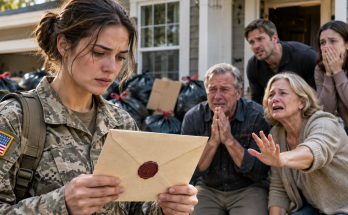
MY FATHER THREW ME AND MY FIVE-YEAR-OLD SON OUT INTO A WINTER STORM BECAUSE I REFUSED TO SIGN AWAY MY GRANDFATHER’S INHERITANCE—BUT THE OLD BRASS KEY HE LEFT ME UNLOCKED A SECRET THAT MADE MY ENTIRE FAMILY BEG FOR MY HELP.
PART 1 — “YOU HAVE NOTHING THAT BELONGS TO YOU”
“You have ten minutes to get out of my house.”
My father’s voice thundered through the kitchen, loud enough to make my five-year-old son, Ethan, drop the wooden train he had been playing with.
I stood beside the counter, staring at the papers spread across the table.
“What are you talking about, Dad?”
“Don’t pretend you don’t understand.” He shoved the documents toward me. “Sign them, take your son, and leave.”
My sister, Vanessa, sat near the window wearing a cream-colored sweater and an expression of absolute satisfaction. Beside her sat her husband, Mark, who had spent the last twenty minutes explaining why selling our grandfather’s old lakeside property was supposedly the best financial decision for everyone.
Everyone except me, apparently.
Outside, snow drifted across the driveway. The wind rattled the windows of the farmhouse where I had lived since my husband died two years earlier.
I worked as a nursing assistant at a rehabilitation center, often taking overnight shifts so I could afford Ethan’s preschool and the medication he needed for his asthma. My father had allowed us to stay in the farmhouse after my husband’s death, but he reminded me constantly that the roof over our heads belonged to him.
Every favor came with a price.
Every disagreement became evidence that I was ungrateful.
And every time I tried to build a life of my own, my family found a way to pull me back.
That afternoon, however, they wanted something much bigger than my paycheck.
They wanted my signature on a document transferring my inheritance rights to my sister.
“I won’t sign this,” I said.
My father’s face darkened.
“What did you just say?”
“I said I won’t sign it. Grandpa left me something, and I want to understand what I’m giving up before I agree to anything.”
Vanessa laughed.
“Oh, please. You’re talking about that falling-apart property by the lake? Nobody wants it. Mark has a buyer willing to pay good money for the land.”
“Then why do you need my signature?”
Her smile disappeared.
Mark leaned forward.
“Because the estate documents are complicated, and your signature will simplify the sale.”
“I’m not signing anything until an independent lawyer reviews it.”
My father struck the table with his palm.
“You have a roof over your head because of me. You eat my food. You use my electricity. And now you want to act like some wealthy landowner?”
Ethan hurried to my side and wrapped his arms around my leg.
“Mommy?”
I rested a hand on his head.
“It’s okay, sweetheart.”
My father pointed toward the papers.
“Your grandfather was an old man who made promises he couldn’t keep. That property should have stayed in this family.”
“It is in the family,” I replied. “I’m part of the family.”
He stepped closer.
“Don’t lecture me about family.”
I could smell the coffee on his breath. His hands were trembling with anger.
For years, I had learned to recognize the signs. The tightening jaw. The sudden silence. The way everyone else in the room stopped moving and waited for me to apologize.
Usually, I did.
Usually, I lowered my eyes and promised to do better.
But Ethan was watching me.
And I couldn’t teach my son that love meant accepting every cruelty someone chose to inflict.
“No,” I said again. “I’m not signing it.”
My father grabbed my wrist and pulled me away from the table.
“After everything I’ve done for you?”
“Please let go.”
He released me so abruptly that I stumbled against a chair.
Ethan began to cry.
Vanessa rose from her seat, but instead of helping me, she gathered the papers into a neat stack.
“Dad, don’t waste your time. She’s always been difficult.”
I looked at my sister.
“Vanessa, I’m not trying to hurt you. I just want to know what Grandpa actually left me.”
She shook her head.
“You always make everything about yourself.”
Then my father pointed at the front door.
“Get out.”
I stared at him.
“It’s snowing.”
“Then you should have thought about that before disrespecting me.”
“Dad, Ethan is five years old.”
“That’s not my problem anymore.”
Those words hurt more than his grip on my wrist.
I didn’t argue again.
I took Ethan upstairs, helped him put on his winter coat, and packed his clothes into a small suitcase. I added his inhaler, his favorite stuffed rabbit, and the framed photograph of my late husband that sat on the bedside table.
As I knelt to zip the suitcase, Ethan whispered, “Are we going to be homeless?”
My throat tightened.
“No, sweetheart. We’re going to find somewhere safe.”
I didn’t know where that would be.
But I knew I wouldn’t let him see me surrender.
Beneath my bed sat an old metal box wrapped in a faded blue cloth. My grandfather, Samuel, had given it to me shortly before he died.
He had been the only person in my family who never treated my kindness as weakness.
When I was little, he taught me to plant apple trees, repair a fence, and read the clouds before a storm. When my husband died, Grandpa held me while I cried and promised that I would never be as alone as I felt.
A few months before his death, he placed the box in my hands.
“Keep this somewhere safe, Lily,” he had said. “And don’t open it unless someone tries to convince you that you have nothing.”
At the time, I thought he was being sentimental.
Now, with my father ordering me into a snowstorm, I understood.
I carried the box downstairs.
My father stood beside the open front door. Vanessa and Mark watched from behind him.
He looked at the box and laughed.
“What is that supposed to be? Your treasure?”
I said nothing.
“Take your junk and go.”
I stepped outside with Ethan’s hand in mine.
The cold struck my face immediately. Snowflakes caught in Ethan’s hair, and he pressed himself against my coat.
Behind us, the front door slammed shut.
I stood at the bottom of the porch steps, holding a suitcase in one hand and the metal box in the other.
For a moment, I couldn’t move.
Then Ethan looked up at me.
“Mommy, are we still a family?”
I knelt in the snow and pulled him into my arms.
“Yes,” I whispered. “You and I are a family. And we’re going to be okay.”
We walked to my old car and climbed inside.
With the heater barely working, I called my friend Rachel, who immediately offered us her spare bedroom for the night.
Only after Ethan had fallen asleep beneath a warm blanket did I return to the metal box.
The latch was rusty, but it opened with a soft click.
Inside lay three things: an old photograph of Grandpa standing beside a beautiful lakeside inn, a brass key tied with a red ribbon, and a sealed envelope bearing my full name.
My hands trembled as I opened the letter.
My dearest Lily,
If you are reading this, someone has finally tried to convince you that you have no place in this world unless they permit it.
Do not believe them.
The key opens the gate at Willowmere. Go there before you make any decisions about your future.
There is something waiting for you that I should have explained while I was still alive.
Trust the documents. Not the promises.
With all my love, Grandpa.
I turned over the photograph.
On the back, he had written an address.
Willowmere Estate — Lake Crescent Road.
I had heard the name before. It was an old lakeside inn Grandpa had purchased decades earlier, a place with a white wooden porch, a stone chimney, and a garden that stretched toward the water.
I had assumed he sold it years ago.
But beneath the photograph was a folded document.
The first line read:
DEED OF OWNERSHIP.
I unfolded it carefully.
The property description matched the address on the photograph.
And under the name of the new owner, I saw my own.
Lily Bennett.
I covered my mouth.
My grandfather hadn’t merely left me a key.
He had left me an entire property.
But why had my father never mentioned it?
And why had my sister been so desperate to obtain my signature?
I looked again at the deed.
A second page was attached, containing a note from Grandpa’s attorney.
The note referenced a trust account and an appointment scheduled for the following morning.
Then my phone began vibrating.
It was Vanessa.
I answered cautiously.
Her voice was no longer smug.
“Lily, where are you?”
“Why?”
“Dad says you’ve taken Grandpa’s documents.”
“I have my own belongings.”
She inhaled sharply.
“Listen to me. You don’t understand what you’ve found.”
My stomach tightened.
“What do you know about Willowmere?”
There was a long silence.
Then she whispered six words that changed everything.
“That property is worth four million dollars.”
PART 2 — THE SECRET BEHIND THE BRASS KEY
I didn’t sleep much that night.
Every time I closed my eyes, I saw my father’s face when he ordered us out. I heard Ethan asking whether we were still a family. And I kept thinking about the deed inside Grandpa’s metal box.
Four million dollars.
That amount was almost impossible to comprehend.
I’d spent years stretching grocery money, working exhausting shifts, and putting off buying new shoes because Ethan needed something for school. I had never imagined owning anything more valuable than my old car.
Yet the deed appeared to name me as the owner of an estate my family had apparently been fighting over.
At seven the next morning, I called the attorney listed in Grandpa’s letter.
A woman named Patricia Wells answered.
When I explained who I was, she became quiet.
“Lily Bennett?”
“Yes.”
“Do you have your grandfather’s original letter and the brass key?”
I looked at the box on Rachel’s kitchen table.
“Yes.”
“Then I need you to come to my office this morning. Bring every document you found. And please don’t sign anything your family gives you.”
I swallowed.
“Did my grandfather know my father was trying to take the property?”
Patricia paused.
“Your grandfather had concerns about how the estate would be handled. But I’d rather review the documents before drawing conclusions.”
Her office was located above a small bank in the town center. When I arrived with Ethan, she greeted us warmly and led us into a private conference room.
She examined the deed, checked the seals, and compared the document with the records in her file.
Then she removed a thick folder from a locked cabinet.
“Your grandfather established a trust several years ago,” she explained. “Willowmere was placed into that trust, with you named as the intended beneficiary under specific conditions.”
I stared at her.
“What conditions?”
“Your grandfather wanted the property preserved as a place of security for you and your child. He also wanted to make sure that you received independent legal advice before any sale or transfer could take place.”
She turned a page.
“The trust records show that you were to receive control of the property after your grandfather’s death, subject to the final transfer documents and applicable estate procedures.”
I felt dizzy.
“So the deed is real?”
“The records strongly support its authenticity, but we’ll need to complete the remaining verification. The important thing is that your father and sister could not simply demand that you sign away your rights.”
I looked down at Ethan.
He was quietly drawing a picture of a house with a yellow sun above it.
“Why didn’t Grandpa tell me?”
Patricia softened.
“From his letters, I believe he wanted you to have a fresh start without feeling that you owed anyone anything. He also worried that your family might pressure you if they knew the full value of the property.”
I thought about my father’s words.
Everything you have is because I allow it.
I had believed him for so long that I hadn’t realized how completely he had convinced me that I was powerless.
Patricia opened another folder.
“This is the part we need to investigate carefully.”
Inside were copies of correspondence between Grandpa and a property developer named Richard Cole.
Richard had approached Grandpa about purchasing Willowmere and the surrounding land. The development proposal involved turning the lakeside estate into a luxury resort.
The offer had been substantial.
But Grandpa had refused to sell.
According to the letters, he wanted Willowmere to remain available to members of the family and to be preserved as a place where people could recover after difficult periods in their lives.
A handwritten note appeared in the margin of one letter.
The property is not just land. It is a home people can return to when the world has become unkind.
I wiped my eyes.
That sounded exactly like him.
Patricia continued.
“Three months ago, Mr. Cole contacted our office again. He claimed that your father was authorized to negotiate on behalf of the estate.”
My head snapped up.
“My father?”
“Yes. We informed him that we could not accept instructions from your father without appropriate authorization.”
“Did my father know about the trust?”
“He had been informed that the property was subject to estate restrictions. But we have no record that he was authorized to sell it.”
I remembered the papers on the kitchen table.
The document Vanessa had wanted me to sign.
“What would have happened if I’d signed?”
Patricia studied the page I had photographed on my phone.
“This appears to be a proposed assignment of your beneficial interest. If validly executed and accepted under the relevant trust terms, it could have transferred significant rights to your sister. We need to review the complete document, but I would not recommend signing it.”
I felt sick.
My sister hadn’t simply wanted my help.
She wanted my inheritance.
“And Mark?” I asked. “Was he involved with the developer?”
Patricia nodded toward a letter.
“His company appears to have communicated with Mr. Cole’s representatives. We need more information before determining the extent of anyone’s involvement.”
I leaned back in my chair.
For years, Vanessa had borrowed money from me without repaying it. She had asked me to babysit her daughter and then complained that I wasn’t available enough. Whenever I received a promotion, she found a way to turn my good news into a competition.
I’d always assumed she resented me because our father favored her.
I had never imagined she might be trying to take a property worth millions of dollars.
Patricia handed me a copy of a letter Grandpa had written to her.
“There’s one more thing.”
The letter explained that Willowmere contained a locked records room behind the old reception desk. Grandpa had kept the original trust inventory and several personal documents there.
The brass key in my box was identified as the key to the estate’s main gate.
A second key, which Grandpa had arranged to leave with his caretaker, would open the records room.
“Why would those documents matter?” I asked.
“Because the original inventory may clarify which assets were included in the trust and whether anyone attempted to remove property records.”
She looked at me seriously.
“I recommend visiting Willowmere with a representative from our office. Don’t go there alone if you’re worried about your family’s reaction.”
I agreed.
That afternoon, Patricia arranged for a colleague to accompany us to the estate.
The drive took nearly an hour.
When we reached Lake Crescent Road, I saw the iron gate between two tall stone pillars. Beyond it stood a winding driveway lined with bare oak trees.
At the end of the drive was Willowmere.
The inn was larger than I remembered from childhood photographs. Its white paint had faded, and ivy climbed one side of the building, but the wide porch and stone chimney were still there.
The lake shimmered beyond the gardens.
For a moment, I could almost hear Grandpa laughing on the porch while he taught me to skip stones.
I unlocked the gate.
Inside the building, dust covered the furniture. The reception desk stood beneath an old brass chandelier, and a row of framed photographs showed the inn in its better days.
A caretaker named Henry came out of a side room.
When he saw me, his eyes widened.
“Lily?”
I nodded.
He removed his cap.
“Your grandfather told me you’d come someday.”
My throat tightened.
“He did?”
“He told me to keep the place safe until you were ready. He said that if anyone came claiming they owned Willowmere, I should ask them to show me the original authorization.”
I looked at Patricia.
She nodded, encouraging Henry to continue.
“Your grandfather left something else,” Henry said. “A sealed envelope. He told me to give it to you only after you brought the brass key.”
He led us to the old reception desk and unlocked a small drawer.
Inside lay a cream-colored envelope.
My name was written across it.
I opened it with trembling fingers.
Lily,
If you’ve reached Willowmere, then you’ve taken the first step toward believing that your life can be different.
I know your father can be a difficult man. I know Vanessa often expects you to give more than you can afford. I have watched you put everyone else’s needs ahead of your own.
That is not why I am leaving you this property.
I am leaving it to you because I trust your heart, and because you have always understood that a home should protect people, not control them.
I stopped reading.
Tears blurred the page.
Patricia waited quietly while I gathered myself.
Then I continued.
There is an account attached to the estate that I established for the property’s maintenance and restoration. It must be administered according to the trust documents. Do not let anyone persuade you to hand it over without independent advice.
The original inventory is in the records room. Henry has the key.
One day, I hope you’ll decide what Willowmere should become. Whatever you choose, make the decision freely.
Love always, Grandpa.
Henry brought us to a narrow door behind the reception area.
Inside the records room were old account books, property maps, maintenance records, and several sealed document boxes.
Patricia began documenting the materials.
One folder contained recent correspondence from Richard Cole’s development company. Another contained a draft sale agreement bearing my father’s name.
But the agreement was unsigned by the authorized trustee.
Attached to it was a handwritten note from Grandpa:
No sale is authorized without Lily’s informed consent and proper legal review.
Patricia looked up.
“This confirms that your grandfather anticipated a possible attempt to sell the estate without following the trust requirements.”
I sat down on an old wooden chair.
The pieces were beginning to fit together.
My father had wanted me out of the way. Vanessa had wanted my signature. Mark had a connection to the developer. And Grandpa had left a clear trail of documents designed to protect the property.
Then Henry handed Patricia another folder.
“Your grandfather asked me to keep this separate,” he said. “He said it concerned the family’s financial arrangements.”
Inside were copies of invoices and letters showing that Mark’s company had requested an advance payment from the developer before any authorized sale had taken place.
Patricia examined them carefully.
“These documents need to be authenticated and reviewed. We shouldn’t assume what they prove until we verify the records.”
My phone rang.
My father.
I answered.
“Lily, where are you?”
“I’m safe.”
“Don’t play games with me. Vanessa says you’ve been talking to lawyers about Willowmere.”
“I have.”
“You have no idea what you’re doing. That property is too much for you to manage.”
“Then why did you want me to sign away my rights?”
He fell silent.
I waited.
Finally, he said, “Come home. We’ll work something out.”
“Home?”
“You know what I mean.”
I looked around the records room, at Grandpa’s careful notes and the boxes he had preserved for me.
“No,” I said quietly. “I don’t think I do.”
His voice turned cold.
“If you keep this up, don’t expect me to help you again.”
I glanced toward Ethan, who was sitting beside Henry, coloring a picture of the lake.
“I didn’t ask you to help me,” I replied. “I asked you not to hurt me.”
Then I ended the call.
Patricia placed the documents in a secure folder.
“We’ll preserve everything and notify the appropriate parties that the proposed transaction is disputed. You should also keep a record of any further pressure or threats.”
As we left Willowmere, I looked back at the old inn.
For the first time in my life, I wasn’t looking at it as a place that belonged to someone else.
It was a place my grandfather had trusted me to protect.
But I still didn’t know how far my family would go to take it.
That evening, Vanessa sent me a photograph.
It showed Ethan’s favorite toy train sitting on the porch of our father’s farmhouse.
Beneath it, she had written:
You forgot something when you left.
Then another message appeared.
Dad wants the deed back. He says he’ll give you one chance to return everything and sign the papers.
I stared at the screen.
They weren’t asking for an explanation anymore.
They were demanding surrender.
And this time, I had documents, witnesses, and a lawyer who knew exactly what Grandpa had intended.
I typed a single response.
The documents will speak for themselves.
Then I blocked the number.
But the next morning, Patricia called with news that changed everything.
The developer had contacted her office.
He wanted to meet with us immediately.
And he claimed that my father had already promised him possession of Willowmere in exchange for a large advance payment.
PART 3 — THE HOUSE MY GRANDFATHER LEFT FOR ME
The meeting took place in Patricia’s conference room three days later.
I arrived carrying the metal box, the brass key, and the original documents Grandpa had left behind. Ethan stayed with my friend Rachel, who had promised to take him to the park afterward.
I wanted him to remember that his life could still contain ordinary, happy days.
He didn’t need to sit in another room while adults argued about money.
Richard Cole arrived with his attorney.
He was a tall man in his sixties, dressed in a charcoal suit. He looked less like a villain than a businessman who had become deeply concerned about a deal that was falling apart.
After introductions, Patricia explained that the purpose of the meeting was to establish what had been represented to the developer and what authority, if any, had existed to make those representations.
Richard opened a folder.
“My company was told that Willowmere would be available for purchase,” he said. “We were shown documents suggesting that the estate’s interests had been settled.”
Patricia asked him to identify the documents.
He produced copies of correspondence and a draft agreement.
One letter bore my father’s signature.
Another included Mark’s company letterhead.
Richard explained that his company had advanced funds toward preliminary planning, believing that the sale would proceed once the remaining paperwork was completed.
“But we were never given a fully executed transfer,” he admitted. “When our legal team requested confirmation, the answers became inconsistent.”
I looked at him.
“Did you know I was named in the trust?”
He hesitated.
“We were told there was a family beneficiary, but that the matter had been resolved.”
“Who told you?”
“My representative spoke primarily with Mark and your father.”
Patricia asked for copies of every communication.
Richard agreed.
He also confirmed that his company had no intention of taking possession of the property while the dispute remained unresolved.
For the first time, I began to understand the scale of what my family had attempted.
They had been making promises about a property they did not have clear authority to sell. They had pressured me to sign away my rights while withholding information about the proposed transaction.
But the records were beginning to expose the inconsistencies.
Patricia turned toward me.
“Lily, your grandfather’s trust documents establish that the property was intended for your benefit. We still need to complete the formal transfer and confirm the estate’s financial obligations, but the available records support your position.”
I swallowed.
“What happens to Willowmere now?”
“That will depend on the trust terms and the remaining administrative steps. But you do not need to sign the assignment your sister presented.”
Richard closed his folder.
“I want to be clear about something,” he said. “My company wants a legitimate transaction. We don’t want to acquire property through a disputed agreement.”
I nodded.
“Then I hope you’ll help establish what actually happened.”
He agreed to provide his records to the appropriate reviewers.
Over the following weeks, Patricia and her colleagues worked through the estate documents. They confirmed the trust’s terms, verified the deed, and reviewed the communications connected with the proposed sale.
The evidence did not establish every motive behind my family’s actions, but it did show that the proposed transfer had not been properly authorized.
The estate’s legal advisers formally rejected the assignment my sister had wanted me to sign.
The developer withdrew from the proposed transaction pending resolution of the dispute.
And the property remained protected while the final ownership steps were completed.
Meanwhile, my father continued calling.
At first, he shouted.
“You’ve embarrassed this family!”
Then he tried guilt.
“Your mother hasn’t slept. Vanessa is furious. Do you want to destroy everyone over a piece of land?”
Finally, he tried bargaining.
“Come back home. We’ll forget all of this. You can have your little property, and we’ll move on.”
I listened without interrupting.
Then I asked him a question I had wanted to ask since the night he threw us out.
“Dad, when I was standing outside in the snow with Ethan, did you worry about whether we had somewhere to sleep?”
He said nothing.
“Did you wonder whether he was cold? Whether he was frightened? Whether I had enough money to feed him?”
“Lily, don’t make this dramatic.”
“I’m not. I’m asking you whether you thought about us.”
His silence answered me.
I ended the call.
For years, I had believed that if I worked harder, helped more, and asked for less, my father would eventually treat me with kindness.
I had confused obedience with love.
And I had mistaken the absence of conflict for peace.
Now I understood that peace meant being able to say no without fearing what someone might do to me.
The legal process continued.
A formal review established that the property belonged under the trust arrangements Grandpa had created for my benefit. The transfer was completed according to the verified documents, and the estate’s financial records were placed under independent administration.
My sister’s proposed assignment was abandoned.
My father was no longer able to present Willowmere as property he could sell at will.
I did not celebrate his humiliation.
I celebrated the fact that the uncertainty was finally over.
Then I faced a decision.
Willowmere was beautiful, but it needed extensive repairs. The roof leaked in two places, the plumbing was outdated, and several guest rooms had been closed for years.
I could sell the property once everything was properly settled.
I could renovate it and turn it into a profitable inn.
Or I could do something Grandpa might have loved.
I spent several weeks talking to local residents, reviewing the maintenance budget, and learning what it would take to restore the building.
Eventually, I decided to reopen Willowmere as a small guesthouse with a few rooms reserved for families who needed temporary accommodation during medical treatment or difficult transitions.
The project would require careful financial planning, insurance, safety inspections, and professional management. I didn’t pretend I could do everything alone.
But I knew why I wanted to try.
I remembered the nights I had sat beside my husband’s hospital bed, frightened of what the next bill might bring.
I remembered the shame I had felt when I needed help.
And I remembered standing in the snow with a little boy who thought his family might be disappearing.
I wanted Willowmere to become a place where people could find shelter without having to prove they deserved it.
When I told Rachel, she hugged me.
“Your grandfather would be proud.”
I smiled through my tears.
“I hope so.”
The restoration took months.
I painted the reception room a warm cream color, repaired the porch, and planted new flowers beside the front steps. Henry helped me uncover the old photographs of the inn, and a local carpenter repaired the wooden sign that hung above the entrance.
I kept Grandpa’s original brass key in a small glass case beside the reception desk.
Not because it was valuable.
Because it reminded me of the night I thought I had lost everything.
On the day Willowmere welcomed its first guests, Ethan stood beside me in a new blue jacket.
He looked up at the building.
“Mommy, is this our house?”
I knelt beside him.
“It’s our responsibility, sweetheart. And it’s a place where we can help people.”
He thought about that.
“Can people stay here when they’re sad?”
I smiled.
“Yes. Sometimes people need a safe place while they figure out what comes next.”
He wrapped his arms around my neck.
“Then Grandpa made a good place.”
I held him tightly.
“Yes,” I whispered. “He really did.”
That evening, a letter arrived from Vanessa.
She wrote that she had been angry and jealous for years. She had believed that because I needed help, I should always be willing to give more. She admitted that she had accepted our father’s version of events without asking me what I wanted.
She apologized for the night I had been forced out and for the pressure she had placed on me to sign the documents.
I read the letter twice.
Then I placed it in a drawer.
I wasn’t ready to forgive everything. An apology could begin a conversation, but it couldn’t erase the fear Ethan and I had experienced.
I would decide what kind of relationship I wanted with my sister when I was ready.
As for my father, he sent no apology.
Months later, I heard that he and Vanessa were no longer speaking regularly. The proposed development deal had fallen apart, and the family had been forced to face the financial decisions they had made without my consent.
I didn’t seek revenge.
I didn’t need to.
I had a son to raise, a property to manage, and a life to rebuild.
One autumn afternoon, I stood on Willowmere’s porch and watched the leaves drift across the lake. Ethan was inside helping Henry arrange books in the little reading room. A family had arrived that morning while their daughter received treatment at a nearby hospital.
Their mother had thanked me repeatedly for giving them somewhere quiet to rest.
I told her she didn’t need to thank me.
Then I looked out at the water and remembered Grandpa’s letter.
The property is not just land. It is a home people can return to when the world has become unkind.
He had given me far more than a deed.
He had given me the chance to build something that my family could never take away simply by shouting louder than I could.
I had once believed that being powerless meant having no money, no home, and nobody willing to stand beside me.
Now I understood that power could begin with one small decision.
The decision not to sign.
The decision to ask for help.
The decision to protect a child who was watching and learning what love should look like.
My father had thrown me out believing that I had nowhere to go.
He had forgotten that my grandfather had spent years preparing a place for me to stand.
And when I finally unlocked the gate at Willowmere, I discovered that the inheritance waiting behind it wasn’t just a property.
It was the freedom to build a life without begging anyone for permission.
My family had spent years telling me that everything I had belonged to them. My grandfather left me one key that proved otherwise.
And the first thing I did with the home he entrusted to me was make sure that someone else, someday, would have a safe place to go when the world told them they had nowhere left.