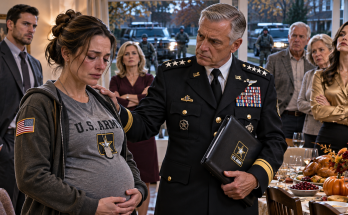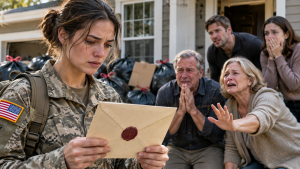
AFTER ELEVEN MONTHS OVERSEAS, I RETURNED HOME AND FOUND MY ENTIRE LIFE STUFFED INTO GARBAGE BAGS. MY PARENTS HAD GIVEN MY HOUSE TO MY BROTHER AND HIS WIFE. THEY TOLD ME I COULD SLEEP IN THE GARAGE. I DIDN’T ARGUE. I CHECKED ONE DOCUMENT MY GRANDFATHER HAD LEFT BEHIND. BY THE NEXT MORNING, MY FAMILY WAS BEGGING ME NOT TO OPEN THE SECOND ENVELOPE…
PART 1 — THE HOUSE THEY THOUGHT THEY OWNED
The first thing I noticed when I opened my front door was the smell of fresh paint.
The second thing was the garbage bags.
There were twelve of them stacked against the living-room wall.
Black plastic bags.
Tightly knotted.
I recognized the faded blue blanket sticking out of one. It had traveled with me through three military bases, two deployments, and more lonely nights than I cared to count.
I pulled open the first bag.
My uniforms were inside.
The second contained my books.
The third held photographs of my grandfather.
Someone had packed up my entire life while I was serving overseas.
I stood there for several seconds, unable to understand what I was seeing.
Then my mother walked down the staircase.
“Oh, you’re home.”
Her voice sounded almost disappointed.
I looked at her.
“I told you I’d be arriving today.”
She adjusted the bracelet on her wrist.
“Well, your brother needed the space.”
My father appeared behind her, holding a coffee mug.
“Things have changed around here, Natalie.”
I looked toward the hallway.
My grandfather’s old clock was gone.
The dining table had been replaced with a glass one.
And the framed photograph of me standing beside my grandfather on the day he handed me the house keys had disappeared.
“Where’s my bedroom?”
My mother sighed.
“Your brother and his wife have it now. They’re expecting a baby.”
I turned toward the staircase.
“Where am I supposed to sleep?”
Dad pointed toward the back door.
“We cleared a space in the garage. There’s a mattress out there.”
I stared at him.
The garage.
I had spent eleven months stationed overseas, missing birthdays, holidays, and family celebrations. I had sent money home when my father said the roof needed repairs. I had paid the property taxes because I believed I was helping protect my grandfather’s house.
And now I was being told to sleep beside the lawn equipment.
My brother, Marcus, walked into the room wearing one of my grandfather’s old watches.
He smiled.
“Don’t make this difficult, Natalie. You know you’re never here.”
His wife, Jessica, followed him.
“Besides, we’re starting our family. We need a permanent home.”
I looked at the watch on his wrist.
My grandfather had promised it to me.
But I didn’t mention that.
I didn’t argue.
I simply picked up the garbage bags and carried them toward the garage.
My mother watched me.
“That’s better. For once, think about someone besides yourself.”
I closed the garage door behind me.
Then I moved a heavy toolbox away from the back wall.
Behind it was a narrow wooden cabinet my grandfather had installed years earlier. Inside was a small metal lockbox.
I entered the combination.
My grandfather’s birthday.
Inside were several documents, including the original property deed and a sealed letter.
The deed showed that the house had been transferred into a family trust years before his death.
I was the sole beneficiary.
My parents had never been owners.
My brother had never been an owner.
And nobody had the legal right to transfer the property without following the trust’s requirements.
I read the document twice.
Then I opened my laptop.
That’s when I discovered something even worse.
For eleven months, someone had been using my identity.
My property-tax account had been changed.
A home-equity application had been submitted.
And there were three withdrawals from an account my grandfather had established for property maintenance.
The total amount missing was $68,400.
I checked the application.
The borrower was listed as Marcus.
The property was listed as collateral.
And the signature authorizing the transaction carried my name.
I had never signed it.
I sat quietly in the garage while laughter drifted from the kitchen.
My family was celebrating their new home.
They had no idea I had just discovered the first piece of evidence.
But there was something else.
At the bottom of the application was a witness’s name.
My father.
I saved every document.
Then I opened the sealed letter from my grandfather.
It contained only one sentence:
“If anyone in this family ever tries to borrow against this house, contact the attorney whose name is on the second page.”
I turned the page.
And recognized the name.
It belonged to a woman who had once worked for the federal government.
I picked up my phone and called her.
She answered after two rings.
“Natalie?”
“Ms. Whitmore, I think someone has tried to steal my house.”
There was a long silence.
Then she asked a question I wasn’t expecting.
“Did your father already tell you about the second trust?”
I looked at the letter.
“Second trust?”
She lowered her voice.
“Then your grandfather never told you what he really left you.”
And suddenly, I understood that the house was only the beginning.
PART 2 — THE SECRET MY GRANDFATHER BURIED
The next morning, I arrived at a law office downtown.
Ms. Eleanor Whitmore was waiting for me.
She was in her late sixties, with silver hair and the kind of expression that made people think twice before lying.
She examined the deed, the bank statements, and the loan application.
Then she stopped at the signature page.
“This isn’t your signature.”
“No, ma’am.”
“Did you give your father permission to handle your finances?”
“Never.”
She placed the documents on the desk.
“Then someone may have committed forgery and attempted financial fraud using your identity.”
I nodded.
She opened a drawer and removed a thick folder.
“Your grandfather instructed me to keep this separate from the original property trust.”
Inside was a second legal document.
It described an investment trust established by my grandfather decades earlier.
The trust held several commercial properties and a portfolio of investments.
I looked at her.
“Why am I only hearing about this now?”
“Because your grandfather wanted you to finish your military service without family pressure. He also included specific protections in the trust.”
She turned the document toward me.
I read the first paragraph.
My grandfather had named me the primary beneficiary.
But the next section made my hands go cold.
The trust required an independent review if anyone attempted to use the family home as collateral without the beneficiary’s written consent.
If unauthorized borrowing was discovered, the trustee had the authority to freeze related transactions and investigate anyone involved.
“Does my father know about this?”
Eleanor looked at me carefully.
“He knows there was a trust. He does not know the complete terms.”
I leaned back.
“Then why did he try to put the house up as collateral?”
She opened another envelope.
“Because someone told him the trust had been changed.”
She showed me a document claiming that I had transferred my interest in the property to Marcus six months earlier.
It carried my name.
My signature.
And a notary stamp.
I had been on deployment at the time.
I checked the date.
The document had supposedly been signed in a state I had never visited.
Eleanor made a copy.
“This is very important. Don’t confront your family yet. We need to preserve the original records and notify the proper authorities.”
I agreed.
Then my phone began vibrating.
It was Marcus.
I answered.
“Where are you?”
“Why?”
“Mom says you’re going around asking questions about the house.”
“I’m handling some paperwork.”
He laughed.
“Good. Dad wants you to sign the final transfer tomorrow. The bank needs it before Friday.”
I looked at Eleanor.
She slowly shook her head.
“What transfer?”
“The ownership transfer. Don’t act confused, Natalie. You’re giving me the house. Dad already arranged everything.”
I remained silent.
Then Marcus added something that changed the entire situation.
“By the way, you should probably stop looking into the old investment account. Dad says the money was his.”
I ended the call.
Eleanor looked at me.
“Did he just admit he knew about the account?”
“He did.”
She wrote something down.
Then she opened a final envelope.
“This was delivered to my office by your grandfather’s accountant three days before he died.”
Inside was a handwritten note.
It read:
“If Marcus ever claims the house belongs to him, look at the construction company registered under his wife’s name. The real owner is someone else.”
I read it again.
Jessica’s construction company?
Eleanor searched the business records on her computer.
A few minutes later, she stopped typing.
“Natalie, there’s something you need to see.”
She turned the screen toward me.
The construction company had received two large payments from the same account where my grandfather’s money had disappeared.
But the company wasn’t owned by Jessica.
It was registered under her name only.
The actual controlling interest belonged to my father.
And one of the payments had been approved by someone using my military email address.
I stared at the screen.
My father hadn’t simply taken money.
He had built an entire financial arrangement around my identity.
Then Eleanor opened the last page of the business filing.
A name appeared under the heading:
AUTHORIZED CORPORATE REPRESENTATIVE.
It was my sister, Chloe.
I looked at Eleanor.
“Why would Chloe be involved?”
She didn’t answer immediately.
Instead, she picked up the phone.
“I think it’s time we brought in the investigator.”
At that exact moment, a message appeared on my screen.
It was from my mother.
“Come home tonight. Your father has something important to tell you. Bring your military identification and sign the papers. Don’t embarrass this family.”
I looked at the message.
Then I looked at the evidence spread across the desk.
For the first time, I wasn’t afraid of what my family might do.
I was afraid of what they had already done.
Because Eleanor had just discovered that the money trail led somewhere much bigger than the house.
And my grandfather had left one final instruction:
“Do not open the second envelope until every member of the family has been identified.”
PART 3 — THE MORNING THEIR LIES COLLAPSED
I returned to the house at 8:30 the following morning.
My father was waiting at the dining table.
Marcus sat beside him.
Jessica was holding a folder.
My mother stood near the kitchen counter, looking irritated.
Chloe was there, too.
They had arranged the documents neatly across the table.
Dad smiled when he saw me.
“Finally. Let’s get this finished.”
I put my bag down.
“What exactly am I signing?”
“The transfer. The house goes to Marcus, and you can get on with your life.”
He pushed a document toward me.
I read the first page.
It transferred my entire interest in the property to my brother for one dollar.
One dollar.
I looked up.
“That’s what you think the house is worth?”
Dad frowned.
“Don’t start.”
Marcus leaned forward.
“You’re never here. We need the house more than you do.”
My mother added, “Your grandfather would have wanted the family to stay together.”
I looked at her.
“Did Grandpa also want you to withdraw $68,400 from his investment account?”
Nobody moved.
Dad’s expression changed.
“What are you talking about?”
I placed a printed bank statement on the table.
Then another.
And another.
“These withdrawals were made while I was overseas. This loan application carries my forged signature. And this document claims I transferred the property to Marcus while I was thousands of miles away.”
Marcus pushed his chair backward.
“That’s not what happened.”
I placed the next document in front of him.
“Then explain why your construction company received the missing money.”
Jessica looked at my father.
My mother stopped moving.
Dad slowly stood.
“You had no right to go through those accounts.”
I met his eyes.
“They were never your accounts.”
He pointed at me.
“You have no idea what you’re dealing with. I know people. I can make one phone call and destroy your promotion.”
I almost laughed.
For eleven months, I had followed orders in places where a wrong decision could cost lives.
I wasn’t going to be frightened by a man who had forged his daughter’s signature.
“That’s a threat, Dad. You should be careful about making another one.”
He reached for the transfer document.
But before he could touch it, the front door opened.
Eleanor Whitmore walked in with two investigators and a real-estate attorney.
My father’s face went pale.
Eleanor placed a folder on the table.
“Richard, we need to discuss the attempted unauthorized transfer of this property, the loan application, and the transactions connected to the family investment trust.”
My mother looked at me.
“You brought strangers into our house?”
I answered quietly.
“It’s my house.”
Eleanor opened the folder.
“According to the original deed and the trust documents, that is correct.”
Marcus shook his head.
“That’s impossible. Dad said Grandpa left the property to the family.”
Eleanor turned toward him.
“Your grandfather left instructions very clearly. The property belongs to Natalie. It has never belonged to you.”
Dad tried to interrupt.
“That trust was changed!”
Eleanor placed a certified copy of the original document in front of him.
“It wasn’t.”
Then she removed a second document.
“This is the part your father apparently never explained.”
She opened the envelope.
Inside was an amendment to the investment trust.
It revealed that my grandfather had appointed an independent trustee to protect the property and investigate any unauthorized transactions.
But there was another condition.
If anyone in the family used forged documents to claim ownership, the trustee could suspend their access to the trust and refer the evidence for investigation.
My father stared at the page.
Then Eleanor placed one final document on the table.
It was a signed statement from my grandfather, dated two weeks before his death.
He had written:
“I know Richard has been asking about the house. I also know he has been pressuring Natalie to sign financial documents. If he attempts to take the property, I want the truth investigated, regardless of who is responsible.”
My mother began crying.
Marcus looked toward the door.
Jessica slowly moved away from him.
Then Chloe spoke.
“Mom, Dad told me the documents were already approved.”
Everyone turned toward her.
She was shaking.
“He said Natalie had signed everything before deployment. He told me I only had to be listed as a witness.”
The investigator asked her to explain.
Chloe looked at me.
“I didn’t know the signature was forged. Dad said it was just paperwork to protect the house.”
My father shouted, “Stop talking!”
But it was too late.
Chloe handed over her phone.
There were messages showing my father instructing her to submit the paperwork, telling Marcus to prepare the loan, and warning everyone not to let me see the original trust documents.
The investigators began collecting the records.
No one was arrested in that moment. The financial transactions and forged documents would need a full investigation, and the legal process would take time.
But the house transfer was stopped.
The disputed accounts were placed under review.
And my father’s threats no longer controlled the room.
My mother approached me.
“Natalie, we’re still family. Can’t we work this out privately?”
I looked at her.
“Family doesn’t pack someone’s belongings into garbage bags while they’re serving their country. Family doesn’t steal their money. And family doesn’t forge their signature.”
She lowered her eyes.
Marcus asked whether I was going to throw him and Jessica out immediately.
I looked at the garbage bags still stacked near the garage.
“I’ll follow the law. Just like I should have been allowed to do from the beginning.”
That afternoon, I returned to the garage.
I opened the final envelope my grandfather had left for me.
Inside was a photograph of the two of us standing in front of the house.
On the back, he had written:
“A home isn’t the building, Natalie. It’s the place where you are respected. Never surrender your future just to keep people comfortable with your silence.”
I sat on the old mattress for a long time.
Then I began unpacking my uniforms.
I moved my grandfather’s photograph back to the living room.
I put his clock above the fireplace.
And I called my commanding officer to explain why I would need a few days to handle a legal matter.
Three months later, the investigation confirmed that multiple documents had been forged and funds had been improperly transferred. The bank reversed the disputed loan process, and the trustee pursued recovery of the missing money through the proper legal channels.
My father and Marcus faced the consequences of the investigation.
Chloe cooperated and admitted what she knew.
I didn’t celebrate their downfall.
I simply changed the locks, restored the house, and began living in the home my grandfather had trusted me to protect.
On the first quiet Sunday after everything was settled, I stood in the living room and looked at the photograph above the fireplace.
For eleven months, I had believed that coming home would be the easiest part of returning from deployment.
I was wrong.
But my grandfather had been right about one thing.
Sometimes the strongest response isn’t an argument. It’s letting the truth speak when the time comes.