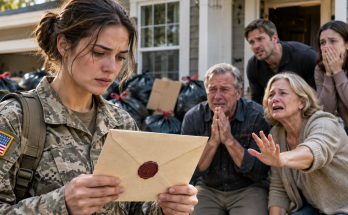
AT 74, I ADOPTED A NEWBORN GIRL AFTER MY ENTIRE FAMILY WARNED ME I WAS TOO OLD—THEN MY CHILDREN SUED TO TAKE CONTROL OF MY $6 MILLION ESTATE. BUT WHEN THE JUDGE OPENED THE SEALED LETTER MY LATE HUSBAND HAD HIDDEN FOR 38 YEARS, MY SON BEGGED HIM TO STOP READING.
PART 1 — “MOTHER, YOU’RE NOT THINKING CLEARLY”
At seventy-four years old, I thought the most difficult chapter of my life was behind me.
My husband had been gone for eleven years. My children were grown, my grandchildren visited when their schedules allowed, and I had learned how to make peace with the silence of a large house.
Then, one rainy Thursday morning, a social worker placed a sleeping newborn girl in my arms.
And by the following week, my own children were threatening to have me declared mentally incompetent.
My name is Eleanor Whitmore. I spent thirty-two years as a school librarian, raised two children, and helped my late husband build a successful construction business. We were never the wealthiest family in town, but we lived comfortably, and my husband left behind a substantial estate.
When I retired, I imagined traveling, gardening, and spending time with my grandchildren.
I never imagined becoming a mother again.
The baby was named Grace.
She was six weeks old when I first met her, with a tiny nose, soft brown hair, and a habit of curling her fingers around mine whenever I held her.
Her biological mother had died shortly after childbirth. Her father was not listed on the original paperwork, and the authorities had been unable to identify a suitable family placement willing to take responsibility for her.
I learned about Grace through a charitable organization I had supported for years.
Initially, I intended to contribute money toward her care.
But when I visited the center, I found her lying awake in a crib, staring at the ceiling while the other babies slept.
I asked the nurse whether I could hold her.
The moment she was placed in my arms, she stopped fussing.
I remember looking down at her and feeling something I had not felt since my own children were infants.
A sense of purpose.
Not the kind that comes from being needed by everyone.
The kind that comes from realizing that someone small and vulnerable has been placed in your care, and that you have the opportunity to make her world safer.
I spoke with doctors, adoption specialists, and my attorney. I underwent medical evaluations, reviewed the financial responsibilities, and learned about the legal requirements.
The process was not easy.
Some people questioned whether I had enough energy to raise a child at my age. Others worried about what would happen when I became older.
Those concerns deserved serious consideration.
I addressed them with a care plan, financial arrangements, and a network of people who had agreed to help if I ever needed assistance.
Eventually, the adoption was approved.
Grace came home with me on a Tuesday afternoon.
I prepared the nursery in the smallest bedroom, bought a crib, and placed a rocking chair beside the window.
For the first time in years, the house no longer felt empty.
Then I called my daughter, Victoria.
“Mom, what do you mean you adopted a baby?”
Her voice was so sharp that I instinctively moved the phone away from my ear.
“I mean I adopted a baby girl. Her name is Grace.”
There was a long silence.
Then she laughed, but there was no humor in it.
“Mom, you’re seventy-four!”
“I know how old I am.”
“You can barely manage the stairs when your arthritis acts up. What happens when this child is five? Ten? What happens if you get sick?”
“I have made arrangements.”
“What arrangements?”
I explained the medical assessments, the financial planning, and the people who had agreed to support us.
She interrupted before I could finish.
“This is insane. You need to reverse this decision before you destroy everything.”
“Grace is not a decision I can simply reverse, Victoria. She is a child.”
My son, Christopher, called that evening.
He did not ask how Grace was sleeping.
He did not ask whether she was healthy.
He asked one question.
“What happens to Dad’s money now?”
I stared at the phone.
“What does that have to do with Grace?”
“Everything. You’ve changed your will, haven’t you?”
“I have made arrangements for her future.”
Christopher exhaled angrily.
“Unbelievable. We spent years believing Dad’s estate would eventually pass to us and our children. Now you’re bringing a stranger into the family and giving her a share?”
I looked at Grace, who was sleeping in her bassinet.
“She is a baby, Christopher. She didn’t ask to be born into difficult circumstances.”
“And we didn’t ask you to make reckless decisions with our inheritance!”
I ended the call.
For the next several weeks, my children barely spoke to me.
Then a letter arrived from a law firm.
Victoria and Christopher were petitioning the court to appoint a guardian over my financial and personal affairs. They claimed that my decision to adopt Grace demonstrated impaired judgment and that I was no longer capable of managing my estate independently.
They also requested that the court review the adoption and the changes I had made to my will.
I read the letter twice.
I was hurt, but I wasn’t surprised.
For years, my children had spoken about their eventual inheritance as though it were already theirs.
They had opinions about which property I should sell, how I should invest my money, and when I should move into a smaller home.
Whenever I disagreed, they reminded me that I was getting older.
I had tolerated those conversations because I believed they came from concern.
Now I wasn’t sure.
I hired an attorney named Helen Foster, who specialized in estate planning and elder law.
Helen reviewed my medical records, my financial documents, and the reports from the adoption proceedings.
“Eleanor,” she told me, “your age alone does not establish that you lack the capacity to make decisions. The court will examine the evidence. We’ll make sure your wishes and Grace’s interests are properly represented.”
I nodded.
“I don’t want my children punished. I want them to understand that I am still capable of deciding how to live my life.”
Helen looked at me carefully.
“Then we will focus on the facts.”
The hearing was scheduled for the following month.
On the morning of the hearing, I dressed in a navy-blue suit and placed Grace in a pale pink blanket.
She slept against my chest as Helen and I entered the courtroom.
Victoria sat beside Christopher, holding a thick folder.
Neither of them looked at me.
The judge, Arthur Bennett, reviewed the petition before speaking.
“Mrs. Whitmore, your children claim that your recent decisions demonstrate that you may no longer be capable of managing your affairs independently. They are asking the court to grant them authority over your finances and medical decisions.”
I held Grace a little closer.
“Your Honor, I understand their concerns. But I disagree with their conclusions.”
Christopher’s attorney stood.
“Mrs. Whitmore, isn’t it true that you adopted this child at an advanced age without consulting your family?”
“I consulted the professionals responsible for evaluating my application.”
“But you did not consult your adult children.”
“No. I did not believe their permission was legally required.”
He raised his eyebrows.
“And isn’t it true that you changed your estate plan shortly afterward?”
“Yes.”
“Why?”
“Because Grace is now my daughter, and I have a responsibility to plan for her future.”
Victoria lowered her eyes.
Christopher leaned toward his attorney and whispered something.
The judge noticed.
“Mr. Whitmore, if you have something to say, you may say it when it is your turn.”
Christopher sat back.
The attorney continued questioning me about my finances, medical appointments, and daily routine.
I answered every question.
Then he produced a document.
“Mrs. Whitmore, are you familiar with this letter?”
I looked at it.
It was an old envelope bearing my late husband’s handwriting.
My heart skipped a beat.
“Yes,” I whispered.
“Isn’t it true that your husband left this letter shortly before his death?”
“Yes.”
“And isn’t it true that you have refused to disclose its contents to your children?”
I looked toward Victoria.
Her face had suddenly gone pale.
The letter had been hidden in my husband’s study for thirty-eight years. I had found it only a few months earlier, inside a locked wooden drawer behind an old photograph.
I had not shown it to my children because I was still trying to understand what it meant.
The judge adjusted his glasses.
“Mrs. Whitmore, why is this letter relevant to the current proceedings?”
I took a breath.
“Because it contains information about a decision my husband made long before he died. Information that my children have never known.”
“What decision?”
I looked at my attorney.
Helen nodded gently.
I reached into my handbag and removed a sealed copy of the letter.
“Your Honor, I believe this letter explains why my husband would have wanted Grace to have a place in our family.”
The judge accepted it.
He examined the handwriting, checked the date, and began reading.
His expression changed.
He stopped after the first page.
Then he looked at me.
“Mrs. Whitmore, do you understand what this letter appears to suggest?”
“Yes, Your Honor.”
Victoria stood abruptly.
“Mom, what is in that letter?”
I didn’t answer.
Christopher’s attorney asked to examine the document, but the judge raised his hand.
“One moment.”
He turned to the final page.
Then he looked directly at Christopher.
“Mr. Whitmore, before we continue, I need to ask you something.”
Christopher swallowed.
“What?”
The judge placed the letter on the desk.
“Why did you tell your attorney that your father had no other children?”
The courtroom went silent.
Victoria turned toward her brother.
“What is he talking about?”
Christopher’s face drained of color.
I closed my eyes.
For thirty-eight years, I had carried a secret that I never wanted to become a weapon against my children.
But now the letter was open.
And the truth was finally coming.
PART 2 — THE SECRET MY HUSBAND BURIED FOR THIRTY-EIGHT YEARS
Christopher stood so abruptly that his chair scraped across the courtroom floor.
“I don’t know what you’re talking about,” he said.
Judge Bennett remained calm.
“Then I suggest you listen carefully before answering again.”
He turned to my attorney.
“Ms. Foster, do you have any additional documents related to this letter?”
Helen opened her folder.
“Yes, Your Honor. We have a certified copy of a birth record, correspondence from a family services agency, and a statement from the attorney who prepared the original document.”
Victoria looked between us.
“Mom, what is happening?”
I wanted to reach for her hand.
I wanted to tell her that nothing in the letter changed the love I had for her.
But the words wouldn’t come.
The truth was too complicated to explain in a single sentence.
My husband, Richard, had died eleven years earlier after a sudden heart attack. We had been married for more than four decades. I had loved him deeply, even when he made mistakes.
Thirty-eight years ago, before our children were born, Richard had worked as a young engineer in another state.
He had told me that his work required him to travel frequently.
I believed him.
Then, one evening, I received a telephone call from a woman named Margaret Ellis.
She told me that Richard had a son.
The child had been born before Richard and I married.
His name was Andrew.
I confronted my husband that night.
He did not deny it.
He explained that he had been young, frightened, and unprepared for fatherhood. The child’s mother had decided to raise Andrew with the help of her own family.
Richard had contributed financial support, but he had never established a close relationship with his son.
I was devastated.
Not because Andrew existed.
Because Richard had allowed me to build a marriage without telling me something so important.
We argued for days.
Eventually, Richard admitted that he had been ashamed of his past and afraid that I would leave him.
I did not leave.
But I told him that if we were going to remain married, he had to be honest with me from that point forward.
He promised he would be.
For many years, we never spoke about Andrew again.
I assumed the matter had been settled privately.
Then, shortly before Richard died, he told me that he had tried to contact his son.
He had learned that Andrew had died in a workplace accident several years earlier, leaving behind a young daughter.
That little girl had been raised by her maternal grandmother.
Her name was Grace.
The same Grace I had adopted.
I had not known the connection when I first met her.
I discovered it only after the adoption process had begun, when a family history report revealed Andrew’s identity.
I had asked the agency to verify the information before making any assumptions.
The records confirmed the connection.
Grace was my late husband’s biological granddaughter.
And the letter explained why Richard had wanted me to know.
Judge Bennett read the next page aloud.
Eleanor,
If this letter has reached you, I have probably run out of time to explain something I should have told you years ago.
Before I met you, I had a son named Andrew. I was young, and I made decisions I regret. I contributed financially to his upbringing, but I did not become the father he deserved.
I cannot change the past. I can only acknowledge it.
I have learned that Andrew had a daughter. If anything happens to him, I hope someone in our family will make sure she is safe.
I am not asking you to adopt her or to take responsibility for a life you did not choose.
I am asking you not to turn away simply because the circumstances are complicated.
If you ever meet her, please remember that she is not responsible for my mistakes.
The judge paused.
I could barely breathe.
He continued.
I have made arrangements for a portion of my estate to be held for Andrew’s descendants, should they ever be identified and the legal requirements be satisfied.
The money is not meant to purchase forgiveness. It is meant to provide a chance for someone who may need one.
I have asked my attorney to preserve the records. Eleanor, I know this will be difficult to hear. But I hope that when the time comes, you will choose what you believe is right.
Richard.
Victoria was crying now.
“You knew Dad had another son?”
“Yes,” I whispered. “I learned about Andrew before you were born.”
She stared at me.
“Why didn’t you tell us?”
“Because your father and I believed we had resolved the matter privately. And because I did not want to burden you with something that was not yours to carry.”
Christopher shook his head.
“This is unbelievable. So you’re saying the baby is somehow connected to Dad’s old relationship?”
“She is your half-brother’s daughter,” Helen explained carefully. “The records establish a biological relationship, subject to the documentation in the case file.”
Christopher looked toward the judge.
“Then this is about money. She wants to give Grace Dad’s money.”
I turned toward him.
“No, Christopher. This is about a child who has lost her mother and father and needs a family.”
“You’re giving her our inheritance!”
The judge struck his desk with a small wooden gavel.
“Mr. Whitmore, that is enough.”
Christopher fell silent.
Judge Bennett reviewed the financial documents.
“Mrs. Whitmore, your husband’s letter references a separate arrangement for his descendants. Can you explain what that means?”
Helen stood.
“Your Honor, the estate records show that Mr. Whitmore established a trust intended to benefit his descendants, subject to its terms and applicable law. We have requested the original trust documents and a current accounting.”
“Has Mrs. Whitmore transferred any funds to herself or the child from that trust?”
“No, Your Honor. The trust has been administered separately, and no disputed transfer has been made.”
The judge nodded.
“Then we will not assume that a potential beneficiary has received anything until the documents establish that fact.”
I felt some of the pressure leave my chest.
At least one person in the room understood that the question wasn’t simply who would receive money.
It was whether Grace would be treated as a person with rights, rather than as a threat to someone else’s expectations.
Victoria approached the witness stand when her attorney called her.
She admitted that she had initially been worried about my health and the demands of raising a newborn at my age.
But she also admitted that she had discussed my estate with Christopher before filing the petition.
“We were concerned about the changes Mom had made,” she said. “We thought she might be giving away everything Dad left us.”
The judge asked her a direct question.
“Did your mother ever tell you that she intended to give away the entire estate?”
“No.”
“Did she ever tell you that she was unable to care for the child?”
“No.”
“Then what evidence do you have that she lacks the capacity to make decisions?”
Victoria looked down.
“We thought adopting a baby at seventy-four was proof that something was wrong.”
The judge leaned back.
“An unusual decision is not automatically an incompetent decision. The court must examine the relevant evidence, including medical assessments and the person’s actual ability to understand and manage her affairs.”
Victoria began to cry.
“I thought she was going to leave us with nothing.”
I looked at her.
“You were never promised my money, Victoria. You were promised my love.”
She covered her face.
For a moment, I wanted to comfort her.
But I was still her mother, and I could not pretend that the lawsuit had not hurt me.
Then Christopher’s attorney asked to call another witness.
A man in his sixties entered the courtroom carrying a leather folder.
He introduced himself as Thomas Reed, the attorney who had handled Richard’s estate planning.
He confirmed that Richard had created a trust for his descendants and that the original records were preserved in his firm’s archive.
He also explained that the trust was separate from my personal estate and that the beneficiary provisions would have to be interpreted according to the original documents.
Christopher looked increasingly anxious.
“Are you saying I might not receive the money I expected?”
Thomas answered carefully.
“I’m saying the trust must be administered according to its terms. No one should assume that an expected inheritance is guaranteed before the relevant legal process is complete.”
The judge asked for the original trust document to be submitted at the next hearing.
Then he turned toward me.
“Mrs. Whitmore, I want to make something clear. The question of your competence is separate from the question of inheritance. We will not allow one to be used as a shortcut to decide the other.”
I nodded.
“Thank you, Your Honor.”
He continued.
“Your medical reports indicate that you understand the nature and consequences of your decisions. The court will review the remaining evidence before ruling on the petition.”
The hearing ended without a final decision.
Outside the courtroom, Victoria approached me.
“Mom, can we talk?”
I held Grace close.
“Not today.”
She nodded, tears running down her cheeks.
Christopher walked past us without speaking.
I watched him disappear through the courthouse doors.
For years, I had believed that the greatest challenge of growing older would be accepting the physical changes that came with time.
I had never imagined that I would have to defend my right to make decisions simply because my children disagreed with them.
That evening, I sat beside Grace’s crib and watched her sleep.
I thought about Richard’s letter.
I thought about Andrew, a man I had never met but whose daughter now depended on me.
And I wondered how many lives had been shaped by secrets that nobody had been brave enough to explain.
The following morning, Thomas Reed called.
He had located the original trust records.
But there was something else.
Richard had left a second letter, addressed not to me, but to Christopher.
It had been sealed for decades.
And according to Thomas, it contained a statement that could change everything my son believed about his father’s estate.
PART 3 — THE LETTER THAT CHANGED THE INHERITANCE
The final hearing took place two weeks later.
I arrived with Helen, carrying Grace in her pink blanket.
Victoria was already seated beside her attorney.
Christopher sat several chairs away, staring at the floor.
Thomas Reed entered with the original trust documents and two sealed letters.
Judge Bennett reviewed the records before inviting Thomas to explain them.
“The trust was established by Richard Whitmore many years ago,” Thomas said. “It provides for eligible descendants under specified conditions. The documents also explain how the trustee must handle questions involving a beneficiary who was not previously identified in the family records.”
The judge looked at Christopher.
“Mr. Whitmore, you have argued that your mother’s decision to adopt Grace threatens your expected inheritance. Have you read the original trust?”
“No, Your Honor.”
“Then I suggest you refrain from describing its terms until you have.”
Christopher lowered his head.
Thomas continued.
“The trust does not guarantee that every child of the family will receive an identical distribution. It requires the trustee to follow the stated provisions and consider the circumstances specified in the document.”
He opened the first letter.
“This was written by Richard to his son Christopher.”
The judge asked whether Christopher consented to its being read in court.
After speaking briefly with his attorney, Christopher agreed.
Thomas unfolded the letter.
Christopher,
If you are reading this, you are old enough to understand that money is not the same thing as love.
I have tried to provide for you and your sister. I have paid for your education, supported your family when you needed help, and worked to leave you financial security.
But I never intended for my estate to become a promise that you would receive everything I owned.
The trust exists to carry out specific responsibilities. It is not a prize for being my oldest son, and it is not a measure of how much I loved you.
There are people in this world who may become part of our family through circumstances none of us expected.
If that happens, I expect you to remember that they are human beings, not competitors for your affection.
Thomas paused.
Christopher’s face had turned pale.
The letter continued.
I know you worry about losing what you have worked for. But the money you may one day inherit is not yours while I am alive, and it is not yours simply because you expect it.
Your mother has the right to make her own decisions. She has the right to spend her resources according to her wishes, provided she understands those decisions and follows the law.
If you ever find yourself asking a court to take away her independence, make certain that your concern is truly about her well-being and not about your fear of receiving less.
Thomas lowered the letter.
Nobody spoke.
Christopher stared at the table.
The judge asked Thomas to explain the second letter.
“This one was written to the trustee,” he said. “It contains instructions concerning the administration of the trust if a previously unknown descendant is identified.”
He handed the document to the judge.
Judge Bennett read it silently, then looked toward the attorneys.
“The trust appears to contemplate the possibility of additional descendants. We will need to confirm the applicable provisions and ensure the trustee follows them. I will not make assumptions about the ultimate distribution today.”
Christopher stood.
“Your Honor, does this mean Grace gets part of Dad’s estate?”
The judge looked at him.
“It means the trust must be administered according to its terms. Your expectations do not determine the outcome.”
Christopher sank back into his chair.
For the first time since the lawsuit began, he looked less angry than frightened.
I understood that fear.
He had spent years believing that his future was secure because he knew what his father intended to leave him.
Now he was being asked to confront the possibility that his understanding had never been complete.
But fear did not excuse what he had done.
The judge turned to the petition concerning my mental competence.
Helen presented the medical evaluations, the independent assessments, and the financial records showing that I understood my responsibilities and had made plans for Grace’s care.
She also presented evidence that I had followed the adoption process and had not concealed assets or transferred money improperly.
The court-appointed evaluator confirmed that I understood the nature and consequences of my decisions.
Christopher’s attorney questioned the evaluator about my age, my physical limitations, and the demands of raising a newborn.
The evaluator acknowledged that older parents may need additional support.
But she found no evidence that I lacked the capacity to make my own decisions.
When the questioning ended, Judge Bennett folded his hands.
“I have considered the evidence presented by both sides.”
My heart pounded.
“Mrs. Whitmore’s age and the unusual circumstances of her adoption do not, by themselves, establish incapacity. The evidence shows that she understands her decisions, has sought appropriate professional advice, and has made reasonable arrangements for the child’s care.”
He looked toward Victoria and Christopher.
“The court recognizes that adult children may have genuine concerns about an aging parent’s safety. But those concerns must be supported by evidence. They cannot be used simply because a parent makes a decision the children dislike.”
Victoria began crying quietly.
The judge continued.
“The petition to appoint a guardian over Mrs. Whitmore’s personal and financial affairs is denied on the evidence before this court.”
I closed my eyes.
For the first time in months, I felt that I could breathe.
The judge then addressed Grace’s adoption.
“The adoption was completed through the appropriate process. There is no evidence before me that the child is unsafe in Mrs. Whitmore’s care. The court will not disturb that arrangement merely because a family dispute has arisen over inheritance.”
He paused.
“As for the estate, any questions regarding the trust must be handled separately by the appropriate fiduciaries and legal representatives. No beneficiary is entitled to assume ownership of assets before the trust’s provisions have been applied.”
The hearing was over.
Outside the courtroom, Victoria approached me.
“Mom, I was scared.”
I looked at her.
“Of what?”
“Of losing you. Of you getting older and needing help. Of everything changing.”
I waited.
She wiped her face.
“But I also thought about the money. I thought about what Dad had left us, and I let that fear become more important than asking what you needed.”
Her voice broke.
“I’m sorry.”
I wanted to believe her.
I wanted to believe that the daughter who used to sit beside me at the kitchen table, sharing stories long after midnight, was still there beneath the fear and resentment.
“I love you, Victoria,” I said. “But I need you to understand that loving me doesn’t mean controlling me.”
She nodded.
“I understand.”
Christopher approached more slowly.
For a moment, he said nothing.
Then he looked at Grace.
“She looks like Dad,” he whispered.
I glanced down at my granddaughter.
There was something familiar in the shape of her eyes, though I had never thought about it that way before.
Christopher swallowed.
“I spent so long thinking she was taking something away from us that I never thought about what she had already lost.”
I didn’t answer immediately.
He continued.
“I was wrong to assume that your decision meant you had stopped thinking clearly. I was wrong to make everything about the inheritance.”
He looked at me.
“I don’t expect you to forgive me today.”
“No,” I said gently. “You shouldn’t.”
He nodded.
“But if you want a relationship with Grace, that relationship must be about her. Not the trust. Not the money. Not what you think you might receive someday.”
“I understand.”
I hoped he did.
Over the following months, the trust was administered according to its original terms. The trustee completed the necessary reviews, and Grace’s legal interests were addressed separately from my personal estate.
I did not become wealthy overnight, and my children did not suddenly lose everything they had expected.
The truth was more complicated than that.
There were legal requirements, financial responsibilities, and decisions that had to be made carefully.
But the courtroom battle ended.
My independence remained intact.
And Grace continued growing in the home I had prepared for her.
On her first birthday, Victoria arrived carrying a small cake decorated with pink flowers.
Christopher came later with a wooden rocking horse he had repaired himself.
For a while, we sat in the garden and watched Grace reach for the bright ribbons tied around her presents.
Nobody discussed inheritance.
Nobody asked about the trust.
For one afternoon, we were simply a family trying to learn how to be together again.
That evening, after everyone had left, I sat beside Grace’s crib and opened Richard’s letter one final time.
I had spent years believing that keeping a family together meant protecting everyone from uncomfortable truths.
Now I understood that secrets could protect people temporarily while hurting them for decades.
Richard had made mistakes.
I had made mistakes, too.
My children had allowed fear to guide their decisions.
But none of us could change the past.
All we could do was decide what kind of future we wanted to build.
I looked at Grace sleeping beneath her little blanket.
She had no idea that her existence had brought a family inheritance dispute into a courtroom.
She had no idea that a judge had questioned my competence or that her biological grandfather had left behind a letter that changed the way her family understood itself.
She was simply a little girl who needed to be fed, comforted, and loved.
And I was the person who had promised to do those things.
At seventy-four, I had learned that growing older did not mean my life had stopped changing.
It meant I had lived long enough to understand that the most important decisions are rarely the easiest ones.
I could have spent my remaining years protecting the inheritance my children expected.
Instead, I chose to make room for a child who needed a home.
And when the courtroom doors opened that morning, the truth that walked inside was not merely the identity of a baby’s father.
It was the truth that a family can carry secrets for generations, but no amount of money can decide who deserves love.
I was seventy-four when I became a mother again. My children tried to take away my independence because they feared what they might lose. But in the end, the greatest thing our family gained was the chance to stop treating love like an inheritance that could be divided.
Grace didn’t destroy our family.
She revealed what we needed to change.
And every morning, when I lift her from her crib and hear her laugh, I am reminded that sometimes the most unexpected chapter of your life becomes the one that finally teaches everyone what family truly means.